Power Electronics Market Revenue, Trends, and Strategic Insights by 2035
Power Electronics Market Size
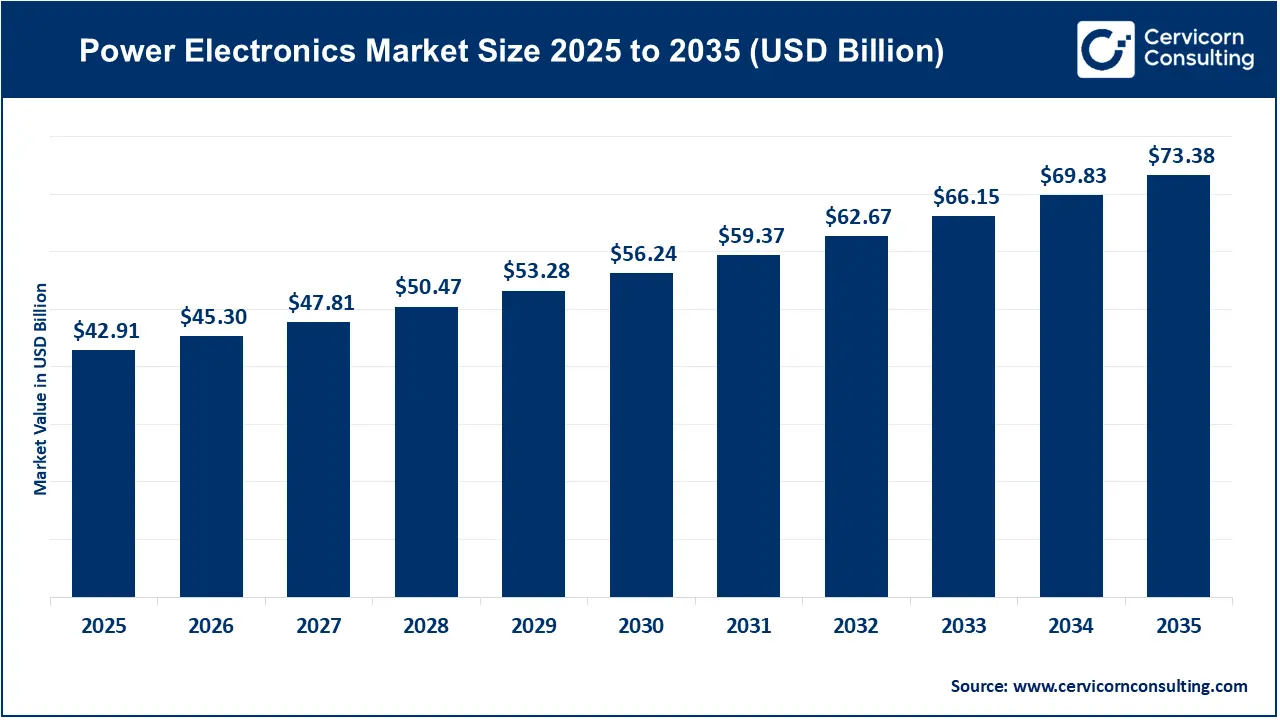
The global power electronics market was valued at approximately USD 42.91 billion in 2025 and is projected to reach around USD 73.38 billion by 2035, expanding at a CAGR of approximately 5.51% during the forecast period.
Power Electronics Market Growth Factors
The global power electronics market is expanding as industries accelerate electrification, energy efficiency, renewable-energy deployment, electric mobility, automation, and digital infrastructure investment. Demand for power semiconductors, converters, inverters, modules, power ICs, MOSFETs, IGBTs, silicon-carbide (SiC) devices, and gallium-nitride (GaN) technologies is increasing across electric vehicles, charging infrastructure, solar and wind systems, energy storage, industrial machinery, data centers, consumer electronics, telecommunications, and smart grids. Automotive electrification is particularly important because EVs require substantially more power-management and power-conversion electronics than conventional vehicles.
At the same time, renewable-energy projects require efficient conversion between generated electricity, storage systems, and electrical grids. Data-center expansion is creating another high-value application because AI workloads require increasingly efficient power delivery and thermal management. Industrial automation, robotics, variable-frequency drives, motor control, and factory electrification are also increasing demand for high-efficiency power devices. The transition from conventional silicon toward SiC and GaN is strengthening the market by enabling higher switching frequencies, lower energy losses, greater power density, and improved thermal performance.
Get a Free Sample: https://www.cervicornconsulting.com/sample/2727
What Is the Power Electronics Market?
Power electronics refers to the technologies, components, and systems used to convert, control, switch, regulate, and manage electrical power. Unlike conventional electronics that primarily process information and signals, power electronics focuses on controlling electricity at different voltage, current, and frequency levels.
The market includes power semiconductors and supporting technologies such as power MOSFETs, insulated-gate bipolar transistors (IGBTs), thyristors, diodes, power integrated circuits, gate drivers, intelligent power modules, rectifiers, inverters, converters, voltage regulators, and increasingly SiC- and GaN-based devices.
These technologies are deployed across electric vehicles, industrial equipment, renewable-energy installations, telecommunications infrastructure, consumer electronics, aerospace and defense, rail transportation, energy storage, data centers, and electrical grids.
The market is also evolving from individual components toward integrated power-management solutions. Manufacturers increasingly combine switching devices, drivers, sensing, protection, and control functions into compact modules. This integration reduces system complexity and can improve efficiency, reliability, thermal performance, and design flexibility.
Why Is Power Electronics Important?
Power electronics is fundamental to the transition toward an electrified and energy-efficient economy. Virtually every modern electrical system requires some form of power conversion or regulation.
In electric vehicles, power electronics controls the flow of energy between batteries, inverters, motors, onboard chargers, and charging infrastructure. In solar photovoltaic systems, inverters convert DC electricity from solar panels into AC electricity suitable for buildings or the grid. Wind turbines similarly depend on power converters to manage variable electrical output.
Industrial facilities use power electronics to control motors, pumps, compressors, robotics, and production equipment. Efficient motor drives can reduce electricity consumption while providing precise control.
The technology is also increasingly important for data centers. AI servers and high-performance computing systems consume large amounts of electricity, creating demand for efficient power supplies, voltage conversion, power distribution, and thermal-management technologies.
The emergence of SiC and GaN is further increasing the strategic importance of power electronics. SiC is particularly attractive for high-voltage applications such as EV traction inverters, renewable-energy systems, and industrial power conversion, while GaN is gaining ground in high-frequency, compact applications such as fast chargers and selected data-center power architectures. Industry research identifies SiC and GaN as important growth technologies because they can outperform conventional silicon in demanding high-voltage and high-frequency applications.
Leading Companies in the Power Electronics Market
The competitive landscape includes global semiconductor manufacturers, power-device specialists, industrial automation companies, and diversified electronics corporations. Five particularly important participants are Infineon Technologies, Mitsubishi Electric, STMicroelectronics, Texas Instruments, and onsemi. Industry estimates place these five companies among the leading power semiconductor suppliers, collectively accounting for approximately 45.5% of the market in 2025, while Infineon alone held more than 19.5%.
| Company | Specialization | Key Focus Areas | Notable Features | 2025 Revenue | Market Share* | Global Presence |
|---|---|---|---|---|---|---|
| Infineon Technologies AG | Power semiconductors, automotive semiconductors, microcontrollers | EVs, SiC, GaN, renewable energy, industrial power, data centers | Global power-semiconductor leader; strong automotive and energy portfolio | €14.662B | ~19.5% | Europe, Americas, Asia-Pacific and global manufacturing/customer network |
| Mitsubishi Electric Corporation | Power modules, IGBTs, SiC power devices, industrial systems | Rail, EVs, industrial drives, renewable energy, power grids | Strong high-power module position and long-standing industrial customer base | ¥5,521.7B | Top-five supplier; No. 2 power-module position historically | Japan, Asia-Pacific, Europe, Americas and other global markets |
| STMicroelectronics N.V. | Power discretes, MOSFETs, SiC devices, analog and embedded semiconductors | Automotive, industrial, EVs, energy, smart systems | Integrated semiconductor portfolio and strong European automotive presence | $11.8B | Top-five supplier | Europe, Americas and Asia-Pacific |
| Texas Instruments Incorporated | Analog semiconductors, power-management ICs, embedded processing | Automotive, industrial, data centers, consumer and power management | Broad analog portfolio, internal manufacturing and extensive customer base | $17.682B | Top-five supplier | 30+ countries, with major operations in Americas and Asia-Pacific |
| ON Semiconductor Corporation (onsemi) | Power semiconductors, SiC, intelligent power and sensing | EVs, charging, energy infrastructure, industrial automation | Strong intelligent-power and SiC strategy | $7.082B | Top-five supplier | Americas, Europe and Asia-Pacific |
Infineon Technologies AG
Infineon is one of the strongest players in power semiconductors, with a portfolio spanning silicon, SiC, GaN, power modules, automotive electronics, industrial power, and energy infrastructure. The company reported €14.662 billion in FY2025 revenue.
Its competitive position is particularly strong in automotive and power devices. Infineon reported that it was the No. 1 supplier in power discretes and modules, with a 17.7% share of the 2024 global power discretes and modules market according to Omdia data cited by the company.
Mitsubishi Electric Corporation
Mitsubishi Electric is a major Japanese power-electronics and industrial-technology supplier. Its power semiconductor portfolio includes IGBT modules, SiC modules, and other power devices used in rail transportation, industrial drives, renewable energy, and automotive applications.
The company reported ¥5,521.7 billion in FY2025 revenue, up from ¥5,257.9 billion in FY2024. Mitsubishi Electric has historically held a particularly strong position in power modules and has described itself as the No. 2 company in the global power-module market.
STMicroelectronics N.V.
STMicroelectronics combines analog, power, embedded-processing, sensing, and automotive semiconductor capabilities. Its Power and Discrete segment generated $1.685 billion in 2025, while the company’s total net revenue was $11.8 billion.
ST is investing heavily in SiC manufacturing and advanced power technologies. Its power devices support EV traction, charging, industrial equipment, renewable energy, and other energy-conversion applications.
Texas Instruments Incorporated
Texas Instruments has a broad analog and embedded semiconductor portfolio with significant exposure to power-management ICs. The company generated $17.682 billion in 2025 revenue, including $14.01 billion from analog products.
TI serves automotive, industrial, personal electronics, communications, and data-center markets. Its 2025 revenue mix included 33% automotive, 33% industrial, 21% personal electronics, and 9% data center, demonstrating the importance of power management across multiple end markets.
ON Semiconductor Corporation (onsemi)
onsemi is particularly focused on intelligent power and sensing technologies. Its portfolio targets EVs, vehicle electrification, charging infrastructure, energy infrastructure, and industrial automation.
The company reported $7.0823 billion in 2025 revenue. Its 2025 sustainability disclosure also reported approximately $4.684 billion of triple-bottom-line revenue, equivalent to 78% of total revenue, covering areas including AI data centers, EV charging, vehicle electrification, energy infrastructure, and industrial automation.
Leading Trends and Their Impact
1. Rapid Adoption of Silicon Carbide
SiC is becoming one of the most important technologies in next-generation power electronics. Compared with traditional silicon, SiC enables higher-voltage operation, lower switching losses, and improved thermal performance.
Its adoption is particularly strong in EV traction inverters, fast chargers, solar inverters, energy storage, and industrial power conversion.
Impact: SiC enables longer EV driving ranges, more compact power systems, higher charging efficiency, and improved renewable-energy conversion.
2. Expansion of Gallium Nitride
GaN is gaining momentum in high-frequency and high-power-density applications. Fast chargers, USB-C adapters, telecommunications equipment, and certain data-center power systems are among the key opportunities.
Industry forecasts identify GaN as one of the faster-growing power semiconductor technologies through the next decade.
Impact: GaN can reduce the size and weight of power supplies while increasing switching frequency and efficiency.
3. Electrification of Vehicles
EV adoption is creating structural demand for power semiconductors. Each EV requires power devices for propulsion, battery management, charging, DC-DC conversion, and thermal systems.
Automotive accounted for approximately 31.02% of the power semiconductor market in 2025, according to industry estimates.
Impact: Automakers and semiconductor suppliers are increasingly designing power architectures around higher-voltage batteries, SiC traction inverters, 800V charging platforms, and integrated power modules.
4. Renewable Energy and Energy Storage
Solar and wind installations require power electronics to convert, regulate, and distribute electricity. Battery energy-storage systems also depend on bidirectional converters and power-management systems.
Impact: Growth in renewable generation increases demand for high-efficiency inverters, grid-connected converters, power modules, and smart-grid technologies.
5. AI Data Centers
AI infrastructure is generating a new source of demand for power electronics. High-performance GPUs and accelerators require sophisticated power-delivery architectures capable of supplying large currents efficiently.
Impact: Data-center operators increasingly need high-efficiency power supplies, advanced voltage regulators, GaN technologies, thermal-management systems, and higher-density power distribution.
6. Industrial Automation
Factories are adopting robotics, automated production lines, variable-frequency drives, machine vision, and connected industrial equipment.
Impact: More automated machinery translates into greater demand for motor drives, power ICs, IGBTs, MOSFETs, intelligent power modules, and energy-efficient control systems.
Successful Examples of Power Electronics Market Adoption Around the World
China: EVs and High-Volume Electrification
China represents one of the world’s largest opportunities for power electronics because of its enormous EV, charging, battery, solar, and industrial manufacturing ecosystems. Large-scale electrification has created demand for traction inverters, onboard chargers, DC-DC converters, SiC devices, charging modules, and grid-connected power electronics.
This combination of vehicle production and renewable-energy deployment creates an integrated ecosystem in which power electronics suppliers can scale rapidly.
Japan: Rail and Industrial Power Modules
Japan has developed a strong power-module ecosystem around industrial automation, rail transportation, air conditioning, renewable energy, and automotive applications. Mitsubishi Electric’s long-standing position in power modules illustrates how advanced IGBT and SiC technologies can become deeply embedded in industrial infrastructure. Mitsubishi Electric has highlighted its extensive experience in both silicon and SiC power modules.
Europe: EVs and Industrial Decarbonization
Europe has become an important market for SiC-based power electronics because of its automotive manufacturing base and decarbonization objectives. Semiconductor manufacturers are expanding SiC capabilities to support EVs, renewable-energy systems, industrial automation, and energy infrastructure.
United States: Data Centers and Semiconductor Manufacturing
The United States is seeing power-electronics demand from AI data centers, EVs, industrial automation, aerospace, and semiconductor manufacturing. Investments supported by the CHIPS Act are also encouraging domestic semiconductor production. Texas Instruments, for example, received CHIPS Act incentives and continues to expand its U.S. manufacturing footprint.
India: EV Charging and Domestic Electronics
India is emerging as an important growth market due to EV adoption, renewable-energy deployment, electronics manufacturing, and semiconductor localization. In August 2026, the Indian government approved 31 investment proposals worth ₹7,877 crore under the Electronics Component Manufacturing Scheme, strengthening domestic electronics-component manufacturing.
The country has also introduced guidelines supporting EV charging infrastructure and battery-swapping and charging stations, alongside programs such as PM E-DRIVE and PM-eBus Sewa.
Global Regional Analysis
North America
North America is a major market for power electronics because of its large automotive, aerospace, industrial, data-center, and renewable-energy industries. The rapid expansion of AI computing is particularly important because hyperscale data centers require sophisticated power conversion and distribution infrastructure.
The U.S. semiconductor ecosystem is also receiving significant policy support. The CHIPS Act is encouraging domestic semiconductor manufacturing through incentives, tax credits, and investment support. Texas Instruments reported receiving $335 million in CHIPS Act incentives during 2025, including $75 million in direct funding, while qualifying investments can also benefit from a 35% investment tax credit.
This policy environment can strengthen local manufacturing of power-management and semiconductor technologies while reducing dependence on overseas supply chains.
Europe
Europe remains a technology-intensive market for power electronics, supported by automotive electrification, renewable energy, industrial automation, rail transportation, and energy-efficiency targets.
The European Chips Act is encouraging semiconductor capacity, technology development, supply-chain resilience, and advanced manufacturing. The policy environment is particularly relevant to power electronics because automotive and industrial applications represent major European semiconductor demand centers.
Infineon’s strong European manufacturing and R&D base gives the region an important anchor in power semiconductor development. The company’s portfolio spans power systems, automotive, renewable-energy integration, and digitalization.
Asia Pacific
Asia Pacific is the largest regional market, accounting for approximately 51.35% of global power semiconductor revenue in 2025.
China, Japan, South Korea, Taiwan, and India collectively provide a broad ecosystem spanning semiconductor manufacturing, consumer electronics, EVs, batteries, renewable energy, industrial automation, and telecommunications.
China benefits from large-scale EV and renewable-energy deployment, Japan has strong expertise in power modules and industrial electronics, Taiwan is central to semiconductor manufacturing, South Korea has major electronics and automotive industries, and India is expanding semiconductor and electronics manufacturing.
Government-backed localization is becoming increasingly important throughout the region. India’s Semicon 2.0, approved in 2026 with a budget outlay of ₹1,27,500 crore, is designed to expand semiconductor design and manufacturing. The program specifically identifies applications including automobiles, industrial electronics, telecommunications, aerospace, and power electronics.
China
China’s power electronics industry is supported by its enormous manufacturing base and investments in EVs, renewable energy, energy storage, and grid infrastructure. Policies under the broader industrial and clean-energy strategy have encouraged domestic development of semiconductor technologies and electrification-related supply chains.
The country’s large EV production ecosystem provides an important market for SiC modules, IGBTs, MOSFETs, onboard chargers, and other power devices. Its renewable-energy scale also creates significant demand for high-power inverters and grid-conversion equipment.
Japan
Japan remains a strategically important power-electronics market, particularly for industrial machinery, railways, automotive systems, air conditioning, renewable energy, and power grids.
Government and industry strategies increasingly emphasize semiconductor resilience and domestic technological competitiveness. Japanese companies are also responding to stronger competition in SiC and other advanced power technologies. Mitsubishi Electric’s power semiconductor strategy focuses on strengthening its scale, SiC capability, and global competitiveness.
India
India represents a high-growth opportunity because of expanding electrification, renewable-energy capacity, EV adoption, charging infrastructure, industrial modernization, and domestic electronics manufacturing.
The National Policy on Electronics 2019 explicitly identified power electronics for mobility and strategic electronics as an area requiring policy support and emphasized domestic manufacturing, R&D, skilled workforce development, and semiconductor-related capabilities.
More recently, Semicon 2.0 has significantly increased the scale of government support for semiconductor design and manufacturing. The government states that approved semiconductor manufacturing and packaging projects are expected to serve sectors including automobiles, power electronics, telecommunications, and industrial electronics.
Government Initiatives and Policies Shaping the Power Electronics Market
Government policies are becoming a major factor influencing investment decisions, manufacturing locations, technology development, and supply-chain strategy.
United States – CHIPS Act: The U.S. semiconductor policy framework provides incentives for domestic semiconductor manufacturing and advanced facilities. It is helping companies such as Texas Instruments expand U.S. manufacturing capacity.
European Union – European Chips Act: Europe is promoting semiconductor capacity, supply-chain resilience, research, and advanced manufacturing to reduce strategic dependencies and strengthen its semiconductor ecosystem.
India – Semicon 2.0: India’s 2026 semiconductor program has a ₹1,27,500 crore outlay and focuses on design, manufacturing, packaging, ecosystem development, and technological capabilities. Power electronics is explicitly among the targeted application areas.
India – Electronics Component Manufacturing Scheme: The ECMS is encouraging domestic component production. In August 2026, 31 proposals worth ₹7,877 crore were approved, supporting India’s ambition to build a stronger electronics supply chain.
India – EV Charging Policies: The government has introduced national guidelines for EV charging infrastructure and battery-swapping and charging stations. PM E-DRIVE and PM-eBus Sewa further support electric mobility and charging infrastructure.
Japan – Semiconductor and Power Device Strategy: Japanese industrial policy is increasingly focused on rebuilding semiconductor competitiveness, strengthening domestic capabilities, and supporting advanced power devices such as SiC technologies. Mitsubishi Electric’s recent strategy reflects the industry’s emphasis on scale and international competitiveness.
These policies are reshaping the power electronics market by encouraging local production, supporting semiconductor fabs and packaging facilities, promoting EV adoption, accelerating renewable-energy deployment, and reducing dependence on concentrated international supply chains. As governments increasingly treat semiconductors and power-conversion technologies as strategic infrastructure, companies with strong manufacturing capabilities, advanced SiC/GaN portfolios, automotive qualifications, and regional supply networks are positioned to benefit from the next phase of market expansion.
To Get Detailed Overview, Contact Us: https://www.cervicornconsulting.com/contact-us
Read Report: Green Chemicals Market Revenue, Trends, and Strategic Insights by 2035