Manufacturing Execution System (MES) Market Revenue, Trends, and Strategic Insights by 2035
Table of Contents
ToggleManufacturing Execution System (MES) Market Size
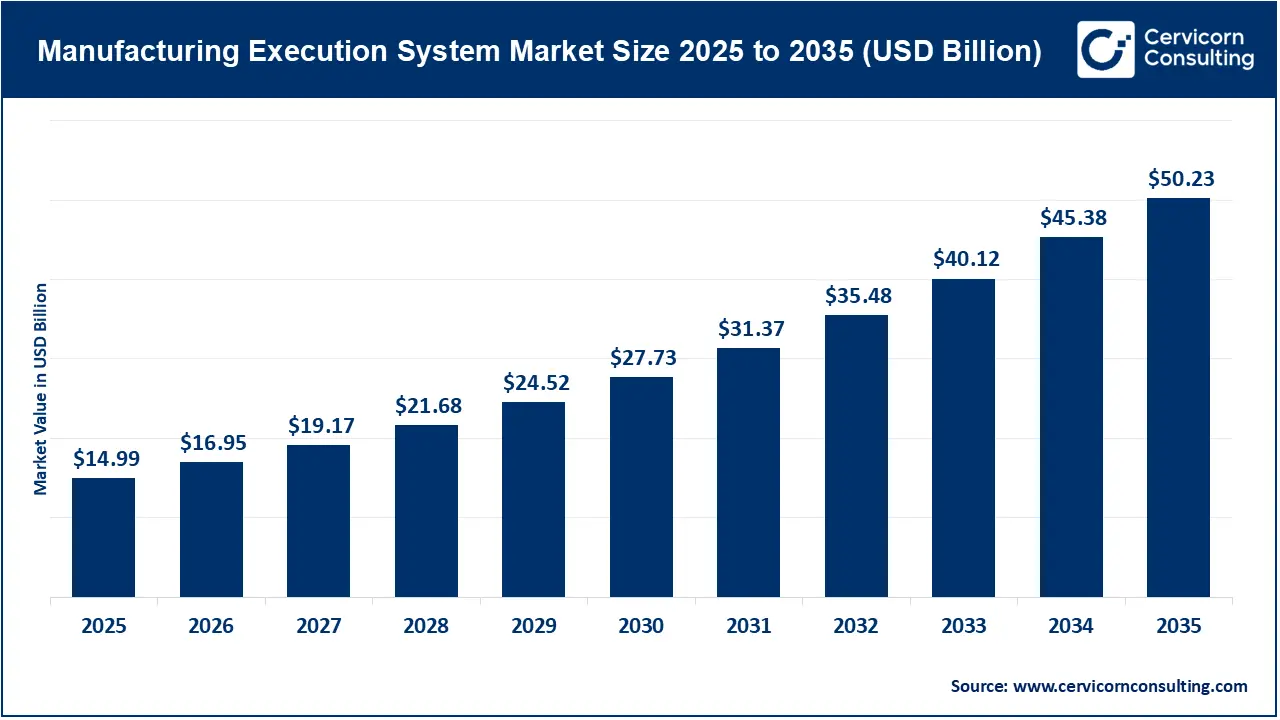
The global manufacturing execution system (MES) market was valued at approximately USD 14.99 billion in 2025 and is projected to reach nearly USD 50.23 billion by 2035, growing at a CAGR of 12.85%.
Manufacturing Execution System (MES) Market Growth Factors
The global Manufacturing Execution System (MES) market is experiencing significant growth due to rapid digital transformation across manufacturing industries, increasing adoption of Industry 4.0 technologies, growing investments in smart factories, rising demand for real-time production monitoring, expanding implementation of Industrial Internet of Things (IIoT), increasing automation in manufacturing facilities, growing need for quality management and regulatory compliance, rising emphasis on operational efficiency, predictive maintenance, cloud-based manufacturing solutions, artificial intelligence-powered analytics, digital twin integration, and advanced robotics.
Manufacturers across automotive, electronics, pharmaceuticals, food & beverage, aerospace, chemicals, metals, and energy sectors are adopting MES platforms to improve production visibility, minimize downtime, optimize resource utilization, and enhance product quality. Government initiatives promoting digital manufacturing, industrial automation, and sustainable production further support market expansion. Additionally, increasing demand for connected supply chains, data-driven manufacturing decisions, cybersecurity-enhanced industrial software, and seamless integration with ERP and SCADA systems continues to accelerate the adoption of MES solutions worldwide.
Get a Free Sample: https://www.cervicornconsulting.com/sample/2695
What is the Manufacturing Execution System (MES) Market?
The Manufacturing Execution System (MES) market refers to the global ecosystem of software platforms, technologies, and service providers that develop and deploy systems for monitoring, managing, tracking, documenting, and optimizing manufacturing operations in real time.
An MES acts as the digital bridge between enterprise-level planning systems such as Enterprise Resource Planning (ERP) and the physical production floor. It captures production data directly from machines, sensors, operators, and production lines to provide complete visibility into manufacturing processes.
Modern MES solutions perform numerous critical functions, including:
- Production scheduling
- Work order management
- Inventory tracking
- Quality control
- Traceability
- Equipment performance monitoring
- Workforce management
- Downtime analysis
- Maintenance coordination
- Regulatory compliance
With increasing factory automation, MES has become one of the core technologies enabling digital manufacturing and smart factories.
Why is Manufacturing Execution System (MES) Important?
Manufacturers today operate in highly competitive markets where efficiency, quality, traceability, and cost optimization determine profitability. MES provides the intelligence required to achieve these goals.
Major benefits include:
Real-Time Production Visibility
Manufacturers gain live insights into every production stage.
Higher Productivity
MES minimizes machine downtime and production bottlenecks.
Improved Product Quality
Continuous monitoring reduces defects and waste.
Regulatory Compliance
Industries such as pharmaceuticals and food processing require complete production records.
Better Resource Utilization
Labor, equipment, and materials are used more efficiently.
Supply Chain Optimization
MES enables better coordination between production and inventory.
Predictive Maintenance
Equipment failures are detected before causing production losses.
Enhanced Decision Making
Managers receive dashboards powered by AI-driven analytics.
Sustainability
Energy consumption and material waste can be optimized.
Manufacturing Execution System (MES) Market Overview
The MES market has evolved from basic production tracking software into an intelligent manufacturing platform integrating:
- Artificial Intelligence
- Machine Learning
- Cloud Computing
- Industrial IoT
- Edge Computing
- Robotics
- Digital Twins
- Big Data Analytics
Manufacturers increasingly demand unified platforms capable of integrating machines, sensors, ERP systems, and supply chain applications into one connected manufacturing environment.
Cloud deployment is rapidly gaining popularity due to scalability, lower infrastructure costs, remote accessibility, and faster implementation.
Major Applications of MES
Industries adopting MES include:
- Automotive
- Aerospace
- Electronics & Semiconductor
- Pharmaceutical Manufacturing
- Medical Devices
- Food & Beverage
- Chemicals
- Metals & Mining
- Packaging
- Energy
- Consumer Goods
- Textile Manufacturing
Leading Companies in the Manufacturing Execution System (MES) Market
| Company | Specialization | Key Focus Areas | Notable Features | Estimated 2025 Revenue | Estimated MES Market Share | Global Presence |
|---|---|---|---|---|---|---|
| Emerson Electric Co. | Industrial automation and digital manufacturing | Plant automation, operational excellence, industrial software | DeltaV MES integration, Plantweb digital ecosystem | Approximately USD 18–19 Billion | 4–6% | North America, Europe, Asia-Pacific, Middle East, Latin America |
| General Electric Company | Industrial digital technologies | Smart manufacturing, industrial AI, digital operations | Proficy MES, industrial analytics, cloud manufacturing | Approximately USD 38–40 Billion | 5–7% | More than 170 countries |
| Oracle Group | Enterprise software and cloud manufacturing | Cloud ERP, manufacturing intelligence, supply chain integration | Oracle Manufacturing Cloud, AI-driven production insights | Approximately USD 60–62 Billion | 6–8% | More than 175 countries |
| Siemens AG | Industrial automation and digital industries | Smart factories, Industry 4.0, digital twins | Opcenter Execution MES, comprehensive automation suite | Approximately USD 90–95 Billion | 15–18% | More than 190 countries |
| ABB Ltd | Automation and robotics | Manufacturing automation, energy efficiency, industrial robotics | ABB Ability™, advanced factory automation | Approximately USD 33–35 Billion | 5–7% | Operations in over 100 countries |
Leading Trends Transforming the Manufacturing Execution System (MES) Market
1. Artificial Intelligence Integration
AI is revolutionizing MES by enabling predictive analytics, automated scheduling, defect detection, and intelligent production planning.
Impact
- Reduced downtime
- Faster decision making
- Improved production quality
- Lower manufacturing costs
2. Cloud-Based MES
Manufacturers increasingly prefer cloud deployment over on-premise infrastructure.
Impact
- Lower IT investments
- Remote factory monitoring
- Easy software updates
- Multi-site management
3. Industrial Internet of Things (IIoT)
Thousands of connected sensors continuously feed production data into MES platforms.
Impact
- Real-time equipment monitoring
- Predictive maintenance
- Improved Overall Equipment Effectiveness (OEE)
4. Digital Twin Technology
Virtual factory replicas enable manufacturers to simulate production before implementation.
Impact
- Faster optimization
- Reduced engineering costs
- Improved production planning
5. Edge Computing
Processing production data closer to machines reduces latency.
Impact
- Faster analytics
- Real-time control
- Improved manufacturing responsiveness
6. Robotics Integration
Collaborative robots (Cobots) increasingly operate alongside MES.
Impact
- Increased automation
- Higher throughput
- Reduced labor shortages
7. Sustainability Monitoring
MES platforms now monitor:
- Carbon emissions
- Energy consumption
- Water usage
- Material waste
Impact
Supports ESG reporting and sustainable manufacturing.
8. Cybersecurity Enhancements
As factories become connected, cybersecurity has become essential.
Impact
- Secure production data
- Reduced cyber threats
- Compliance with industrial security standards
Impact of Industry 4.0 on MES
Industry 4.0 has fundamentally transformed MES capabilities.
Modern MES platforms now integrate:
- AI
- Robotics
- Autonomous vehicles
- Digital twins
- Smart sensors
- Cloud platforms
- ERP software
- Supply chain systems
This integration enables fully connected manufacturing ecosystems.
Successful Manufacturing Execution System (MES) Examples Around the World
Siemens Electronics Factory (Germany)
Siemens operates one of the world’s most advanced smart factories using its Opcenter MES platform.
Achievements include:
- Highly automated production
- Near real-time production monitoring
- Significant productivity improvements
- Reduced manufacturing defects
GE Aviation Manufacturing Facilities (United States)
GE integrates Proficy MES into aerospace manufacturing operations.
Benefits include:
- Complete component traceability
- Regulatory compliance
- Predictive maintenance
- Improved operational efficiency
Toyota Production Facilities (Japan)
Toyota utilizes MES alongside lean manufacturing principles.
Results include:
- Lower production waste
- Better inventory management
- Improved production scheduling
- Enhanced quality assurance
Samsung Electronics (South Korea)
Samsung employs advanced MES across semiconductor manufacturing plants.
Benefits:
- High-precision manufacturing
- Real-time yield monitoring
- Reduced production errors
- AI-assisted process optimization
Pfizer Pharmaceutical Manufacturing (Global)
Pfizer leverages MES to support pharmaceutical production.
Outcomes:
- Electronic batch records
- FDA compliance
- Quality assurance
- Faster production release cycles
Bosch Smart Factories (Germany)
Bosch combines MES with IIoT platforms and AI.
Results:
- Connected manufacturing
- Predictive analytics
- Improved productivity
- Reduced downtime
Global Regional Analysis of the Manufacturing Execution System (MES) Market
North America
North America remains one of the largest MES markets due to:
- Advanced manufacturing infrastructure
- High automation adoption
- Strong cloud computing ecosystem
- AI-driven industrial innovation
Key Industries
- Aerospace
- Automotive
- Medical Devices
- Electronics
- Food Processing
Government Initiatives and Policies
- Advanced Manufacturing National Program
- Manufacturing USA innovation institutes
- National Institute of Standards and Technology (NIST) smart manufacturing initiatives
- Incentives for semiconductor manufacturing under the CHIPS and Science Act
- Federal investments supporting digital manufacturing and industrial cybersecurity
These programs encourage adoption of smart manufacturing technologies, digital production systems, and advanced industrial software.
Europe
Europe is a mature MES market driven by sustainability and industrial modernization.
Major countries include:
- Germany
- France
- Italy
- United Kingdom
- Netherlands
Growth Drivers
- Industry 4.0 implementation
- Advanced robotics
- Green manufacturing
- Digital factories
Government Initiatives and Policies
- European Union Digital Europe Programme
- Horizon Europe research funding
- European Green Deal
- National Industry 4.0 strategies in Germany, Italy, and France
- Industrial digitalization incentives for SMEs
European policies encourage energy-efficient manufacturing, automation, and digital transformation across industrial sectors.
Asia-Pacific
Asia-Pacific is projected to experience the fastest growth.
Leading markets include:
- China
- Japan
- India
- South Korea
- Singapore
- Taiwan
Growth Factors
- Rapid industrialization
- Expanding electronics manufacturing
- Automotive production
- Government-backed smart factory initiatives
- Rising foreign investments
Government Initiatives and Policies
China
- Made in China 2025
- Intelligent Manufacturing Development Plan
- Industrial Internet initiatives
Japan
- Society 5.0
- Connected Industries strategy
India
- Make in India
- Digital India
- Production-Linked Incentive (PLI) schemes
- National Policy on Advanced Manufacturing initiatives
South Korea
- Smart Factory Promotion Strategy
- Manufacturing Innovation 3.0
Governments are actively funding factory automation, industrial AI, robotics, and digital manufacturing infrastructure.
Latin America
Digital manufacturing adoption continues to expand across:
- Brazil
- Mexico
- Argentina
- Chile
Growth Drivers
- Automotive production
- Food manufacturing
- Mining industries
- Industrial modernization
Government Initiatives and Policies
- Brazil’s Industry 4.0 Strategy
- Mexico’s manufacturing modernization initiatives
- National digital transformation programs supporting industrial competitiveness
- Public-private partnerships promoting automation and workforce upskilling
Increasing investment in smart factories and export-oriented manufacturing is creating opportunities for MES vendors.
Middle East & Africa
The region is steadily adopting MES solutions as part of broader industrial diversification efforts.
Major markets include:
- Saudi Arabia
- United Arab Emirates
- South Africa
Growth Drivers
- Industrial diversification
- Oil & gas digitalization
- Smart manufacturing
- Infrastructure development
Government Initiatives and Policies
Saudi Arabia
- Vision 2030
- National Industrial Development and Logistics Program (NIDLP)
United Arab Emirates
- Operation 300bn
- UAE Industry 4.0 initiative
South Africa
- Industrial Policy Action Plan (IPAP)
- Digital industrial development programs
These initiatives encourage automation, advanced manufacturing technologies, digital production systems, and local industrial competitiveness.
Future Outlook of the Manufacturing Execution System (MES) Market
The MES market is expected to remain a cornerstone of digital manufacturing as industries accelerate investments in automation, connected factories, and intelligent production systems. The convergence of artificial intelligence, industrial IoT, cloud computing, edge analytics, and digital twins will continue to redefine MES capabilities, enabling manufacturers to achieve greater operational visibility, predictive decision-making, and end-to-end production optimization. As organizations prioritize resilience, sustainability, and supply chain agility, MES platforms will increasingly evolve into integrated digital ecosystems that support real-time collaboration, regulatory compliance, and data-driven manufacturing across global production networks.
To Get Detailed Overview, Contact Us: https://www.cervicornconsulting.com/contact-us
Read Report: Automotive Telematics Market Revenue, Trends, and Strategic Insights by 2035