Lubricants Market Revenue, Trends, and Strategic Insights by 2035
Lubricants Market Size
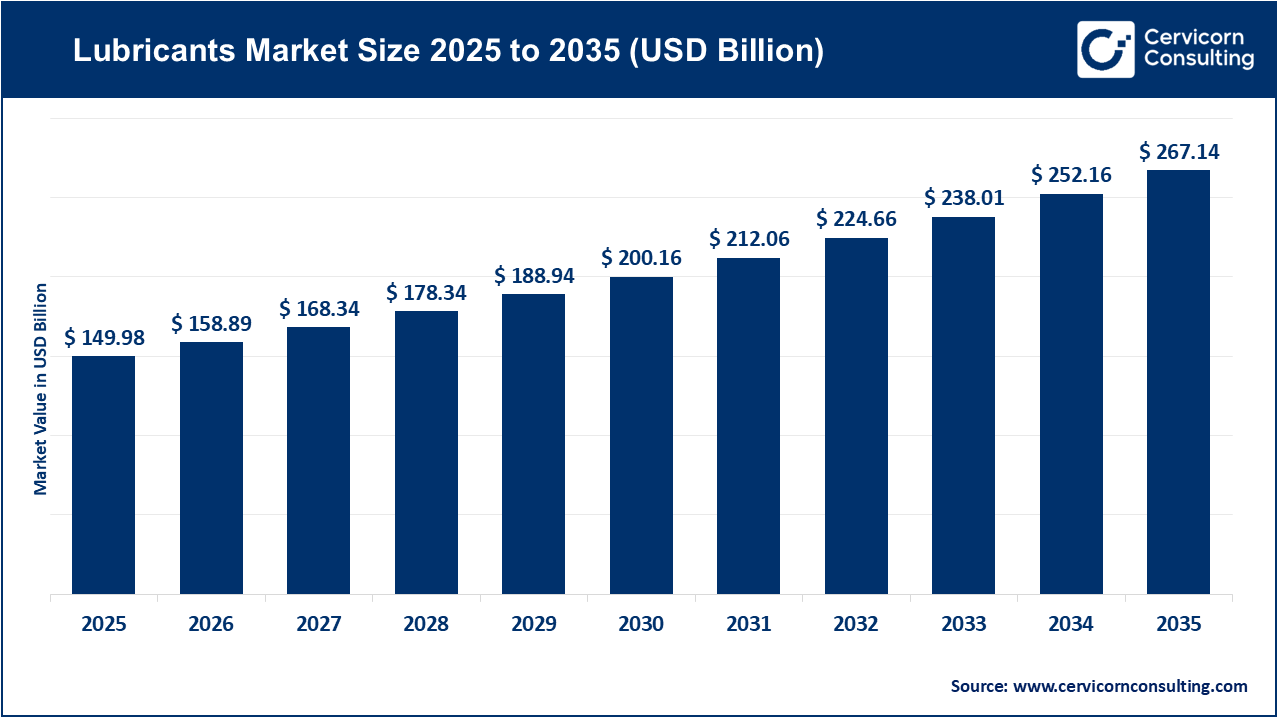
The global lubricants market size was worth USD 149.98 billion in 2025 and is anticipated to expand to around USD 267.14 billion by 2035, registering a compound annual growth rate (CAGR) of 6% from 2026 to 2035.
Why the Lubricants Market Is Important
The lubricants industry is indispensable for industrial infrastructure and economic productivity. At its core, lubrication enables machinery to operate with minimal friction, which directly translates into reduced energy consumption, lower maintenance costs, decreased failure rates, and enhanced equipment uptime. In the automotive sector, lubricants are essential for engine performance, fuel efficiency, emission control, and long‑term durability. In industrial settings, they ensure seamless operation of bearings, gears, compressors, turbines, and hydraulic systems. Beyond mechanical protection, modern lubricants contribute to environmental goals by minimizing waste, supporting fuel economy, and advancing eco‑friendly formulations that align with global sustainability mandates. As global economies expand and mechanization deepens across sectors, the lubricants market underpins efficiency, reliability, and competitiveness in almost every value chain.
Market Growth Factors
The lubricants market is propelled by a confluence of dynamic factors including rapid industrialization in emerging economies, growing vehicle fleet sizes in Asia Pacific and Latin America, stringent regulatory standards for emissions and fuel efficiency requiring advanced lubricant formulations, rising adoption of synthetic and bio‑based lubricants for superior performance and environmental compliance, increased renewable energy infrastructure (e.g., wind turbines requiring specialized gear oils), expansion of construction and mining operations boosting demand for heavy‑duty lubricants, technological innovation such as nanotechnology‑enhanced additives improving wear resistance, and heightened awareness of total cost of ownership benefits that efficient lubrication strategies deliver to end users.
Additionally, digitization, predictive maintenance through IoT and sensor‑enabled lubrication monitoring, strategic industry collaborations, and government policies incentivizing energy savings and eco‑friendly products further drive market growth across multiple sectors.
Get a Free Sample: https://www.cervicornconsulting.com/sample/2905
Key Players in the Lubricants Market
Below is an in‑depth look at some of the market’s influential global and regional players, covering their specialization, focus areas, notable features, 2024 revenues (where publicly available or estimated), market share profiles, and global presence.
1. Sinopec Lubricant Company
Company & Specialization:
Sinopec Lubricant Company is a key subsidiary of China Petroleum & Chemical Corporation (Sinopec Group), one of China’s largest integrated energy and chemical corporations. Specializing in automotive and industrial lubricants, the company produces engine oils, transmission fluids, greases, metalworking fluids, and specialty oils tailored for a range of sectors.
Key Focus Areas:
Sinopec focuses on adding value through innovation, R&D partnerships with automotive OEMs, and expanding high‑performance synthetic lubricants. It emphasizes compliance with international performance standards (API, ACEA, ILSAC) while strengthening its product portfolio for hybrid and electric vehicle applications.
Notable Features:
• Extensive refinery and production facilities across China
• Strong distribution network domestically and growing exports
• Investment in advanced additive technologies
• Collaboration with equipment manufacturers for tailor‑made solutions
2024 Revenue & Market Share:
In 2024, Sinopec Lubricant Company continued to be one of the largest lubricant producers in Asia, with consolidated revenues estimated in the multimillion‑to‑billion USD range, reflecting its strong domestic sales and increasing overseas footprint. It holds a substantial share of China’s lubricant market — typically ranking among the top three players — and is expanding globally.
Global Presence:
While deeply rooted in China, Sinopec lubricants are marketed to Asia Pacific regions, Africa, and select Middle Eastern and European markets through strategic partnerships and export channels.
2. PetroChina
Company & Specialization:
PetroChina Lubricant sector operates under China’s largest oil and gas producer, PetroChina Company Limited. Its lubricant offerings include engine oils, industrial lubricants, greases, and specialties designed for high‑temperature and heavy‑duty applications.
Key Focus Areas:
PetroChina emphasizes product quality, broad grade coverage (from conventional to advanced synthetic oils), and services aligned with regional climate and operational conditions. It supports infrastructure clients, heavy‑equipment operators, and automotive OEMs.
Notable Features:
• Backed by one of China’s biggest upstream and downstream energy platforms
• Integration of refining, lubricant blending, and additive capabilities
• Broad distribution network including service stations nationwide
2024 Revenue & Market Share:
PetroChina remains a dominant lubricants supplier in China with significant revenue contributions from automotive and industrial segments. It consistently ranks among the highest in terms of market share within China’s domestic lubricants industry.
Global Presence:
The company exports lubricants to neighboring Asian markets and Africa, leveraging PetroChina’s global trading channels.
3. China National Petroleum Corporation (CNPC)
Company & Specialization:
CNPC is China’s state‑owned oil and gas conglomerate, with a strong foothold in upstream production, refining, petrochemicals, and lubricants. Its lubricant products encompass automotive oils, industrial lubricants, greases, and specialty formulations.
Key Focus Areas:
CNPC prioritizes high‑quality lubricant grades for heavy‑duty engines, construction equipment, and industrial gear systems. It also invests in R&D for synthetic and environmentally friendly lubricants that meet global standards.
Notable Features:
• Government backing and strategic alignment with national industrial goals
• Integrated production facilities across China
• Emphasis on safety, quality, and environmentally compliant lubrication solutions
2024 Revenue & Market Share:
CNPC’s lubricant segment contributes significantly to its overall downstream revenue, maintaining a strong position within China’s massive lubricant demand landscape.
Global Presence:
With operations in Central Asia, the Middle East, and Africa, CNPC extends its lubricant sales through local partnerships and distribution hubs.
4. Indian Oil Corporation Limited (IOCL)
Company & Specialization:
Indian Oil Corporation Limited (IOCL) is India’s largest commercial enterprise in the energy sector. Its lubricant division produces automotive engine oils, industrial lubricants, aviation oils, greases, and metalworking fluids under established brand names.
Key Focus Areas:
IOCL places strategic emphasis on advanced and fuel‑efficient lubricants, extensive field service support, and partnerships with vehicle manufacturers. The company also focuses on ecological formulations to meet India’s emission and fuel efficiency regulations.
Notable Features:
• One of India’s largest lubricant brands with extensive retail and dealer networks
• Tailored solutions for diverse climatic and operating conditions
• Strong presence in automotive and industrial sectors
2024 Revenue & Market Share:
In 2024, IOCL’s lubricant revenues remained robust, with significant market share in the Indian lubricants industry (often ranking among the top two domestic players). Its broad set of SKUs across segments underpins widespread adoption.
Global Presence:
IOCL primarily operates domestically but has growing exports to neighboring South Asian and African markets.
5. Bharat Petroleum Corporation Limited (BPCL)
Company & Specialization:
Bharat Petroleum Corporation Limited (BPCL) is another major Indian energy company with a strong presence in the lubricants ecosystem. BPCL produces auto and industrial lubricants, marine oils, greases, and specialty fluids.
Key Focus Areas:
BPCL emphasizes performance, quality control, and servicing industrial customers. It actively collaborates with equipment OEMs to co‑develop lubricant formulations optimized for specific applications.
Notable Features:
• Strong domestic brand recognition in India
• Focus on customer service and technical support
• Production facilities strategically located for nationwide distribution
2024 Revenue & Market Share:
BPCL secures a meaningful share of the Indian lubricants market, competing closely with IOCL and other regional players. Revenue from lubricants continues to contribute significantly to its downstream portfolio.
Global Presence:
BPCL’s lubricant distribution is largely concentrated in India with selective export operations.
Leading Trends in the Lubricants Market and Their Impact
Several key trends are shaping the future of the lubricants market, each with significant implications for manufacturers, end‑users, and policy frameworks:
1. Shift Toward Synthetic and Bio‑based Lubricants
Synthetic lubricants offer superior thermal stability, oxidative resistance, and longer service life compared to conventional mineral oils. Bio‑based lubricants reduce environmental impact and improve biodegradability. As regulations tighten around emissions, waste, and ecosystem protection, demand for advanced and eco‑friendly lubricants is rising. This trend pressures legacy players to innovate, invest in new formulations, and position sustainable products as premium offerings.
Impact:
• Reduced environmental impact & waste
• Higher performance with improved equipment protection
• Increased R&D and production costs
2. Electrification of Vehicles
The transition toward electric vehicles (EVs) changes lubricant demands. While EVs require fewer engine oils, they necessitate specialized thermal management fluids, gear fluids for e‑axles, and long‑life greases. This shift diversifies market offerings beyond traditional engine oils.
Impact:
• Reduced demand for conventional engine oils over time
• Growth in specialty lubricants for EV components
3. Digitalization & IoT‑based Lubrication Monitoring
Predictive maintenance platforms now integrate sensors and connectivity to track lubricant condition in real time, enabling optimal replacement schedules and reduced unplanned downtime.
Impact:
• Better asset utilization
• Longer lubricant life cycles
• data‑driven maintenance decisions
4. Regulatory & Environmental Compliance
Governments worldwide are implementing stricter emission norms and waste disposal regulations. Lubricant producers must align formulations with environmental standards (e.g., API/ACEA performance categories, biodegradability criteria).
Impact:
• Greater focus on low‑SAP additive technologies
• Compliance costs and innovation investments
5. Regional Demand Growth in Emerging Economies
Growing industrialization, automotive utilization, and infrastructure development in Asia, Latin America, and parts of Africa are driving lubricant consumption.
Impact:
• Market expansion beyond traditional developed regions
• Regional players gaining importance
Successful Examples in the Lubricants Market Around the World
The lubricants market has seen numerous real‑world success stories that demonstrate innovation, market penetration, and strategic growth:
Shell’s Global Market Leadership
Shell has consistently led with strong R&D capabilities, extensive global distribution, and diversified product portfolios including advanced synthetic lubricants. Tailored solutions for automotive OEMs and industrial clients have solidified its market dominance in Europe, Asia, and the Americas.
ExxonMobil’s High‑Performance Formulations
ExxonMobil’s Mobil 1 and other advanced oil ranges set benchmarks for performance, especially in high‑performance and motorsport applications. Its investments in formulation science and brand positioning have led to premium segment leadership.
TotalEnergies’ Sustainability Focus
TotalEnergies has successfully expanded bio‑based and low‑impact lubricant offerings, aligning its product strategy with global sustainability goals. This approach has found traction among environmentally conscious industrial clients.
Regional Success in India
Indian Oil and Bharat Petroleum have carved significant market positions domestically through large dealer networks, localized products for varying climatic needs, and competitive pricing.
Global Regional Analysis Including Government Initiatives & Policies Shaping the Market
North America
The North American lubricants market continues to be driven by technology upgrades, aftermarket demand, and regulatory frameworks like the Environmental Protection Agency (EPA) policies promoting fuel efficiency and reduced emissions. Government incentives for cleaner fuels and energy‑efficient engines elevate demand for high‑performance synthetic lubricants.
Initiatives & Policies:
• EPA emissions standards for vehicles
• Incentives for energy efficiency
Europe
Europe’s lubricants landscape is heavily influenced by stringent environmental regulations, including Euro 6/7 standards and sustainability directives. There is strong uptake of biodegradable and low‑toxicity lubricants for industrial applications.
Initiatives & Policies:
• EU emissions mandates
• Renewable energy and biodegradability standards
Asia Pacific
Asia Pacific represents the fastest‑growing lubricants market driven by industrialization, expanding automotive fleets, and infrastructure development. Governments in China and India are promoting electric mobility, improved fuel standards, and pollution control, which influence lubricant formulations.
Initiatives & Policies:
• China’s GB/China VI emission standards
• India’s BS VI implementation and EV policy incentives
• Industrial modernization programs
Latin America
Latin American markets are expanding with infrastructure investment and automotive growth. Policies encouraging local production and reduced dependency on imports are shaping competitive dynamics.
Initiatives & Policies:
• Local content requirements
• Emission regulation alignment with global standards
Middle East & Africa
Growth is tied to oil & gas activities, heavy machinery use, and industrial expansion. Governments focus on economic diversification, increasing manufacturing, and adopting environmental policies that influence lubricant preferences.
Initiatives & Policies:
• Economic diversification strategies
• Environmental and industrial quality regulations
To Get Detailed Overview, Contact Us: https://www.cervicornconsulting.com/contact-us
Read Report: Footwear Market Growth Drivers, Trends, Key Players and Regional Insights by 2035