Liquid-cooled EV Charger Module Market Revenue, Trends, and Strategic Insights by 2035
Table of Contents
ToggleLiquid-cooled EV Charger Module Market Size
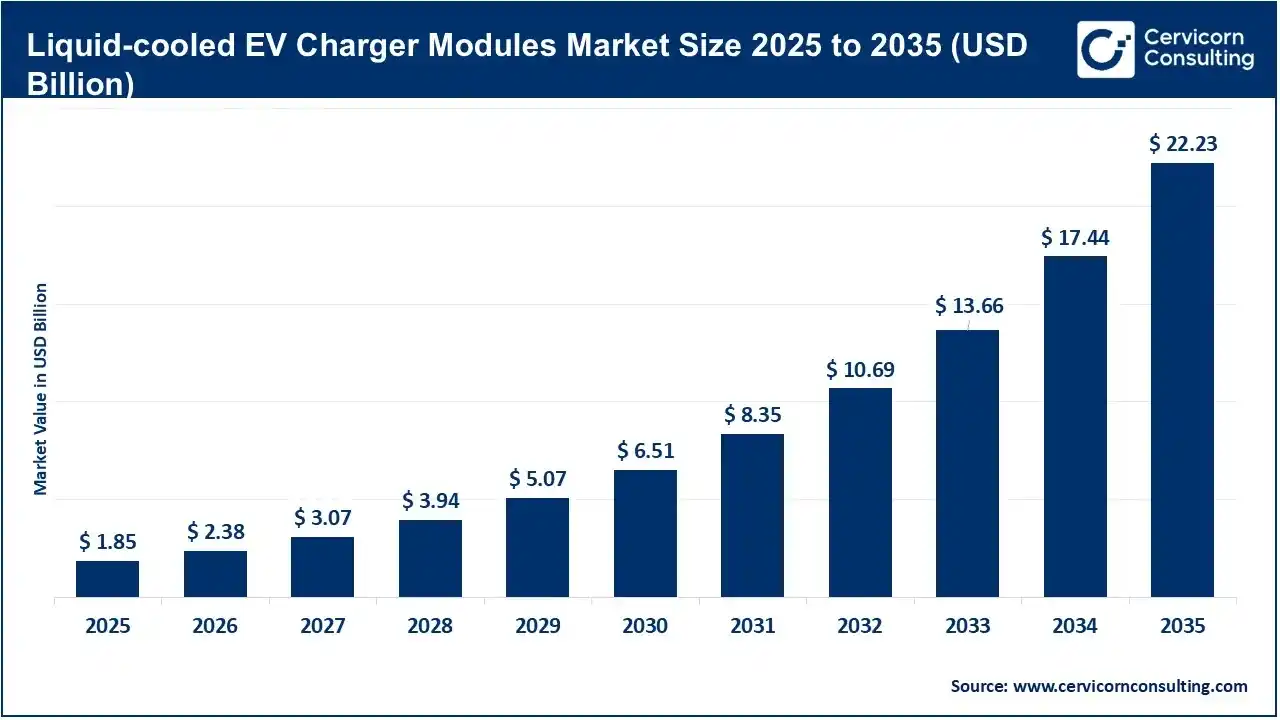
The global liquid-cooled EV charger modules market was valued at approximately USD 1.85 billion in 2025 and is projected to reach about USD 22.24 billion by 2035, expanding at a 28.2% CAGR from 2026 to 2035. Asia-Pacific accounted for approximately 55.0% of the market in 2025, followed by North America at 20.0%.
Liquid-Cooled EV Charger Modules Market Growth Factors
Growth in the liquid-cooled EV charger modules market is being driven by the rapid deployment of high-power and ultra-fast EV charging infrastructure, increasing adoption of 800V and 1,000V EV architectures, rising demand for shorter charging times, increasing power density requirements, expansion of electric commercial fleets, and the need for reliable charging equipment capable of operating under continuous high loads. Conventional air-cooled charging modules face increasing thermal-management challenges as charging power rises, whereas liquid cooling can dissipate heat more efficiently while supporting compact, high-density designs.
The growing penetration of silicon-carbide (SiC) power electronics is further supporting high-efficiency charging modules, while public fast-charging stations, highway charging corridors, bus and truck depots, and commercial fleet facilities are creating demand for high-power systems. Government investment in charging infrastructure is also accelerating the opportunity: China added more than 1.3 million public charging points in 2025 alone, Europe continued expanding ultra-fast charging under AFIR, the United States expanded fast-charging infrastructure despite changes in federal funding implementation, and India’s PM E-DRIVE program allocated INR 20 billion toward public EV charging infrastructure.
Get a Free Sample: https://www.cervicornconsulting.com/sample/3016
What Is the Liquid-Cooled EV Charger Modules Market?
Liquid-cooled EV charger modules are power-conversion components used inside high-performance DC EV charging systems. Their primary function is to convert incoming AC electricity into controlled DC electricity that can be supplied to an EV battery. Unlike conventional air-cooled modules, liquid-cooled systems circulate a coolant through thermal pathways around heat-generating power components.
This approach becomes increasingly valuable as charger output rises. Higher power means greater heat generation within semiconductors, inductors, capacitors and other electrical components. Liquid cooling allows manufacturers to maintain operating temperatures while keeping the module compact and supporting higher power density.
Current commercial products demonstrate the evolution of this technology. For example, UUGreenPower offers liquid-cooled charging modules with high protection levels, high power density, low noise and wide-voltage capabilities. Its UR100040-LQ-DD module is designed around liquid-cooling heat dissipation and provides constant-power output across a wide voltage range.
Tonhe has also developed 40 kW liquid-cooled charging modules using SiC power devices. One of its liquid-cooled modules provides a 50–1,000 VDC output range, peak efficiency of at least 97%, IP65 protection and a stated service life exceeding 10 years.
The market therefore sits at the intersection of power electronics, thermal management, EV charging infrastructure and high-voltage vehicle platforms.
Why Is Liquid Cooling Important for EV Charging?
Liquid cooling becomes increasingly important as charging systems move beyond conventional power levels.
Higher Power Density
Liquid cooling enables more effective heat removal from high-power components, allowing manufacturers to package greater electrical capacity into smaller physical spaces. This is especially important for urban charging stations where land and equipment footprint can be expensive.
Ultra-Fast Charging
Modern EV manufacturers are targeting charging times comparable with conventional refueling. BYD’s Super e-Platform, for example, introduced a 1,000 kW charging architecture and claims 400 km of range can be added in five minutes under appropriate conditions. BYD also developed a fully liquid-cooled megawatt charging terminal with a maximum output capability of 1,360 kW.
Reliability
Charging stations may operate for long periods under heavy loads. Improved thermal control can help reduce thermal stress on power semiconductors and other components, supporting consistent performance and longer operating life.
Reduced Noise
Liquid-cooled modules can reduce dependence on high-speed cooling fans. Tonhe, for example, describes its 40 kW liquid-cooled module as a low-noise solution with a liquid-cooling architecture and high protection rating.
Compact Charging Infrastructure
Higher power density can help charging equipment manufacturers develop smaller cabinets and more flexible charging architectures. This can be particularly beneficial for highway rest stops, urban charging hubs, fleet depots and high-throughput commercial locations.
Key Companies in the Liquid-Cooled EV Charger Modules Market
| Company | Specialization | Key Focus Areas | Notable Features | 2025 Revenue* | Market Share** | Global Presence |
|---|---|---|---|---|---|---|
| Infypower | EV charging power modules and power electronics | High-power DC charging, liquid cooling, power conversion | High power density, wide voltage range, high reliability | Not publicly disclosed | ~8.8% indicative | China and international EV charging markets |
| UUGreenPower | EV DC charging modules and charging solutions | Liquid-cooled modules, V2G, high-power charging | Wide voltage range, high protection, low noise, high density | CNY 1.32B | ~13.5% indicative | China and 50+ global markets/customers |
| TELD | EV charging equipment and charging networks | Charging infrastructure, charging equipment, network operations | Large charging ecosystem and network integration | Not separately disclosed | N/A | China; expanding international ecosystem |
| Tonhe Electronics Technologies | Power electronics and EV charging modules | Liquid-cooled DC modules, SiC, high-voltage charging | ≥97% efficiency, IP65, wide operating range | CNY 1.56B | ~5.6% indicative | China, North America, Europe, Asia-Pacific and other regions |
| Winline Technology | EV charging modules, fast chargers and energy solutions | High-power charging, modules, energy storage | 1.2M+ modules and 100,000+ terminals in service | Not publicly disclosed | N/A | 50+ countries and regions |
* 2025 revenue refers to total company revenue where publicly available, not liquid-cooled-module revenue.
** Market-share figures marked “indicative” come from published liquid-cooling charging-module market datasets and should not be treated as audited company-reported 2025 shares. Other companies do not have a sufficiently transparent standalone 2025 market-share disclosure.
Infypower
Infypower is positioned strongly in charging power electronics and high-power EV charging modules. Its liquid-cooled LRG1K0100G module, for example, supports a 150–1,000 VDC output range and up to 100 A, with a 30 kW rated power. The company highlights high efficiency, zero audio noise, high power density and reliability for liquid-cooled DC charging applications.
UUGreenPower
UUGreenPower specializes in EV charging modules and DC fast-charging solutions. The company reports more than 700 employees and more than 1,000 industry customers globally. Its portfolio includes 15 kW, 20 kW, 30 kW and 40 kW charging modules as well as liquid-cooled solutions. UUGreenPower reported approximately CNY 1.32 billion in 2025 revenue.
TELD
TELD is differentiated by its combination of charging equipment and charging-network operations. Its charging ecosystem includes intelligent charging systems, microgrid solutions and standalone charging equipment. Its broader network position gives the company visibility into charging utilization and infrastructure requirements. A 2026 financial filing showed that EV charging-network business accounted for 26.0% of total revenue during the first ten months of 2025.
Tonhe Electronics Technologies
Tonhe combines power electronics expertise with EV charging technology. Its 2025 revenue reached approximately CNY 1.56 billion, representing nearly 29% year-over-year growth. The company’s new-energy vehicle business generated approximately CNY 1.09 billion in 2025.
Its liquid-cooled charging portfolio includes 40 kW modules using SiC power devices, high-voltage output and IP65 protection. This positions Tonhe well for high-power charging cabinets, fleet charging and other demanding applications.
Winline Technology
Winline operates as an international EV charging and new-energy system provider, with capabilities spanning EV charging modules, fast-charging stations and energy storage. The company says it has nearly 1,000 employees, including approximately 300 R&D engineers, and more than 170 invention patents. By the end of 2025, it reported more than 1.2 million EV charging modules and 100,000+ DC charging terminals operating across more than 50 countries and regions.
Leading Trends and Their Impact
1. Shift Toward 800V and 1,000V Charging Architectures
The transition from conventional 400V platforms toward 800V and 1,000V architectures is one of the strongest catalysts for liquid-cooled charging. Higher voltage allows more power to be transferred without proportionally increasing current, while ultra-fast charging still creates substantial thermal-management requirements.
Impact: Module suppliers are developing higher-voltage, wider-output-range products capable of supporting multiple EV architectures.
2. Megawatt Charging
Megawatt charging is moving from commercial-vehicle applications toward passenger EV demonstrations. BYD’s 1 MW Super e-Platform illustrates the direction of the market, while Zeekr has announced a fully liquid-cooled ultrafast charging pile capable of up to 1.2 MW per charging gun.
Impact: Charging-module power ratings are likely to increase, encouraging greater adoption of liquid cooling, SiC semiconductors and modular power architectures.
3. SiC Power Electronics
SiC semiconductors offer advantages for high-frequency, high-voltage power conversion. Tonhe’s liquid-cooled module, for example, uses SiC devices and reports peak efficiency of at least 97%.
Impact: Greater efficiency can reduce electrical losses while liquid cooling helps manage the thermal load created by high-power operation.
4. Growth of Fleet and Heavy-Duty Charging
Electric buses, delivery vehicles, trucks and commercial fleets require high charger utilization. Unlike private passenger vehicles, fleet vehicles often have limited charging windows.
Impact: Fleet operators have stronger incentives to deploy high-power charging infrastructure, creating an attractive market for liquid-cooled modules.
5. Modular Charging Architecture
Charging station manufacturers increasingly use multiple power modules operating in parallel. This allows capacity to be scaled according to demand.
The 41–60 kW power category accounted for approximately 42% of the liquid-cooled EV charger modules market in 2025, while the 21–40 kW segment represented 27%.
Impact: Modular designs allow operators to expand capacity without completely replacing charging cabinets.
6. Integration With Energy Storage
High-power chargers can place substantial instantaneous demand on electrical grids. Integrating battery energy storage with ultra-fast charging stations can help manage peak power requirements.
Impact: Future charging hubs may combine liquid-cooled power modules, stationary batteries, renewable energy and intelligent energy-management software.
Successful Examples of Liquid-Cooled and Ultra-Fast Charging Around the World
China — BYD Megawatt Flash Charging
China is the clearest example of the movement toward liquid-cooled high-power charging. BYD introduced its Super e-Platform in 2025 with a 1,000V architecture, 1,000A charging capability and up to 1 MW charging power. BYD also announced a fully liquid-cooled charging terminal capable of up to 1,360 kW.
This example demonstrates how liquid cooling is becoming an enabling technology for charging levels far beyond conventional DC fast charging.
China — Huawei Fully Liquid-Cooled Charging
Huawei introduced fully liquid-cooled ultra-fast charging technology capable of up to 600 kW. The architecture incorporates liquid cooling in both the charging power cabinet and dispensers. Huawei has stated that the technology can increase station turnover and reduce operating expenses compared with conventional charging configurations.
China — Zeekr 1.2 MW Charging
Zeekr announced a fully liquid-cooled ultrafast charging pile capable of 1.2 MW per charging gun. The development demonstrates the rapid progression from 360 kW to 600 kW, 800 kW and eventually megawatt-class charging.
Europe — Expansion of Ultra-Fast Highway Charging
Europe is creating an increasingly favorable environment for high-power charging. The European Union’s Alternative Fuels Infrastructure Regulation requires fast-charging stations for cars and vans of at least 150 kW at intervals along major TEN-T corridors, creating a regulatory foundation for widespread high-power infrastructure.
Although not every European high-power charger uses liquid-cooled modules, the regulatory shift toward higher charging capacity creates a strong long-term opportunity for liquid-cooled power-conversion technologies.
India — Rapid Charging Infrastructure Expansion
India represents an emerging opportunity. Approximately 40,000 new public chargers were installed in 2024, while the PM E-DRIVE scheme allocated INR 20 billion for charging infrastructure. The IEA estimates that India’s public charging stock could increase from about 75,000 points at the end of 2024 to approximately 375,000 by 2030 under its Stated Policies Scenario.
As India’s EV fleet becomes more commercialized and highway charging expands, higher-power liquid-cooled modules could become increasingly important.
Global Regional Analysis
Asia-Pacific
Asia-Pacific dominated the liquid-cooled EV charger modules market with approximately 55.0% share in 2025.
China is the primary regional driver because it combines a massive EV market, extensive charger deployment, large power-electronics manufacturing capacity and aggressive ultra-fast charging development. At the end of 2025, China represented more than 65% of global public charging points and had more than 4.7 million public charging points. Its fast and ultra-fast charger stock reached approximately 2.2 million.
Government initiatives: China’s policies have consistently supported EV infrastructure development, while more recent efforts emphasize faster charging, network expansion and vehicle-grid integration. China has also announced plans to expand its national charging network by more than 60% from the 2025 level by the end of 2027.
Japan and South Korea are also important markets because of their advanced automotive industries and growing investment in high-power charging technologies. Japan has targeted 300,000 public charging points by 2030, approximately nine times its 2024 stock.
India is expected to become another significant growth market as electric passenger vehicles, buses, three-wheelers and commercial fleets increase.
North America
North America held approximately 20.0% of the global liquid-cooled EV charger modules market in 2025, making it the second-largest regional market.
The United States is particularly important because of its large highway network, expanding EV fleet and demand for high-power charging. In 2025, the country’s fast and ultra-fast charging stock increased by about 30% to nearly 70,000 points.
Government initiatives: The National Electric Vehicle Infrastructure program, established under the Bipartisan Infrastructure Law, has provided federal support for highway charging. However, implementation experienced uncertainty during 2025–2026 as federal funding obligations were paused and subsequently revised. By April 2026, around 550 NEVI-funded fast-charging points were operational across 19 states.
The region’s commercial fleet, logistics and long-distance transportation sectors could become particularly important customers for liquid-cooled charging modules because high utilization favors powerful, thermally robust charging equipment.
Europe
Europe is developing a dense high-power charging ecosystem through a combination of regulation, infrastructure investment and automaker electrification.
The EU’s Alternative Fuels Infrastructure Regulation (AFIR) requires charging stations delivering at least 150 kW for cars and vans along major TEN-T corridors, with minimum total station power requirements increasing over time. In 2025, EU ultra-fast charging infrastructure continued to expand, with the number of ultra-fast charging points increasing by approximately 30%.
Government initiatives: AFIR is complemented by the revised Energy Performance of Buildings Directive, which promotes EV charging readiness in buildings. The EXPAND-E project also provided more than EUR 70 million in funding for charging projects across 23 EU member states.
These measures are encouraging charging operators to install higher-capacity systems, supporting demand for advanced thermal-management technologies.
Latin America
Latin America remains an emerging market, but EV adoption is increasing in major economies such as Brazil, Mexico, Chile and Colombia. The market opportunity is initially concentrated around urban charging hubs, fleet electrification and major transportation corridors.
Liquid-cooled modules are likely to gain traction first in high-utilization locations rather than residential charging because their higher cost is easier to justify where chargers need to deliver large amounts of energy throughout the day.
Government incentives for EV purchases, public transportation electrification and charging infrastructure are expected to influence the speed of adoption. Brazil, in particular, has growing electric bus and fleet electrification activity, creating potential demand for high-power charging.
Middle East & Africa
The Middle East & Africa region is at an earlier stage of EV charging development but offers long-term potential because of urbanization, infrastructure investment and government sustainability programs.
The Gulf states are increasingly investing in electric mobility and charging networks as part of broader energy-transition strategies. High temperatures make thermal management particularly important, giving liquid-cooled systems an additional technical advantage in demanding environments.
In Africa, charging deployment is more concentrated in countries with stronger EV adoption and renewable-energy initiatives, including South Africa and selected North African markets. Fleet charging, buses and commercial transport are likely to be the most attractive early applications for high-power liquid-cooled systems.
Government Initiatives and Policies Shaping the Market
Government policy is becoming one of the most important structural factors affecting the liquid-cooled EV charger modules industry.
China: Large-scale charger deployment, EV incentives, high-voltage charging development and grid-integration initiatives are encouraging the rapid adoption of high-power charging. China had more than 4.7 million public charging points at the end of 2025 and continues to target major network expansion.
European Union: AFIR establishes minimum charging capacity and distance requirements along major transportation corridors. This directly supports demand for high-power and ultra-fast chargers.
United States: The Bipartisan Infrastructure Law and NEVI program created a major framework for highway fast-charging development, although implementation and federal funding priorities have evolved during 2025–2026.
India: PM E-DRIVE allocated INR 20 billion toward public EV charging infrastructure, including support for targeted EV chargers. The program is particularly significant because India is simultaneously experiencing growth in electric two-wheelers, three-wheelers, buses, passenger vehicles and commercial fleets.
Japan: The country is targeting approximately 300,000 public charging points by 2030, creating opportunities for higher-performance charging technologies as EV penetration increases.
Southeast Asia: Indonesia, Thailand, Malaysia and Vietnam are expanding charging infrastructure, with more than 24,000 chargers installed across these four markets by 2024. Indonesia has targeted 30,000 charging stations by 2030, while Thailand has targeted 12,000.
The combined effect of these policies is shifting the EV charging industry from simply increasing the number of chargers toward improving charging speed, power density, reliability and utilization. This transition directly strengthens the business case for liquid-cooled EV charger modules, particularly in public fast charging, commercial fleets and emerging megawatt charging applications.
To Get Detailed Overview, Contact Us: https://www.cervicornconsulting.com/contact-us
Read Report: Liquid Packaging Market Revenue, Trends, and Strategic Insights by 2035