India Consumer Electronics Market Revenue, Trends, and Strategic Insights by 2035
India Consumer Electronics Market Overview
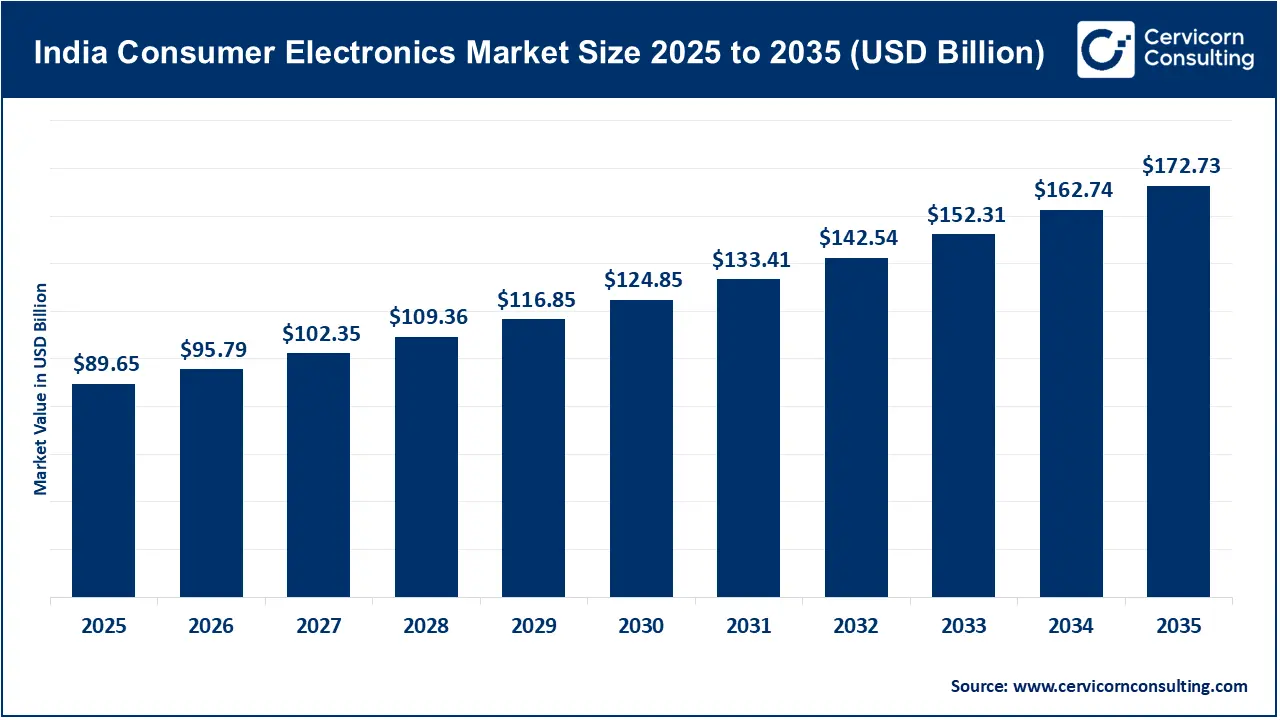
The India consumer electronics market was valued at USD 89.65 billion in 2025 and is projected to reach approximately USD 172.73 billion by 2035, expanding at a CAGR of 6.78% from 2026 to 2035. The market benefits from India’s large population, expanding working-age demographic, increasing internet penetration, urbanization, rising disposable incomes, and rapid adoption of connected technologies.
India Consumer Electronics Market Growth Factors
The India consumer electronics market is being driven by rising disposable incomes, urbanization, expanding middle-class consumption, increasing smartphone and internet penetration, rapid 5G adoption, e-commerce expansion, premiumization, smart-home adoption, technological innovation, and government-backed electronics manufacturing programs. The growing availability of affordable smartphones and connected devices is expanding the addressable consumer base beyond metropolitan cities into Tier-2, Tier-3, semi-urban, and rural markets. Consumers are also increasingly replacing conventional televisions and appliances with smart, connected, energy-efficient, and AI-enabled alternatives. Financing options, digital payments, organized retail, online marketplaces, and omnichannel distribution are making electronics more accessible.
At the manufacturing level, initiatives such as the Production Linked Incentive scheme, PLI 2.0 for IT hardware, Electronics Component Manufacturing Scheme, Semicon India Programme, SPECS, and Electronics Manufacturing Clusters are encouraging localization, investment, component production, and exports. Government data indicates that electronics manufacturing has expanded substantially, while domestic value addition has reached approximately 18%-20%, creating a stronger foundation for India’s next phase of electronics growth.
What Is the India Consumer Electronics Market?
The India consumer electronics market refers to the ecosystem of electronic products manufactured, imported, distributed, sold, and consumed by Indian households and individual consumers. It includes smartphones, tablets, laptops, televisions, audio equipment, wearables, refrigerators, washing machines, air conditioners, microwaves, smart-home devices, gaming products, cameras, accessories, and other connected electronic products.
The market can broadly be divided into personal electronics, home entertainment, home appliances, computing devices, mobile devices, wearables, audio products, and smart-home solutions. Smartphones remain one of the largest categories, while televisions, refrigerators, washing machines, air conditioners, audio devices, and connected appliances are increasingly influenced by premiumization and smart functionality.
The market is also shifting from individual products toward technology ecosystems. Consumers increasingly prefer devices that communicate with one another through applications, cloud platforms, voice assistants, artificial intelligence, and Internet of Things technologies. Euromonitor notes that India’s 2025 consumer electronics market increasingly moved from standalone devices toward interconnected ecosystems, with AI-powered and premium products gaining importance.
Get a Free Sample: https://www.cervicornconsulting.com/sample/2730
Why Is the India Consumer Electronics Market Important?
The market is important for both consumer welfare and India’s industrial development. For consumers, electronics improve communication, entertainment, household efficiency, education, healthcare access, productivity, and digital connectivity.
For the economy, the industry contributes to manufacturing, employment, exports, foreign investment, technology transfer, logistics, retail, and component development. Electronics manufacturing has become one of India’s most strategically important industrial sectors. Government data indicates that the broader electronics ecosystem supports around 25 lakh jobs, while mobile manufacturing alone employs approximately 12 lakh people.
The sector is particularly significant because India is transitioning from being primarily a large electronics consumption market toward becoming a major manufacturing and export hub. Mobile-phone production increased from ₹18,000 crore in FY2014-15 to ₹5.45 lakh crore in FY2024-25, while mobile-phone exports increased 127 times to approximately ₹2 lakh crore.
Major Companies in the India Consumer Electronics Market
| Company | Specialization | Key Focus Areas | Notable Features | 2025 Revenue | Market Share |
|---|---|---|---|---|---|
| Samsung Electronics India | Smartphones, TVs, appliances, tablets, wearables, computers | AI, premium smartphones, Smart TVs, connected homes, local manufacturing | Broad portfolio and large Indian manufacturing footprint | ₹1,11,183 crore FY25 | 14.1% smartphone share in 2025 |
| Xiaomi India | Smartphones, TVs, wearables, IoT and smart-home products | Value technology, AIoT, ecosystem products, online/offline expansion | Strong affordability and connected-device ecosystem | ₹24,144.5 crore total revenue FY25 | ~13% smartphone share in 2025 |
| LG Electronics India | TVs, refrigerators, washing machines, ACs, kitchen appliances | Premium appliances, AI-enabled products, energy efficiency, localization | Category leadership across major appliances | ₹24,366.6 crore FY25 revenue from operations | 27.5% panel TVs; 29.9% refrigerators; 33.5% washing machines; 18.0% room ACs, H1 2025 |
| Sony India | TVs, audio, cameras, gaming and consumer AV products | Premium entertainment, OLED/BRAVIA, audio, imaging | Strong premium brand positioning | ₹7,851.08 crore FY25 | Focused on premium/super-premium TV segment; targeted 3%-5% share gain |
| Vivo India | Smartphones, mobile accessories, connected devices | Camera technology, 5G, AI, offline distribution, premiumization | Strong retail network and smartphone leadership | ₹41,395 crore FY25 | 19.3% smartphone share in 2025 |
Samsung Electronics India
Samsung is one of India’s most diversified consumer-electronics companies, with operations spanning smartphones, tablets, televisions, refrigerators, washing machines, air conditioners, monitors, computers, wearables, and accessories. Samsung India Electronics reported ₹1,11,183 crore in revenue from operations for FY2025, crossing the ₹1 lakh crore milestone for the first time. Its mobile-phone business remains a major contributor, although the company’s strength comes from its presence across several consumer categories.
Samsung’s 2025 strategy increasingly emphasized AI, premiumization, foldable smartphones, OLED/QLED televisions, SmartThings connectivity, and AI-enabled home appliances. In India’s smartphone market, Samsung held approximately 14.1% share in 2025, ranking behind Vivo according to IDC data.
Xiaomi India
Xiaomi built its Indian presence around affordable smartphones and a high-value proposition, subsequently expanding into smart TVs, earbuds, smartwatches, tablets, routers, home appliances, and other IoT products. Xiaomi Technology India’s FY25 total revenue was approximately ₹24,144.5 crore, with sales of ₹23,976.8 crore.
The company’s strategy is evolving from smartphone-led growth toward an integrated AIoT ecosystem, connecting smartphones with televisions, wearables and smart-home products. However, Xiaomi faced pressure in India’s smartphone market during 2025. IDC data indicated that Xiaomi’s market share declined, while CMR reported approximately 13% share for Xiaomi during 2025.
LG Electronics India
LG has a particularly strong position in India’s home-appliance and television segments. Its portfolio includes refrigerators, washing machines, air conditioners, televisions, microwaves, monitors, soundbars and other consumer products.
LG Electronics India reported ₹243.67 billion, or approximately ₹24,366.6 crore, in revenue from operations in FY2025.
The company’s market position is especially strong in major household categories. During the six months ended June 2025, LG held 29.9% refrigerator share, 33.5% washing-machine share, 18.0% room-air-conditioner share, 20.6% inverter-AC share, and 27.5% panel-TV share in the offline channel by value.
LG’s current growth strategy focuses heavily on premiumization, AI-enabled appliances, energy efficiency, localized manufacturing, and exports.
Sony India
Sony India focuses primarily on premium consumer electronics, including BRAVIA televisions, audio systems, cameras, gaming-related products and imaging technologies. Sony India reported ₹7,851.08 crore in revenue from operations during FY2025, an increase of 2.44% from the previous year.
Rather than competing aggressively in entry-level categories, Sony emphasizes premium and super-premium entertainment products. In 2025, the company targeted a 3%-5% increase in its share of premium and super-premium TV categories, supported by festive demand, television price reductions and premium product launches.
Vivo India
Vivo has become one of India’s strongest smartphone brands through its combination of camera-focused innovation, 5G devices, retail distribution, regional marketing and increasingly premium smartphones. Vivo Mobile India reported approximately ₹41,395 crore revenue in FY25.
IDC data placed Vivo at 19.3% of India’s smartphone market in 2025, making it the leading smartphone brand for the year. Omdia likewise reported that Vivo remained India’s smartphone leader in full-year 2025, highlighting the company’s strong offline execution and portfolio management.
Leading Trends and Their Impact
1. Premiumization
Indian consumers are increasingly moving toward premium smartphones, larger televisions, OLED displays, advanced refrigerators, fully automatic washing machines and high-efficiency air conditioners. Premiumization increases average selling prices and revenue opportunities for established brands.
2. AI-Powered Consumer Electronics
Artificial intelligence is becoming a central differentiator. AI is being integrated into smartphones, televisions, refrigerators, washing machines, air conditioners, cameras and audio products. AI can enable personalized recommendations, energy optimization, voice control, image enhancement and predictive maintenance.
3. Smart-Home Ecosystems
Consumers are increasingly interested in connected homes in which televisions, appliances, lighting, smartphones and wearable devices communicate through a single ecosystem. Samsung’s SmartThings strategy is an example of this shift, while Xiaomi is also building an extensive AIoT ecosystem.
4. Affordable 5G
The expansion of affordable 5G smartphones is broadening access to high-speed connectivity. In 2025, smartphone competition increasingly shifted toward value-driven 5G portfolios, while premium demand remained resilient.
5. Omnichannel Retail
Online marketplaces remain important, but physical retail continues to play a major role in electronics because consumers often want to see and compare high-value products before purchasing. Successful companies therefore combine e-commerce, brand stores, multi-brand retailers, regional distributors and direct-to-consumer channels.
6. Localized Manufacturing
Manufacturing localization is becoming a major competitive advantage. Companies can reduce logistics exposure, respond faster to domestic demand and use India as an export base. The government has increasingly shifted policy attention from finished products toward components and deeper value addition.
7. Energy-Efficient Appliances
Energy efficiency is increasingly influencing purchases of air conditioners, refrigerators, washing machines and televisions. Rising electricity costs and environmental awareness are strengthening demand for products with better efficiency ratings and inverter technologies.
Successful Examples of the India Consumer Electronics Market Around the World
India as a Global Smartphone Manufacturing Hub
One of the strongest examples is India’s transformation into a global smartphone manufacturing base. Electronics exports exceeded $47 billion in 2025, with smartphones accounting for a major portion of the growth. Approximately $30 billion of electronics exports were linked to PLI-driven smartphone exports.
Apple iPhone Exports From India
Although Apple is not included in the requested company list, its Indian manufacturing expansion illustrates the global impact of India’s electronics ecosystem. Apple exported approximately $22 billion worth of iPhones from India in 2025, according to Business Standard, making the country increasingly important to global smartphone supply chains.
Samsung’s Global Manufacturing Role
Samsung’s manufacturing presence in Noida demonstrates how India can serve both its domestic market and international supply chains. The Noida facility has become an important part of Samsung’s global smartphone manufacturing network, with Uttar Pradesh authorities noting that the plant manufactures more than 25% of Samsung smartphones sold worldwide.
Indian Electronics Manufacturers Expanding Overseas
Indian companies such as Havells, Dixon Technologies and Voltas are also increasingly targeting developed markets. Havells has established a US subsidiary, Dixon has been expanding smartphone exports, while Voltas has secured appliance export opportunities involving European partners.
These examples demonstrate that India’s opportunity is expanding beyond domestic consumption toward global contract manufacturing, original design manufacturing, exports and localized product development.
Government Initiatives and Policies Shaping the Market
Production Linked Incentive Scheme for Large-Scale Electronics Manufacturing
The PLI Scheme for Large Scale Electronics Manufacturing was introduced in 2020 to encourage domestic mobile-phone and specified component manufacturing. Eligible companies can receive incentives linked to incremental sales of goods manufactured in India. The scheme was designed to overcome cost disadvantages, attract investment and develop a stronger electronics manufacturing ecosystem.
The program has had a measurable impact. By July 2025, the PLI scheme for large-scale electronics manufacturing had generated cumulative production of approximately ₹8.83 lakh crore, investment of ₹12,492 crore and more than 128,000 direct jobs.
PLI 2.0 for IT Hardware
PLI 2.0 for IT Hardware targets laptops, tablets, all-in-one PCs, servers and ultra-small-form-factor devices. The program also supports localization of components and sub-assemblies and includes incentives related to semiconductor design, IC manufacturing and packaging.
This policy can help India diversify beyond smartphones and strengthen domestic production of computing products.
Electronics Component Manufacturing Scheme
The Electronics Component Manufacturing Scheme (ECMS) was approved in March 2025 and notified in April 2025. It aims to create a stronger domestic component ecosystem, attract global and Indian investments, develop production capabilities and integrate Indian companies into global value chains.
This is particularly important because India’s electronics growth has historically depended heavily on imported components. Developing domestic component production can increase value addition, reduce supply-chain risks and improve India’s competitiveness.
Semicon India Programme
The Semicon India Programme is designed to support semiconductor and display manufacturing as well as semiconductor design capabilities. Semiconductor availability is critical to the long-term expansion of smartphones, televisions, appliances, automotive electronics, wearables and other connected devices.
SPECS
The Scheme for Promotion of Manufacturing of Electronic Components and Semiconductors (SPECS) provides financial support for capital expenditure associated with eligible electronic components and semiconductor/display manufacturing. MeitY describes the scheme as providing a 25% financial incentive on eligible capital expenditure.
Modified Electronics Manufacturing Clusters 2.0
The Modified EMC 2.0 program supports the creation of electronics manufacturing clusters, ready-built facilities and plug-and-play infrastructure. Such clusters can reduce manufacturing costs and encourage suppliers and original equipment manufacturers to locate near one another.
Make in India and Atmanirbhar Bharat
The broader Make in India and Atmanirbhar Bharat strategies encourage domestic manufacturing, supply-chain development and greater value addition. The government’s current approach increasingly covers the complete electronics value chain—from finished products and sub-assemblies to components, materials, machinery and tools.
Public Procurement Preference
The government has also used public procurement policies to encourage the purchase of domestically manufactured products. Combined with manufacturing incentives, this creates additional demand for India-based electronics producers and component suppliers.
100% FDI in Electronics
India permits 100% foreign direct investment through the automatic route in the electronics sector, helping attract multinational manufacturers and supply-chain partners. This supports capital inflows, technology transfer and integration with global production networks.
Future Direction of the India Consumer Electronics Market
The next phase of India’s consumer electronics industry is likely to move beyond simply increasing the number of devices sold. AI integration, smart-home connectivity, premium products, domestic components, energy efficiency, semiconductor capabilities and exports are expected to become increasingly important.
The market’s competitive structure is also likely to change as global brands expand manufacturing in India while domestic manufacturers strengthen design and engineering capabilities. At the same time, smartphone growth is becoming more mature. India’s smartphone market shipped approximately 154.2 million units in 2025, down around 1% year over year, demonstrating that future value growth will increasingly depend on premiumization, replacement demand, connected ecosystems and new categories rather than only unit expansion.
For manufacturers, the biggest opportunity lies in combining India’s enormous domestic consumer base with its growing manufacturing and export capabilities. For policymakers, deeper localization of components and greater integration into global value chains will be crucial to ensure that India’s consumer electronics success extends from assembly toward higher-value engineering, design, components and technology development.
To Get Detailed Overview, Contact Us: https://www.cervicornconsulting.com/contact-us
Read Report: AI in Food Safety Market Revenue, Trends, and Strategic Insights by 2035