India Battery Energy Storage System Market Revenue, Trends, and Strategic Insights by 2035
India Battery Energy Storage System Market Size
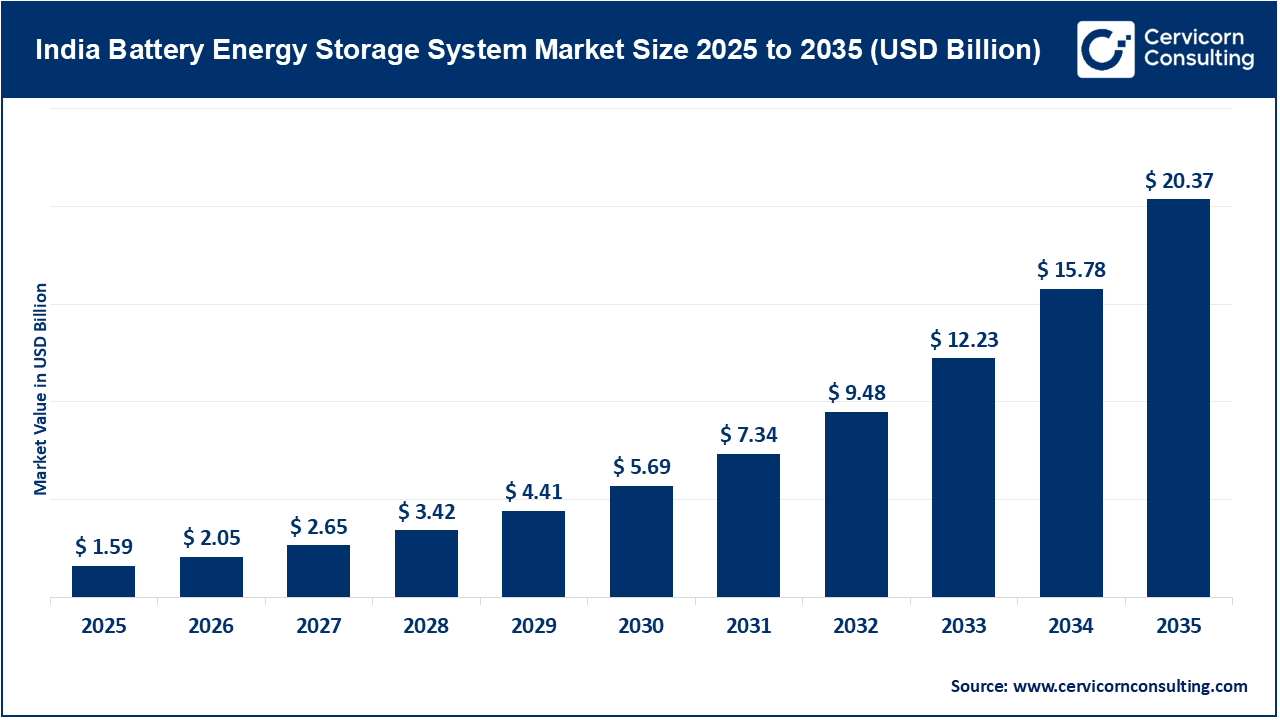
The India battery energy storage system market size was worth USD 1.59 billion in 2025 and is anticipated to expand to around USD 20.37 billion by 2035, registering a compound annual growth rate (CAGR) of 29.1% from 2026 to 2035.
India Battery Energy Storage System Market Growth Factors
The growth of the India BESS market is driven by multiple interconnected factors, including aggressive renewable energy deployment targets, increasing grid instability due to intermittent solar and wind power, and the government’s push to modernize the electricity infrastructure. Policy initiatives such as energy storage obligations for distribution companies, transmission charge waivers for storage projects, and production-linked incentives for advanced battery manufacturing are accelerating adoption. Declining lithium-ion battery costs, improved energy density, and longer battery life cycles have significantly improved the commercial viability of BESS.
Additionally, rising electricity demand from industrialization, urbanization, electric vehicles, and data centers is increasing the need for peak load management and backup power solutions. The emergence of new business models such as energy storage-as-a-service, along with technological advancements in battery management systems and AI-driven optimization software, further strengthens market growth prospects.
What Is the India Battery Energy Storage System Market?
The India Battery Energy Storage System (BESS) market comprises technologies, solutions, and services designed to store electrical energy in rechargeable batteries for later use. These systems capture electricity during periods of low demand or high renewable generation and release it during peak demand or low generation periods. BESS installations can be utility-scale systems connected directly to the grid, co-located with solar or wind power plants, or deployed behind-the-meter in commercial, industrial, and residential settings.
In India, lithium-ion battery technology currently dominates the market due to its high efficiency, fast response time, scalability, and declining costs. Battery energy storage systems perform multiple functions, including frequency regulation, voltage stabilization, peak shaving, load shifting, renewable energy firming, and backup power. As the Indian power grid becomes increasingly complex with higher renewable penetration, BESS is evolving from a supporting technology into a core component of the national energy infrastructure.
Why Is the India Battery Energy Storage System Market Important?
Battery energy storage systems are critically important for India’s energy transition and long-term power security. Renewable energy sources such as solar and wind are inherently variable, creating supply-demand mismatches that can destabilize the grid. BESS helps smooth these fluctuations by storing excess energy and supplying it when generation drops. This capability improves grid reliability and reduces the need for fossil fuel-based peaking power plants.
BESS also supports peak load management by reducing stress on transmission and distribution networks during high-demand periods. For commercial and industrial users, energy storage provides backup power, lowers electricity costs through demand charge management, and enhances energy resilience. At a national level, widespread BESS adoption supports decarbonization goals, improves energy efficiency, and strengthens India’s ability to integrate large volumes of clean energy while maintaining grid stability.
Key Companies in the India Battery Energy Storage System Market
Tata Power Renewable Energy Ltd.
- Company & Specialization: Tata Power Renewable Energy Ltd. is a subsidiary of Tata Power and focuses on renewable energy generation and integrated energy solutions, including battery energy storage systems.
- Key Focus Areas: Utility-scale BESS projects, renewable-plus-storage solutions, round-the-clock clean energy supply, and grid-scale energy storage deployments.
- Notable Features: Strong balance sheet, end-to-end power sector presence, and close alignment with national renewable energy objectives.
- 2024 Revenue & Market Share: BESS revenues are embedded within Tata Power’s broader renewable energy portfolio, which continues to expand rapidly.
- Global Presence: Primarily India-focused, with international operations in select overseas markets.
Fluence Energy Inc.
- Company & Specialization: Fluence Energy Inc. is a global energy storage technology and services provider specializing in large-scale battery energy storage systems.
- Key Focus Areas: Utility-scale BESS deployments, grid services, energy storage software, and advanced battery optimization platforms.
- Notable Features: Recognized as one of the world’s leading BESS providers with a strong project pipeline and technology leadership.
- 2024 Revenue & Market Share: Multi-billion-dollar global revenue with a top-tier market share in utility-scale energy storage.
- Global Presence: Active in over 40 countries across North America, Europe, Asia-Pacific, and emerging markets, including India.
Exide Energy Solutions Ltd.
- Company & Specialization: Exide Energy Solutions Ltd. is a subsidiary of Exide Industries, one of India’s largest battery manufacturers.
- Key Focus Areas: Stationary energy storage systems, grid support applications, commercial and industrial BESS, and lithium-ion cell manufacturing.
- Notable Features: Decades of battery manufacturing expertise and a strong transition strategy toward advanced energy storage technologies.
- 2024 Revenue & Market Share: Energy storage is a growing segment within Exide’s diversified battery business.
- Global Presence: Strong domestic footprint with expanding export and international business operations.
BYD Co. Ltd.
- Company & Specialization: BYD Co. Ltd. is a global leader in batteries, electric vehicles, and renewable energy solutions, including large-scale battery energy storage systems.
- Key Focus Areas: Grid-scale BESS, industrial and commercial storage, integrated battery solutions, and renewable energy support systems.
- Notable Features: Developer of some of the world’s largest battery energy storage projects and vertically integrated battery manufacturing capabilities.
- 2024 Revenue & Market Share: Energy storage contributes significantly to BYD’s diversified global revenue stream.
- Global Presence: Extensive global footprint spanning Asia, Europe, the Americas, and Australia.
Amara Raja Energy & Mobility Ltd.
- Company & Specialization: Amara Raja Energy & Mobility Ltd. is a leading Indian battery manufacturer expanding into lithium-ion and advanced energy storage systems.
- Key Focus Areas: Stationary energy storage, grid-connected BESS, lithium-ion cell manufacturing, and industrial energy solutions.
- Notable Features: Strategic technology partnerships and a strong manufacturing base in India.
- 2024 Revenue & Market Share: Energy storage remains an emerging but fast-growing segment within the company’s battery portfolio.
- Global Presence: Predominantly India-centric with selective international market exposure.
Leading Trends in the India Battery Energy Storage System Market and Their Impact
One of the most significant trends shaping the India BESS market is the dominance of lithium-ion technology, driven by cost reductions, scalability, and high energy efficiency. Battery prices have declined sharply over the past decade, making large-scale storage projects increasingly viable. Another major trend is the integration of digital technologies such as artificial intelligence, predictive analytics, and cloud-based energy management systems, which enhance battery performance, extend operational life, and optimize revenue generation.
The rise of hybrid renewable projects combining solar, wind, and battery storage is also reshaping project development models. Additionally, new financing and ownership structures, including energy storage-as-a-service and public-private partnerships, are lowering entry barriers and accelerating adoption across sectors. Together, these trends are improving project economics and accelerating the commercialization of BESS across India.
Successful Examples of Battery Energy Storage Systems Around the World
Globally, battery energy storage systems have demonstrated strong economic and operational benefits. In the United States, large-scale BESS deployments support grid balancing, renewable integration, and peak demand management. Australia’s grid-scale battery installations have significantly improved frequency control and system reliability while delivering cost savings. In Europe, countries such as Germany and the United Kingdom have successfully integrated energy storage into power markets to manage renewable intermittency and grid congestion. These global examples provide valuable insights and benchmarks for India’s rapidly evolving BESS ecosystem.
Policies Shaping the India Battery Energy Storage System Market
Government policy plays a decisive role in shaping India’s BESS market. Key initiatives include transmission charge waivers for energy storage projects, enabling favorable economics for grid-connected storage assets. Regulatory reforms are increasingly recognizing energy storage as a distinct asset class, allowing for independent contracting, trading, and tariff mechanisms. Draft amendments to electricity rules aim to permit storage sale, leasing, and rental models, expanding market participation.
Additionally, domestic manufacturing incentives under production-linked incentive schemes are strengthening India’s battery supply chain and reducing import dependence. Collectively, these policies are accelerating investment, encouraging innovation, and positioning India as a major global BESS market.
To Get Detailed Overview, Contact Us: https://www.cervicornconsulting.com/contact-us
Read Report: Air Compressor Market Growth Drivers, Trends, Key Players, and Regional Insights by 2035