Generative AI 2.0 Market Revenue, Trends, and Strategic Insights by 2035
Generative AI 2.0 Market Size
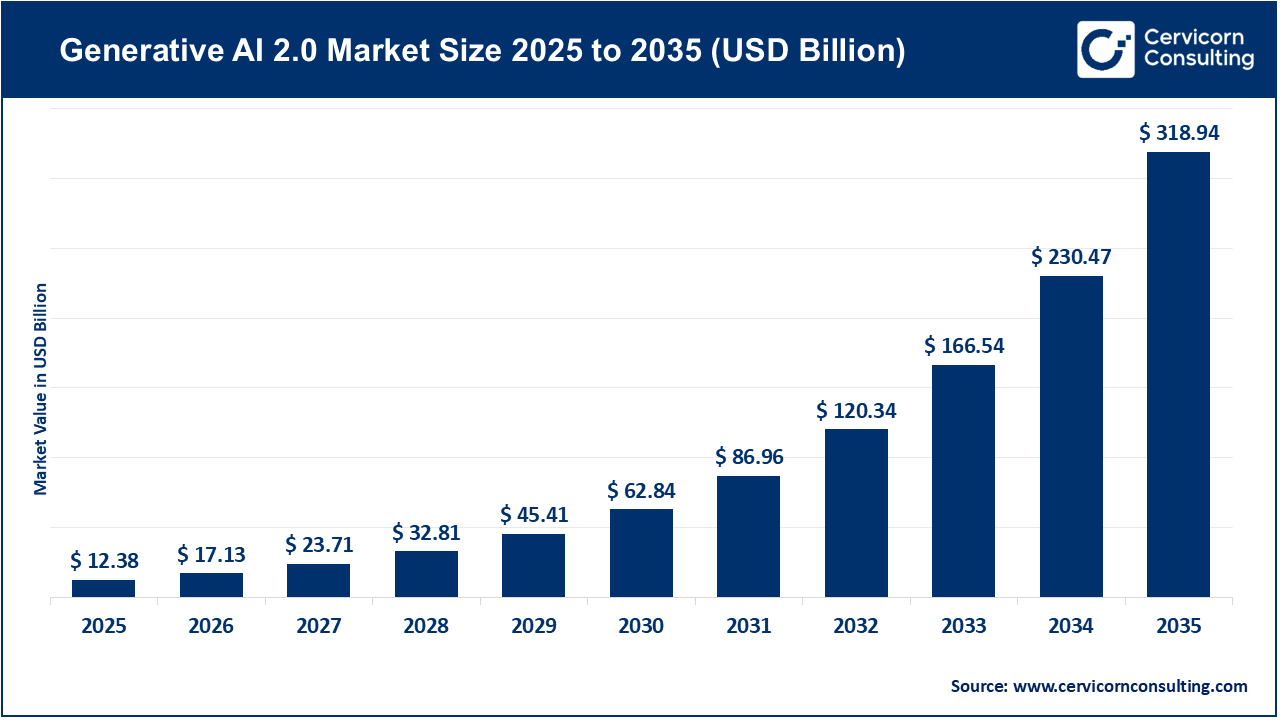
The global generative AI 2.0 market size was worth USD 12.38 billion in 2025 and is anticipated to expand to around USD 318.94 billion by 2035, registering a compound annual growth rate (CAGR) of 38.7% from 2026 to 2035.
Generative AI 2.0 Market Growth Factors
The growth of the Generative AI 2.0 market is driven by rising demand for automation and productivity enhancement across industries, rapid advancements in large language and multimodal models, increasing enterprise adoption of AI-powered software solutions, and substantial investments in cloud infrastructure and AI-optimized hardware. Businesses are increasingly deploying generative AI to streamline operations, personalize customer experiences, accelerate software development, and reduce costs, while hyperscalers continue to expand AI-ready data centers and computing capacity.
Additionally, the growing availability of AI development platforms, government-backed AI initiatives, expanding venture capital funding, and the integration of generative AI into everyday digital tools have significantly lowered adoption barriers. Regulatory clarity in key regions and a strong push toward responsible AI frameworks further reinforce market confidence, enabling sustainable and scalable growth of the Generative AI 2.0 ecosystem worldwide.
What Is the Generative AI 2.0 Market?
The Generative AI 2.0 market encompasses advanced artificial intelligence platforms, foundation models, infrastructure solutions, and services that enable machines to autonomously generate high-quality content, insights, and decisions across multiple formats. These systems are capable of producing text, images, video, audio, code, and structured outputs while also supporting reasoning, planning, and decision-making capabilities.
Unlike first-generation generative AI, which primarily focused on standalone content creation, Generative AI 2.0 emphasizes multimodal intelligence, real-time responsiveness, task automation, and deep integration into enterprise systems. The market includes:
- Large-scale foundation models and multimodal AI systems
- Cloud-based AI platforms and APIs
- AI-optimized hardware and accelerators
- Enterprise AI applications and industry-specific solutions
Together, these components form a rapidly expanding market that is reshaping digital experiences, operational efficiency, and innovation strategies across the global economy.
Get a Free Sample: https://www.cervicornconsulting.com/sample/2866
Why Is Generative AI 2.0 Important?
Generative AI 2.0 is important because it fundamentally changes how knowledge work, creativity, and decision-making are performed. By automating complex cognitive tasks, it enables organizations to operate faster, smarter, and more efficiently while reducing dependency on manual processes. For enterprises, generative AI enhances productivity, supports data-driven decision-making, and enables hyper-personalized customer engagement at scale.
From a broader economic perspective, Generative AI 2.0 is a key driver of innovation, enabling new business models, accelerating research and development, and addressing labor shortages in knowledge-intensive industries. Governments view it as a strategic technology for national competitiveness, digital sovereignty, and economic growth. For individuals, it improves accessibility to information, education, and creative tools, making advanced digital capabilities more widely available than ever before.
Key Companies Shaping the Generative AI 2.0 Market
OpenAI
Company: OpenAI
Specialization: Foundation models, conversational AI, multimodal generative systems
Key Focus Areas:
- Large language and multimodal models
- Conversational AI and digital assistants
- Autonomous AI agents
- Enterprise AI APIs and platforms
Notable Features:
OpenAI is known for developing some of the most advanced generative models, offering strong contextual understanding, reasoning capabilities, and multimodal outputs. Its platforms support both consumer-facing and enterprise-grade applications, with rapid innovation cycles and a broad developer ecosystem.
2024 Revenue: Approximately USD 4–5 billion (estimated)
Market Share: Around 9% of the global foundation model and generative AI platform market
Global Presence: Strong global footprint with users, developers, and enterprise clients across North America, Europe, Asia Pacific, and emerging markets
Google (Alphabet / DeepMind)
Company: Google (Alphabet), including DeepMind
Specialization: Multimodal AI models, AI-enhanced search and productivity tools
Key Focus Areas:
- Multimodal foundation models
- AI-driven search and digital assistants
- Cloud-based AI platforms for enterprises
- Advanced AI research and safety
Notable Features:
Google integrates generative AI directly into its core products, including search, workspace tools, and cloud services. DeepMind strengthens its research capabilities with breakthroughs in reasoning, reinforcement learning, and multimodal intelligence.
2024 Revenue: AI revenue not separately disclosed; significant contribution to Alphabet’s overall growth
Market Share: Approximately 15% of the generative AI platform market
Global Presence: Extensive global operations with strong adoption across enterprises, developers, and consumers
Microsoft
Company: Microsoft
Specialization: Enterprise AI, cloud-based generative platforms, productivity AI
Key Focus Areas:
- Azure OpenAI Service
- Microsoft Copilot across productivity and business tools
- Enterprise AI deployment and integration
- Hybrid cloud and AI infrastructure
Notable Features:
Microsoft excels at embedding generative AI into widely used enterprise software, enabling seamless adoption across business workflows. Its strong cloud infrastructure and strategic AI partnerships have positioned it as a leader in enterprise AI commercialization.
2024 Revenue: Over USD 245 billion (total company revenue)
Market Share: Approximately 39% share in the foundation model and AI platform segment
Global Presence: Operations in over 100 countries with a dominant presence in enterprise and public-sector markets
NVIDIA
Company: NVIDIA
Specialization: AI hardware, GPUs, and accelerated computing platforms
Key Focus Areas:
- AI training and inference hardware
- Data center and cloud AI acceleration
- AI software frameworks and platforms
- Partnerships with cloud and AI companies
Notable Features:
NVIDIA dominates the AI hardware segment, providing the computational backbone for training and deploying large-scale generative AI models. Its GPUs and AI platforms are widely used by hyperscalers, research institutions, and enterprises.
2024 Revenue: Strong growth driven by AI and data center demand
Market Share: Over 90% share in AI accelerator hardware
Global Presence: Global operations with customers across cloud providers, enterprises, and research organizations
Amazon Web Services (AWS)
Company: Amazon Web Services
Specialization: Cloud infrastructure and generative AI platforms
Key Focus Areas:
- AI-ready cloud infrastructure
- Managed generative AI services
- Enterprise AI deployment tools
- Scalable data and compute platforms
Notable Features:
AWS provides one of the most comprehensive global cloud infrastructures for generative AI workloads, supporting diverse AI models and large-scale enterprise deployments with high reliability and security.
2024 Revenue: Approximately USD 108 billion
Market Share: Around 19% of the generative AI platform and infrastructure market
Global Presence: Extensive global data center network supporting enterprises worldwide
Leading Trends and Their Impact on the Generative AI 2.0 Market
One of the most influential trends in the Generative AI 2.0 market is the rise of multimodal foundation models, which can process and generate text, images, audio, video, and structured data within a single system. This capability significantly expands use cases across creative, analytical, and operational domains.
Another key trend is the deep embedding of AI into enterprise software, where generative AI is becoming a native feature rather than a standalone tool. Productivity platforms, customer relationship systems, and analytics tools are increasingly AI-driven, enhancing efficiency and user experience.
AI infrastructure innovation is also reshaping the market. Companies are investing heavily in specialized chips, energy-efficient data centers, and hybrid cloud architectures to reduce the cost and environmental impact of AI operations.
At the same time, responsible AI and governance frameworks are gaining prominence. Organizations are prioritizing transparency, security, and ethical AI usage to comply with regulations and build user trust.
Finally, the democratization of generative AI through open models and accessible platforms is enabling startups, small businesses, and emerging economies to participate in AI-driven innovation, broadening the market’s global reach.
Successful Examples of Generative AI 2.0 Adoption Worldwide
In healthcare, generative AI is being used for clinical documentation, medical imaging analysis, drug discovery, and personalized treatment planning, significantly reducing time-to-diagnosis and improving patient outcomes.
In the media and entertainment industry, generative AI supports content creation, visual effects, animation, and personalized marketing campaigns, enabling faster production cycles and more engaging content.
The financial services sector leverages generative AI for fraud detection, risk analysis, automated reporting, and customer engagement, improving accuracy and operational efficiency.
In e-commerce and retail, AI-generated product descriptions, personalized recommendations, and dynamic pricing models enhance customer experience and conversion rates.
Public sector organizations are adopting generative AI to automate citizen services, improve policy analysis, and enhance digital governance platforms.
Global Regional Analysis and Government Initiatives
North America
North America leads the Generative AI 2.0 market due to strong technology ecosystems, high investment levels, and early enterprise adoption. Government initiatives support AI research, workforce development, and responsible deployment, reinforcing the region’s leadership position.
Europe
Europe emphasizes ethical AI, data protection, and regulatory compliance. Government programs and innovation funding support AI research while ensuring transparency and accountability, creating a balanced environment for sustainable market growth.
Asia Pacific
Asia Pacific is the fastest-growing region, driven by aggressive digital transformation initiatives, expanding cloud infrastructure, and government-backed AI strategies. Countries across the region are investing in AI talent, startups, and public-sector adoption.
Latin America, Middle East, and Africa
These regions are experiencing steady growth as governments and enterprises invest in digital infrastructure and AI adoption. Partnerships with global technology providers and regional innovation hubs are accelerating market development.
To Get Detailed Overview, Contact Us: https://www.cervicornconsulting.com/contact-us
Read Report: Renewable Chemicals Market Revenue, Trends, and Strategic Insights by 2035