Distributed Cloud Market Revenue, Trends, and Strategic Insights by 2035
Distributed Cloud Market Size
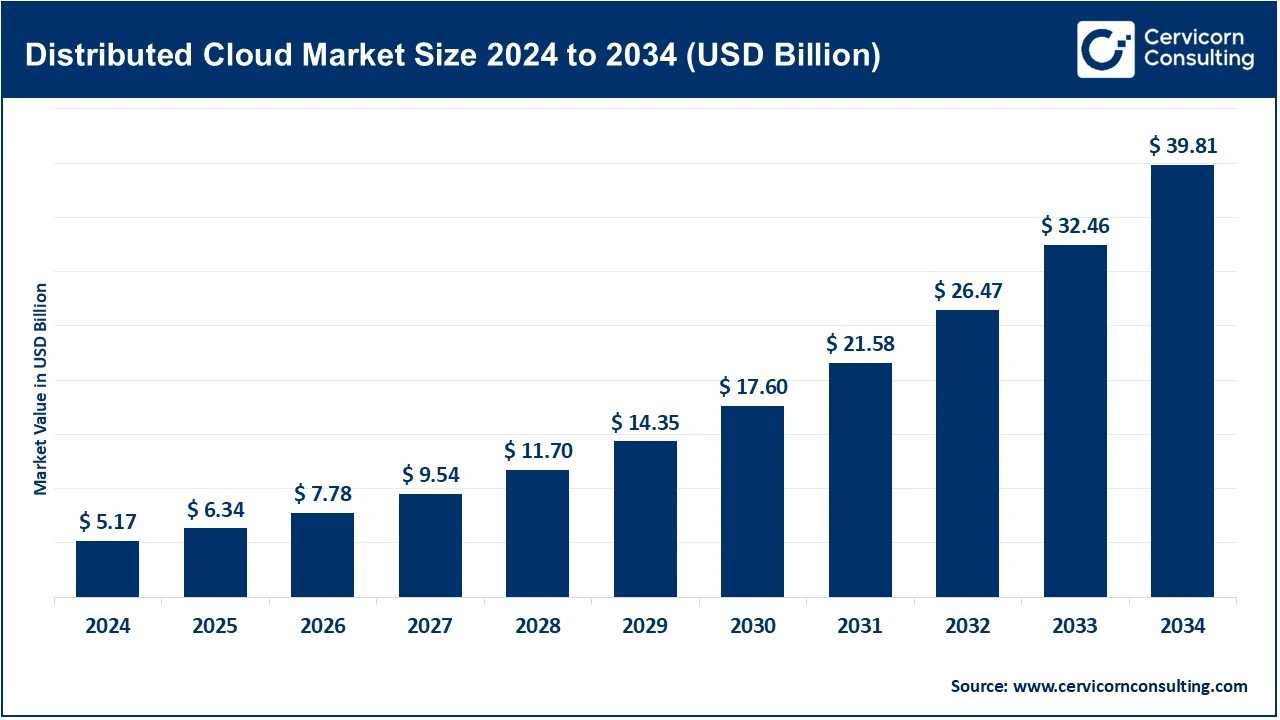
The global distributed cloud market size was worth USD 5.17 billion in 2025 and is anticipated to expand to around USD 39.81 billion by 2035, registering a compound annual growth rate (CAGR) of 22.6% from 2026 to 2035.
What Is the Distributed Cloud Market?
The distributed cloud market encompasses technologies, platforms, and services that deliver cloud computing capabilities across multiple geographically dispersed locations while being centrally managed by a single cloud provider. Unlike traditional cloud models that rely on large centralized data centers, distributed cloud extends compute, storage, and networking services to edge locations, on-premises environments, and regional facilities closer to end users and data sources. This approach enables organizations to deploy cloud workloads where they are most effective, reducing latency, improving performance, and addressing regional data sovereignty requirements. Distributed cloud architectures unify public cloud scalability with localized infrastructure control, making them ideal for modern applications such as real-time analytics, Internet of Things (IoT), artificial intelligence (AI), autonomous systems, and industry-specific workloads requiring compliance, resilience, and operational efficiency. As enterprises increasingly adopt hybrid and multicloud strategies, distributed cloud has emerged as a critical framework supporting flexible, secure, and high-performance digital operations.
Distributed Cloud Market Growth Factors
The growth of the distributed cloud market is driven by a convergence of technological innovation, regulatory evolution, and changing enterprise requirements. Rising demand for low-latency computing is a primary driver, as applications such as real-time analytics, autonomous vehicles, industrial automation, and immersive digital experiences require data processing closer to end users and devices. The rapid expansion of edge computing and IoT ecosystems further accelerates demand, with billions of connected devices generating vast volumes of data that must be processed locally to avoid network congestion and delays. Regulatory and data sovereignty requirements are another significant factor, as governments worldwide enforce data localization and privacy laws that necessitate localized cloud infrastructure.
Additionally, enterprises are increasingly embracing hybrid and multicloud strategies to optimize cost, resilience, and flexibility, driving demand for distributed cloud platforms that offer centralized governance across diverse environments. Advances in networking technologies, including 5G and high-speed broadband, have improved connectivity and made distributed deployments more viable. Finally, the rise of AI and machine learning workloads, particularly AI inference at the edge, has reinforced the need for distributed architectures capable of processing data in real time while maintaining security and compliance.
Why the Distributed Cloud Market Is Important
The distributed cloud market is important because it addresses fundamental limitations of centralized cloud computing in an increasingly digital and data-driven world. Traditional cloud models can struggle with latency, regulatory compliance, and localized performance requirements, particularly for mission-critical or real-time applications. Distributed cloud mitigates these challenges by placing compute and storage resources closer to users and data sources, enabling faster response times and improved user experiences. It also supports compliance with data protection and sovereignty regulations by allowing organizations to process and store data within specific geographic boundaries. From a resilience perspective, distributed cloud enhances business continuity by reducing dependency on a single data center or region, thereby minimizing the impact of outages. Furthermore, it enables enterprises to modernize legacy systems and integrate on-premises infrastructure with cloud-native services, supporting digital transformation initiatives across industries such as healthcare, finance, manufacturing, telecommunications, and government. As organizations pursue agility, scalability, and security simultaneously, distributed cloud has become a foundational element of modern IT strategies.
Key Companies in the Distributed Cloud Market
Amazon Web Services (AWS)
Specialization: Comprehensive cloud infrastructure and platform services with strong distributed and edge capabilities.
Key Focus Areas: Compute, storage, networking, AI and machine learning, edge computing, and hybrid cloud services.
Notable Features: Extensive global infrastructure, scalable cloud services, advanced analytics and AI tools, and a vast partner ecosystem.
2024 Revenue & Market Share: AWS remains the global market leader in cloud infrastructure with approximately 32% market share, driven by sustained demand across enterprises and public sector organizations.
Global Presence: Strong footprint across North America, Europe, Asia-Pacific, Latin America, and the Middle East, with numerous regions and availability zones worldwide.
Microsoft Corporation (Microsoft Azure)
Specialization: Enterprise-focused cloud services with integrated hybrid and distributed cloud solutions.
Key Focus Areas: Hybrid cloud, edge computing, AI services, developer platforms, and enterprise software integration.
Notable Features: Seamless integration with enterprise productivity and operating systems, robust hybrid cloud management tools, and strong AI capabilities.
2024 Revenue & Market Share: Azure holds approximately 22–23% market share and continues to record rapid growth as enterprises expand hybrid and distributed cloud deployments.
Global Presence: Extensive global data center network with strong adoption across North America, Europe, and Asia-Pacific.
Cisco Systems Inc.
Specialization: Networking, security, and infrastructure technologies enabling distributed cloud environments.
Key Focus Areas: Cloud networking, edge computing, secure connectivity, and infrastructure orchestration.
Notable Features: Industry-leading networking solutions that underpin distributed cloud architectures, with strong emphasis on security and performance.
2024 Revenue & Market Position: Cisco plays a critical role in distributed cloud deployments through its networking and infrastructure portfolio, supporting enterprise and service provider environments globally.
Global Presence: Strong presence in North America and Europe with expanding adoption in Asia-Pacific.
IBM Corporation
Specialization: Hybrid and distributed cloud solutions for enterprise and regulated industries.
Key Focus Areas: Hybrid cloud platforms, AI, multicloud management, and secure enterprise infrastructure.
Notable Features: Integration of Red Hat OpenShift for distributed Kubernetes deployments, strong focus on compliance and security.
2024 Revenue & Market Position: IBM’s cloud and hybrid offerings contribute significantly to its enterprise revenue, particularly among industries with complex regulatory requirements.
Global Presence: Broad global presence with strong penetration in North America, Europe, and Asia-Pacific.
Hewlett Packard Enterprise (HPE)
Specialization: Hybrid cloud infrastructure and edge-to-cloud solutions.
Key Focus Areas: Hybrid cloud platforms, edge computing, AI-ready infrastructure, and managed services.
Notable Features: HPE GreenLake platform enables cloud-like experiences across on-premises and edge environments.
2024 Revenue: HPE reported approximately USD 7.6 billion in quarterly revenue, reflecting strong enterprise demand for hybrid and distributed cloud solutions.
Global Presence: Extensive enterprise customer base across North America, Europe, Asia-Pacific, and emerging markets.
Leading Trends and Their Impact
Edge Computing Expansion
Edge computing is a core enabler of distributed cloud, allowing organizations to process data closer to where it is generated. This trend significantly reduces latency and bandwidth costs while improving reliability for real-time applications such as industrial automation, smart cities, and connected vehicles.
AI and Machine Learning at the Edge
Distributed cloud supports the deployment of AI and machine learning models at edge locations, enabling real-time inference and analytics without reliance on centralized data centers. This capability is transforming sectors such as manufacturing, healthcare, and retail by enabling faster decision-making and enhanced automation.
Data Sovereignty and Regulatory Compliance
Increasing regulatory scrutiny around data privacy and localization has made distributed cloud architectures essential for compliance. By allowing localized data processing while maintaining centralized control, distributed cloud helps organizations meet regulatory requirements without sacrificing scalability.
Hybrid and Multicloud Strategies
Enterprises are increasingly combining public cloud, private cloud, and on-premises infrastructure. Distributed cloud platforms provide unified management and orchestration across these environments, supporting flexibility, resilience, and cost optimization.
5G and Advanced Connectivity
The rollout of 5G networks enhances the feasibility of distributed cloud deployments by enabling ultra-low latency and high-bandwidth connectivity. This trend supports advanced use cases such as autonomous systems, immersive digital experiences, and large-scale IoT deployments.
Successful Examples of Distributed Cloud Adoption Worldwide
Retail and E-Commerce
Global retailers use distributed cloud architectures to localize inventory management, pricing, and checkout services. This improves customer experience by reducing latency and ensuring availability during peak demand periods.
Healthcare Systems
Healthcare providers deploy distributed cloud solutions to process and store sensitive patient data locally while supporting real-time diagnostics, telemedicine, and AI-driven clinical decision support.
Industrial IoT and Manufacturing
Manufacturers use distributed cloud platforms to analyze sensor data at factory sites, enabling predictive maintenance, quality control, and operational optimization without delays caused by centralized processing.
Enterprise Hybrid IT Environments
Large enterprises leverage distributed cloud to integrate on-premises data centers with public cloud services, improving disaster recovery, workload portability, and governance across global operations.
Global Regional Analysis with Government Initiatives and Policies
North America
North America leads the distributed cloud market due to advanced digital infrastructure, early adoption of cloud technologies, and strong investments in 5G and AI. Government initiatives supporting digital transformation, cybersecurity, and cloud adoption in public sector agencies have accelerated market growth. Policies encouraging secure and resilient digital infrastructure further support distributed cloud deployment across industries.
Europe
Europe’s market growth is strongly influenced by stringent data protection and privacy regulations. Government policies emphasizing data sovereignty and secure digital ecosystems encourage adoption of distributed and hybrid cloud models. Public sector cloud strategies and investments in digital infrastructure are further driving adoption across healthcare, finance, and manufacturing sectors.
Asia-Pacific
Asia-Pacific is the fastest-growing region in the distributed cloud market, driven by rapid digitalization, expanding 5G networks, and strong government support for cloud-first strategies. Countries such as China, India, and Japan are investing heavily in digital infrastructure, smart cities, and data localization initiatives, accelerating demand for distributed cloud solutions.
Latin America
Latin America is witnessing growing adoption of distributed cloud as governments and enterprises invest in digital transformation. Initiatives to modernize public services, improve connectivity, and strengthen cybersecurity are creating new opportunities for distributed cloud deployments across the region.
Middle East & Africa
The Middle East and Africa are emerging markets for distributed cloud, supported by national digital economy strategies, smart city projects, and government investments in cloud infrastructure. Data localization policies and public-private partnerships are further accelerating market growth in these regions.
To Get Detailed Overview, Contact Us: https://www.cervicornconsulting.com/contact-us
Read Report: Steel E-commerce Market Revenue, Global Presence, and Strategic Insights by 2035