AI Optical Transceiver Market Revenue, Trends, and Strategic Insights by 2035
AI Optical Transceiver Market Size
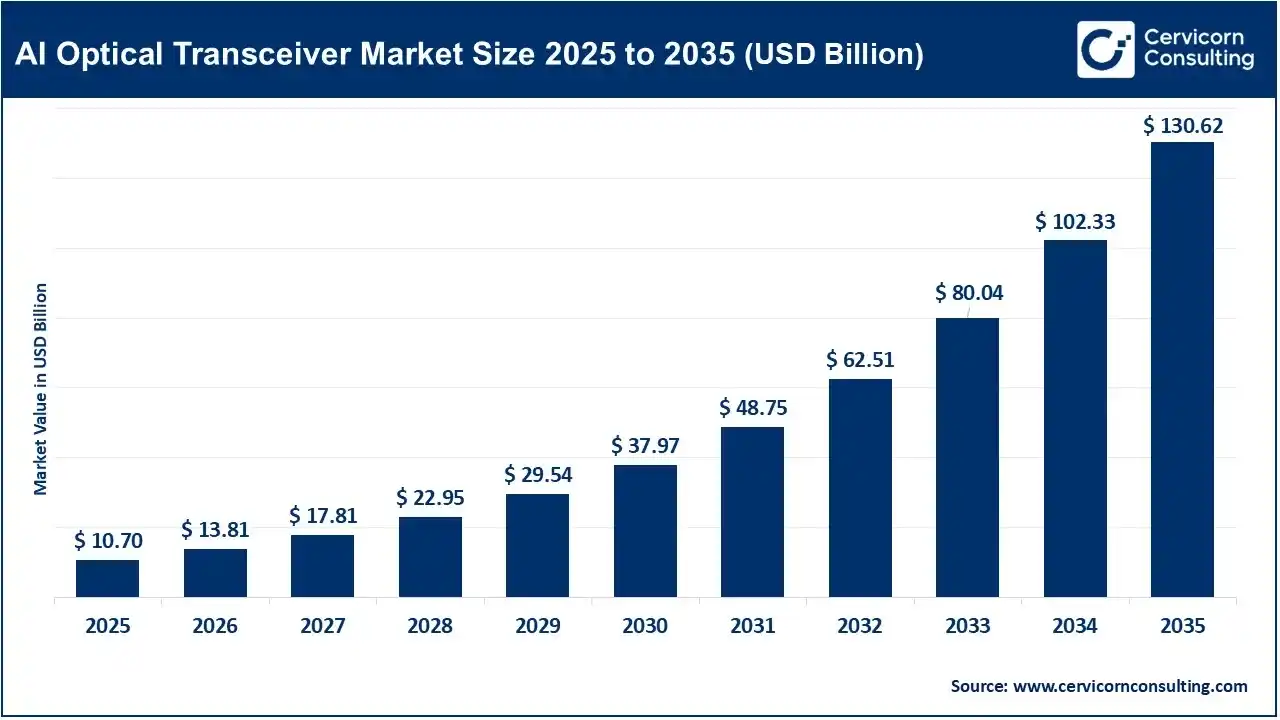
The global AI optical transceiver market size was valued at USD 10.70 billion in 2025 and is projected to reach USD 130.62 billion by 2035, representing a 28.4% CAGR.
AI optical transceiver market growth factors
The increasing deployment of AI accelerators is generating enormous east-west traffic between GPUs, switches, storage systems, and compute nodes, increasing the number and speed of optical links required inside and between data centers. The market is also benefiting from the migration from 400G toward 800G and 1.6T optical connectivity, with 800G accounting for approximately 57% of the AI optical transceiver market in 2025 in the referenced market analysis. Silicon photonics, EML-based technologies, advanced DSPs, PAM4 signaling, co-packaged optics, linear-drive optics, and optical circuit switching are further expanding the technological opportunity. Hyperscale cloud service providers remain important buyers because AI training and inference infrastructure requires large-scale optical fabrics.
At the same time, government-backed AI infrastructure programs in the United States, China, Europe, and India are supporting additional data-center and computing-capacity deployment, indirectly increasing demand for high-speed optical interconnects. China’s national computing initiatives, Europe’s AI Factories and AI Gigafactory plans, India’s IndiaAI Mission, and U.S. policies supporting AI data-center infrastructure are examples of initiatives that can stimulate the broader infrastructure ecosystem surrounding AI optical connectivity.
Get a Free Sample: https://www.cervicornconsulting.com/sample/3042
What is the AI optical transceiver market?
AI optical transceivers are high-speed optical communication modules designed to transmit and receive data using optical signals within AI-oriented computing and networking infrastructure. They convert electrical signals into optical signals for transmission through fiber and then convert received optical signals back into electrical signals.
In conventional networking environments, optical transceivers are used for communications between servers, switches, routers, storage systems, and data centers. AI infrastructure places much greater demands on these connections because thousands or even tens of thousands of GPUs and accelerators can operate together as a distributed computing system.
During AI model training, large quantities of parameters, gradients, activation data, and intermediate results move between accelerators. Consequently, the optical network can become a critical part of overall system performance. Optical transceivers provide the physical connectivity required to move this information at increasingly high speeds.
The market encompasses technologies and products including 400G, 800G, 1.6T and emerging higher-speed optical transceivers, along with different optical architectures such as EML, DML, VCSEL, silicon photonics and coherent technologies.
According to Acumen Research and Consulting, the compute/AI fabric application represented approximately 70% of the AI optical transceiver market in 2025, highlighting the importance of optical connectivity inside AI computing environments.
Why is the AI optical transceiver market important?
The importance of optical transceivers is closely connected with the architecture of modern AI data centers. AI processors can execute enormous numbers of calculations per second, but their performance can be constrained if data cannot move between processors quickly enough.
Optical connectivity addresses this challenge by providing high-bandwidth links between compute and networking components. As AI clusters become larger, the number of optical connections increases substantially. This makes transceivers an important component in the overall AI infrastructure stack alongside GPUs, CPUs, switches, optical fiber, networking ASICs, DSPs, servers, storage, and power systems.
Higher-speed transceivers can also reduce the number of physical links required to achieve a particular aggregate bandwidth. Moving from 400G to 800G and subsequently 1.6T can therefore support higher network capacity while helping data-center operators manage rack density and network complexity.
Energy efficiency is another important factor. AI data centers consume significant amounts of electricity, making power consumption per transmitted bit an increasingly important consideration. Optical suppliers are therefore working on lower-power designs, improved laser technologies, advanced packaging, silicon photonics, and other approaches intended to improve performance per watt.
The market’s importance is also reflected in the strategic activities of major suppliers. Coherent, for example, reported that its fiscal 2025 revenue increased to USD 5.81 billion, with communications revenue benefiting from strong AI data-center demand. Lumentum similarly reported USD 1.645 billion in fiscal 2025 revenue, with its Cloud & Networking business reaching USD 1.411 billion and strong demand for products supporting AI data centers.
Leading companies in the AI optical transceiver market
InnoLight Technology
Company: InnoLight Technology / Zhongji InnoLight
Specialization: High-speed optical interconnects and optical transceivers
Key Focus Areas: AI and cloud data centers, 800G, 1.6T, silicon photonics, coherent optics and next-generation optical interconnects
Notable Features: Portfolio extending from 10G to 1.6T; extensive high-speed optical manufacturing and global supply-chain footprint
2025 Revenue: RMB 38.24 billion for Zhongji InnoLight
Market Share: 24.1% of the broader data-center transceiver market in 2025, according to Global Market Insights
Global Presence: China-based R&D and manufacturing with international operations and customers across major global cloud and AI markets
InnoLight has established a strong position in high-speed data-center optics. Its AI and data-center portfolio includes 100G, 200G, 400G, 800G and 1.6T solutions. The company has also demonstrated 1.6T optical transceivers using 200G-per-lane technology.
Zhongji InnoLight reported record 2025 revenue of RMB 38.24 billion and states that it has ranked first globally by revenue among optical interconnect solution providers for five consecutive years since 2021, based on China Insights Consultancy.
Eoptolink Technology
Company: Eoptolink Technology Inc.
Specialization: High-speed optical transceivers and optical communication components
Key Focus Areas: 400G, 800G, 1.6T, EML and silicon-photonics solutions, data centers and AI networks
Notable Features: Large portfolio of 800G modules in OSFP and QSFP-DD formats; development of higher-speed optical modules
2025 Revenue: Public market estimates vary; company-level 2025 revenue should be distinguished from AI-specific revenue
Market Share: Approximately 11.2% of the broader data-center transceiver market in 2025 according to Global Market Insights
Global Presence: China-based operations serving global cloud and data-center customers
Eoptolink has developed high-speed optical products in response to cloud and AI networking requirements. Its 800G portfolio includes both EML- and silicon-photonics-based solutions and supports OSFP and QSFP-DD800 form factors.
The company’s development direction increasingly centers on 800G and 1.6T connectivity as AI clusters require greater bandwidth. Industry estimates have also projected substantial growth in Eoptolink’s 2025 revenue, although estimates from financial analysts should not be confused with audited company revenue.
Coherent Corp.
Company: Coherent Corp.
Specialization: Optical communications, lasers, optical components, transceivers and photonic technologies
Key Focus Areas: AI data centers, 800G and 1.6T transceivers, silicon photonics, EMLs, lasers and optical networking
Notable Features: Vertically integrated photonics portfolio and broad optical technology base
2025 Revenue: USD 5.81 billion
Market Share: Approximately 6.9% of the broader data-center transceiver market in 2025
Global Presence: Global operations spanning North America, Europe and Asia
Coherent has been active in the transition toward higher-speed AI networking. The company demonstrated a 1.6T-DR8 transceiver operating with eight 200G electrical and optical lanes and designed for AI and networking applications.
Coherent’s fiscal 2025 revenue increased 23% to USD 5.81 billion, while its Datacenter & Communications segment benefited from strong AI data-center demand. The company also recorded its first revenue from 1.6T transceivers during fiscal 2025.
Lumentum Holdings
Company: Lumentum Holdings Inc.
Specialization: Photonic components, lasers and optical communications products
Key Focus Areas: AI data centers, 800G and 1.6T transceivers, EMLs, laser technologies and optical circuit switching
Notable Features: High-speed datacom transceivers and advanced laser technologies for AI infrastructure
2025 Revenue: USD 1.645 billion
Market Share: Approximately 1.5% of the broader data-center transceiver market in 2025
Global Presence: U.S.-based company with international manufacturing, R&D and customer operations
Lumentum’s datacom portfolio includes 800 Gbps and 1.6 Tbps OSFP modules, including DR4 configurations, targeting high-density AI and cloud data-center networks.
In fiscal 2025, Lumentum reported revenue of USD 1.645 billion, up 21% year over year. Cloud & Networking revenue reached USD 1.411 billion, supported by AI data-center demand and products including EML chips, pump lasers, narrow-linewidth laser assemblies and 800G modules.
Applied Optoelectronics (AOI)
Company: Applied Optoelectronics, Inc.
Specialization: Advanced optical networking products and optical transceivers
Key Focus Areas: Data centers, 800G transceivers, hyperscale networking and automated manufacturing
Notable Features: 800G single-mode transceiver production and hyperscale customer relationships
2025 Revenue: USD 455.7 million
Market Share: A separately reported AI optical transceiver share is not publicly established; AOI is a smaller participant than the largest suppliers in broader market-share estimates
Global Presence: U.S.-headquartered with manufacturing and international operations
AOI reported 2025 revenue of approximately USD 455.7 million, compared with USD 249.4 million in 2024.
The company received its first volume order for 800G data-center transceivers from a major hyperscale customer in December 2025. In April 2026, AOI announced an additional USD 71 million order for 800G single-mode data-center transceivers, taking orders from the same customer since mid-March to USD 124 million.
Important market-share note: AI optical transceiver market share is not separately disclosed for all five companies. The percentages above therefore refer to the broader data-center transceiver market where available, rather than claiming that they represent exact AI-specific shares. Global Market Insights estimated 2025 shares of 24.1% for InnoLight, 11.2% for Eoptolink, 6.9% for Coherent and 1.5% for Lumentum.
Leading trends and their impact
Migration from 400G to 800G
The transition toward 800G is one of the strongest trends in AI networking. AI clusters require greater aggregate bandwidth between accelerators and switches, making 800G increasingly important for high-density networks.
The referenced AI optical transceiver market analysis estimates that 800G accounted for 57% of market revenue in 2025, while 400G represented approximately 25%.
Emergence of 1.6T transceivers
1.6T represents the next major step in optical connectivity. Coherent, InnoLight and Lumentum have all demonstrated or commercialized technologies associated with 1.6T optical connectivity. InnoLight demonstrated 1.6T transmission using 200G-per-lane technology, while Coherent recorded first 1.6T transceiver revenue in fiscal 2025.
Silicon photonics
Silicon photonics is becoming increasingly important because it allows optical functions to be integrated using semiconductor manufacturing techniques. The technology can support higher levels of integration and is being considered for future high-volume AI optical connectivity.
The AI optical transceiver market analysis estimates that silicon photonics represented approximately 27% of the market in 2025, making it the second-largest optical technology category after EML-based solutions.
Higher bandwidth per lane
The industry is moving from 100G-per-lane toward 200G-per-lane and ultimately higher-speed optical lanes. This transition helps increase total module capacity without proportionally increasing the number of optical modules.
Lumentum reported demonstrations of 1.6T architectures based on 200G-per-lane technology, while Coherent has demonstrated 1.6T modules using eight 200G lanes.
Power efficiency
As AI data centers become larger, power consumption becomes an important consideration. Transceiver suppliers are focusing on lower power per bit, improved laser efficiency, thermal management and advanced packaging.
Lumentum specifically describes its 800G and 1.6T transceivers as designed for bandwidth efficiency and operation under demanding thermal conditions in AI and cloud data centers.
Co-packaged and linear-drive optics
Co-packaged optics and linear-drive optical architectures are receiving greater industry attention as conventional pluggable approaches face power, thermal and density challenges at increasingly high speeds.
Lumentum’s 2026 industry update highlighted the movement toward 1.6T, 200G-per-lane technologies, co-packaged optics, external laser sources and optical circuit switching as important developments in next-generation AI optical infrastructure.
Successful examples of AI optical transceiver adoption around the world
North America: hyperscale AI data centers
North America represents the largest regional market for AI optical transceivers, accounting for approximately 55% of the market in 2025 according to Acumen Research and Consulting.
The region benefits from a concentration of hyperscale cloud companies, AI infrastructure developers and large data centers. Optical suppliers are responding with 800G and 1.6T solutions designed for AI cluster connectivity.
AOI’s 800G volume order from a major hyperscale customer illustrates the transition from product qualification toward larger-scale deployment.
China: national computing infrastructure
China has built a large-scale national computing infrastructure and is continuing to expand intelligent computing capacity. Chinese policy initiatives emphasize coordination among computing power, data, electricity and networks.
China’s national computing-power strategy has specifically encouraged 400G/800G high-bandwidth all-optical connections between national computing hubs and demand areas.
In August 2025, China’s State Council issued an “AI+” action plan calling for stronger intelligent-computing infrastructure and improved coordination among computing, electricity and network resources.
Europe: AI Factories
Europe is developing a network of AI Factories based around EuroHPC supercomputing infrastructure. These facilities connect computing power, data and talent and are intended to support AI model development.
The European Commission states that 19 AI Factories and 13 associated antennas are being established, while EU and participating-country investments in supercomputing and AI Factories during 2021–2027 are expected to reach approximately €10 billion.
The infrastructure creates potential demand for high-speed networking and optical interconnects because AI supercomputing facilities require fast communication between accelerators, storage and networking systems.
India: IndiaAI Mission
India is expanding its AI compute infrastructure through the IndiaAI Mission. The program has an approved outlay of approximately ₹10,372 crore, with more than 38,000 GPUs onboarded through the common compute initiative as of March 2026.
The expansion of AI compute infrastructure and data centers creates an emerging opportunity for high-speed optical networking and transceiver suppliers.
Global regional analysis, including government initiatives and policies shaping the market
North America
North America currently represents the largest regional market, with a 55% share in 2025. The United States has a dense ecosystem of hyperscale cloud providers, AI companies, semiconductor manufacturers and networking suppliers.
U.S. policy is also increasingly focused on AI data-center infrastructure. In July 2025, Executive Order 14318 directed federal agencies to facilitate the development of large AI data-center infrastructure and related components, including semiconductors and networking equipment.
The U.S. Department of Energy also selected four federal sites for potential AI data-center and energy infrastructure development. These initiatives can indirectly support demand for optical transceivers because networking is an essential component of large AI data centers.
Asia Pacific
Asia Pacific is expected to become the largest regional market by 2035, reaching approximately 46% of global market share, compared with around 35% in 2025.
China, Japan, South Korea, Taiwan, Singapore and India are important markets because of their semiconductor ecosystems, cloud infrastructure, data-center development and AI investment.
China’s policies supporting intelligent computing and national computing networks are particularly relevant. Its computing-power interconnection initiatives emphasize standardized connectivity and high-bandwidth optical networking.
India is also developing its AI infrastructure through the IndiaAI Mission, which includes compute capacity, indigenous AI models, startup support and AI infrastructure development.
Europe
Europe’s AI infrastructure strategy combines AI Factories, supercomputing infrastructure and planned AI Gigafactories. The European Commission’s AI Continent Action Plan includes at least 19 AI Factories and plans for up to five AI Gigafactories.
In February 2025, the EU announced the InvestAI initiative to mobilize substantial investment in AI, while the AI Gigafactory program is intended to support large-scale computing infrastructure and strengthen Europe’s technology ecosystem.
The resulting expansion of high-performance computing infrastructure is expected to increase demand for advanced networking technologies, including high-speed optical transceivers.
Latin America
Latin America currently represents a smaller portion of the AI optical transceiver market but is projected to experience rapid percentage growth. Acumen Research and Consulting estimates the region at approximately 1% of the global market in 2025, rising to about 1.9% by 2035, with a projected 37.5% CAGR over the forecast period.
Growth opportunities are associated with data-center modernization, cloud adoption, colocation development and increasing AI infrastructure investment in markets such as Brazil and Mexico.
Middle East and Africa
The Middle East and Africa are emerging markets for AI infrastructure as governments and technology companies invest in cloud computing, digital transformation and data centers. New AI infrastructure projects can generate demand for high-speed optical networking, particularly where data-center operators seek to build scalable regional cloud and AI platforms.
The development of sovereign AI infrastructure, digital infrastructure strategies and hyperscale facilities is likely to increase the need for high-bandwidth interconnect technologies over the medium term.
Market outlook
As AI infrastructure expands, competitive differentiation is increasingly shifting toward bandwidth density, power efficiency, optical integration, manufacturing scalability, thermal performance and supply-chain reliability. Suppliers with capabilities across lasers, DSPs, silicon photonics, optical engines, packaging and complete transceiver modules are therefore participating in a market where technology cycles are becoming progressively faster.
The transition from 800G to 1.6T and subsequent higher-speed architectures is likely to remain a central technology theme, while silicon photonics, co-packaged optics, linear-drive optics and optical circuit switching can influence how future AI clusters are interconnected.
To Get Detailed Overview, Contact Us: https://www.cervicornconsulting.com/contact-us
Read Report: Perfusion Systems Market Revenue, Trends, and Strategic Insights by 2035