AI Inference Market Revenue, Trends, and Strategic Insights by 2035
AI Inference Market Size
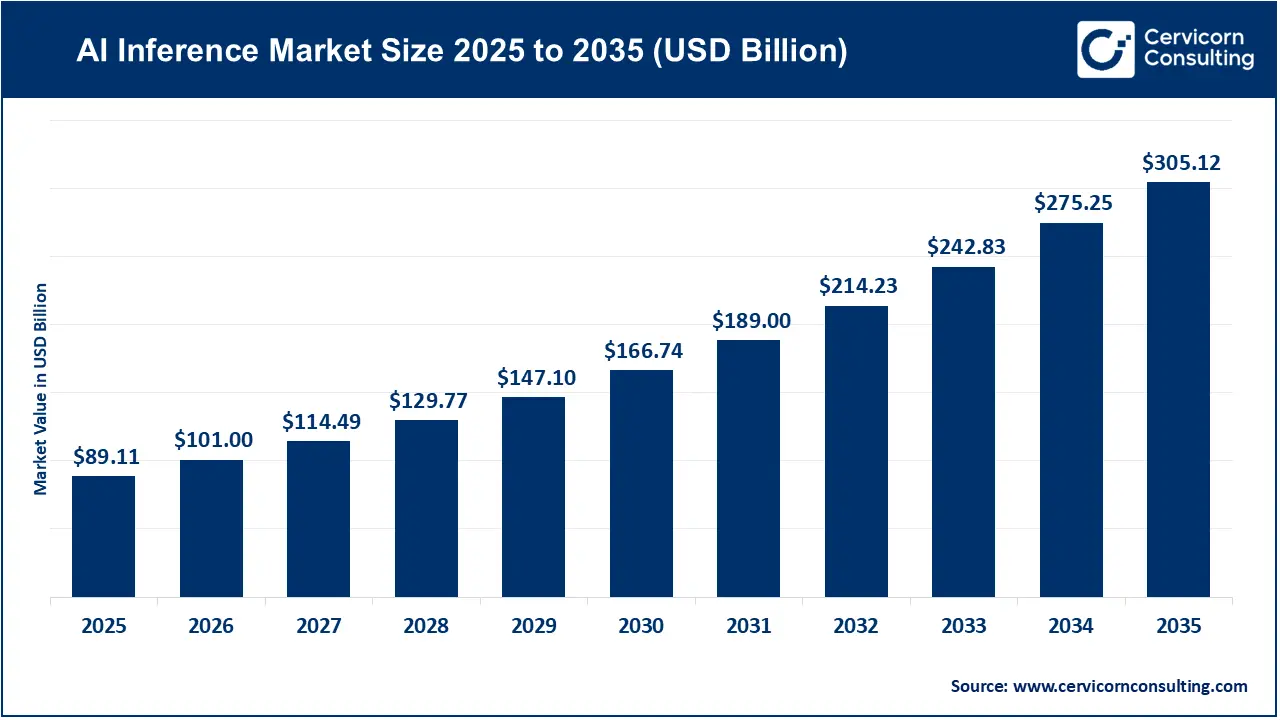
The global AI inference market was valued at approximately USD 89.11 billion in 2025 and is projected to reach USD 305.12 billion by 2035, representing a 13.10% CAGR from 2026 to 2035.
AI inference market growth factors
The global AI inference market growth is being driven by the rapid adoption of generative AI, large language models, computer vision, recommendation engines, autonomous systems, conversational AI, predictive analytics, and AI-enabled enterprise software. The expansion of cloud computing and edge computing is also increasing demand for low-latency inference infrastructure. At the same time, organizations are seeking lower inference costs, improved performance per watt, faster response times, greater data privacy, and specialized processors capable of executing AI workloads efficiently.
The growing number of AI-enabled applications means that inference is becoming a recurring operational workload rather than a one-time development activity. This shift is encouraging hyperscalers, semiconductor companies, cloud providers, and software developers to invest in inference accelerators, CPUs, GPUs, ASICs, inference servers, optimized AI frameworks, and edge AI platforms.
Get a Free Sample: https://www.cervicornconsulting.com/sample/2761
What is the AI inference market?
The AI inference market encompasses the hardware, software, cloud infrastructure, platforms, and services used to execute trained artificial intelligence and machine-learning models on new data and generate predictions, classifications, recommendations, responses, or decisions.
AI inference differs from AI training. During training, large datasets are used to adjust a model’s parameters. During inference, the trained model is deployed and used to produce an output. For example, when a user asks a generative AI chatbot a question, the model processes the prompt and generates an answer through inference.
The market includes GPUs, CPUs, application-specific integrated circuits (ASICs), field-programmable gate arrays (FPGAs), inference servers, accelerators, cloud infrastructure, AI frameworks, inference engines, model-serving platforms, and edge AI systems.
Inference can occur in centralized cloud data centers, enterprise data centers, or at the edge on smartphones, vehicles, industrial machines, cameras, robots, and other connected devices. The choice of deployment depends on factors such as latency, workload size, cost, connectivity, privacy, energy consumption, and regulatory requirements.
Why is the AI inference market important?
AI inference is becoming strategically important because the economic value of an AI model is realized when that model is used repeatedly in production. Training can require substantial computational resources, but once a model is deployed, every query, transaction, recommendation, image analysis, autonomous action, or generated response can create an inference workload.
For enterprises, efficient inference can reduce operating costs while improving response times. In healthcare, inference can support medical-image analysis and clinical decision-support applications. In financial services, it can be used for fraud detection and risk analytics. In retail, recommendation systems and demand forecasting depend on continuous model execution. Automotive companies use inference for perception, driver assistance, and increasingly autonomous driving functions.
The growth of generative AI has intensified this requirement because text, image, video, speech, coding, and multimodal applications can generate very large numbers of inference requests. Consequently, infrastructure providers are increasingly optimizing the complete inference stack—from silicon and memory to networking, software, model compression, and cloud deployment.
Leading companies in the AI inference market
Amazon Web Services, Inc.
Specialization: Cloud computing, AI infrastructure, inference services, custom AI accelerators, and model deployment.
Key focus areas: AWS provides inference infrastructure through services such as Amazon EC2, Amazon SageMaker, Amazon Bedrock, and its custom Trainium and Inferentia accelerator families. Its broad cloud infrastructure allows businesses to deploy AI models without owning all of the underlying computing infrastructure.
Notable features: AWS has developed custom silicon for AI workloads and supports multiple model architectures and deployment approaches. Its scale across cloud regions also allows inference workloads to be distributed geographically.
2025 revenue: Amazon reported USD 716.924 billion in consolidated net sales in 2025, including USD 128.725 billion from AWS. AWS sales increased 20% year over year.
Market share: AWS does not publicly report a standalone global AI-inference market-share figure. Its position is primarily represented through its cloud infrastructure, AI services, and accelerator ecosystem.
Global presence: AWS operates a large international cloud infrastructure footprint serving enterprises, governments, startups, developers, and technology companies across multiple geographic regions.
Arm Limited
Specialization: CPU architecture, semiconductor intellectual property, compute platforms, and energy-efficient processor designs.
Key focus areas: Arm’s architectures are widely used in smartphones, edge devices, embedded systems, automotive computing, cloud infrastructure, and data centers. Its energy-efficient CPU designs are relevant to inference workloads where performance per watt is important.
Notable features: Arm’s ecosystem-based licensing and royalty model allows semiconductor companies to integrate Arm CPU IP into their own processors. Arm reported increasing deployment of Armv9 CPUs and Compute Subsystems in smartphones and data centers during fiscal 2025.
2025 revenue: Arm reported USD 4.007 billion in revenue for the fiscal year ended March 31, 2025, up from USD 3.233 billion in fiscal 2024.
Market share: Arm does not disclose a standalone AI-inference market-share percentage. Its influence is primarily through the processor architectures used by numerous semiconductor and device manufacturers.
Global presence: Arm has a broad global semiconductor ecosystem, with customers and licensees across North America, Europe, Asia-Pacific, and other markets.
Advanced Micro Devices, Inc.
Specialization: CPUs, GPUs, AI accelerators, data-center processors, and adaptive computing.
Key focus areas: AMD is targeting AI inference through its Instinct accelerator portfolio, EPYC server processors, ROCm software ecosystem, and broader data-center platform.
Notable features: AMD’s Instinct MI350 Series was introduced in 2025 with a strong emphasis on inference and large-model workloads. AMD stated that the series could provide up to a 35x generational improvement in inferencing performance under its specified comparison methodology. The MI350 family also offers up to 288 GB of HBM3E memory and up to 8 TB/s of peak theoretical memory bandwidth.
2025 revenue: AMD reported USD 34.639 billion in 2025 revenue, including USD 16.635 billion from its Data Center segment, which increased 32% year over year.
Market share: AMD does not separately disclose AI-inference market share. Its competitive presence spans data-center GPUs, CPUs, software, and AI accelerator platforms.
Global presence: AMD serves customers worldwide across cloud computing, data centers, PCs, gaming, embedded systems, and high-performance computing.
Google LLC
Specialization: AI models, cloud computing, AI accelerators, machine learning infrastructure, and AI-powered consumer services.
Key focus areas: Google combines its Gemini models, Google Cloud infrastructure, Vertex AI, and Tensor Processing Units to address AI training and inference requirements.
Notable features: In 2025, Google introduced Ironwood, its seventh-generation TPU and first TPU designed specifically for inference. Google stated that Ironwood can scale to 9,216 chips and provide 42.5 exaflops of compute per pod.
Google also reported that its products and APIs were processing more than 480 trillion tokens per month in 2025, compared with 9.7 trillion a month a year earlier.
2025 revenue: Alphabet reported USD 402.836 billion in total revenue in 2025, including USD 58.705 billion from Google Cloud.
Market share: Google does not report a standalone AI-inference market-share percentage. Its presence extends across proprietary AI applications, cloud services, custom accelerators, and AI model platforms.
Global presence: Google’s AI and cloud ecosystem serves customers globally through Google Cloud regions, consumer applications, developer platforms, and enterprise AI services.
Intel Corporation
Specialization: CPUs, data-center processors, AI accelerators, networking technologies, and semiconductor manufacturing.
Key focus areas: Intel is focusing on inference through Xeon processors, AI acceleration, data-center computing, networking, and custom ASIC capabilities.
Notable features: Intel has emphasized the continuing role of CPUs in inference because many enterprise AI workloads require a combination of accelerator, CPU, memory, networking, and storage resources. Intel stated that the growing use of inference is increasing the role of CPUs in hyperscale and enterprise AI data centers.
2025 revenue: Intel reported USD 52.9 billion in full-year 2025 revenue.
Market share: Intel does not publicly provide a separate AI-inference market-share figure. Its exposure includes CPUs, AI PCs, data-center processors, networking, and custom ASIC technologies.
Global presence: Intel maintains a global customer and manufacturing ecosystem serving data centers, enterprises, PCs, telecommunications, automotive applications, and other markets.
Leading trends and their impact on the AI inference market
Generative AI and large language models
The rapid deployment of generative AI is one of the most important drivers of inference demand. Chatbots, coding assistants, enterprise copilots, search applications, image-generation systems, and multimodal applications continuously process user requests.
The impact is a shift toward infrastructure capable of handling high request volumes while controlling latency and cost. This is encouraging investment in high-memory accelerators, faster networking, model optimization, quantization, and specialized inference processors.
Rise of inference-specific accelerators
AI infrastructure is increasingly moving toward processors optimized for particular workload characteristics. Google’s Ironwood TPU is an example of an accelerator explicitly designed for inference. AMD’s MI350 family also places significant emphasis on inference performance.
This trend can encourage greater hardware specialization and competition among GPUs, CPUs, ASICs, and other accelerator architectures.
Edge AI and on-device inference
Inference is increasingly moving closer to where data is generated. Smartphones, automobiles, industrial cameras, robots, medical equipment, and IoT devices can execute AI models locally.
Edge inference can reduce latency, bandwidth consumption, and dependence on constant cloud connectivity. It can also help organizations address data-residency and privacy requirements.
AI model optimization
As inference volumes increase, organizations are placing greater emphasis on model compression, quantization, pruning, distillation, batching, caching, and optimized serving. These approaches can reduce memory requirements and computational costs while maintaining acceptable model quality.
Energy efficiency and performance per watt
AI inference can generate substantial data-center power demand. Consequently, cloud operators and enterprises are increasingly evaluating performance per watt rather than performance alone. Efficient CPUs, accelerators, memory systems, cooling technologies, and workload scheduling can all influence inference economics.
Increasing use of hybrid inference
Enterprises are adopting combinations of cloud, private data centers, and edge infrastructure. Sensitive workloads may be processed locally, while computationally intensive or highly scalable applications can run in the cloud.
This hybrid model is increasing demand for software platforms capable of managing inference across different hardware and deployment environments.
Successful examples of AI inference market applications around the world
Google Gemini and large-scale AI services
Google provides an example of inference operating at consumer and enterprise scale. Its Gemini ecosystem processes AI requests through Google’s infrastructure, while its TPU strategy increasingly targets the computational requirements of inference. Google reported significant growth in Gemini usage and token processing during 2025.
AWS cloud-based AI deployment
AWS provides infrastructure that allows enterprises and developers to deploy machine-learning and generative-AI applications without building their own large-scale AI data centers. Its custom accelerators and cloud AI services support model inference across multiple applications.
AMD AI accelerator deployment
AMD’s Instinct platform illustrates the movement toward high-memory accelerators for large-scale inference. The MI350 family was designed for large AI models and data-center workloads, with AMD highlighting inference throughput, memory capacity, and energy efficiency.
India’s AI compute ecosystem
India is developing shared AI compute infrastructure through the IndiaAI Mission. The IndiaAI Compute Portal is designed to provide affordable access to AI compute, networking, storage, and AI platforms for researchers, startups, MSMEs, academia, and other eligible users.
IndiaAI’s published compute guidance includes practical inference workloads such as Llama-based LLM inference, X-ray inferencing, and mixture-of-experts inference, demonstrating the connection between public AI infrastructure and production-oriented inference applications.
China’s expanding AI inference ecosystem
China is also experiencing rapid growth in inference activity. Government data published in 2026 reported that China’s AI training and inference data volume reached 199.48 exabytes in 2025, while inference data alone reached 101.34 exabytes, exceeding training data volume for the first time. The same report said average daily token calls increased substantially during 2025.
Global regional analysis, including government initiatives and policies
North America
North America remains a major AI infrastructure market, supported by hyperscale cloud providers, semiconductor companies, AI developers, data-center investment, and enterprise adoption. One recent market estimate placed North America’s share at 41.78% of the global AI inference market in 2025.
In the United States, government policy is increasingly focused on expanding AI infrastructure and addressing the electricity and data-center requirements associated with AI. The U.S. Department of Energy has explored the use of federal lands for AI infrastructure and identified potential sites for data-center and energy development.
The policy environment is therefore influencing not only AI software development but also data centers, electricity supply, semiconductor production, networking, and computing infrastructure.
Europe
Europe’s AI inference market is being shaped by AI adoption alongside a stronger regulatory focus on transparency, safety, cybersecurity, and responsible AI.
The EU AI Act introduced obligations for providers of general-purpose AI models beginning August 2, 2025. Requirements include technical documentation, copyright policies, and publication of summaries of model training content. Providers of models classified as posing systemic risk face additional requirements covering risk assessment, incident reporting, and cybersecurity.
For inference providers, these requirements can influence model deployment processes, documentation, governance, risk management, and enterprise procurement decisions.
Asia-Pacific
Asia-Pacific is becoming increasingly important because of its large technology manufacturing base, rapidly expanding cloud infrastructure, smartphone ecosystem, semiconductor supply chain, and growing AI adoption.
China’s 2025 AI+ action plan called for deeper integration of AI across economic and social sectors and emphasized infrastructure, technological development, industrial applications, safety, and international cooperation.
China has also been developing standards related to on-device large-model inference engines. A national standardization document addresses technical requirements for on-device large-scale-model inference engines, illustrating the growing importance of edge inference.
Japan, South Korea, Taiwan, Singapore, and other Asia-Pacific markets are also strategically important to the inference ecosystem because of their semiconductor, electronics, cloud, telecommunications, and AI infrastructure capabilities.
India
India’s AI inference opportunity is closely connected to the IndiaAI Mission, which emphasizes AI compute, datasets, indigenous AI capabilities, skilling, startup development, and responsible AI.
The IndiaAI Compute initiative is designed to make AI computing resources more accessible to researchers, startups, MSMEs, academia, students, and government entities. Its platform supports AI compute instances, storage, networking, MLOps, LLMOps, translation, OCR, audio processing, and other AI services.
The development of shared infrastructure can reduce barriers for Indian organizations that need inference capacity but may not have the resources to independently build large AI computing environments.
Middle East
The Middle East is emerging as an important AI infrastructure investment region, particularly through sovereign investment, cloud infrastructure, digital transformation programs, and data-center development.
Countries in the region are increasingly treating AI computing capacity as part of broader digital infrastructure strategies. This creates opportunities for AI inference infrastructure providers, cloud platforms, data-center operators, semiconductor suppliers, and AI application developers.
Latin America
Latin America represents a developing AI inference opportunity as enterprises adopt cloud services, digital banking, e-commerce, telecommunications, automation, and AI-enabled customer-service applications. Cloud-based inference can be particularly relevant because organizations can access AI infrastructure without making the same level of upfront investment required for large private data centers.
Africa
African markets are also gradually adopting AI through telecommunications, financial services, healthcare, agriculture, education, and public-sector applications. Cloud and edge inference can support AI deployment where organizations require scalable infrastructure but face constraints related to capital investment, connectivity, and local computing resources.
As connectivity and data-center capacity improve, AI inference can expand from experimental projects toward more persistent commercial applications.
AI inference market outlook
The AI inference market is evolving from a specialized component of machine learning infrastructure into a core layer of the digital economy. The combination of generative AI, enterprise AI, edge computing, autonomous systems, recommendation engines, computer vision, and conversational applications is increasing the number and diversity of inference workloads.
Market research estimates indicate substantial expansion through the 2030s, although forecasts differ depending on whether they include only inference hardware or the broader hardware, software, cloud, and services ecosystem.
The competitive landscape is consequently expanding beyond traditional accelerator suppliers. Cloud companies, CPU designers, GPU manufacturers, ASIC developers, software providers, data-center operators, and edge-computing companies are all participating in the AI inference value chain.
For enterprises, the central considerations are increasingly shifting toward inference cost, latency, scalability, energy efficiency, privacy, reliability, model compatibility, and deployment flexibility. These factors are expected to influence purchasing decisions as AI moves from experimentation toward continuous production use.
To Get Detailed Overview, Contact Us: https://www.cervicornconsulting.com/contact-us
Read Report: Over-the-Counter (OTC) Market Revenue, Trends, and Strategic Insights by 2035