AI in Drones Market Revenue, Trends, and Strategic Insights by 2035
AI in Drones Market Size
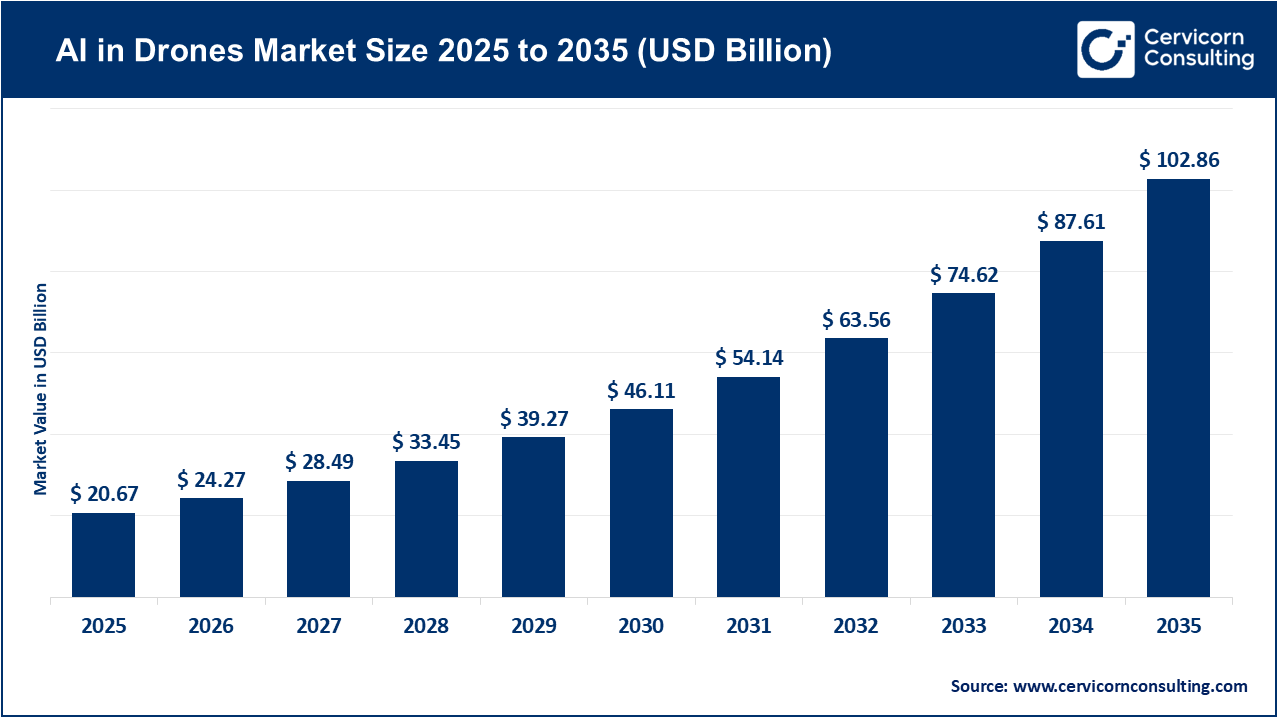
The global AI in drones market size was worth USD 20.67 billion in 2025 and is anticipated to expand to around USD 102.86 billion by 2035, registering a compound annual growth rate (CAGR) of 17.4% from 2026 to 2035.
AI in Drones Market Growth Factors
The growth of the AI in drones market is driven by rising demand for autonomous surveillance and inspection systems, increased adoption of precision agriculture and smart infrastructure monitoring, rapid improvements in AI-based image recognition and real-time data processing, expanding defense and homeland security investments, declining costs of sensors and AI hardware, growing use of drones in last-mile delivery and logistics, supportive government initiatives for unmanned systems, and the integration of cloud computing and edge AI that enables scalable drone fleet management with minimal human intervention.
What Is the AI in Drones Market?
The AI in drones market encompasses technologies, platforms, and services that integrate artificial intelligence into unmanned aerial vehicles to enhance autonomy, perception, navigation, and data analytics. Unlike conventional drones that rely heavily on manual controls or pre-programmed flight paths, AI-powered drones can analyze their surroundings, detect and classify objects, avoid obstacles, optimize flight routes, and make decisions in real time.
This market includes three major components:
-
Hardware, such as AI processors, sensors, cameras, LiDAR, and thermal imaging modules
-
Software, including autonomous flight systems, computer vision algorithms, AI analytics platforms, and mission-planning tools
-
Services, such as drone-as-a-service (DaaS), cloud-based analytics, maintenance, and data interpretation
AI drones are increasingly becoming intelligent aerial platforms that transform raw aerial data into actionable insights, enabling enterprises and governments to operate more efficiently and safely.
Get a Free Sample: https://www.cervicornconsulting.com/sample/2860
Why the AI in Drones Market Is Important
The importance of the AI in drones market lies in its ability to dramatically enhance operational efficiency, safety, and scalability across industries. AI eliminates the need for constant human control, allowing drones to perform repetitive or high-risk tasks autonomously. This reduces labor costs, improves accuracy, and minimizes human exposure to dangerous environments such as disaster zones, industrial facilities, or military operations.
AI-enabled drones also provide real-time insights through advanced analytics, allowing faster decision-making in time-sensitive applications such as emergency response, border surveillance, and infrastructure failure detection. Furthermore, the combination of AI, cloud computing, and edge processing enables organizations to deploy and manage large drone fleets, unlocking new business models and expanding the scope of aerial intelligence beyond traditional use cases.
Key Companies in the AI in Drones Market
Intel Corporation
Specialization: AI computing platforms, edge processors, autonomous systems
Key Focus Areas: AI hardware for drone autonomy, real-time data processing, vision systems
Notable Features: High-performance CPUs, GPUs, and vision processing units optimized for AI workloads; strong AI software ecosystem
2024 Revenue: Approximately USD 53 billion (company-wide)
Market Share: Indirect but influential through AI hardware adoption
Global Presence: North America, Europe, Asia-Pacific
Intel plays a foundational role in the AI in drones ecosystem by supplying the computing power that enables autonomous navigation, object detection, and edge analytics. While not a drone manufacturer, Intel’s AI chips and processors are widely integrated into UAV systems used for industrial and commercial applications.
DJI (SZ DJI Technology Co., Ltd.)
Specialization: Consumer and enterprise drones with embedded AI
Key Focus Areas: Autonomous navigation, obstacle avoidance, aerial imaging, industrial inspection
Notable Features: AI-based flight intelligence, smart tracking, high-resolution imaging, automated mapping
2024 Revenue: Estimated multi-billion-dollar annual revenue
Market Share: Dominant global share in consumer and commercial drone markets
Global Presence: Strong presence across Asia, North America, and Europe
DJI is the global leader in drone manufacturing and has played a pivotal role in mainstreaming AI-powered drones. Its products are widely used in agriculture, construction, media, surveying, and public safety, making DJI a cornerstone of the AI drone market.
DroneDeploy
Specialization: AI-powered drone data analytics and mapping software
Key Focus Areas: Cloud-based image processing, 3D mapping, enterprise analytics
Notable Features: AI-driven insights from aerial data, integration with enterprise systems, scalable cloud platform
2024 Revenue: Privately held; SaaS-based recurring revenue model
Market Share: Strong presence in commercial drone software
Global Presence: Primarily North America with expanding global adoption
DroneDeploy represents the software-driven side of the AI in drones market. By transforming drone imagery into actionable intelligence, the company enables industries such as construction, mining, and agriculture to maximize the value of aerial data.
Qualcomm Incorporated
Specialization: AI processors, 5G connectivity platforms for drones
Key Focus Areas: Edge AI, low-latency communications, autonomous drone platforms
Notable Features: Qualcomm Flight platforms with integrated AI and 5G capabilities
2024 Revenue: Tens of billions USD across semiconductor segments
Market Share: Key enabler in AI-powered drone connectivity
Global Presence: Worldwide semiconductor and technology footprint
Qualcomm’s contribution to the AI in drones market lies in enabling real-time communication and processing. Its AI-enabled chipsets support advanced autonomy and are critical for beyond-visual-line-of-sight (BVLOS) operations.
Teledyne FLIR LLC
Specialization: Thermal imaging and advanced sensor technologies
Key Focus Areas: AI-enabled imaging for defense, security, and inspection drones
Notable Features: High-resolution thermal and multispectral sensors with AI analytics
2024 Revenue: Strong contribution within Teledyne’s imaging segment
Market Share: Leading supplier of advanced drone sensors
Global Presence: North America, Europe, Asia
Teledyne FLIR enhances AI drone capabilities through advanced sensing technologies that allow drones to detect heat signatures, structural anomalies, and environmental changes, particularly in mission-critical applications.
Leading Trends in the AI in Drones Market and Their Impact
One of the most significant trends is the rise of edge AI, where data is processed directly on the drone rather than relying solely on cloud connectivity. This enables faster response times, reduces latency, and improves reliability in remote environments.
Another major trend is the integration of AI with cloud-based fleet management systems, allowing organizations to operate multiple drones simultaneously while centralizing data analytics and compliance monitoring.
Regulatory evolution, especially around BVLOS operations, is unlocking new commercial use cases such as long-distance inspections, delivery services, and large-scale surveillance. Additionally, cross-industry adoption is expanding rapidly, with AI drones becoming essential tools in agriculture, logistics, construction, energy, and public safety.
Successful Examples of AI in Drones Around the World
In the United States, AI-powered drones are increasingly used by law enforcement and emergency services for crowd monitoring, search-and-rescue operations, and disaster assessment. These systems help agencies improve response times and situational awareness.
In India, several state governments are deploying AI drones for traffic monitoring, urban cleanliness enforcement, and public safety surveillance, demonstrating the technology’s role in smart governance initiatives.
Across Europe, AI drones are being integrated into defense and border security operations, as well as infrastructure inspection projects, highlighting their strategic importance in both civilian and military contexts.
In Asia, AI drones are widely used in precision agriculture, smart city development, and environmental monitoring, supported by strong government backing and domestic manufacturing ecosystems.
Global Regional Analysis and Government Initiatives
North America
North America leads the AI in drones market due to strong defense spending, advanced AI research infrastructure, and supportive aviation regulations. Government initiatives promoting smart infrastructure, autonomous systems, and public safety technology continue to drive adoption.
Europe
Europe benefits from harmonized drone regulations, digital transformation programs, and sustainability initiatives. Government-backed projects in smart cities, energy infrastructure, and defense modernization are accelerating AI drone deployments.
Asia Pacific
Asia Pacific is the fastest-growing region, driven by rapid urbanization, strong manufacturing capabilities, and government investments in AI, robotics, and smart cities. Countries like China, Japan, South Korea, and India are leading adopters.
Middle East & Africa
The Middle East is increasingly adopting AI drones for smart city development, oil and gas infrastructure monitoring, and border security. Government-led innovation programs and digital transformation agendas are key growth drivers.
Latin America
Latin America is an emerging market where AI drones are gaining traction in agriculture, mining, and environmental monitoring. Regulatory modernization and pilot programs are supporting gradual adoption.
To Get Detailed Overview, Contact Us: https://www.cervicornconsulting.com/contact-us
Read Report: Edge Computing Market Growth Drivers, Trends, Key Players and Regional Insights by 2035