Agentic CPU Market Outlook: Processor Architecture Selection, CPU-GPU Infrastructure, Hybrid AI Deployment, and Power-Efficient Scaling
Agentic CPU Market: 6 Strategic Decisions Companies Must Make as AI Moves Towards Autonomous Computing
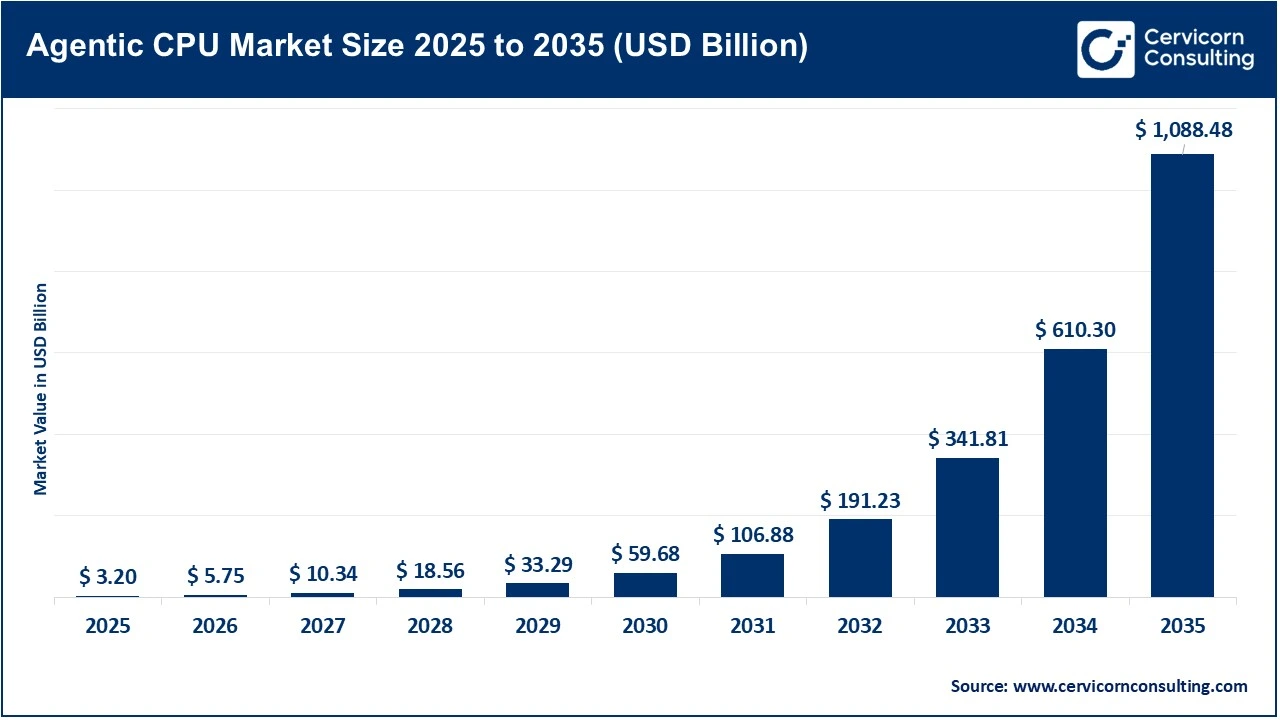
The global agentic CPU market was valued at USD 3.20 billion in 2025 and is projected to reach approximately USD 1,088.48 billion by 2035, expanding at a CAGR of 79.1% from 2026 to 2035.
The rapid adoption of autonomous AI agents is changing the role of CPUs within computing infrastructure. AI systems are increasingly expected to perform multi-step tasks, retrieve information, coordinate other agents, execute software operations, and make decisions with limited human intervention. These workloads require more than conventional processing capacity. They depend on efficient workload orchestration, memory access, low-latency communication, and coordination between CPUs, GPUs, and other computing resources.
For semiconductor manufacturers, hyperscale cloud providers, enterprise technology companies, and AI infrastructure developers, this transition creates an important strategic question: How should computing architectures evolve to support increasingly autonomous AI workloads without creating unsustainable infrastructure costs?
The opportunity extends beyond developing faster processors. Companies must evaluate CPU architecture, deployment environments, workload requirements, software compatibility, and long-term infrastructure economics before committing to agentic computing investments.
1. Should Semiconductor Companies Prioritize x86, ARM, or RISC-V Architectures?
CPU architecture selection will become a major competitive decision as agentic AI workloads expand beyond conventional server processing.
In 2025, x86 processors accounted for 68% of the global agentic CPU market, supported by established software compatibility, enterprise infrastructure adoption, and integration with existing GPU-based computing environments.
However, the competitive landscape is expected to change:
-
x86 processors: Remain important for enterprises requiring compatibility with existing applications, operating systems, and data center infrastructure.
-
ARM-based processors: Offer opportunities for power-efficient computing, high-density server deployments, and scalable AI infrastructure.
-
RISC-V processors: Present long-term opportunities for customization, application-specific designs, and greater architectural flexibility.
-
Custom proprietary architectures: Enable companies to optimize processors for specialized workloads and differentiated computing requirements.
The RISC-V segment is projected to grow at the fastest CAGR of 98.2% between 2026 and 2035, while ARM-based processors are expected to increase their market share from 22% in 2025 to 35% by 2035.
Strategic considerations for companies:
-
Semiconductor manufacturers should evaluate whether to strengthen existing x86 platforms or expand into ARM and RISC-V development.
-
Enterprise hardware providers should assess software migration requirements before introducing alternative CPU architectures.
-
Chip designers should identify workloads where architectural customization can deliver measurable performance or power-efficiency advantages.
-
Investors should distinguish between established processor revenue opportunities and emerging architecture adoption.
The important decision is not simply which architecture offers the highest processing performance. It is which architecture can deliver the best combination of compatibility, scalability, power efficiency, and total cost of ownership for specific agentic workloads.
Get a Free Sample: https://www.cervicornconsulting.com/sample/2973
2. How Should Companies Redesign CPU-GPU Infrastructure for Agentic AI?
Agentic AI is changing the traditional relationship between CPUs and GPUs.
Conventional AI infrastructure places considerable emphasis on GPUs for model training and accelerated inference. However, autonomous agents perform additional operations, including task planning, information retrieval, API interactions, memory management, execution scheduling, and coordination between multiple agents.
These activities increase the importance of CPU processing within AI infrastructure.
For example, an autonomous software development agent may need to retrieve source code, generate a development plan, execute code, run tests, identify errors, and repeat the process. GPUs support model inference, while CPUs handle several surrounding execution and coordination activities.
This creates opportunities for companies developing:
-
High-core-count server processors.
-
High-bandwidth memory architectures.
-
CPU-GPU interconnection technologies.
-
Advanced packaging and chiplet-based designs.
-
High-performance networking and data movement solutions.
-
Rack-scale computing platforms.
The competitive landscape is already reflecting this transition. In March 2026, Arm Holdings introduced its Arm AGI CPU, extending its business into production data center silicon designed for agentic AI infrastructure. NVIDIA has also introduced its Vera CPU for agentic workloads, while AMD has highlighted the changing CPU-GPU infrastructure requirements associated with autonomous AI.
Strategic considerations for companies:
-
Processor manufacturers should evaluate demand for standalone CPU infrastructure alongside traditional accelerator-based systems.
-
Data center operators should assess CPU-to-GPU ratios based on actual workload requirements rather than relying on conventional infrastructure configurations.
-
Component suppliers should identify opportunities in memory, interconnects, networking, and advanced packaging.
-
AI infrastructure developers should benchmark complete workload execution rather than evaluating processors through isolated performance metrics.
Companies that understand the changing division of work between CPUs and GPUs will be better positioned to identify infrastructure investment opportunities.
3. Should Companies Prioritize Cloud Data Centers or Hybrid AI Infrastructure?
Deployment strategy will influence the scale, cost, and commercial viability of agentic CPU investments.
Cloud data centers accounted for 52% of the agentic CPU market in 2025, making them the leading deployment environment. Hyperscale providers require substantial computing resources to support large AI models, autonomous agents, enterprise applications, and distributed workloads.
However, future demand is expected to become more geographically and operationally distributed.
The hybrid cloud infrastructure segment is projected to register the fastest CAGR of 91.5% from 2026 to 2035. Its growth reflects the need to combine public cloud scalability with private infrastructure, data control, and enterprise-specific computing requirements.
Companies should evaluate three major deployment opportunities:
Cloud data centers
-
Large-scale AI agent execution.
-
Hyperscale computing infrastructure.
-
Centralized AI workload orchestration.
-
Multi-tenant AI services.
Enterprise data centers
-
Internal AI assistants and workflow automation.
-
Private knowledge management systems.
-
Financial and operational decision support.
-
Secure processing of enterprise information.
Hybrid cloud and edge AI infrastructure
-
Distributed AI workload execution.
-
Real-time industrial automation.
-
Low-latency decision-making.
-
Data-sensitive applications across multiple locations.
Strategic considerations for companies:
-
Cloud infrastructure providers should evaluate processor density, utilization, and performance per rack.
-
Enterprise IT vendors should develop solutions that integrate with existing on-premise and cloud environments.
-
Semiconductor companies should consider processors optimized for edge, hybrid, and centralized AI workloads.
-
Technology investors should examine which deployment environments offer sustainable demand rather than relying exclusively on hyperscaler spending.
The opportunity lies in developing computing platforms that can operate consistently across different deployment environments.
4. Which Agentic AI Applications Offer the Strongest Commercial Opportunities?
Not all agentic AI applications will generate equivalent demand for CPU infrastructure.
The commercial opportunity depends on the complexity of autonomous workflows, the number of concurrent agents, data retrieval requirements, and the frequency of execution.
In 2025, AI copilots and digital agents accounted for 26% of the agentic CPU market, making them the largest application segment. Retrieval-Augmented Generation (RAG), AI agent orchestration, autonomous software development, and multi-agent systems represent additional areas of demand.
Companies should evaluate the following application opportunities:
| Application | Infrastructure opportunity |
|---|---|
| AI copilots and digital agents | Continuous inference, task execution, and memory management |
| RAG systems | Data retrieval, indexing, and context processing |
| Multi-agent systems | Concurrent execution and agent coordination |
| Autonomous software development | Code execution, compilation, testing, and sandboxing |
| Robotics and physical AI | Low-latency processing and real-time control |
| Research and scientific computing | Complex computation and distributed workload management |
For semiconductor manufacturers, application-specific workload requirements can help identify opportunities for specialized CPU designs.
For cloud providers, understanding application-level demand can improve infrastructure allocation and capacity planning.
For enterprise technology companies, the focus should be on identifying workflows where autonomous execution produces measurable improvements in operating efficiency, processing time, and resource utilization.
Strategic considerations for companies:
-
Identify applications with high-frequency CPU-intensive operations.
-
Evaluate the number of concurrent agents supported by existing infrastructure.
-
Assess memory bandwidth and data retrieval requirements.
-
Prioritize applications with measurable enterprise adoption and repeatable workloads.
-
Develop application-specific processor and infrastructure partnerships.
This approach can help companies avoid investing in generalized AI infrastructure without a clear understanding of the workloads it needs to support.
5. How Should Companies Manage Power Consumption, Design Complexity, and Infrastructure Costs?
The rapid expansion of agentic computing creates an important infrastructure challenge: increasing processing requirements must be balanced against power consumption, semiconductor manufacturing costs, and system complexity.
Unlike occasional AI inference, autonomous agents may operate continuously, accessing databases, executing tools, interacting with other agents, and repeating reasoning cycles.
As a result, infrastructure efficiency becomes an important determinant of commercial competitiveness.
The agentic CPU market faces several challenges:
-
Advanced semiconductor manufacturing: Developing processors with high core counts, advanced interconnections, and specialized capabilities requires substantial engineering investment.
-
Memory bandwidth limitations: Continuous data retrieval and concurrent execution can create memory bottlenecks.
-
Power and cooling requirements: Increasing processor density can place additional pressure on data center energy and thermal management infrastructure.
-
Software optimization: New CPU architectures require compatible operating systems, development environments, and application optimization.
-
Infrastructure economics: Companies must demonstrate that additional processing capacity improves workload throughput and operating economics.
The shift towards rack-level performance is also becoming more visible. Arm’s 2026 collaboration with Red Hat highlighted the importance of integrating processor hardware with enterprise software to support agentic AI deployments across cloud and on-premise environments.
Strategic considerations for companies:
-
Processor manufacturers should prioritize performance per watt and memory efficiency alongside core counts.
-
Data center operators should assess power availability, cooling infrastructure, and rack density before expanding capacity.
-
Enterprise buyers should compare total cost of ownership across different processor architectures.
-
Component suppliers should evaluate demand for advanced memory, thermal management, power delivery, and high-speed interconnect technologies.
Companies that can improve workload throughput without proportionally increasing infrastructure costs may gain a stronger competitive position.
6. Which Regional Markets and Competitive Partnerships Should Companies Prioritize?
Geographic expansion and ecosystem development will influence long-term competitive positioning in the agentic CPU market.
North America accounted for 46% of the global market in 2025, supported by its established semiconductor ecosystem, hyperscale cloud infrastructure, and early adoption of enterprise AI technologies.
However, Asia-Pacific is expected to become the fastest-growing regional market, registering a projected CAGR of 83.6% from 2026 to 2035.
Its growth is supported by semiconductor manufacturing expansion, AI infrastructure investments, industrial automation, robotics, and government-backed technology initiatives.
The projected regional share distribution highlights the changing competitive landscape:
| Region | 2025 market share | 2035 projected share |
|---|---|---|
| North America | 46% | 36% |
| Europe | 16% | 15% |
| Asia-Pacific | 32% | 40% |
| LAMEA | 6% | 9% |
Strategic considerations for companies:
-
Semiconductor companies should evaluate manufacturing partnerships and regional supply chain opportunities across Asia-Pacific.
-
Cloud infrastructure providers should assess regional demand for AI computing capacity and enterprise deployment.
-
Processor developers should establish relationships with operating system providers, software developers, OEMs, and hyperscale customers.
-
Investors should monitor regional semiconductor incentives, infrastructure spending, and technology partnerships.
Competitive partnerships will become particularly important because agentic CPU adoption requires coordination across multiple layers, including silicon, memory, networking, software, cloud infrastructure, and AI application development.
For example, Arm’s expanding ecosystem around its AGI CPU, including collaborations with Meta, Oracle Cloud Infrastructure, and Red Hat, demonstrates how processor development is increasingly connected to broader infrastructure and software partnerships.
Companies entering this market should therefore evaluate ecosystem readiness alongside processor performance and manufacturing capabilities.
Competitive Landscape: Which Companies Are Positioning Themselves in the Agentic CPU Market?
The competitive landscape includes established semiconductor manufacturers, processor architecture developers, and hyperscale technology providers.
Key companies operating in or influencing this market include:
-
NVIDIA Corporation – AI computing platforms, CPUs, GPUs, and accelerated computing infrastructure.
-
Intel Corporation – x86 processors, server CPUs, and enterprise computing platforms.
-
Advanced Micro Devices (AMD) – EPYC server processors and integrated CPU-GPU infrastructure.
-
Qualcomm Incorporated – ARM-based computing platforms and power-efficient processor technologies.
-
Arm Holdings plc – Processor architecture IP, Neoverse platforms, and data center silicon.
-
Apple Inc. – Proprietary processor architectures and integrated computing platforms.
-
Amazon Web Services – Cloud infrastructure and custom processor development.
-
Google LLC – Custom silicon and AI infrastructure.
-
Microsoft Corporation – Cloud computing infrastructure and custom silicon initiatives.
Competition is increasingly shifting from standalone processor specifications towards complete computing platforms. Companies will need to differentiate through processing efficiency, software compatibility, memory architecture, scalability, and ecosystem partnerships.
Conclusion: What Should Companies Prioritize Before Investing in Agentic CPU Technology?
The agentic CPU market represents a significant shift in semiconductor and AI infrastructure requirements. As AI applications transition from generating responses to executing autonomous, multi-step workflows, CPUs are gaining greater importance in workload orchestration, memory management, data retrieval, and coordination across computing resources.
However, the projected market expansion does not mean every architecture, application, or deployment environment will offer equivalent commercial opportunities.
Companies should prioritize six areas:
-
Architecture strategy: Determine whether x86, ARM, RISC-V, or proprietary processor development best supports target workloads.
-
Infrastructure optimization: Evaluate CPU-GPU balance, memory bandwidth, and system-level performance.
-
Deployment strategy: Identify opportunities across cloud, enterprise, hybrid, and edge AI infrastructure.
-
Application prioritization: Focus on workloads with strong CPU requirements and measurable commercial value.
-
Cost and energy efficiency: Improve performance per watt, processor utilization, and total cost of ownership.
-
Competitive positioning: Build partnerships across semiconductor manufacturing, cloud infrastructure, and enterprise software ecosystems.
The central business question is no longer simply how much AI computing capacity companies can deploy. It is how efficiently they can coordinate increasingly autonomous workloads across the entire computing infrastructure.
For semiconductor manufacturers, this creates opportunities in processor design and specialized architectures. For hyperscale providers, it introduces new infrastructure planning requirements. For enterprise technology companies, it creates opportunities to develop scalable autonomous computing environments.
Companies that align processor development, infrastructure investment, and application demand will be better positioned to compete as agentic AI becomes a larger part of enterprise and cloud computing.
To Get Detailed Overview, Contact Us: https://www.cervicornconsulting.com/contact-us