Digital Twins in Healthcare Market Outlook: Clinical Validation, Personalized Treatment, Data Infrastructure, and Commercial Scalability
Digital Twins in Healthcare Market: 6 Decisions Companies Should Make to Improve Clinical Outcomes, Accelerate Innovation, and Scale Adoption
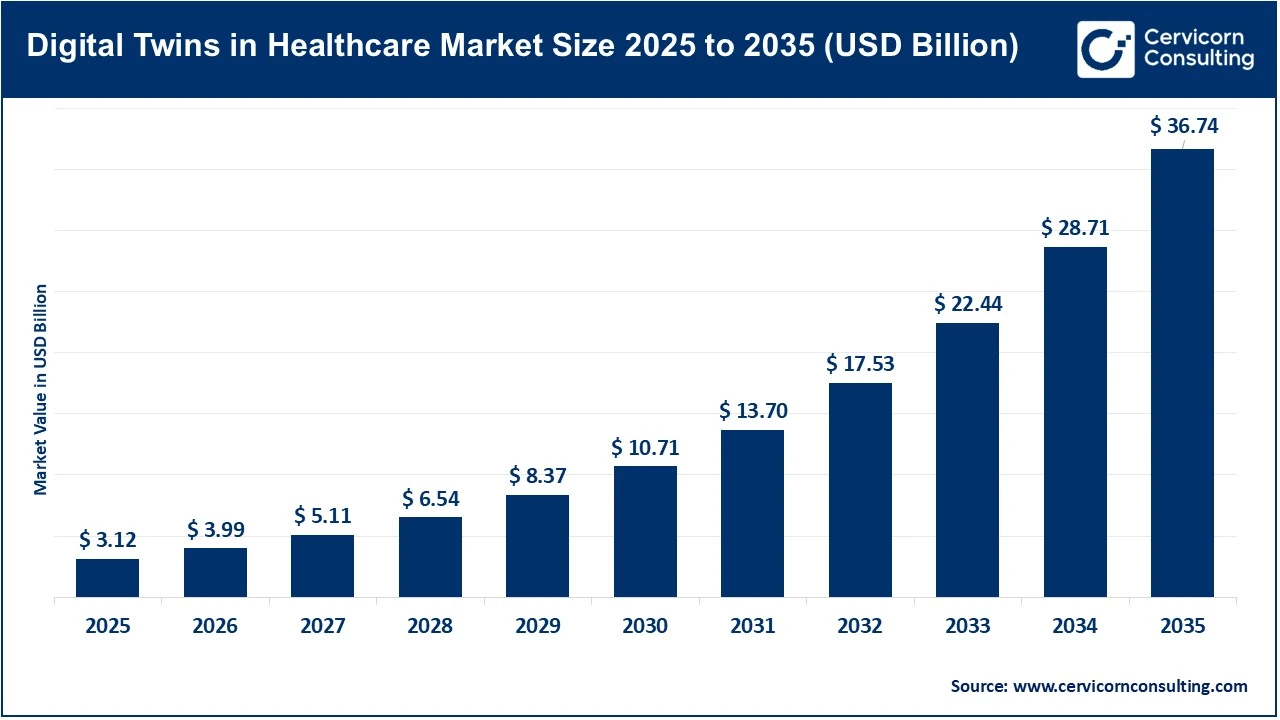
The global digital twins in healthcare market was valued at USD 3.12 billion in 2025 and is projected to reach approximately USD 36.74 billion by 2035, expanding at a compound annual growth rate (CAGR) of 28% from 2026 to 2035. This growth reflects increasing interest in personalized medicine, predictive healthcare, virtual clinical trials, and AI-enabled medical research.
For healthcare providers, pharmaceutical companies, medical device manufacturers, and digital health technology vendors, the opportunity extends beyond adopting new simulation technology. The more important question is where digital twins can deliver measurable improvements in clinical decision-making, research productivity, resource utilization, and patient outcomes.
Digital twins can represent individual patients, organs, medical devices, hospital infrastructure, or healthcare workflows. By combining clinical records, medical imaging, physiological measurements, and computational models, these systems allow organizations to simulate scenarios before implementing changes in real-world settings. However, their value depends on the quality of underlying data, model reliability, integration with existing systems, and the ability to translate simulation results into operational decisions.
Companies evaluating this market should therefore prioritize applications with clearly defined business objectives rather than pursuing digital twin implementation as a standalone technology initiative.
1. Prioritize the Healthcare Applications With the Clearest Return on Investment
The first decision is to identify where digital twins can solve a sufficiently important clinical or operational problem to justify investment. Not every healthcare process requires a digital twin, and the business case varies considerably between patient-specific modeling, drug development, surgical planning, and hospital operations.
According to Cervicorn Consulting’s market analysis, personalized treatment optimization accounted for 27.8% of the digital twins in healthcare market in 2025, making it the largest application segment. Chronic disease management represented 19.4%, followed by drug discovery and pre-clinical modeling at 17.3%. These segments indicate that both patient-centered care and life-sciences research are important areas for commercialization.
Key decisions for companies:
- Healthcare providers: Evaluate whether digital twins can improve treatment planning, risk assessment, chronic disease monitoring, or the allocation of clinical resources.
- Pharmaceutical and biotechnology companies: Assess opportunities to simulate biological processes, investigate treatment responses, and improve preclinical research.
- Medical device manufacturers: Identify applications in virtual device testing, design validation, and patient-specific procedural planning.
- Digital health vendors: Focus on use cases where existing customer data and workflows can support implementation without requiring a complete technology overhaul.
Organizations should compare potential projects using clinical relevance, implementation cost, data availability, expected benefits, and time to deployment. A narrowly defined application with measurable outcomes may be more valuable than a complex whole-body digital twin that requires extensive data integration and validation.
Business implication: Prioritize projects based on demonstrated need and measurable value, not on the sophistication of the simulation technology alone.
Get a Free Sample: https://www.cervicornconsulting.com/sample/2965
2. Decide Whether to Build, Buy, or Partner for Digital Twin Capabilities
Developing a healthcare digital twin requires more than conventional healthcare software. Depending on the application, organizations may need expertise in computational modeling, artificial intelligence, biomedical engineering, clinical data management, simulation software, and healthcare interoperability.
Building a proprietary platform can provide greater control over model architecture, intellectual property, and customization. However, it may require substantial investment, specialized talent, and ongoing validation. Purchasing an established platform can shorten implementation timelines, although integration limitations and vendor dependency must be considered. Partnerships can provide access to specialized capabilities without requiring every component to be developed internally.
Key decisions for companies:
- Build internally when digital twin capabilities are central to the company’s competitive advantage or involve highly specialized proprietary data and models.
- Buy an existing platform when speed to deployment, established functionality, and predictable implementation are the primary priorities.
- Partner with technology providers or research institutions when clinical expertise, computing infrastructure, or model-development capabilities are missing internally.
- Use a hybrid approach when organizations need a commercial platform but also require proprietary models, workflows, or analytics.
Procurement teams should assess model transparency, interoperability, data ownership, scalability, validation evidence, service requirements, and exit provisions before selecting a vendor.
For technology providers, the commercial opportunity lies not only in selling software licenses but also in offering implementation, integration, model customization, validation support, and ongoing technical services.
Business implication: The right operating model should balance speed, control, development cost, and long-term differentiation.
3. Strengthen Data Infrastructure Before Scaling Digital Twins
A digital twin is only as useful as the data and models supporting it. Healthcare organizations often manage fragmented information across electronic health records, laboratory systems, imaging platforms, medical devices, and patient-monitoring applications. Differences in data formats, missing measurements, inconsistent identifiers, and limited interoperability can undermine model reliability.
Digital twins designed for patient-specific treatment may require clinical histories, imaging, laboratory results, physiological measurements, and, where relevant, genomic information. Hospital operations twins may instead depend on equipment utilization, bed occupancy, staffing, patient flow, and maintenance data.
These requirements make data readiness a core investment decision rather than a secondary IT consideration.
Key decisions for companies:
- Establish which data sources are essential for each proposed digital twin application.
- Assess data completeness, accuracy, consistency, representativeness, and update frequency.
- Determine how information will be exchanged between existing clinical systems and the digital twin platform.
- Define data ownership, access permissions, cybersecurity controls, and retention policies.
- Decide whether the model requires continuous data updates or can operate effectively with periodic information refreshes.
Companies should also distinguish between a static simulation and a continuously updated digital twin. Not every application requires real-time data, and unnecessary real-time integration can increase cost and technical complexity.
For vendors, demonstrating compatibility with existing healthcare infrastructure can be a stronger differentiator than offering an extensive list of advanced features.
Business implication: Organizations should establish data readiness and governance requirements before committing to large-scale platform deployment.
4. Evaluate Clinical Validity, Safety, and Regulatory Requirements Early
Digital twins used in healthcare can influence decisions with direct consequences for patient safety. A model that performs well in a laboratory environment may not produce equally reliable results across different patient populations, clinical settings, or operating conditions.
Companies must therefore determine what evidence is necessary to support each intended use. A hospital workflow simulation, a medical device design model, and a patient-specific tool intended to inform treatment decisions may require different validation approaches and levels of clinical oversight.
Key decisions for companies:
- Define the intended use and the decisions the digital twin is expected to support.
- Validate model performance against appropriate clinical, experimental, or operational reference data.
- Assess performance across relevant patient populations and different operating conditions.
- Document model limitations, uncertainty, and circumstances in which results should not be used.
- Establish human oversight, audit trails, change management, and ongoing performance monitoring.
- Determine applicable regulatory obligations and evidence requirements before commercialization.
For medical device companies and vendors developing clinical decision-support applications, regulatory strategy should be integrated into product development from the beginning. Applicable requirements will depend on the intended purpose, functionality, jurisdiction, and level of clinical influence.
Organizations should avoid treating simulated outcomes as equivalent to demonstrated clinical benefits. Evidence that a model can reproduce a physiological process does not automatically establish that its use improves patient outcomes.
Business implication: Early validation and regulatory planning can reduce commercialization risk and improve confidence among healthcare customers.
5. Choose the Right Commercialization Strategy and Customer Segment
The digital twins in healthcare market serves several customer groups, but their purchasing priorities differ. Healthcare providers may focus on clinical outcomes, operational efficiency, and integration with existing systems. Pharmaceutical companies may prioritize research productivity, experimental design, and development timelines. Medical device manufacturers may value simulation accuracy, design optimization, and testing efficiency.
Cervicorn Consulting’s market analysis identifies healthcare providers as the largest end-user segment, accounting for 38.7% of the market in 2025. Pharmaceutical and biopharmaceutical companies represent another important customer group, particularly as digital twin technologies expand across drug discovery, preclinical modeling, and clinical research.
For vendors, this creates a need to differentiate products by customer requirements rather than marketing a single generalized healthcare digital twin platform.
Key decisions for companies:
- Healthcare technology vendors: Determine whether to target hospitals, pharmaceutical companies, medical device manufacturers, or research institutions first.
- Pharmaceutical technology providers: Develop solutions around specific research bottlenecks, such as biological simulation, candidate evaluation, or trial design.
- Medical device companies: Evaluate whether proprietary digital twins can improve product development, customization, or post-deployment monitoring.
- Healthcare providers: Compare vendors according to clinical suitability, implementation complexity, evidence quality, and total cost of ownership.
Commercialization plans should account for procurement cycles, IT integration, clinical stakeholder acceptance, staff training, and the resources required to maintain models after deployment.
Vendors should also distinguish between a technically successful pilot and a repeatable commercial offering. A solution that requires extensive customization for every customer may struggle to scale unless implementation services and pricing are structured accordingly.
Business implication: Select a clearly defined initial customer segment, establish a credible value proposition, and expand only after demonstrating repeatable implementation and customer value.
6. Establish a Measurable Roadmap for Scaling Adoption
The final decision is how to move from experimentation to sustained deployment. Digital twin projects can lose momentum when organizations lack agreed performance indicators, accountable owners, or a clear process for evaluating pilot results.
A successful roadmap should connect technology investment with clinical, operational, or research objectives. Metrics must reflect the intended application rather than relying solely on software adoption or the number of simulations completed.
Key decisions for companies:
- Define baseline performance before implementation.
- Select a limited set of measurable clinical, operational, or research indicators.
- Assign responsibility for model performance, data quality, clinical oversight, and business outcomes.
- Establish decision gates for continuing, modifying, or discontinuing pilot projects.
- Determine the staffing, computing, integration, and maintenance resources required for expansion.
- Review model performance periodically and update the system as data, workflows, or clinical requirements change.
Depending on the application, relevant indicators may include treatment-planning time, model prediction accuracy, equipment downtime, research turnaround time, trial-design efficiency, or resource utilization. Patient outcomes and safety indicators should be included when clinically appropriate and supported by a suitable evaluation design.
Organizations should also account for total cost of ownership, including software, cloud infrastructure, data engineering, validation, integration, training, and ongoing support.
A phased implementation approach allows companies to establish evidence and refine their investment assumptions before expanding across departments, facilities, or therapeutic areas.
Business implication: Scale digital twins only when technical performance, operational feasibility, and measurable value justify broader deployment.
Market Outlook: Where Will Digital Twin Investment Create the Most Value?
The digital twins in healthcare market is expected to expand from USD 3.12 billion in 2025 to approximately USD 36.74 billion by 2035, at a CAGR of 28% over the 2026–2035 forecast period. Increasing demand for personalized treatment, predictive analytics, simulation-based research, and healthcare process optimization is supporting this outlook.
Several market segments deserve particular attention:
- Personalized treatment optimization: Patient-specific simulations may help clinicians evaluate alternative treatment scenarios, subject to model validation and appropriate clinical oversight.
- Drug discovery and preclinical modeling: Pharmaceutical companies can investigate biological mechanisms and treatment responses using computational models to complement laboratory research.
- Clinical trial virtualization: Virtual patient models and simulation methods may help researchers assess trial designs, explore assumptions, and improve planning. Their use does not automatically replace conventional clinical trials.
- Hospital and asset workflow optimization: Digital twins can support resource planning, equipment utilization, maintenance, and operational scenario testing.
- Surgical planning and simulation: Patient-specific anatomical models can help clinicians evaluate procedural options and prepare for complex interventions.
The market’s growth potential does not mean every application will deliver the same commercial returns. Adoption will depend on clinical evidence, data availability, integration costs, regulatory requirements, and the willingness of healthcare organizations to change established workflows.
Companies should therefore assess individual applications on their own economics and evidence requirements rather than treating overall market growth as sufficient justification for investment.
Conclusion
Digital twins are creating new opportunities across healthcare delivery, pharmaceutical research, medical device development, and hospital operations. However, long-term success will depend less on the ability to construct virtual models and more on the ability to use them reliably within real-world decision-making processes.
Companies evaluating the digital twins in healthcare market should focus on six priorities: selecting high-value applications, choosing the appropriate development model, strengthening data infrastructure, validating clinical and technical performance, targeting the right customers, and establishing measurable pathways to scale.
For healthcare providers, the priority is to connect digital twin adoption with better clinical or operational decisions. For pharmaceutical and medical device companies, it is to identify where simulation can complement existing research and development processes. For technology vendors, it is to build solutions that are interoperable, evidence-based, commercially viable, and practical to implement.
The central strategic question is not whether digital twins will become more prominent in healthcare, but which applications can demonstrate sufficient value, reliability, and scalability to justify sustained investment.
To Get Detailed Overview, Contact Us: https://www.cervicornconsulting.com/contact-us