Microchips Market: Where Are the Next Investment Opportunities as AI and Semiconductor Localization Reshape Demand?
Microchips Market: Where Should Businesses Invest as AI and Semiconductor Localization Reshape Demand?
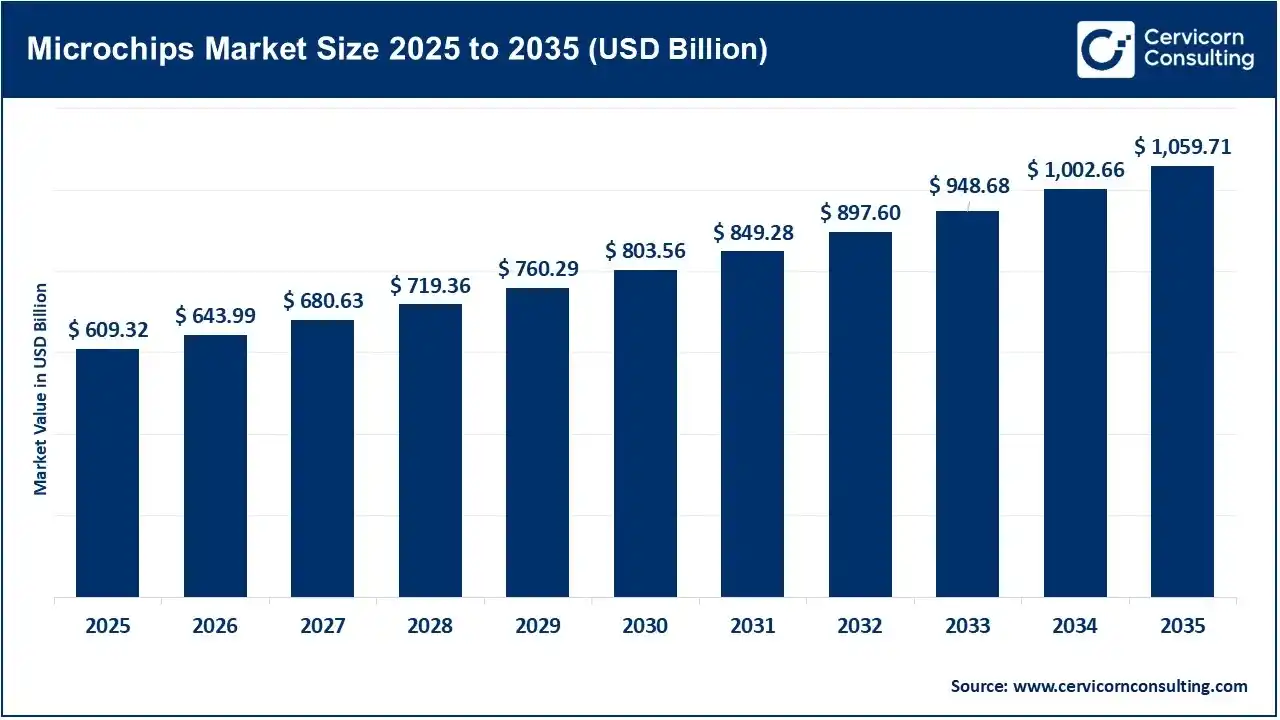
The global microchips market was valued at approximately USD 609.32 billion in 2025 and is projected to reach around USD 1.06 trillion by 2035, expanding at a 5.7% CAGR. Asia-Pacific accounted for approximately 55.2% of the market in 2025, supported by its concentration of semiconductor manufacturing, electronics production, memory, foundries and supply-chain capabilities.
But market growth alone does not indicate where companies should invest.
The more important question is which chip technologies, applications and geographic markets are likely to capture the next wave of semiconductor spending as artificial intelligence, automotive electrification, data centers, industrial automation and supply-chain localization reshape demand.
AI Is Changing the Economics of Microchip Demand
Artificial intelligence is shifting semiconductor demand toward processors, GPUs, AI accelerators, high-bandwidth memory, networking chips and specialized application-specific integrated circuits.
Cervicorn estimates that AI infrastructure is particularly chip-intensive, with a single AI server rack potentially containing more than 4,500 packaged semiconductors. The semiconductor content of AI infrastructure is therefore becoming substantially more important than simply the number of servers being deployed.
This is creating opportunities beyond traditional CPU and memory markets.
Hyperscalers are increasingly developing customized processors and accelerators optimized for their own workloads. At the same time, demand is expanding for chips designed specifically for AI inference, networking, power management and energy-efficient computing.
Recent financing activity illustrates the scale of this shift. SpaceX is reportedly exploring approximately $40 billion in debt financing to purchase Nvidia AI chips, while Broadcom is pursuing major financing connected with custom AI-chip development for OpenAI.
For chip suppliers, therefore, the opportunity is not simply to participate in semiconductor growth. It is to identify which AI workloads require differentiated silicon and where customers are willing to diversify suppliers.
Get a Free Sample: https://www.cervicornconsulting.com/sample/3053
Automotive and Edge Computing Create a Second Growth Engine
AI data centers receive much of the industry’s attention, but automotive electronics represent another important long-term demand center.
Software-defined vehicles, advanced driver-assistance systems, electric vehicles and autonomous driving require increasingly sophisticated microprocessors, microcontrollers, sensors, connectivity chips and system-on-chip architectures.
Cervicorn estimates that automotive microchip components using 20-nanometer-or-smaller nodes could grow at approximately 24% annually through 2030, reaching around USD 18 billion.
This creates opportunities for companies targeting:
- Automotive MCUs and processors
- Edge-AI accelerators
- Power-management semiconductors
- Silicon carbide and other power devices
- Automotive connectivity
- Sensors and perception systems
- Safety and control chips
The strategic attraction is that automotive semiconductor demand is tied not only to vehicle volumes but also to the rising semiconductor content per vehicle.
Semiconductor Localization Is Becoming an Investment Theme
The semiconductor industry is increasingly being shaped by government policy rather than market forces alone.
The United States, Japan, India, South Korea, Europe and other economies are attempting to strengthen domestic semiconductor capabilities to reduce exposure to concentrated manufacturing and geopolitical supply-chain risks.
TSMC, for example, announced an additional USD 100 billion U.S. investment, taking its planned U.S. semiconductor investment to approximately USD 265 billion and expanding its planned manufacturing and packaging footprint.
Japan is pursuing a different strategy through Rapidus. The government-backed company has received approximately USD 15 billion in state support and is targeting 2-nanometer chip production, although securing customers and achieving commercially viable yields remain significant considerations.
For businesses, this means semiconductor opportunities are increasingly geographic.
The relevant question is no longer simply where is semiconductor demand growing? It is also:
Where are governments creating incentives, infrastructure and supply-chain ecosystems that can support profitable semiconductor investment?
India Is Moving From Chip Consumption Toward Ecosystem Development
India is emerging as an important market to watch because policy is increasingly extending beyond semiconductor assembly toward design, manufacturing, materials and advanced packaging.
In July 2026, the Indian government approved Semicon 2.0 with an outlay of ₹1,27,500 crore, covering six areas including chip design, semiconductor machinery and materials, fabs, advanced packaging, research and talent development.
This follows Semicon India’s first phase, under which 12 semiconductor manufacturing units with cumulative investments exceeding ₹1.64 lakh crore had been approved. Five units had commenced commercial production by September 2026.
The investment opportunity is therefore broadening from fabrication into the supporting ecosystem.
Potential areas include:
Chip design → EDA and IP → semiconductor materials → equipment → fabrication → advanced packaging → testing → electronics manufacturing
This is particularly relevant for companies evaluating partnerships, supplier localization or entry into India’s semiconductor ecosystem.
Which Microchip Segments Deserve the Closest Attention?
The market structure suggests that companies should avoid treating “microchips” as a single opportunity.
Cervicorn estimates that microprocessors accounted for 22.8% of the market, while processing functions represented 31.7%. The 6–14 nm technology segment represented approximately 25.8%, reflecting demand across computing, connectivity, automotive and embedded applications.
However, high-growth opportunities can emerge in smaller specialized segments.
1. AI and Custom Accelerators
Purpose-built processors, ASICs, AI accelerators and inference chips are becoming increasingly important as companies seek better performance per watt and greater control over AI infrastructure costs.
2. Automotive Semiconductors
Electrification, ADAS and software-defined vehicles are increasing semiconductor content and creating demand for reliable, specialized automotive chips.
3. Advanced Packaging
As transistor scaling becomes more expensive and technically difficult, advanced packaging, chiplets and heterogeneous integration are becoming increasingly important to system performance.
4. Power Semiconductors
EVs, renewable energy systems, industrial automation and data-center infrastructure are increasing demand for efficient power-management technologies, including silicon carbide and other advanced semiconductor materials.
5. Semiconductor Equipment and Materials
The expansion of fabs creates secondary opportunities in lithography, deposition, inspection, specialty chemicals, gases, wafers and manufacturing equipment.
Supply-Chain Resilience May Matter as Much as Chip Performance
One of the biggest investment considerations is infrastructure dependency.
Advanced semiconductor fabrication requires substantial electricity, ultrapure water, specialized equipment and highly reliable logistics. Cervicorn estimates that leading-edge fabrication facilities can require 200–300 MW of electricity at scale, while a semiconductor fab can consume millions of gallons of water daily.
This makes energy availability, water security and geographic resilience increasingly relevant to site-selection and investment decisions.
At the same time, chip manufacturers must evaluate exposure to raw materials, packaging capacity, equipment suppliers and logistics networks.
Consequently, semiconductor investment decisions are becoming multidisciplinary: technology capability alone is insufficient.
What Should Businesses Watch Through 2030?
The microchips market is moving toward a more fragmented but strategically important structure.
The strongest opportunities are likely to develop where several demand drivers overlap:
AI + data centers + custom silicon
Automotive + electrification + edge AI
Industrial automation + robotics + sensing
Telecom + connectivity + edge computing
Government incentives + semiconductor localization
Advanced nodes + advanced packaging
For investors, semiconductor companies and component suppliers, the opportunity lies in identifying where these trends intersect with capacity shortages, customer concentration, government incentives and technology gaps.
The global market is projected to cross USD 1 trillion by 2035, but the companies best positioned to capture this growth will not necessarily be those with the largest overall chip portfolios. Competitive advantage may increasingly come from owning a critical technology, securing manufacturing capacity, controlling a specialized supply chain or developing chips for a high-value application.
For businesses evaluating the microchips market, the key decisions are therefore becoming more specific: which chip category to target, which application to prioritize, which geography to enter, and where capacity or technology gaps create the strongest commercial opportunity.
To Get Detailed Overview, Contact Us: https://www.cervicornconsulting.com/contact-us
Read Report: xEV power chips are moving to 800 V and beyond: What changes for automakers and semiconductor suppliers?