Data center PON is moving beyond connectivity: What companies need to solve before scaling optical infrastructure
Data center PON is moving beyond connectivity: What operators need to solve before scaling optical infrastructure
Data center networking is being reshaped by AI workloads, hyperscale expansion and rising infrastructure density. The challenge for operators is no longer simply moving more data. It is building networks that can scale across growing numbers of servers and managed devices without adding unnecessary power consumption, cabling complexity and operational overhead.
This is creating a new role for passive optical network (PON) technology inside data centers, particularly for out-of-band management (OOBM) and infrastructure management.
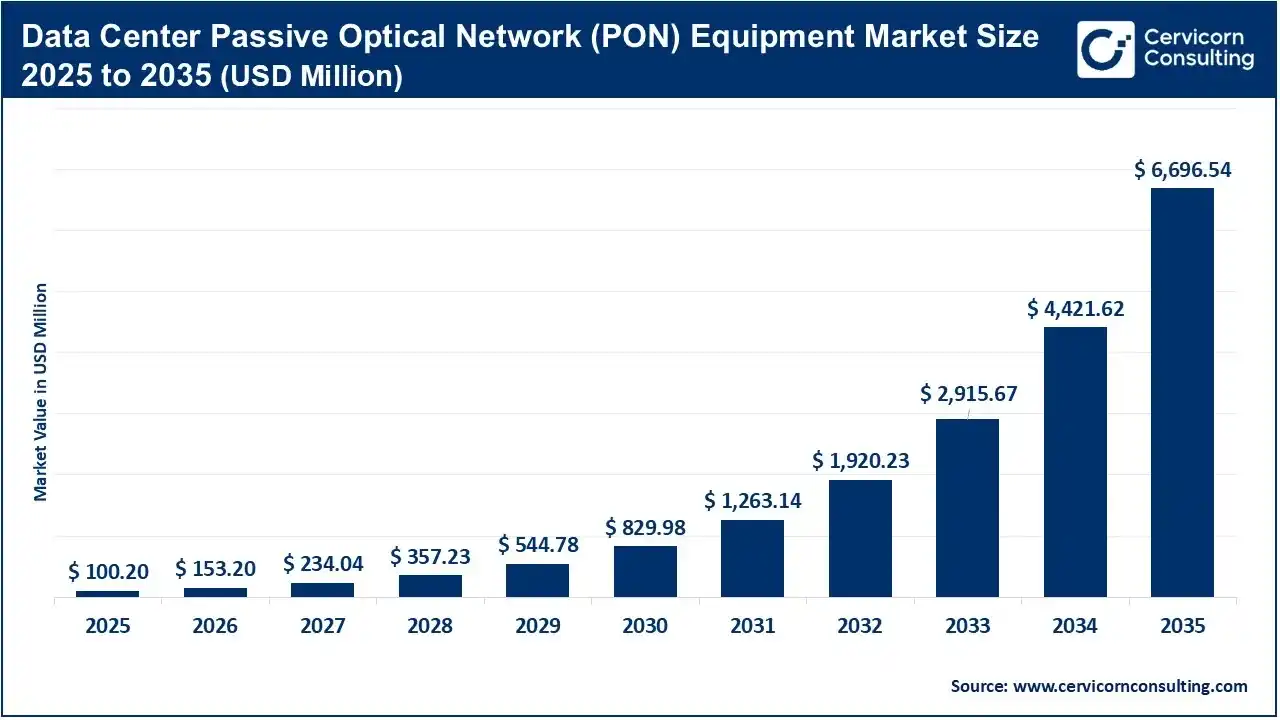
The global data center passive optical network (PON) equipment market was valued at USD 100.20 million in 2025 and is projected to reach nearly USD 6.70 billion by 2035, expanding at a 52.2% CAGR from 2026 to 2035.
The size of the market is still relatively small compared with conventional data-center networking, but the growth rate indicates that operators and technology suppliers are beginning to evaluate PON as part of the broader infrastructure architecture rather than simply as a fiber-access technology.
The first decision: Where does PON actually add value?
PON is unlikely to replace every Ethernet connection inside a data center. Its more immediate value lies in applications where operators need large numbers of reliable management connections without deploying an active switch at every aggregation point.
This is particularly relevant to out-of-band management, where a separate network provides access to servers, switches, storage, power and cooling equipment even when the primary production network is unavailable.
OOBM accounted for 88% of the data center PON equipment market in 2025, showing where the technology currently has the strongest commercial fit.
For operators, the question is therefore less about whether PON is “better” than Ethernet and more about which parts of the infrastructure benefit from a point-to-multipoint optical architecture.
That distinction can prevent costly overdeployment.
Get a Free Sample: https://www.cervicornconsulting.com/sample/3048
AI data centers are changing the networking equation
AI infrastructure is increasing server density while making supporting infrastructure more complex. A large AI facility may need to manage substantial numbers of compute nodes, switches, storage systems, power equipment and cooling systems.
As endpoint counts increase, the management network itself can become difficult to scale.
PON offers an alternative architecture in which a centralized optical line terminal can serve multiple endpoints through passive optical distribution. This can reduce the number of active networking components and simplify cabling in selected applications.
The commercial opportunity is particularly visible in hyperscale facilities. Hyperscale data centers represented 50% of the data center PON equipment market in 2025, while colocation facilities accounted for another 30%.
For operators building AI-oriented facilities, this makes PON worth evaluating as part of the infrastructure design phase rather than treating management connectivity as an afterthought.
The migration challenge: PON must coexist with Ethernet
One of the biggest barriers is not the optical technology itself. It is integration.
Most data centers already operate extensive Ethernet infrastructure, management platforms and established operational processes. Introducing PON can create questions around interoperability, monitoring, provisioning, equipment compatibility and migration.
This explains the growing relevance of hybrid PON-Ethernet architectures.
Hybrid PON-Ethernet OOBM represented 25% of the deployment architecture segment in 2025, providing operators with a migration path rather than requiring an immediate replacement of existing infrastructure.
For technology decision-makers, this makes architecture planning critical. A PON deployment needs to answer practical questions such as:
- Which endpoints should move to PON?
- Which devices should remain on Ethernet?
- How will PON and Ethernet management systems interact?
- What happens during equipment failure or network migration?
- Can the architecture support future PON speed upgrades?
The answers will vary significantly between hyperscale, colocation and enterprise environments.
Higher-speed PON is becoming strategically important
Bandwidth requirements are also changing the technology roadmap.
XGS-PON held a 55% share of the PON technology segment in 2025, while 25G-PON is expected to reach 35% by 2035.
The shift matters because data centers are increasingly being designed around AI, high-performance computing and cloud workloads that require greater capacity across their infrastructure.
However, higher bandwidth alone does not determine the business case. Operators also need to consider endpoint density, optical budgets, split ratios, latency requirements, upgrade cycles and compatibility with existing equipment.
The strategic question is therefore not simply “Which PON speed should we deploy?” but “What speed and architecture will remain viable as the facility scales?”
Energy efficiency is becoming part of the network design decision
Power efficiency is becoming increasingly important as data centers add AI infrastructure.
PON can reduce reliance on active networking equipment in appropriate applications, potentially simplifying the infrastructure and reducing the associated power and maintenance requirements.
This is particularly relevant when thousands of endpoints need management connectivity. Even relatively small reductions in active equipment can become meaningful when multiplied across a large facility.
But operators should evaluate energy savings at the system level, including optical equipment, endpoint devices, cooling implications, maintenance and deployment costs rather than assuming that passive architecture automatically produces the lowest total cost.
Regional expansion is creating different adoption opportunities
North America currently leads the market, accounting for 55% of global data center PON equipment revenue in 2025. The region benefits from established hyperscale infrastructure, cloud adoption and large-scale data center investment.
Asia-Pacific presents a different opportunity. The region is projected to account for 27% of the market by 2035, supported by data center construction, fiber deployment, digital infrastructure investment and expanding AI and cloud workloads.
India is also becoming an increasingly relevant market as hyperscale and colocation capacity expands. Cervicorn’s analysis estimates India’s data-center PON adoption rate at 22%, compared with 38% in the United States and 31% in China.
For equipment suppliers, this suggests that the opportunity will not develop uniformly. Mature markets may focus more heavily on retrofits and infrastructure optimization, while emerging markets can incorporate optical management architectures during new data-center construction.
What companies should evaluate before investing
The rapid growth of the PON equipment market does not mean every data center should immediately adopt the technology.
A more practical evaluation should consider five areas:
1. Endpoint density
PON becomes more interesting as the number of managed devices increases and conventional active-switch architectures become more complex.
2. Management requirements
Facilities with strong requirements for independent OOBM connectivity may have a clearer use case than environments where management traffic is already efficiently handled.
3. Existing infrastructure
The cost and complexity of integrating PON with established Ethernet networks can materially affect the business case.
4. Future bandwidth requirements
Operators should evaluate whether today’s architecture can transition toward 25G-PON, 50G-PON or other higher-capacity technologies as requirements evolve.
5. Total operating economics
Power consumption, cabling, equipment count, maintenance, installation and upgrade requirements should be evaluated together rather than independently.
The opportunity is shifting from fiber connectivity to infrastructure architecture
The growth of data center PON is ultimately less about replacing one networking technology with another.
Its importance lies in the possibility of restructuring how large numbers of data-center endpoints are connected and managed.
With AI and hyperscale facilities increasing infrastructure density, operators are being forced to reconsider how management networks are designed. PON can provide a scalable optical layer for selected applications, particularly OOBM, while hybrid architectures can help organizations introduce the technology without abandoning existing Ethernet investments.
The companies best positioned to benefit will be those that understand where PON creates measurable operational value, where Ethernet remains the better choice, and how both can coexist as data-center requirements continue to change.
To Get Detailed Overview, Contact Us: https://www.cervicornconsulting.com/contact-us
Read Report: Which data center components are gaining demand as AI workloads scale?