Extended Reality Market Revenue, Trends, and Strategic Insights by 2035
Extended Reality Market Size
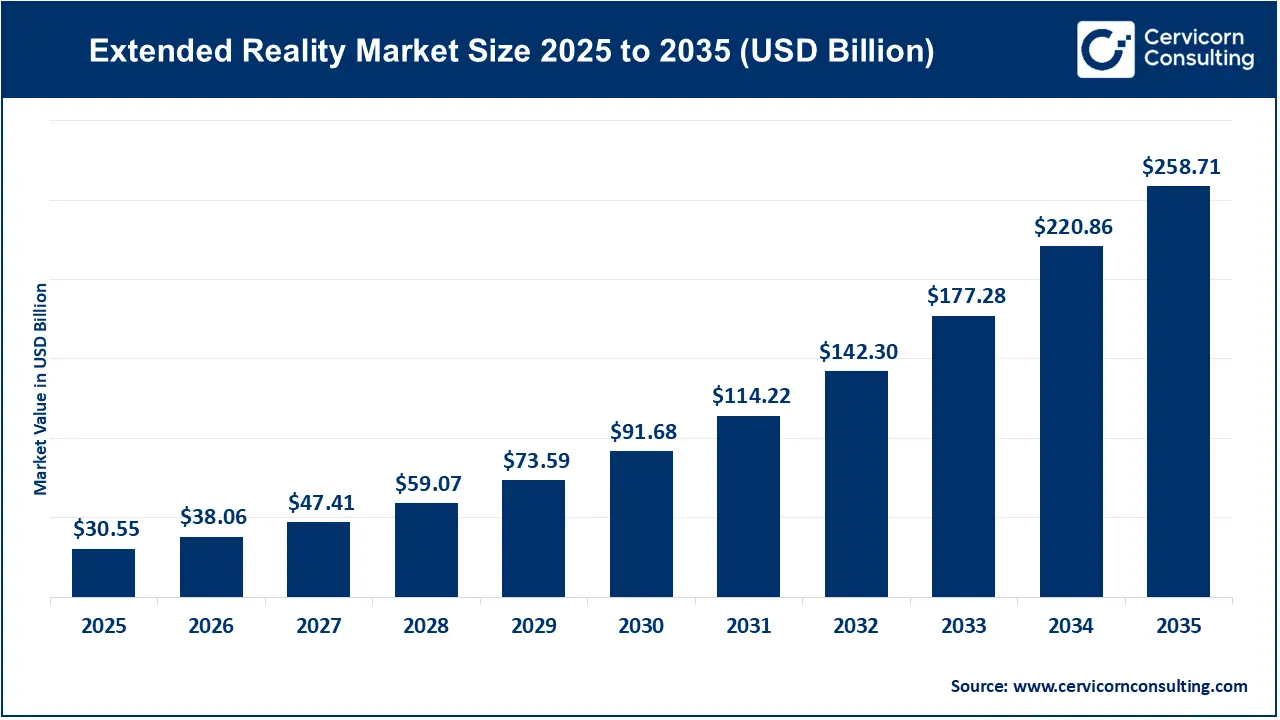
The global extended reality market was valued at approximately USD 30.55 billion in 2025 and is projected to reach USD 258.71 billion by 2035, representing a 23.82% CAGR from 2026 to 2035.
Extended Reality Market Growth Factors
The global extended reality (XR) market is being propelled by the convergence of artificial intelligence (AI), spatial computing, 5G connectivity, cloud computing, edge computing, computer vision, digital twins, and advanced wearable devices. Growing demand for immersive training, remote collaboration, virtual product demonstrations, healthcare visualization, industrial simulation, gaming, entertainment, and interactive education is expanding XR adoption beyond consumer applications into enterprise and public-sector environments.
Falling hardware costs, improvements in displays and sensors, better hand and eye tracking, lighter headsets, AI-enabled glasses, and increasingly sophisticated XR software ecosystems are also supporting market expansion. Enterprises are increasingly using XR to reduce training costs, improve workplace safety, visualize complex data, and simulate operational environments before making physical investments.
Meanwhile, technology companies are integrating generative AI and AI assistants into XR devices, creating more intuitive voice-, vision-, and gesture-based interfaces. The growing availability of standalone headsets and smart glasses is further reducing dependence on high-end computers and smartphones. Governments are also supporting immersive technology through digital transformation, innovation funding, technology standards, skills development, and industry-specific programs.
Get a Free Sample: https://www.cervicornconsulting.com/sample/2756
What Is the Extended Reality Market?
Extended reality is an umbrella term covering virtual reality (VR), augmented reality (AR), and mixed reality (MR), along with related immersive technologies such as spatial computing, haptics, holographic interfaces, and immersive digital environments. VR places users inside computer-generated environments, AR overlays digital information on the physical world, while MR allows physical and digital objects to interact within a shared environment.
The XR market includes hardware, software, platforms, content, development tools, connectivity, and professional services. Hardware includes headsets, smart glasses, sensors, controllers, cameras, spatial audio systems, and related components. Software encompasses operating systems, XR applications, development platforms, 3D engines, digital twins, simulation platforms, and enterprise applications.
The market is also moving toward AI-powered spatial computing, where XR devices understand the user’s environment, recognize objects, interpret speech, track gestures, and provide context-aware assistance. Google’s Android XR initiative illustrates this transition, combining headsets and glasses with Gemini AI to create more natural interactions with digital content.
Why Is the Extended Reality Market Important?
XR is important because it changes how people interact with information, products, machines, workplaces, and digital environments. Traditional computing relies primarily on flat screens, keyboards, and touch interfaces. XR introduces three-dimensional, spatial, visual, and increasingly conversational interfaces.
In manufacturing, engineers can visualize machinery and production processes before physical implementation. Workers can receive digital instructions while performing maintenance. In healthcare, clinicians can use immersive visualization for medical education, surgical planning, rehabilitation, and patient therapy. In education, students can explore historical locations, scientific concepts, industrial processes, and complex three-dimensional objects in immersive environments.
Retail is another important application. Brands can allow consumers to virtually visualize furniture, clothing, vehicles, or other products before purchase. In entertainment, XR enables immersive gaming, virtual concerts, interactive storytelling, and sports experiences.
XR also has strategic importance for governments and enterprises because it can reduce the cost and risk of real-world experimentation. A digital simulation can allow organizations to test scenarios repeatedly before modifying a factory, training employees, deploying equipment, or changing infrastructure.
Leading Companies in the Extended Reality Market
| Company | Specialization | Key Focus Areas | Notable Features | 2025 Revenue | XR Market Share | Global Presence |
|---|---|---|---|---|---|---|
| Accenture | Enterprise XR and immersive consulting | Digital transformation, metaverse, spatial computing, training, digital twins | Nth Floor, enterprise XR services, immersive collaboration | USD 69.7B | Not separately disclosed | Global |
| Apple Inc. | Spatial computing and premium XR hardware | Vision Pro, visionOS, spatial applications, enterprise computing | High-resolution spatial display, eye/hand tracking, Apple ecosystem | USD 416.2B | Not separately disclosed | Global |
| XR platforms, AI and spatial computing | Android XR, Gemini, AR/VR software, smart glasses | AI-powered XR, Android ecosystem, developer platform | USD 402.8B for Alphabet | Not separately disclosed | Global | |
| HTC Corporation | VR/XR hardware and immersive platforms | VIVE, enterprise VR, AI glasses, immersive computing | VIVE ecosystem, professional XR solutions, standalone devices | NT$2.90B | Not separately disclosed | Global |
| Meta Platforms, Inc. | VR, AR and spatial platforms | Quest, Reality Labs, Horizon, AI glasses | Quest ecosystem, Ray-Ban Meta, AI/AR development | USD 200.97B total; Reality Labs USD 2.21B | Not separately disclosed | Global |
Note: Company revenues are total reported corporate revenues unless an XR-specific figure is explicitly available. Company-level XR market share is generally not separately reported. Therefore, these figures should not be interpreted as XR market share.
Accenture
Accenture is primarily positioned on the enterprise-services side of the XR ecosystem. The company provides immersive technology consulting, XR implementation, digital twins, spatial computing, virtual collaboration, and workforce transformation solutions. Accenture describes XR as encompassing VR, AR, MR, haptics, holograms, and immersive tools. Its Nth Floor virtual environment demonstrates how XR can support employee collaboration, learning, onboarding, and corporate events.
Accenture reported USD 69.7 billion in fiscal 2025 revenue, with operations across the Americas, EMEA, and Asia Pacific.
Apple Inc.
Apple approaches XR through the concept of spatial computing, centered on Apple Vision Pro and visionOS. Apple’s strategy emphasizes premium hardware, immersive displays, eye and hand tracking, spatial video, enterprise applications, and integration with its broader hardware and software ecosystem.
In 2025, Apple expanded Vision Pro capabilities through visionOS updates and Apple Intelligence features. Apple also highlighted enterprise applications covering design, training, sales, and education.
Apple reported USD 416.16 billion in fiscal 2025 net sales, although it does not separately disclose Vision Pro or spatial-computing revenue.
Google is developing XR around Android XR, Gemini AI, spatial computing, headsets, and smart glasses. Rather than treating XR only as a hardware category, Google is building an operating-system and developer ecosystem.
Android XR was introduced in partnership with Samsung and Qualcomm, with support for developers through Android Studio, ARCore, Unity, and OpenXR. Google’s strategy is increasingly focused on AI-enabled glasses that can understand what users see and hear and provide contextual assistance through Gemini.
Alphabet generated USD 402.84 billion in 2025 revenue, including USD 58.71 billion from Google Cloud.
HTC Corporation
HTC remains an important specialist in immersive computing through its VIVE brand. Its focus includes VR headsets, enterprise XR, immersive content, professional applications, and AI-enabled wearable devices.
HTC reported NT$2.90 billion in 2025 revenue, compared with NT$3.08 billion in 2024. The company continued expanding its immersive technology portfolio and AI glasses initiatives, while restructuring parts of its VR organization.
Meta Platforms
Meta Platforms is one of the most significant companies in consumer XR through Reality Labs, Meta Quest, Horizon, and AI-enabled smart glasses.
Reality Labs generated USD 2.207 billion in 2025 revenue, up from USD 2.146 billion in 2024. The segment includes Meta’s virtual- and augmented-reality-related hardware, software, and content.
Meta’s Ray-Ban Meta smart glasses also illustrate the industry’s movement away from bulky headsets toward everyday wearable computing. Meta has described its broader vision as combining AI and AR in lightweight glasses.
Leading Trends and Their Impact on the Extended Reality Market
1. AI-Powered XR
The convergence of AI and XR is becoming one of the strongest market trends. AI allows XR systems to understand speech, recognize objects, interpret surroundings, generate content, and personalize experiences.
Google’s Android XR demonstrates this direction by combining Gemini with headsets and glasses. AI can interpret what users see and hear and provide assistance without requiring conventional screen-based interaction.
Impact: AI reduces interaction complexity and makes XR more useful for everyday activities, enterprise workflows, education, navigation, and professional assistance.
2. Smart Glasses Over Traditional Headsets
The industry is gradually expanding from immersive headsets toward lightweight smart glasses. Consumers may be more willing to wear glasses throughout the day than large VR headsets.
Meta’s Ray-Ban Meta and Google’s Android XR glasses strategy demonstrate this shift. The long-term opportunity is to create glasses capable of combining cameras, microphones, displays, AI assistants, navigation, communication, and contextual information.
Impact: Smart glasses could significantly expand the addressable consumer market for XR.
3. Enterprise XR Adoption
Enterprise applications are becoming increasingly important because companies can measure productivity, training, safety, and operational benefits more directly than in many consumer applications.
XR can be used for equipment maintenance, worker training, product design, remote assistance, warehouse operations, healthcare education, construction planning, and industrial simulations.
Accenture’s enterprise XR programs demonstrate how organizations are using immersive environments for collaboration and learning.
4. Digital Twins and Industrial Metaverse
XR is increasingly connected with digital twins. A digital twin can represent a physical asset or environment digitally, while XR provides an immersive interface for interacting with that representation.
This combination is particularly relevant to manufacturing, energy, construction, aerospace, automotive, and infrastructure.
Impact: Organizations can inspect virtual facilities, simulate changes, identify design problems, and train employees before implementing physical modifications.
5. Spatial Computing
Spatial computing is shifting XR from an entertainment-oriented technology to a broader computing platform. Apple’s Vision Pro and Google’s Android XR demonstrate competing approaches to spatial interfaces.
Spatial computing allows digital windows, objects, applications, and information to be placed within physical environments.
Impact: This could eventually transform workplaces by reducing reliance on conventional monitors and enabling flexible three-dimensional workspaces.
6. 5G, Edge Computing and Cloud XR
High-bandwidth, low-latency connectivity enables XR applications to access cloud resources and stream complex content. This can reduce the amount of processing required on individual devices.
The European Commission specifically identifies 5G/6G, AI, edge computing, cloud computing, and data infrastructure as technologies that can strengthen the European XR ecosystem.
Impact: Better connectivity can make XR devices lighter and more capable while supporting remote collaboration and real-time industrial applications.
7. Healthcare and Training Applications
Healthcare is becoming an important XR application because immersive simulation can provide repeatable training environments without requiring access to physical patients or expensive equipment.
XR can support medical education, surgical visualization, rehabilitation, therapy, anatomy learning, and emergency-response simulations.
Impact: Healthcare adoption can provide XR vendors with higher-value enterprise opportunities beyond gaming and entertainment.
Successful Examples of the Extended Reality Market Around the World
Apple Vision Pro in Enterprise and Education
Apple Vision Pro demonstrates the movement of XR toward professional applications. Apple has highlighted use cases involving design, training, sales, education, and other enterprise workflows.
The significance of Vision Pro is not only the device itself but the development of spatial applications and enterprise APIs around Apple’s ecosystem.
Meta Quest and AI Glasses
Meta’s Quest ecosystem has established a large consumer VR platform, while Ray-Ban Meta illustrates how the company is moving toward everyday AI-enabled wearables.
Meta reported that Reality Labs generated USD 2.207 billion in 2025, while continuing to invest heavily in the segment.
Accenture’s Nth Floor
Accenture’s Nth Floor provides an example of enterprise-scale immersive collaboration. The company has used virtual environments for meetings, learning, onboarding, and employee interaction across geographically distributed teams.
South Korea’s Virtual Convergence Strategy
South Korea has been one of the most proactive countries in promoting XR and virtual convergence technologies. Its government established a strategy targeting the development of a virtual convergence economy, including applications in manufacturing, healthcare, education, construction, and other industries.
The strategy included industrial XR flagship projects, support for specialist companies, development of XR technologies, and regulatory improvements.
China’s National VR Development Program
China’s national VR development strategy represents one of the largest government-backed XR initiatives. The country’s 2022–2026 action plan targets an overall VR industry scale exceeding 350 billion yuan, more than 25 million VR terminals, 100 influential enterprises, and 10 industrial clusters by 2026.
The policy also encourages VR integration with manufacturing, culture and tourism, education, sports, healthcare, commerce, smart cities, AI, 5G, cloud computing, and digital twins.
Global Regional Analysis Including Government Initiatives and Policies
North America
North America remains one of the most influential XR markets because of its strong technology ecosystem, venture capital availability, software development capabilities, major platform companies, and advanced enterprise adoption.
The United States is home to Apple, Meta, Google, Microsoft, NVIDIA, Qualcomm, and numerous XR startups. The region has strong adoption across gaming, entertainment, defense, healthcare, retail, education, manufacturing, and enterprise collaboration.
Government-supported applications have also appeared in defense and aerospace. The U.S. Army’s Integrated Visual Augmentation System, for example, was developed as an AR-based modernization program for soldiers. NASA has also developed VR/AR/MR technologies for training and human-performance applications.
The U.S. policy environment is increasingly connected to broader emerging-technology and AI strategies. The 2025 U.S. AI Action Plan also identifies virtual reality among emerging technologies relevant to innovation and national competitiveness.
Canada is also developing capabilities in immersive media, gaming, digital content, and creative technology, supported by a strong research and innovation ecosystem.
Europe
Europe has significant strengths in XR applications, creative industries, industrial technology, research, and SMEs. The European Commission notes that around 90% of European companies working on XR are SMEs, highlighting the importance of smaller technology firms in the regional ecosystem.
The European Commission supports XR research and innovation while connecting immersive technology with AI, 5G/6G, edge computing, cloud infrastructure, and data technologies.
A major development came in December 2025, when the European Commission launched the European Partnership for Virtual Worlds, bringing industry, academia, research organizations, and users together to accelerate research, skills, and immersive applications.
The EU’s approach is also focused on responsible innovation, privacy, safety, digital rights, and European values. This could influence the design and commercialization of XR platforms across the region.
The UK has historically supported immersive technologies through initiatives such as the Audience of the Future program, which provided funding for VR, AR, and immersive experiences.
The UK’s 2025 technology policy continues to identify AR, VR, and XR among important emerging technologies with potential economic impact.
Asia-Pacific
Asia-Pacific is emerging as one of the most dynamic regions for XR because of its large technology manufacturing base, gaming industry, smartphone ecosystem, advanced connectivity, and government support.
China has adopted an explicit national strategy for VR and immersive technology. Its 2022–2026 action plan focuses on core technologies, industrial applications, hardware, software, standards, infrastructure, and commercialization.
Japan has strong capabilities in gaming, robotics, electronics, entertainment, and immersive content. Its government is also supporting international standardization around avatars for metaverse and XR applications. In 2026, Japan’s Ministry of Economy, Trade and Industry highlighted the publication of an international avatar standard intended to improve interoperability, user understanding, and international expansion of Japanese-developed content.
South Korea has pursued a national virtual convergence strategy covering XR, AI, 5G, digital twins, manufacturing, healthcare, education, and smart cities. Seoul also promoted XR and AI through its Entertech Seoul 2025 initiative, bringing together technology, culture, entertainment, and immersive experiences.
India represents a significant emerging opportunity because of its large developer and technology workforce, growing digital economy, gaming sector, and expanding interest in immersive technologies. In 2025, IIT Madras’ Experiential Technology Innovation Centre hosted an international XR symposium focused on positioning India as a leader in immersive technology across the Global South.
Latin America
Latin America is an emerging XR market where applications are increasingly appearing in education, gaming, tourism, healthcare, retail, and industrial training. Brazil and Mexico are among the region’s most important technology markets.
The region’s opportunity is closely linked to smartphone penetration, expanding cloud infrastructure, digital education, gaming communities, and the increasing availability of lower-cost XR hardware. However, affordability, connectivity, local content development, and access to specialized technical talent remain important challenges.
Middle East & Africa
The Middle East is developing XR applications around smart cities, tourism, real estate, education, entertainment, cultural heritage, and infrastructure development. Gulf countries are particularly interested in immersive technologies as part of broader digital-transformation and economic-diversification programs.
XR can support virtual property visualization, tourism experiences, cultural preservation, employee training, and smart-city planning.
Africa represents a longer-term opportunity, particularly in education, healthcare, industrial training, tourism, and remote collaboration. Adoption is likely to depend heavily on affordable hardware, connectivity infrastructure, local developer ecosystems, and partnerships with international technology companies.
Future Market Direction
The extended reality market is transitioning from a hardware-focused industry into a broader AI-enabled spatial computing ecosystem. The next phase is likely to be defined by lightweight smart glasses, multimodal AI assistants, spatial operating systems, digital twins, cloud-rendered XR, enterprise applications, and increasingly realistic digital environments.
Rather than XR being limited to virtual worlds, the technology is increasingly becoming an interface between people, AI systems, physical assets, and digital information. Google’s Android XR strategy, Apple’s spatial-computing ecosystem, Meta’s Quest and smart-glasses portfolio, HTC’s VIVE platform, and Accenture’s enterprise implementations illustrate different approaches to the same broader transformation.
With the global XR market estimated at USD 47.5 billion in 2025 and projected to reach USD 425.0 billion by 2035, the technology is moving toward a period in which immersive computing can become a mainstream component of enterprise, consumer, industrial, healthcare, education, and government digital ecosystems.
To Get Detailed Overview, Contact Us: https://www.cervicornconsulting.com/contact-us
Read Report: Construction Equipment Market Revenue, Trends, and Strategic Insights by 2035