Direct Air Capture Market Revenue, Trends, and Strategic Insights by 2035
Table of Contents
ToggleDirect Air Capture Market Size
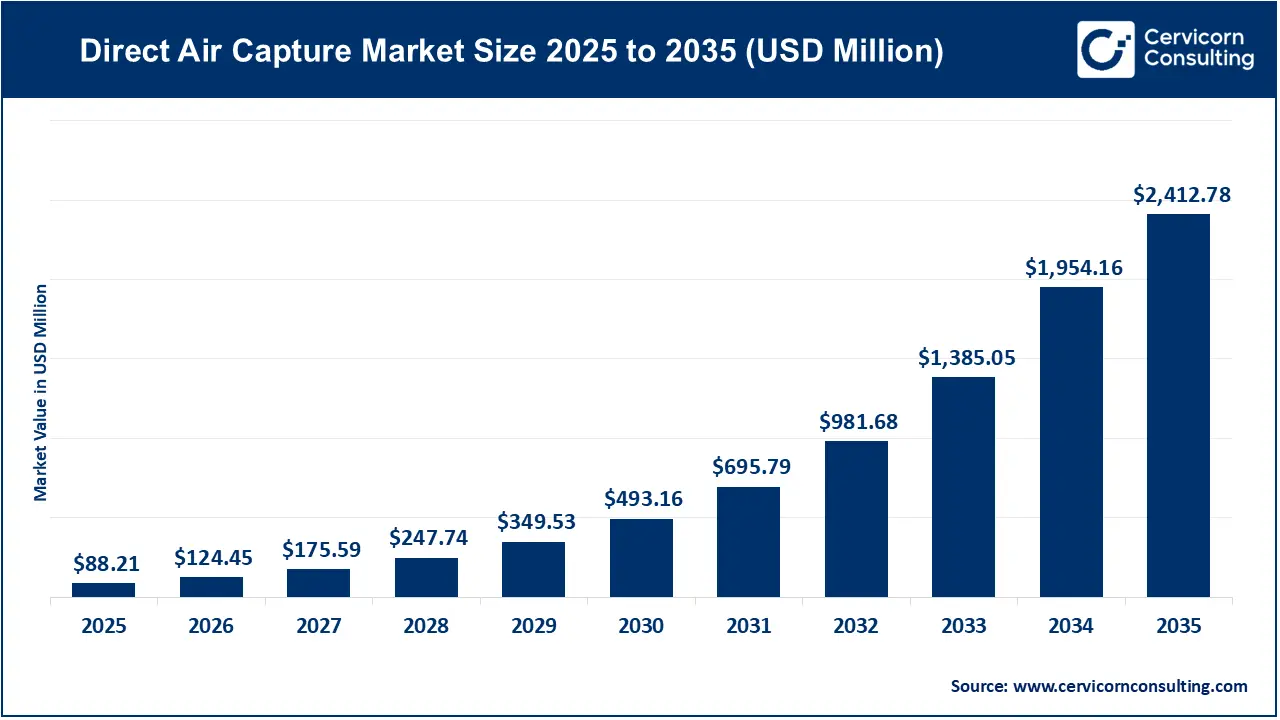
The global direct air capture market is projected to reach USD 88.21 million in 2025 and approximately USD 2,412.78 million by 2035, representing a CAGR of 39.22%.
Direct Air Capture Market Growth Factors
The direct air capture market growth factors include the rising urgency to remove legacy atmospheric CO₂, expansion of corporate net-zero and carbon-removal commitments, government subsidies and tax incentives, development of large-scale DAC hubs, technological improvements in solid sorbents and liquid solvents, increasing availability of renewable electricity and low-carbon heat, expansion of permanent geological storage, growing carbon-removal credit purchases, strategic partnerships between DAC companies and energy companies, and rising demand from hard-to-abate sectors such as aviation, shipping, cement, chemicals and heavy industry.
Corporate buyers are increasingly signing long-term carbon-removal agreements, while governments are providing financial support to reduce the cost and technology risk of early projects. In the United States, the expanded 45Q tax credit can provide up to $180 per tonne for qualifying DAC carbon capture and storage, while Canada’s CCUS investment tax credit provides a particularly strong incentive for DAC projects, with a 60% credit rate for eligible DAC capture equipment through 2035 under current rules. At the same time, the EU’s carbon-removal certification framework is creating a standardized mechanism for recognizing high-quality permanent removals, strengthening the investment case for DAC.
Get a Free Sample: https://www.cervicornconsulting.com/sample/2754
What Is the Direct Air Capture Market?
The direct air capture market encompasses technologies, equipment, services, projects, carbon-removal credits and related infrastructure used to remove CO₂ directly from atmospheric air. DAC systems generally use fans or passive airflow to move large quantities of air across a chemical or mineral material that selectively captures CO₂.
There are two broad technological approaches. Solid-DAC uses solid sorbents such as amine-functionalized materials that adsorb CO₂ and subsequently release it through heat, vacuum or a combination of both. Liquid-DAC uses chemical solutions to absorb CO₂ before a series of chemical reactions and regeneration steps produce a concentrated CO₂ stream. Emerging approaches also include electrochemical, membrane and hybrid systems.
Once captured, CO₂ can follow two major pathways. In DAC with carbon storage (DACCS), the CO₂ is transported and permanently stored underground, including through mineralization. In DAC with carbon utilization, the CO₂ can become a feedstock for synthetic fuels, concrete, chemicals and other products. Carbon Engineering’s technology, for example, is designed around a liquid-based system in which atmospheric CO₂ is captured using a liquid sorbent, while its technology is being commercialized through 1PointFive’s STRATOS facility in Texas.
The market remains relatively small compared with conventional energy and carbon-management industries, but its exceptionally high growth expectations reflect the transition from laboratory and pilot projects toward commercial-scale facilities.
Why Is Direct Air Capture Important?
DAC is important because it addresses a problem that conventional emissions-reduction technologies cannot fully solve: removing CO₂ that has already accumulated in the atmosphere.
Even if global emissions were dramatically reduced, some residual emissions would remain from sectors such as aviation, shipping, agriculture, cement and industrial processes. DAC can potentially compensate for a portion of these residual emissions while also removing historical CO₂ from the atmosphere.
Another advantage is geographical flexibility. Unlike point-source carbon capture, DAC does not have to be located next to a large industrial emitter. Projects can potentially be located where renewable electricity, low-carbon heat, water, land and geological storage are available.
The technology is also measurable. A DAC plant can quantify how much CO₂ is captured and, when paired with durable geological storage, provide a relatively clear pathway for verifying permanent carbon removal.
However, DAC remains energy-intensive and expensive. The central challenge is therefore not simply proving that atmospheric CO₂ can be captured, but reducing energy consumption, capital expenditure and operating costs sufficiently to enable deployment at millions or billions of tonnes per year.
Major Companies in the Direct Air Capture Market
The competitive landscape includes established DAC developers and newer companies pursuing different approaches. Market-share estimates should be interpreted cautiously because the industry is still developing and private companies generally do not publish audited DAC-specific revenue. One recent industry estimate places Climeworks at approximately 40% and Heirloom at approximately 23% of DAC market revenue, with Global Thermostat/Zero Carbon Systems around 3%; another 2024 estimate placed Climeworks at 40.12%, Heirloom at 18.62%, and Global Thermostat at 2.05%. These figures are estimates rather than audited company disclosures.
| Company | Specialization | Key Focus Areas | Notable Features | 2025 Revenue* | Estimated Market Position | Global Presence |
|---|---|---|---|---|---|---|
| Climeworks | Solid-sorbent DAC | DAC + permanent storage, carbon-removal services, large-scale hubs | Orca and Mammoth; modular technology; Icelandic geothermal energy | Not publicly disclosed | ~40% in one industry estimate | Switzerland, Iceland, U.S. and international markets |
| Carbon Engineering ULC. | Liquid-DAC | Large-scale DAC, DACCS, CO₂ utilization | Liquid solvent system; STRATOS designed for 500,000 tCO₂/year | Not separately disclosed | Market share not independently disclosed | Canada technology base; U.S. commercial deployment |
| Global Thermostat | Solid-sorbent DAC | Atmospheric carbon removal, industrial CO₂ supply, fuels and materials | Amino-polymer sorbents; modular systems | Not publicly disclosed | ~2–3% in industry estimates | U.S., Europe and Asia-Pacific |
| Heirloom Carbon Technologies | Mineral/limestone-based DAC | Permanent removal, mineralization, DAC hubs | Limestone sorbent; modular architecture; low-cost focus | Not publicly disclosed | ~19–23% in industry estimates | U.S.; expanding international partnerships |
| Soletair Power | Building-integrated DAC | Distributed urban capture, HVAC integration, CO₂ utilization | Retrofittable systems; building-based capture; Power-to-X | Not publicly disclosed | Niche/private; no reliable standalone share published | Finland, Germany, Denmark, UAE and other markets |
*Private DAC companies generally do not disclose audited 2025 DAC-specific revenue; therefore, unavailable figures should not be interpreted as zero revenue.
Climeworks
Climeworks is one of the best-known DAC companies globally and has built its business around solid-sorbent direct air capture combined with permanent carbon storage. Its Orca plant in Iceland has a capture capacity of up to 4,000 tonnes of CO₂ annually, while Mammoth is designed for up to 36,000 tonnes annually. Mammoth represents a roughly tenfold scale-up from Orca and is being used to generate operational experience for much larger facilities.
Climeworks has also been expanding its U.S. development pipeline and aims to move from today’s thousands of tonnes toward megaton-scale removal. The company raised another USD 162 million in 2025, taking total funding above USD 1 billion, highlighting investor confidence in the DAC sector.
Carbon Engineering ULC.
Carbon Engineering developed a liquid-DAC technology using an air contactor, chemical processing and regeneration steps. The company’s technology is being commercialized through 1PointFive, an Occidental subsidiary.
The flagship STRATOS facility in Ector County, Texas, is designed to capture up to 500,000 tonnes of CO₂ annually when fully operational. Carbon Engineering itself is now closely integrated with Occidental’s commercial DAC strategy, so separate 2025 revenue and market-share figures for Carbon Engineering are not publicly comparable with independent DAC startups.
STRATOS is particularly important because it represents the industry’s transition from demonstration-scale facilities toward hundreds-of-thousands-of-tonnes annual capacity. Corporate buyers including JPMorganChase, Palo Alto Networks and NYK have signed agreements for DAC-enabled carbon-removal credits associated with STRATOS.
Global Thermostat
Global Thermostat focuses on solid-sorbent DAC based on proprietary amino-polymer materials. Its technology is designed to capture CO₂ at relatively low regeneration temperatures and can supply CO₂ for permanent storage or utilization.
The company has operated demonstration infrastructure in the United States and established Global Thermostat Japan with ICMG to strengthen its Asian presence. Industry sources estimate its share of the DAC market at approximately 2–3%, although the company does not publish an audited DAC-specific market-share figure.
Heirloom Carbon Technologies
Heirloom Carbon Technologies differentiates itself through a limestone-based approach. Limestone is heated to release CO₂, leaving calcium oxide that is hydrated and exposed to atmospheric air to absorb CO₂. The material is then regenerated and reused. Heirloom says its process accelerates the natural carbonation process from years to a matter of days.
Its Tracy, California facility demonstrated the company’s approach at commercial scale, while its Louisiana projects are designed for much larger deployment. Heirloom’s portion of Project Cypress is planned to eventually reach approximately 300,000 tonnes of CO₂ removal annually, with the first phase designed for 100,000 tonnes per year.
Soletair Power
Soletair Power takes a different approach by integrating DAC directly into building ventilation systems. Its systems use HVAC airflow to capture CO₂ and can subsequently provide concentrated CO₂ for utilization or storage.
The company reports that its building-integrated systems can capture up to 20 tonnes of CO₂ annually per unit under certain configurations, while its newer system specifications highlight higher potential capacity at the building level. It has delivered systems across Finland, Germany, Denmark and the UAE.
Its approach could create a distributed DAC market, in which thousands or millions of buildings become small carbon-capture sites rather than relying exclusively on massive centralized facilities.
Leading Trends and Their Impact on the Direct Air Capture Market
1. Movement Toward Megaton-Scale DAC
The industry is rapidly shifting from pilot systems toward facilities capable of capturing hundreds of thousands or eventually millions of tonnes annually. STRATOS is designed for 500,000 tonnes per year, while Heirloom’s Louisiana plans target hundreds of thousands of tonnes. This transition should improve economies of scale but also increases requirements for energy, infrastructure, storage and financing.
2. Expansion of Carbon Removal Credit Markets
Corporate buyers are increasingly signing long-term agreements for durable carbon removal. CDR.fyi reported 2.47 million tonnes of DAC credits contracted between 2022 and the first half of 2025, although only a small fraction had been delivered at that point. Climeworks, Heirloom and 1PointFive accounted for the overwhelming majority of contracted DAC volumes.
3. Lower-Cost Sorbents and Materials
Reducing the cost of sorbents is becoming central to commercialization. Heirloom’s limestone approach, Climeworks’ improved solid sorbents and Global Thermostat’s amino-polymer materials demonstrate the industry’s effort to replace expensive or energy-intensive materials with scalable alternatives.
4. Modularization and Standardization
Modular DAC systems can potentially be mass-produced rather than engineered as unique megaprojects. Climeworks has emphasized modular collector containers, while Heirloom is developing modular DAC facilities and Soletair Power applies modular systems to buildings. Standardization can reduce construction time and accelerate learning.
5. Integration With Renewable Energy
DAC requires energy to move air, regenerate capture materials, compress CO₂ and manage storage. Consequently, developers increasingly seek locations with abundant renewable electricity, geothermal heat, waste heat or other low-carbon energy sources. Iceland is particularly attractive because Climeworks combines DAC with geothermal energy and Carbfix’s mineral-storage infrastructure.
6. Carbon Utilization
Not all captured CO₂ will necessarily be stored underground. DAC developers are exploring synthetic fuels, concrete, chemicals and industrial gases. This is especially relevant to aviation and shipping, where atmospheric CO₂ can become a carbon feedstock for synthetic fuels.
7. Greater Focus on Measurement and Verification
As carbon-removal markets grow, buyers increasingly require evidence that one tonne purchased corresponds to one tonne of verified atmospheric removal. Certification frameworks such as the EU’s CRCF are therefore becoming strategically important.
Successful Examples of the Direct Air Capture Market Around the World
Iceland – Climeworks Orca and Mammoth
Iceland is one of the most important DAC markets because it combines geothermal energy with geological CO₂ storage. Climeworks’ Orca became operational in 2021 with up to 4,000 tonnes of annual capture capacity. Mammoth subsequently expanded the company’s capacity to a nameplate 36,000 tonnes per year.
The combination of renewable energy, DAC and Carbfix’s mineral-storage process provides an integrated model that other countries are seeking to replicate.
United States – Heirloom Tracy
Heirloom’s Tracy, California facility represents an important commercial demonstration of limestone-based DAC. Captured CO₂ has been integrated into concrete, demonstrating that DAC can be connected to permanent carbon-utilization pathways rather than relying solely on underground storage.
United States – STRATOS, Texas
STRATOS represents one of the largest DAC projects under commercial development. Carbon Engineering’s liquid-DAC technology is being deployed by 1PointFive with a planned capacity of up to 500,000 tonnes annually.
The project’s corporate carbon-removal agreements also illustrate how advance purchasing can create demand before large DAC facilities reach full capacity.
Finland, Germany, Denmark and UAE – Soletair Power
Soletair Power demonstrates a decentralized approach. Its projects include HVAC-integrated DAC in Finland and Denmark, outdoor DAC systems in Germany and Power-to-X applications demonstrated in the UAE.
This model is particularly relevant to urban markets where large centralized DAC facilities may face land and infrastructure constraints.
Global Regional Analysis and Government Initiatives
North America
North America is currently the leading regional market for DAC, supported by major U.S. federal funding, private investment, geological storage potential and strong corporate demand. One 2025 estimate places North America’s market share at approximately 46.7%.
United States
The U.S. has established one of the world’s most extensive policy frameworks for DAC. The Department of Energy’s Regional DAC Hubs Program aims to develop four domestic hubs, with each hub designed to demonstrate technology at commercial scale with potential capture of at least 1 million tonnes of CO₂ annually.
The Inflation Reduction Act expanded the 45Q tax credit, with DAC projects eligible for up to $180 per tonne for qualifying permanent storage. The Bipartisan Infrastructure Law also created billions of dollars of support for DAC hubs and CO₂ infrastructure.
Major projects such as STRATOS in Texas and Project Cypress in Louisiana are consequently positioning the U.S. as a central hub for commercial DAC deployment.
Canada
Canada has created a particularly attractive investment environment through its CCUS Investment Tax Credit. Current policy provides a 60% tax credit for eligible equipment used in direct air capture projects through 2035, with lower rates applying afterward.
Canada’s policy framework is significant for companies such as Carbon Engineering because it supports both technology development and the broader carbon-management ecosystem.
Europe
Europe is becoming an important DAC market because of its climate-neutrality objective, carbon-removal certification efforts and growing demand for durable removals.
European Union
The EU adopted the Carbon Removals and Carbon Farming Regulation, creating a voluntary certification framework designed to establish quality standards for carbon-removal activities. In 2026, the European Commission adopted the first methodologies covering permanent carbon removals, including DAC with carbon storage.
This is important because credible certification can help create a more transparent European carbon-removal market while reducing greenwashing risks.
Iceland
Iceland is already a global DAC leader through Climeworks and Carbfix. Its geothermal energy and mineral-storage resources create favorable conditions for DACCS and provide a model for combining clean energy, atmospheric carbon removal and permanent storage.
United Kingdom
The UK is developing a dedicated Greenhouse Gas Removals Business Model designed to provide revenue certainty for engineered removals. The government’s 2025 GGR framework seeks to establish durable demand while supporting investment in carbon capture and storage infrastructure.
The UK government also identifies DACCS as one of the engineered greenhouse-gas-removal technologies relevant to meeting future carbon budgets.
Asia-Pacific
Asia-Pacific is expected to be one of the fastest-growing DAC regions as governments and corporations explore carbon-removal technologies alongside industrial decarbonization.
Japan
Japan is developing a growing interest in DAC as part of its carbon-neutrality strategy. Japanese companies are purchasing DAC credits from international developers, while Japanese financial institutions are investing in DAC companies. In 2025, the Development Bank of Japan invested in Heirloom, specifically highlighting DAC as a technology with potential applications in permanent storage, concrete and low-carbon fuels.
Japan’s position is particularly important because its industrial economy includes hard-to-abate sectors such as shipping, aviation, steel and chemicals.
China
China’s enormous industrial base and carbon-neutrality target create long-term potential for DAC, particularly as carbon-removal technologies become integrated into broader CCUS and negative-emission strategies. However, the country’s DAC deployment remains less mature than the leading U.S. and European projects, with the market currently focused more heavily on carbon capture and utilization technologies.
Australia
Australia has significant geological storage potential, abundant renewable energy resources and increasing interest in carbon-removal technologies. These characteristics provide favorable conditions for future DAC development, particularly in regions where renewable power and CO₂ storage can be combined.
Latin America, Middle East & Africa
These regions currently represent smaller portions of the global DAC market but offer significant long-term potential.
Latin America could benefit from abundant renewable energy, large geological formations and emerging carbon markets. Countries such as Brazil may eventually combine DAC with renewable power and permanent storage.
The Middle East has strong potential because of its existing energy infrastructure, engineering expertise and carbon-management capabilities. The region is also developing carbon-capture projects and could potentially integrate DAC with low-cost renewable energy, natural gas infrastructure and geological storage.
Africa remains an emerging market. DAC deployment will depend heavily on access to affordable renewable energy, financing, CO₂ storage infrastructure and international carbon-removal markets. Countries with excellent solar resources could become attractive locations as DAC technologies become more energy-efficient.
Market Outlook Through the Next Decade
The direct air capture market is moving from a technology-demonstration phase toward a commercial infrastructure phase. The most important shift is the emergence of facilities measured in hundreds of thousands of tonnes rather than hundreds or thousands of tonnes. STRATOS, Heirloom’s Louisiana projects and Climeworks’ future U.S. hubs illustrate this transition.
At the same time, the market will increasingly be divided into several business models: centralized DACCS facilities, DAC-to-fuels systems, DAC-to-materials applications, distributed building-integrated DAC and carbon-removal-as-a-service platforms.
The long-term competitiveness of DAC will depend on five major variables: cost per tonne removed, energy consumption, permanence of storage, verification quality and availability of policy support. Companies that can simultaneously reduce costs and demonstrate durable, independently verifiable removals are likely to gain an advantage as governments and corporations increase procurement.
The market’s rapid expansion is therefore not simply a story of more DAC machines. It is the development of an entire ecosystem involving capture technology, renewable energy, heat, CO₂ pipelines, geological storage, carbon-removal certification, corporate procurement, financing and government incentives. As these components mature together, direct air capture is positioned to become an increasingly important component of the global carbon-removal economy.
To Get Detailed Overview, Contact Us: https://www.cervicornconsulting.com/contact-us
Read Report: Software-Defined Vehicles Market Revenue, Trends, and Strategic Insights by 2035