Software-Defined Hardware Market Revenue, Trends, and Strategic Insights by 2035
Software-Defined Hardware Market Size
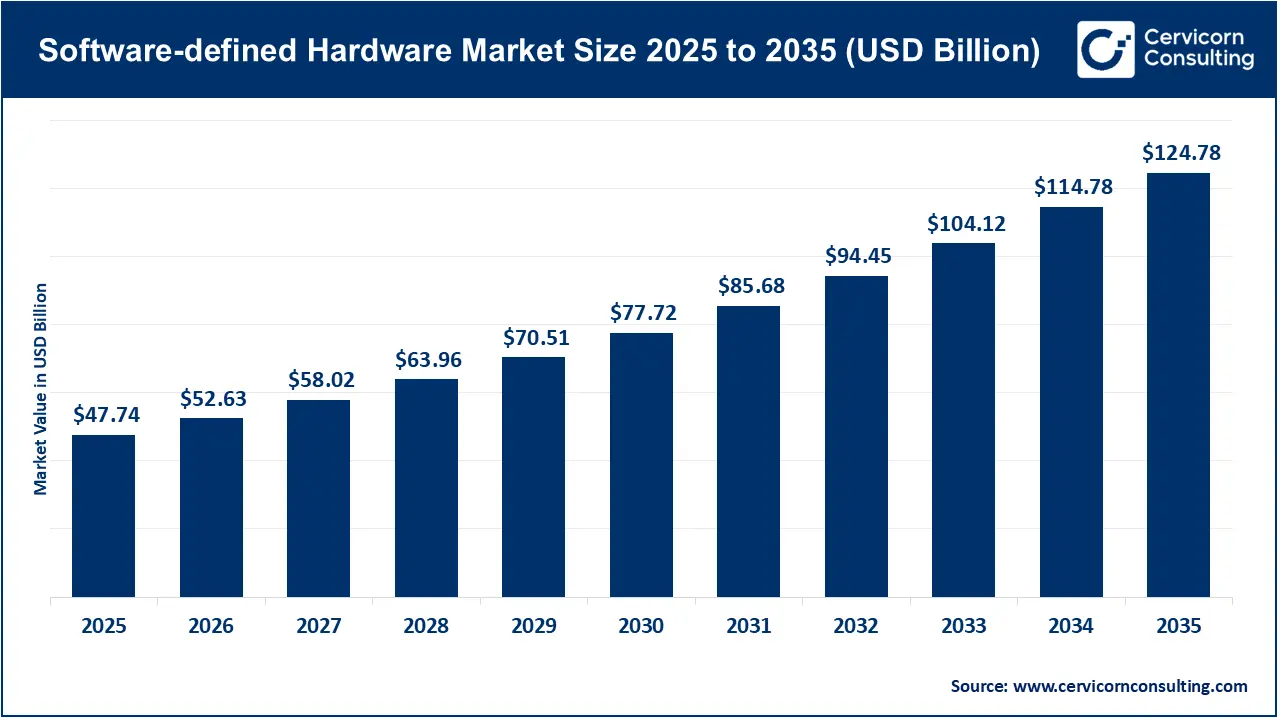
The global software-defined hardware market size was USD 47.74 billion in 2025, with projections reaching USD 124.78 billion by 2035 at a 10.08% CAGR.
Software-Defined Hardware Market Growth Factors
The software-defined hardware market is expanding as enterprises increasingly seek computing infrastructure that can be reconfigured, optimized, and upgraded through software instead of requiring complete hardware replacement. Growth is being driven by the rapid adoption of artificial intelligence (AI), machine learning, cloud computing, edge computing, high-performance computing (HPC), 5G networks, autonomous systems, robotics, automotive electronics, and data-intensive workloads that require specialized acceleration.
Programmable hardware such as field-programmable gate arrays (FPGAs), adaptive compute platforms, GPUs, reconfigurable accelerators, smart network interface cards, and heterogeneous computing systems allow organizations to modify hardware functionality after deployment, improving performance and extending product lifecycles. The expansion of hyperscale data centers is another major factor because cloud providers increasingly use programmable accelerators to optimize workloads without designing new application-specific integrated circuits for every application.
At the same time, rising semiconductor development costs, shorter product cycles, supply-chain uncertainty, energy-efficiency requirements, and demand for workload-specific computing are encouraging companies to move toward flexible architectures. Government efforts to strengthen domestic semiconductor ecosystems are also supporting investment in advanced chip design, manufacturing, packaging, AI infrastructure, and programmable computing. Together, these developments are shifting hardware from a fixed-function asset toward a software-configurable computing platform.
Get a Free Sample: https://www.cervicornconsulting.com/sample/2740
What Is the Software-Defined Hardware Market?
The software-defined hardware market refers to technologies in which the behavior, configuration, functionality, or workload optimization of physical computing hardware can be modified substantially through software.
Traditional hardware is generally designed for specific functions. Once manufactured and deployed, changing its fundamental functionality can require replacing components or developing an entirely new chip. Software-defined hardware introduces greater flexibility by allowing hardware resources to be programmed, configured, virtualized, or dynamically optimized.
FPGAs are one of the clearest examples. Unlike fixed-function processors, FPGAs can be reconfigured after manufacturing to perform different computational tasks. Modern software-defined hardware extends this concept across GPUs, adaptive SoCs, programmable network devices, accelerators, chiplets, data-processing units, and heterogeneous computing architectures.
The market therefore sits at the intersection of semiconductors, programmable logic, AI acceleration, cloud infrastructure, embedded computing, networking, and software development.
Microsoft’s Project Catapult demonstrates the concept at hyperscale. Microsoft describes FPGAs as combining speed, programmability, and flexibility and reports that nearly every new server in its data centers integrates an FPGA into its distributed architecture.
Why Is Software-Defined Hardware Important?
Software-defined hardware is important because it addresses one of the biggest challenges facing modern computing: hardware must evolve almost as quickly as software.
AI models, cybersecurity requirements, networking protocols, automotive algorithms, and industrial workloads can change significantly during the lifetime of a product. A fixed-function system may become inefficient when workloads change. A programmable platform, in contrast, can potentially be updated without replacing the complete physical infrastructure.
1. Greater Hardware Flexibility
Organizations can adapt hardware to different workloads using software or firmware updates. This is particularly valuable for data centers, telecommunications equipment, defense systems, automotive platforms, and industrial equipment.
2. Longer Product Lifecycles
Reconfigurable hardware can potentially remain useful for longer because functionality can be updated after deployment. This reduces pressure to replace complete systems whenever workload requirements change.
3. AI and Accelerator Optimization
AI workloads frequently require specialized acceleration. GPUs, FPGAs, adaptive processors, and other accelerators can be optimized for specific models, inference workloads, or data-processing requirements.
4. Reduced Development Risk
Developing a new ASIC can require substantial engineering investment and lengthy development cycles. Programmable hardware provides a middle ground between general-purpose processors and completely customized silicon.
5. Energy Efficiency
Workload-specific acceleration can execute certain tasks more efficiently than general-purpose computing. This is increasingly important as data centers face rising electricity consumption and sustainability requirements.
6. Faster Innovation
Software-defined hardware allows companies to introduce new functionality through software updates rather than waiting for an entirely new hardware generation.
Leading Companies in the Software-Defined Hardware Market
The competitive landscape includes semiconductor companies developing GPUs, CPUs, FPGAs, adaptive SoCs, AI accelerators, networking processors, and software ecosystems.
| Company | Specialization | Key Focus Areas | Notable Features | 2025 Revenue | Market Position / Share | Global Presence |
|---|---|---|---|---|---|---|
| NVIDIA Corporation | GPUs, AI accelerators, networking | AI, data centers, HPC, automotive, robotics | CUDA ecosystem, GPUs, accelerated computing, networking | $130.5B fiscal 2025 | Leading AI-accelerator ecosystem; exact software-defined hardware share not separately reported | Global |
| Intel Corporation | CPUs, FPGAs, AI accelerators, networking | Data centers, PCs, edge, foundry, embedded | Xeon, Gaudi, FPGA/adaptive computing portfolio, oneAPI | $52.9B | Major diversified computing and programmable-hardware participant | Global |
| Advanced Micro Devices (AMD) | CPUs, GPUs, adaptive computing | Data centers, AI, PCs, embedded, gaming | EPYC, Instinct, Ryzen, Radeon and adaptive-computing portfolio | $34.6B | Major CPU/GPU and adaptive-computing competitor | Global |
| Qualcomm Technologies, Inc. | SoCs, AI, connectivity, edge computing | Automotive, IoT, smartphones, edge AI, robotics | Snapdragon, AI engines, heterogeneous computing | $44.3B | Strong edge/embedded and connected-computing position | Global |
| Xilinx, a part of AMD | FPGAs, adaptive SoCs | Data centers, networking, automotive, industrial, aerospace | Versal adaptive SoCs, FPGA technology, programmable acceleration | Included in AMD | Major FPGA/adaptive-computing technology portfolio | Global |
NVIDIA Corporation
NVIDIA is one of the strongest forces behind the software-defined hardware model because its strategy combines specialized silicon with a large software ecosystem. Its GPUs, networking products, CUDA platform, libraries, development tools, and AI software allow developers to optimize hardware for changing workloads.
NVIDIA reported $130.5 billion in fiscal 2025 revenue, up 114% year over year, with growth led by data-center demand and accelerated computing.
Its software-hardware integration is particularly important for AI infrastructure. Instead of selling a GPU as an isolated component, NVIDIA increasingly provides a complete computing platform encompassing processors, interconnects, software, algorithms, systems, and services.
The company has a global presence across North America, Europe, Asia-Pacific, and other technology markets.
Intel Corporation
Intel remains an important participant because of its broad portfolio spanning CPUs, accelerators, networking technologies, programmable logic, and manufacturing.
Intel generated $52.9 billion in revenue in 2025.
Its software-defined hardware strategy is connected to heterogeneous computing, AI acceleration, edge computing, networking, and programmable hardware. Intel’s acquisition of Altera strengthened its FPGA and programmable-logic capabilities, giving the company an important position in applications where hardware must be adapted after deployment.
Intel’s global ecosystem includes data centers, cloud providers, telecommunications companies, industrial customers, automotive applications, and enterprise computing.
Advanced Micro Devices (AMD)
AMD has become a major competitor in CPUs and GPUs while also expanding its adaptive-computing capabilities through its Xilinx portfolio.
AMD reported $34.6 billion in 2025 revenue, representing 34% annual growth. Its data-center revenue reached $16.6 billion, driven by EPYC processors and Instinct GPU accelerators.
AMD’s combination of CPUs, GPUs, adaptive SoCs, FPGAs, and software creates a heterogeneous computing portfolio suited to software-defined infrastructure.
Qualcomm Technologies, Inc.
Qualcomm’s strength lies in edge computing, connectivity, AI-enabled SoCs, automotive systems, and embedded devices.
Qualcomm reported $44.3 billion in fiscal 2025 GAAP revenue. The company also highlighted growth in automotive and IoT and its expansion into data centers and advanced robotics.
Its Snapdragon platforms integrate computing, graphics, AI acceleration, connectivity, and power management. This integrated approach supports software-defined functionality in smartphones, vehicles, industrial devices, robotics, and other edge systems.
Xilinx, a Part of AMD
Xilinx remains one of the most recognizable names in programmable hardware, although it now operates within AMD.
Its FPGA and adaptive-computing technology enables developers to configure hardware for different workloads. Products such as adaptive SoCs can combine programmable logic with processing elements, making them suitable for networking, telecommunications, automotive, aerospace, industrial automation, and data-center applications.
Because Xilinx is part of AMD, its financial performance is included within AMD’s reporting rather than being separately reported as an independent public company.
Leading Trends and Their Impact on the Software-Defined Hardware Market
1. AI-Driven Accelerated Computing
AI is the most significant trend reshaping software-defined hardware.
Training and inference workloads require enormous computational resources. GPUs and other accelerators allow organizations to match hardware resources with specific AI workloads.
Impact: Demand is increasing for programmable accelerators, AI-enabled CPUs, GPUs, adaptive SoCs, and software stacks capable of optimizing hardware utilization.
NVIDIA’s fiscal 2025 results demonstrate the scale of this shift, with its data-center business becoming the central growth engine.
2. Growth of Edge AI
AI processing is moving from centralized cloud environments toward vehicles, cameras, robots, industrial machines, smartphones, and other edge devices.
Impact: Hardware must support different AI workloads while operating within strict power, size, latency, and cost constraints. This favors configurable SoCs, NPUs, FPGAs, and heterogeneous processors.
3. Cloud-Based Programmable Hardware
Cloud providers are making specialized hardware accessible as infrastructure services. Amazon Web Services, for example, introduced EC2 F1 instances with programmable FPGAs, allowing developers to use FPGA acceleration without building an entire hardware appliance.
Impact: Programmable hardware becomes more accessible to software developers and smaller companies, expanding the potential customer base.
4. Software-Hardware Co-Design
The industry is increasingly moving toward co-design, where software and hardware are developed together.
Impact: Semiconductor companies are competing not only on silicon performance but also on compilers, SDKs, libraries, development environments, AI frameworks, and developer ecosystems.
5. Chiplets and Heterogeneous Computing
Chiplet architectures allow multiple computing components to be integrated into a single package.
Impact: Chiplets can make advanced computing platforms more modular and may complement software-defined architectures by allowing different processing elements to work together.
6. Data-Center Energy Efficiency
AI workloads are increasing pressure on data-center electricity consumption.
Impact: Organizations are seeking workload-specific acceleration and dynamic hardware utilization to achieve greater performance per watt.
7. Automotive Software-Defined Vehicles
Modern vehicles increasingly resemble software platforms. Autonomous driving, advanced driver-assistance systems, infotainment, connectivity, and vehicle-control functions can receive software updates after deployment.
Impact: Automakers require computing platforms that can support evolving algorithms and applications over long vehicle lifecycles.
Successful Examples of Software-Defined Hardware Around the World
Microsoft Project Catapult — United States
Microsoft’s Project Catapult is one of the most prominent examples of programmable hardware deployed at cloud scale.
Microsoft developed FPGA-based infrastructure to accelerate workloads and process network traffic. The architecture allows an FPGA to operate as a local compute accelerator, inline processor, or remote accelerator.
The project demonstrated that programmable hardware could become an integral component of hyperscale cloud infrastructure rather than remaining a specialized enterprise technology.
AWS EC2 F1 — United States
AWS F1 allows customers to deploy applications using FPGA acceleration through cloud infrastructure.
The model reduces many traditional barriers associated with FPGA adoption, including hardware procurement, system construction, and deployment complexity. AWS also enabled FPGA applications to be packaged for reuse and marketplace distribution.
This represents an important transition toward hardware-as-a-service and programmable acceleration-as-a-service.
NVIDIA AI Infrastructure — Global
NVIDIA’s AI infrastructure illustrates another successful software-defined hardware model. Its GPUs are tightly connected to CUDA, libraries, AI frameworks, networking, and system-level software.
The company’s success demonstrates that the competitive advantage of modern computing hardware increasingly comes from the combination of silicon and software rather than silicon alone.
AMD Adaptive Computing — Global
AMD’s integration of Xilinx provides a broad adaptive-computing portfolio spanning FPGAs, adaptive SoCs, CPUs, GPUs, and data-center accelerators.
The strategy allows customers to select different combinations of fixed and programmable processing depending on workload requirements.
Automotive Computing Platforms — Europe, Asia, and North America
Modern vehicles increasingly use centralized or zonal computing architectures in which software controls multiple vehicle functions.
These architectures create opportunities for configurable processors, AI accelerators, programmable logic, and software-defined electronic control systems.
Global Regional Analysis
North America
North America is a major hub for software-defined hardware because it combines leading semiconductor companies, hyperscale cloud providers, AI developers, research institutions, and venture-capital ecosystems.
The United States is particularly important because companies such as NVIDIA, Intel, AMD, Qualcomm, Microsoft, Amazon, and major cloud providers are developing programmable computing platforms.
Government semiconductor policy is also strengthening the regional ecosystem. The U.S. CHIPS and Science Act has supported domestic semiconductor manufacturing and research, reinforcing efforts to develop a more resilient semiconductor supply chain.
The region’s strong AI infrastructure investment is expected to sustain demand for GPUs, FPGAs, adaptive accelerators, networking processors, and heterogeneous computing.
Europe
Europe is focusing heavily on semiconductor sovereignty, supply-chain resilience, AI infrastructure, automotive electronics, industrial automation, and advanced computing.
The European Chips Act entered into force in September 2023 and aims to strengthen Europe’s semiconductor ecosystem, improve supply-chain resilience, and reduce external dependencies. The EU has also established an objective of increasing its semiconductor market share toward 20%.
In 2026, the European Commission proposed Chips Act 2.0, designed to further strengthen semiconductor production, design, investment, demand, and technological sovereignty. The initiative specifically identifies AI applications, cloud infrastructure, connected vehicles, drones, and industrial robotics as important technology areas.
These policies can indirectly benefit software-defined hardware by supporting advanced chip design, AI computing, robotics, automotive systems, and data-center infrastructure.
Asia-Pacific
Asia-Pacific represents one of the most strategically important regions for software-defined hardware because of its semiconductor manufacturing capabilities, electronics production, telecommunications infrastructure, automotive industry, and rapidly expanding AI ecosystem.
China, Japan, South Korea, Taiwan, and India are developing semiconductor and advanced-computing capabilities.
Japan has been particularly active in supporting next-generation semiconductor manufacturing. Japan’s Ministry of Economy, Trade and Industry has provided substantial support for Rapidus and other semiconductor supply-chain initiatives. In 2025, METI announced an additional ¥802.5 billion in support for Rapidus, taking total planned support to ¥1.7225 trillion.
METI has also supported semiconductor supply-security projects involving companies across manufacturing, materials, and equipment.
South Korea’s semiconductor ecosystem, led by major technology companies, provides a strong foundation for AI accelerators, memory, advanced packaging, data centers, and edge computing.
India is also strengthening its semiconductor ecosystem through the India Semiconductor Mission and production-linked incentives, with increasing attention on chip design, manufacturing, packaging, and electronics infrastructure.
China
China is pursuing greater semiconductor self-reliance and domestic computing capabilities amid international technology restrictions.
Government support for semiconductor research, manufacturing, domestic AI infrastructure, and advanced computing is encouraging local development of processors, accelerators, FPGAs, and AI systems.
For software-defined hardware, China’s large industrial, automotive, telecommunications, and data-center markets create significant potential demand. However, technology restrictions and supply-chain limitations can affect access to some advanced semiconductor technologies.
Japan
Japan has a particularly strong position in semiconductor materials, manufacturing equipment, automotive electronics, robotics, and industrial technology.
Government initiatives supporting domestic advanced semiconductor production can create opportunities for programmable computing platforms used in automotive, robotics, industrial automation, and AI.
METI’s semiconductor policies demonstrate Japan’s emphasis on economic security and resilient semiconductor supply chains.
United Kingdom
The UK is emphasizing semiconductor design, intellectual property, compound semiconductors, research, and advanced technologies.
Its National Semiconductor Strategy includes investment of up to £200 million during 2023–2025 and up to £1 billion over the following decade, with a focus on domestic capabilities, R&D, infrastructure, and supply-chain resilience.
The UK’s strengths in chip design, research, compound semiconductors, AI, quantum technology, and cybersecurity provide a favorable environment for software-defined and programmable hardware innovation.
Government Initiatives and Policies Shaping the Market
Government policy is becoming increasingly important because software-defined hardware depends on the wider semiconductor ecosystem.
United States — CHIPS and Science Act
U.S. semiconductor policy is focused on strengthening domestic manufacturing, research, supply-chain resilience, and technological leadership.
For software-defined hardware companies, this can encourage domestic investment in advanced processors, packaging, fabrication, AI infrastructure, and semiconductor R&D.
European Union — European Chips Act and Chips Act 2.0
The EU is seeking to reduce external semiconductor dependencies while expanding advanced chip design and production.
The original Chips Act mobilized more than €52 billion in public and private investment, according to the European Commission. Chips Act 2.0 further emphasizes advanced chips, AI infrastructure, demand creation, and semiconductor sovereignty.
Japan — Semiconductor Economic Security Policies
Japan is supporting domestic semiconductor production and advanced technologies through financial assistance and supply-security programs.
Support for Rapidus illustrates the country’s ambition to rebuild advanced semiconductor manufacturing capabilities.
United Kingdom — National Semiconductor Strategy
The UK strategy focuses on areas where the country has established advantages, particularly chip design, semiconductor IP, compound semiconductors, and R&D.
India — India Semiconductor Mission
India’s semiconductor strategy is aimed at developing domestic semiconductor manufacturing, design, packaging, and electronics capabilities.
For software-defined hardware, growth in domestic chip design and electronics manufacturing can create opportunities in automotive, telecom, industrial automation, consumer electronics, AI infrastructure, and edge computing.
Future Direction of the Software-Defined Hardware Market
The next stage of software-defined hardware will likely move beyond standalone FPGAs and programmable processors toward fully heterogeneous, software-orchestrated computing platforms.
Future systems are expected to combine CPUs, GPUs, NPUs, FPGAs, custom accelerators, networking processors, memory technologies, and chiplets. Software will determine how workloads are distributed across these resources.
AI will accelerate this transformation because different AI workloads require different combinations of compute, memory, networking, and acceleration.
The concept of the data center is also changing. Instead of viewing a server as a fixed machine, enterprises increasingly view infrastructure as a pool of programmable resources that can be dynamically assigned to workloads.
Automotive applications could similarly evolve toward vehicles in which computing capabilities are continuously updated throughout the vehicle lifecycle. Industrial systems could use programmable accelerators to adapt to new production requirements, while telecommunications infrastructure could dynamically optimize networks through software.
The result is a gradual transformation from hardware-defined computing to software-orchestrated computing.
The competitive advantage will therefore increasingly depend on three interconnected capabilities: advanced silicon, programmable architecture, and software ecosystems. Companies that can integrate all three are likely to have a strong position as enterprises seek computing platforms that are flexible, upgradeable, energy-efficient, and optimized for rapidly changing workloads.
To Get Detailed Overview, Contact Us: https://www.cervicornconsulting.com/contact-us
Read Report: Polyethylene Glycol (PEG) Market Revenue, Trends, and Strategic Insights by 2035