Regenerative Agriculture Market Revenue, Trends, and Strategic Insights by 2035
Table of Contents
ToggleRegenerative Agriculture Market Size
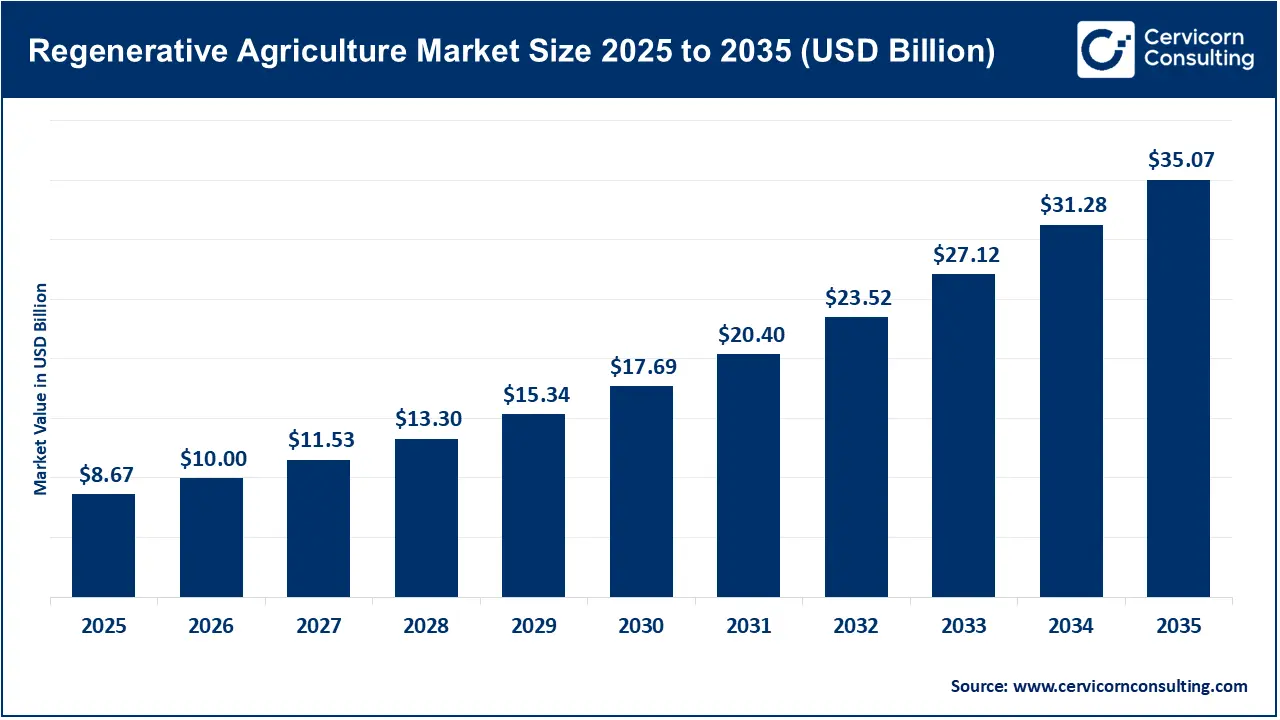
The global regenerative agriculture market was USD 8.67 billion in 2025, with the market projected to reach USD 35.07 billion by 2035, representing a 15.00% CAGR from 2026 to 2035, while North America accounted for 37.8% of global revenue in 2025.
Regenerative Agriculture Market Growth Factors
The regenerative agriculture market is expanding because of rising soil degradation, increasing climate variability, growing demand for sustainably produced food, pressure on farmers to reduce input costs, corporate net-zero and Scope 3 emissions commitments, government incentives for climate-smart and conservation-oriented agriculture, increasing adoption of precision farming and artificial intelligence, development of biological inputs and soil microbiome technologies, growing carbon and biodiversity markets, increasing consumer interest in ethically produced food, and the need to improve agricultural resilience without sacrificing productivity. Farmers are increasingly evaluating regenerative practices not simply as environmental measures but as tools for improving soil structure, water retention, nutrient cycling, biodiversity, input efficiency, and long-term profitability.
At the same time, food and beverage companies are developing regenerative sourcing programs to protect future agricultural supply chains, while technology providers are creating digital measurement, reporting and verification systems that make soil carbon, nitrogen efficiency, biodiversity and farm-level environmental performance more measurable.
Government policy is also becoming an important catalyst: the U.S. launched a USD 700 million NRCS Regenerative Agriculture Pilot Program, while a June 2026 U.S. executive order directed USDA to expand the program and encourage public-private partnerships; the European Union’s CAP eco-schemes reward environmental and climate-friendly farming practices; India is expanding natural farming through dedicated programs; Brazil’s ABC+ strategy promotes resilient, low-carbon agricultural systems; and Australia’s Climate-Smart Agriculture Program supports sustainable resource management and carbon and biodiversity incentives.
Get a Free Sample: https://www.cervicornconsulting.com/sample/2749
What Is the Regenerative Agriculture Market?
The regenerative agriculture market encompasses the products, technologies, services, farm-management systems, advisory solutions, biological inputs, monitoring platforms, financing mechanisms, and ecosystem-service opportunities associated with farming practices designed to restore rather than merely maintain agricultural ecosystems.
Unlike conventional agriculture, which traditionally emphasizes maximizing short- and medium-term production, regenerative agriculture focuses on improving the underlying ecological conditions that make farming productive. Common practices include:
- No-till and reduced-tillage farming
- Cover cropping
- Crop rotation
- Intercropping
- Agroforestry
- Silvopasture
- Rotational and holistic grazing
- Compost and organic amendments
- Biological fertilizers and biostimulants
- Integrated pest management
- Water-conservation systems
- Soil microbiome management
- Precision nutrient application
- Carbon farming
- Biodiversity enhancement
Consequently, the commercial market extends beyond physical farm products. It includes soil testing, carbon measurement, digital agronomy, farm-management software, biological solutions, robotics, precision agriculture, carbon-credit platforms, regenerative certification, advisory services, and sustainable supply-chain programs.
Why Is Regenerative Agriculture Important?
Regenerative agriculture is important because agricultural productivity ultimately depends on the health of soil, water, biodiversity and ecosystems.
1. Soil Health
Healthy soil provides physical structure, biological activity and nutrient availability for crops. Regenerative practices such as cover cropping, reduced tillage and organic amendments can support soil organic matter and microbial activity.
2. Water Management
Improved soil structure can increase water infiltration and retention while reducing erosion and runoff. This is particularly valuable in regions facing drought and unpredictable rainfall.
3. Lower Input Dependency
Farmers can potentially reduce dependence on synthetic fertilizers and pesticides through nutrient cycling, biological inputs, crop diversification and integrated pest management.
4. Climate Resilience
Regenerative systems are increasingly being evaluated as tools for adapting agricultural production to heat, drought, flooding and other climate-related stresses.
5. Biodiversity
Crop diversification, agroforestry, hedgerows and integrated livestock systems create habitats for beneficial insects, microorganisms and other organisms.
6. Farmer Economics
Regenerative agriculture can improve farm economics by reducing selected input requirements, creating premium-market opportunities and opening additional revenue channels such as carbon and biodiversity markets.
However, regenerative agriculture is not automatically profitable in every geography or farming system. Transition costs, learning requirements, yield variability, access to markets and measurement challenges remain important considerations.
Leading Companies in the Regenerative Agriculture Market
The competitive landscape includes technology startups, biological-input companies, agricultural service providers, impact investors and large agribusiness organizations. The following five companies are among the organizations identified in market research coverage of the sector.
| Company | Specialization | Key Focus Areas | Notable Features | 2025 Revenue | Market Share | Global Presence |
|---|---|---|---|---|---|---|
| Agreed.Earth | Agricultural sustainability and nitrogen management | Nitrogen efficiency, carbon footprint, farm economics | SaaS-based nitrogen tracking and loss monitoring | Not publicly disclosed | Not publicly disclosed | UK/Europe with agricultural and agribusiness applications |
| Aker Technologies, Inc. | Agricultural technology and data-driven farm management | Precision agriculture, field intelligence, sustainable production | Technology-enabled agricultural decision support | Not publicly disclosed | Not publicly disclosed | International market presence |
| Astanor Ventures | Impact investment in agrifood technology | Regenerative agriculture, climate transition, biodiversity, resource efficiency | Global impact-investing model; supports companies from seed to growth | Not applicable; private investment firm | Not applicable as an operating agriculture company | Europe, U.S. and global portfolio |
| Biotrex | Soil microbial analysis | Soil health, microbial diversity, biological activity | BIOTREX 31 and BIOTREX 95 microbial analysis technologies | Not publicly disclosed | Not publicly disclosed | Japan, Europe and international distributor network |
| Carbon Robotics | AI-powered agricultural robotics | Automated weeding, herbicide reduction, farm automation | LaserWeeder and Carbon Autonomy use computer vision and AI | Over USD 100 million annual revenue currently reported by company | Not publicly disclosed | 15 countries; manufacturing in U.S. and Europe |
Agreed.Earth
Agreed.Earth focuses on agricultural sustainability through nitrogen accounting and tracking. Its technology monitors nitrogen use and losses, providing farmers and organizations with information that can support both environmental performance and profitability. The company was founded in 2021 and is based in Cambridge, England. Public financial databases do not provide a verified 2025 revenue figure or market-share percentage, so these figures should not be estimated.
Aker Technologies, Inc.
Aker Technologies is identified in regenerative agriculture market research as an emerging agricultural technology participant. Its positioning reflects the broader market shift toward data-driven agriculture, where farm-level information can be used to improve resource efficiency, crop management and sustainability outcomes. Publicly verifiable 2025 revenue and market-share data are not available, making it more appropriate to classify these figures as not publicly disclosed rather than assign speculative numbers.
Astanor Ventures
Astanor Ventures differs from the other companies because it is primarily an impact venture capital investor, rather than a conventional regenerative agriculture product manufacturer. Its investment strategy targets the agrifood system, including climate transition, nature positivity, resource efficiency and regenerative solutions. Astanor states that it works with founders to embed regenerative principles and improve impact measurement.
Because Astanor is an investment firm, an agricultural-market revenue figure or operating-company market share would be misleading. Its relevance lies in its ability to provide capital and strategic support to companies developing regenerative technologies.
Biotrex
BIOTREX provides soil microbial analysis designed to measure microbial activity, diversity and functional potential. Its technology uses Community-Level Physiological Profiling to understand how soil microbial communities metabolize different substrates. The company offers BIOTREX 31 and BIOTREX 95 analysis approaches and has developed distribution and laboratory relationships across Europe.
This type of technology is becoming increasingly relevant because regenerative agriculture requires better measurement of soil biology rather than relying exclusively on conventional chemical soil tests.
Carbon Robotics
Carbon Robotics represents the intersection of regenerative agriculture and physical AI. Its LaserWeeder technology uses computer vision, deep learning and lasers to identify and destroy weeds while reducing reliance on herbicides.
The company states that it has grown to more than USD 100 million in annual revenue, serves customers in 15 countries, and operates manufacturing facilities in the U.S. and Europe. Because this is a company-reported current annual-revenue figure rather than a separately audited 2025 filing, it should not be interpreted as a precise FY2025 revenue number.
Leading Trends and Their Impact on the Regenerative Agriculture Market
1. AI and Precision Agriculture
Artificial intelligence is changing regenerative agriculture from a largely practice-oriented concept into a data-driven management system.
AI can analyze satellite imagery, soil measurements, weather information, crop conditions and farm machinery data to identify areas requiring intervention. Robotic systems such as Carbon Robotics’ LaserWeeder demonstrate how AI can directly reduce chemical inputs while automating labor-intensive operations.
Impact: AI improves precision, reduces unnecessary input application and makes regenerative practices more scalable.
2. Soil Carbon Measurement and MRV
Measurement, reporting and verification are becoming critical as companies and farmers seek to monetize carbon and environmental outcomes.
Digital MRV platforms can track changes in soil carbon, nitrogen use, biodiversity and farm management practices.
Impact: Better measurement increases credibility and can improve access to sustainability-linked financing and carbon markets.
3. Growth of Biological Inputs
Microbial fertilizers, biostimulants, biological crop-protection products and soil amendments are becoming important components of regenerative farming.
BIOTREX’s soil microbial analysis illustrates another part of this ecosystem: farmers and input manufacturers increasingly want to understand whether biological interventions are actually changing soil function.
Impact: Biological solutions can reduce dependence on conventional agricultural inputs while improving soil functionality.
4. Corporate Regenerative Sourcing
Food companies are increasingly working directly with farmers to improve the sustainability of ingredient supply chains.
General Mills, for example, has committed to advancing regenerative agriculture across 1 million acres by 2030 and reported engagement with more than 600,000 acres in fiscal 2024.
Impact: Corporate procurement programs create demand for regenerative commodities and help transfer sustainability investment toward farms.
5. Carbon and Biodiversity Markets
Agricultural land is increasingly viewed not only as a food-production asset but also as a provider of ecosystem services.
Carbon sequestration, biodiversity, water-quality improvement and soil restoration can create additional economic opportunities.
Impact: Farmers may develop diversified revenue streams, although market integrity, measurement standards and permanence requirements remain critical.
6. Regenerative Certification and Traceability
Certification systems are developing to provide consumers and businesses with greater confidence about regenerative claims.
Traceability technologies can connect farm-level practices with products moving through the supply chain.
Impact: Greater standardization can reduce greenwashing and make regenerative products easier to differentiate.
7. Robotics and Automation
Labor shortages are accelerating demand for automated farm machinery. Robots can perform precision weeding, monitoring and other operations while minimizing soil disturbance and chemical use.
Impact: Automation can reduce labor costs while supporting regenerative objectives.
8. Farmer-Centric Business Models
Successful regenerative agriculture increasingly depends on making the economics work for farmers.
Programs that combine agronomic support, technology, financing, market access and performance-based incentives are likely to outperform programs that focus only on environmental targets.
Successful Examples of Regenerative Agriculture Around the World
United States – White Oak Pastures
White Oak Pastures in Georgia is one of the best-known regenerative livestock examples. The farm began transitioning toward holistic agricultural practices in the 1990s, eliminated chemical fertilizers in 2000 and subsequently developed vertically integrated processing capabilities. It became recognized as a regenerative agriculture leader by the Savory Institute.
The model demonstrates how regenerative agriculture can combine rotational grazing, ecosystem management, livestock production, direct marketing and value-added processing.
India – Andhra Pradesh Community-Managed Natural Farming
Andhra Pradesh provides one of the world’s largest examples of community-led agroecological farming. NITI Aayog reports that the Andhra Pradesh Community Managed Natural Farming program had expanded from approximately 40,000 farmers in 2016 to around 750,000 farmers and farm workers in 2020–21.
The program combines natural inputs, crop diversification, mulching, reduced disturbance, community knowledge-sharing and farmer-to-farmer extension.
Individual farmer examples also illustrate the economic potential. NITI Aayog reports that farmer Adaribariki Seethamma earned ₹28,000 from 0.30 acres, with cultivation costs of approximately ₹2,300, while another farmer, Vijay Kumar, reported gross income of ₹55,000 against costs of ₹12,000 in a natural-farming demonstration.
Kenya – Regenerative Smallholder Agriculture
In eastern Kenya, Farm Africa’s Strengthening Regenerative Agriculture in Kenya initiative has supported more than 50,000 farmers in Embu and Tharaka Nithi counties. The program focuses on restoring soil health, conserving water, improving productivity and increasing farmer resilience.
The example demonstrates how regenerative agriculture can be adapted to smallholder farming rather than being limited to large commercial farms.
Australia – Regenerative Grazing
Australian livestock systems are increasingly experimenting with adaptive grazing, pasture diversification, silvopasture and reduced synthetic inputs. Recent research published in Nature Food evaluated regenerative-agriculture practices across Australian sheep farms and found that profitability and productivity depend strongly on local conditions such as rainfall, stocking rates and pasture characteristics.
This highlights an important lesson for the global market: regenerative agriculture is context-dependent, and no single practice produces the same outcome everywhere.
Europe – Agroecology and Carbon Farming
European agriculture is increasingly integrating agroecological practices, agroforestry, precision farming and carbon farming through CAP eco-schemes. The European Commission specifically identifies agroecology, precision farming, agroforestry and carbon farming as practices that can receive support under eco-schemes.
Global Regional Analysis Including Government Initiatives and Policies
North America
North America is currently the leading regional market, accounting for approximately 35.7% of global regenerative agriculture revenue in 2025 according to Grand View Research.
The U.S. market benefits from strong participation by food manufacturers, retailers, agricultural technology companies, farmers and conservation organizations. Demand is also supported by carbon markets, precision agriculture and corporate sustainability programs.
A particularly important development occurred in December 2025, when USDA’s Natural Resources Conservation Service launched its Regenerative Agriculture Pilot Program with USD 700 million, comprising USD 400 million through EQIP and USD 300 million through CSP.
In June 2026, the U.S. government further strengthened the policy environment through an executive order directing USDA to expand the regenerative pilot program and promote public-private partnerships.
Canada also has significant potential because of its large agricultural land base, climate-smart agriculture programs and growing demand for sustainable agricultural commodities.
Europe
Europe is one of the most policy-driven regenerative agriculture markets.
The EU Common Agricultural Policy 2023–27 requires member states to include eco-schemes that reward farmers for climate- and environmentally beneficial practices. Approximately 25% of direct payments are allocated to eco-schemes during the 2023–27 period. Eligible activities include organic farming, agroecology, precision farming, agroforestry and carbon farming.
The EU’s broader sustainability agenda is therefore creating an institutional framework for regenerative agriculture.
The proposed post-2027 CAP also emphasizes stronger incentives for biodiversity, climate and animal-welfare practices and includes support for farms transitioning toward more sustainable models.
Asia-Pacific
Asia-Pacific represents a major long-term growth opportunity because of its enormous agricultural population, diverse farming systems and exposure to water scarcity, soil degradation and climate change.
India
India is developing a broad policy ecosystem around natural and regenerative farming. The National Mission on Natural Farming, launched in 2024, provides an output-based incentive of ₹4,000 per acre per year for two years, with support for bio-input resource centers and natural-farming clusters. As of March 5, 2026, government data reported 18,786 clusters, covering 8.80 lakh hectares, with 18.19 lakh farmers enrolled.
Other programs, including Paramparagat Krishi Vikas Yojana, Soil Health & Fertility initiatives, Per Drop More Crop and agroforestry programs, contribute to the broader transition toward resource-efficient agricultural production.
Australia
Australia’s regenerative agriculture market is strongly connected with climate resilience, natural capital and carbon farming.
The Australian Government’s Climate-Smart Agriculture Program provides AUD 302.1 million over five years from 2023–24 to 2027–28 through the Natural Heritage Trust. The program supports emissions reduction, climate resilience, carbon and biodiversity incentives and sustainable natural-resource management.
Australia’s Agriculture and Land Sector Plan also seeks to balance agricultural production, carbon storage and nature repair while maintaining benefits for regional communities.
New Zealand
New Zealand has developed a strong research and policy focus on regenerative agricultural systems. Its government has previously supported research into regenerative agriculture and sustainable food and fibre systems, including efforts to establish an evidence base for regenerative practices.
In 2025–26, however, New Zealand shifted away from introducing an on-farm agricultural emissions-pricing system by 2030 and adopted a more technology-led and market-led approach to reducing agricultural emissions.
This policy direction may encourage technology providers, biological-input developers and market-based sustainability platforms.
Latin America
Latin America has significant regenerative agriculture potential because of its enormous agricultural land base and established experience with integrated crop-livestock systems, agroforestry and conservation agriculture.
Brazil
Brazil’s ABC+ Plan for 2020–2030 is particularly important. The government describes ABC+ as a national strategic agenda for climate adaptation and low-carbon agriculture, with the objective of creating sustainable, resilient and productive agricultural systems. It emphasizes integrated landscape management, productivity, farmer income, resilience and greenhouse-gas reduction.
Brazil’s established experience with no-till farming, integrated crop-livestock-forestry systems and biological agricultural inputs provides a strong foundation for regenerative agriculture.
Middle East & Africa
The Middle East and Africa represent a high-potential but highly diverse market.
In water-stressed Middle Eastern economies, regenerative agriculture is closely associated with water efficiency, controlled-environment farming, soil restoration and precision irrigation.
In Africa, the opportunity is strongly linked to smallholder productivity, soil fertility, agroforestry, drought resilience and farmer incomes. Kenya provides an important example, with regenerative programs supporting more than 50,000 farmers in eastern counties.
For African markets, scalable farmer-extension models, affordable biological inputs, mobile advisory platforms and blended financing are likely to be especially important because many smallholders cannot independently absorb the upfront costs associated with transitioning to new production systems.
Market Outlook
The regenerative agriculture market is increasingly evolving from a collection of farming practices into a full agricultural ecosystem involving technology, biological inputs, data, finance, food supply chains, carbon markets and government programs.
The most important competitive shift is likely to be from simply selling a regenerative product toward demonstrating measurable outcomes. Soil health indicators, microbial activity, water retention, nutrient efficiency, biodiversity, carbon sequestration and farmer profitability are becoming increasingly important metrics.
As measurement technologies mature, companies that can connect farm practices → measurable environmental outcomes → financial value are positioned to play a larger role in the market. At the same time, government incentives and corporate sourcing commitments can accelerate adoption by reducing transition risks for farmers.
The result is an increasingly interconnected market in which AI-powered machinery, soil analytics, biological inputs, carbon measurement, regenerative certification, sustainable finance and farmer advisory services work together to make regenerative agriculture more commercially viable at scale.
To Get Detailed Overview, Contact Us: https://www.cervicornconsulting.com/contact-us
Read Report: Liquid-cooled EV Charger Module Market Revenue, Trends, and Strategic Insights by 2035