Internal Combustion Engine Market Revenue, Trends, and Strategic Insights by 2035
Internal Combustion Engine Market Size
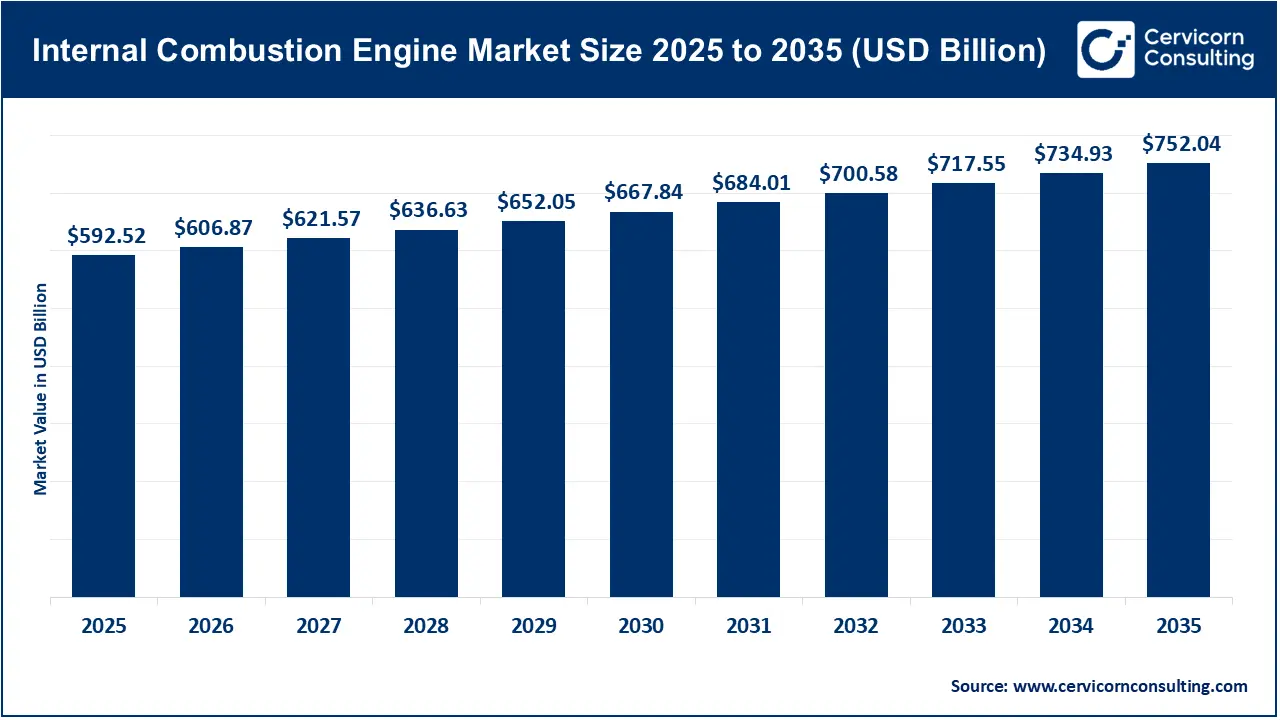
The global internal combustion engine market was valued at approximately USD 592.52 billion in 2025 and is projected to reach USD 752.04 billion by 2035, expanding at a CAGR of 2.41% during the forecast period.
Internal Combustion Engine Market Growth Factors
The internal combustion engine market continues to be supported by strong demand for passenger cars, commercial vehicles, heavy-duty trucks, construction equipment, agricultural machinery, marine vessels, distributed power systems, and industrial applications, particularly in emerging economies where charging infrastructure for electric vehicles remains uneven and conventional fuel distribution networks are well established. Rising urbanization, expanding logistics and transportation activity, infrastructure development, increasing agricultural mechanization, and demand for high-power equipment are sustaining the use of gasoline and diesel engines. Technological improvements in turbocharging, direct fuel injection, variable valve timing, exhaust-gas recirculation, selective catalytic reduction, particulate filters, engine control units, and hybrid powertrains are also extending the relevance of combustion engines by improving fuel economy and reducing emissions.
In addition, hybrid vehicles continue to combine internal combustion engines with electric motors, allowing manufacturers to retain combustion technology while meeting increasingly stringent efficiency and emissions requirements. Demand from heavy-duty applications is particularly important because trucks, buses, construction equipment, mining machinery, agricultural equipment, marine engines, and backup generators often require long operating ranges, rapid refueling, high torque, and reliable operation under demanding conditions.
At the same time, government regulations are forcing manufacturers to invest in cleaner combustion technologies, alternative fuels, and electrified powertrains, creating a transition rather than an immediate disappearance of the internal combustion engine.
Get a Free Sample: https://www.cervicornconsulting.com/sample/2737
What Is the Internal Combustion Engine Market?
The internal combustion engine (ICE) market encompasses the manufacturing, sale, integration, replacement, servicing, and technological development of engines that generate mechanical power by burning fuel inside a combustion chamber. These engines generally use gasoline, diesel, natural gas, liquefied petroleum gas, biofuels, synthetic fuels, or other combustible fuels.
Internal combustion engines can broadly be divided into spark-ignition engines and compression-ignition engines. Gasoline engines generally use spark ignition, while diesel engines primarily rely on compression ignition. Engine configurations vary from small single-cylinder engines to sophisticated multi-cylinder power units used in cars, trucks, buses, ships, locomotives, aircraft-related applications, agricultural machinery, mining equipment, and stationary power-generation systems.
The market is not limited to new engines. It also includes replacement engines, engine components, maintenance, remanufacturing, aftermarket parts, fuel-injection systems, turbochargers, emission-control systems, lubricants, and engine-management technologies.
Although battery-electric vehicles are expanding rapidly, ICE technology remains deeply embedded in the global transportation and industrial ecosystem. Millions of vehicles already depend on combustion engines, while commercial fleets and off-highway machinery often require power characteristics that are difficult to replace immediately with battery-electric alternatives.
Why Is the Internal Combustion Engine Market Important?
The importance of the internal combustion engine market comes from its enormous role in global mobility, industrial productivity, logistics, agriculture, construction, and energy security. Combustion engines provide high energy density, rapid refueling, established infrastructure, and long operating ranges. These characteristics are especially valuable for heavy-duty vehicles that travel long distances or operate continuously.
For developing economies, ICE vehicles can also remain economically attractive because gasoline and diesel distribution networks are already widespread. In regions where electricity grids are unreliable or public charging infrastructure is still developing, conventional and hybrid vehicles provide practical mobility.
The technology is also becoming more sophisticated. Modern engines use electronic control systems, advanced combustion strategies, lightweight materials, improved lubrication, high-pressure fuel injection, turbocharging, and after-treatment technologies to extract greater efficiency from every unit of fuel.
Consequently, the market is shifting from traditional ICE technology toward high-efficiency, low-emission, hybrid-compatible and alternative-fuel combustion systems.
Major Companies in the Internal Combustion Engine Market
| Company | Specialization | Key Focus Areas | Notable Features | 2025 Revenue* | Market Share | Global Presence |
|---|---|---|---|---|---|---|
| AB Volvo | Heavy-duty engines and commercial vehicles | Trucks, buses, construction equipment, power solutions | High-torque diesel engines, fuel efficiency, alternative powertrains | SEK 479.2 billion | Not separately disclosed | Nearly 180 markets |
| Toyota Motor Corporation | Passenger-vehicle and hybrid engines | Gasoline, hybrid, commercial mobility, efficient powertrains | Toyota Hybrid System, high-efficiency gasoline engines | ¥48.04 trillion | Not separately disclosed | Global |
| Volkswagen Group | Passenger and commercial vehicle engines | Gasoline, diesel, hybridization, modular platforms | Modular engine platforms, turbocharging, hybrid integration | €321.9 billion | Not separately disclosed | Global |
| Rolls-Royce plc / Rolls-Royce Holdings | High-performance power systems | Marine, defense, power generation, aerospace | Advanced large engines and power systems | £21.21 billion | Not separately disclosed | Global |
| Mahindra & Mahindra Ltd. | Automotive and utility engines | SUVs, commercial vehicles, tractors, agricultural machinery | Diesel powertrains, utility vehicles, farm equipment | ₹159,211 crore | Not separately disclosed | India and international markets |
AB Volvo
AB Volvo is a major player in commercial transportation, construction equipment, marine and industrial power solutions. Its ICE activities are particularly significant in heavy-duty trucks, buses, construction machinery and industrial applications where high torque, durability and uptime are essential.
Volvo Group reported SEK 479.2 billion in net sales in 2025, equivalent to approximately €43 billion, while serving customers in almost 180 markets and employing nearly 100,000 people.
Volvo’s strategy increasingly combines efficient combustion engines with electrification, alternative fuels and connected services. Its approach illustrates how ICE manufacturers can transition toward lower-carbon transportation without abandoning combustion technology in applications where it remains commercially important.
Toyota Motor Corporation
Toyota Motor Corporation is one of the world’s most influential combustion-engine manufacturers and has developed a particularly important bridge between ICE and electrification through hybrid vehicles.
Toyota reported ¥48.04 trillion in sales revenues for fiscal 2025, with vehicle-related revenue representing the majority of sales. Toyota’s strategy emphasizes a diversified approach involving hybrid-electric, plug-in hybrid, battery-electric and other powertrain technologies rather than relying exclusively on one propulsion system. Its global sales and production network provides substantial scale for continued development of highly efficient combustion engines.
The Toyota Hybrid System is particularly important because it demonstrates how an ICE can remain central to a vehicle while an electric motor reduces fuel consumption and allows the engine to operate more efficiently.
Volkswagen Group
Volkswagen Group operates a large global portfolio covering passenger cars, commercial vehicles and premium brands. Internal combustion engines remain important across its gasoline and diesel vehicle portfolios, even as the company expands battery-electric vehicles.
Volkswagen Group generated €321.9 billion in sales revenue in 2025 and delivered approximately 9.0 million vehicles worldwide. Approximately 80.5% of Volkswagen Group’s sales revenue came from outside Germany in 2025, emphasizing the group’s global reach.
The company’s ICE strategy increasingly focuses on downsized turbocharged engines, emissions-control systems, hybridization and modular architectures that can support multiple propulsion technologies.
Rolls-Royce plc / Rolls-Royce Holdings
Rolls-Royce Holdings is relevant to the broader combustion-engine market through large-scale power systems, marine engines, defense propulsion and aerospace technologies.
Rolls-Royce Holdings reported £21.207 billion in statutory revenue in 2025, while underlying revenue reached £20.059 billion. Its large-engine capabilities are particularly important where power density, reliability and endurance are critical.
Unlike passenger-car manufacturers, Rolls-Royce illustrates the importance of combustion engines beyond road transportation. Marine vessels, defense platforms, distributed power systems and other specialized applications can require very high power output and long operating cycles.
Mahindra & Mahindra Ltd.
Mahindra & Mahindra Limited has a strong position in India’s automotive and agricultural machinery sectors. Its combustion-engine exposure includes utility vehicles, commercial vehicles and tractors, making the company particularly relevant to emerging-market ICE demand.
Mahindra reported ₹159,211 crore in consolidated income from operations in FY2025, representing a 14% increase over FY2024. The company also reported a 22.5% SUV revenue market share in FY2025.
Mahindra’s position demonstrates why ICE technology continues to matter in markets where SUVs, utility vehicles, commercial transportation and agricultural machinery remain important sources of mobility and economic productivity.
Leading Trends and Their Impact
1. Hybridization of Internal Combustion Engines
Hybridization is arguably one of the most important trends shaping the future of ICE technology. Hybrid vehicles combine a combustion engine with an electric motor, battery and power electronics.
This approach allows manufacturers to reduce fuel consumption without requiring consumers to depend entirely on charging infrastructure. Toyota’s extensive hybrid portfolio demonstrates the commercial potential of this model.
Impact: Hybridization extends the life of combustion engines while accelerating their transition toward greater efficiency and lower emissions.
2. Advanced Fuel-Injection Technology
High-pressure direct injection, electronically controlled injection systems and improved combustion management are helping engines extract more useful energy from fuel.
Modern engine-control units continuously adjust injection timing, fuel quantity, air-fuel ratios and ignition characteristics.
Impact: Better combustion improves fuel economy and can reduce pollutant emissions while increasing engine performance.
3. Turbocharging and Downsizing
Manufacturers increasingly use turbochargers to produce the power of larger engines from smaller-displacement units.
Impact: Downsized turbocharged engines can reduce fuel consumption while maintaining performance, although their effectiveness depends on driving conditions and vehicle design.
4. Alternative Fuels
Natural gas, biofuels, renewable diesel, hydrogen-derived fuels and synthetic fuels are becoming increasingly relevant to the combustion-engine ecosystem.
Alternative fuels can allow existing engine architectures to remain useful while lowering lifecycle emissions depending on fuel production pathways.
Impact: Fuel diversification creates opportunities for ICE technology in commercial transportation, agriculture, marine applications and industrial equipment.
5. Stricter Emission Standards
Governments worldwide are imposing increasingly demanding emissions requirements. These rules are encouraging investment in particulate filters, selective catalytic reduction, exhaust-gas recirculation, advanced catalysts and sophisticated engine-management systems.
Impact: Regulatory pressure increases development costs but creates opportunities for advanced engine components and emissions-control technologies.
6. Electrification and ICE-EV Convergence
Electrification does not necessarily mean the immediate disappearance of ICE technology. Instead, the market is increasingly moving toward powertrain combinations such as mild hybrids, full hybrids and plug-in hybrids.
Impact: Engine manufacturers are increasingly developing combustion engines specifically for hybrid operation, optimizing them for efficiency rather than simply maximum standalone power.
7. Software-Defined Engine Management
Software is becoming a central component of modern engine operation. Sensors, controllers and algorithms can optimize combustion, emissions, fuel economy and thermal management.
Impact: The competitive advantage of engine manufacturers is increasingly shifting from mechanical hardware alone toward integrated hardware-software systems.
Successful Examples of the Internal Combustion Engine Market Around the World
Toyota’s Global Hybrid Model
Toyota’s hybrid strategy is one of the clearest examples of successful ICE adaptation. Instead of treating electric propulsion and combustion engines as mutually exclusive technologies, Toyota integrated them into a single powertrain strategy. The company continues to report vehicle production and sales across global markets while developing connected, automated and electrified mobility technologies.
This model has helped demonstrate that the combustion engine can remain commercially relevant when paired with electric propulsion and sophisticated energy management.
Volvo’s Heavy-Duty Powertrain Ecosystem
Volvo demonstrates another successful ICE application: heavy-duty transportation. Trucks and construction machinery require high torque, durability and dependable operation. Volvo continues to offer fuel-efficient products while expanding alternative powertrain solutions.
Its 2025 results showed continued strength in its service business even during a cyclical downturn in vehicle demand, demonstrating the economic importance of the installed engine and vehicle base.
Mahindra’s Utility and Agricultural Applications
Mahindra’s ICE-powered SUVs, commercial vehicles and tractors illustrate the importance of combustion engines in emerging economies. Agricultural equipment requires high torque and dependable operation across geographically dispersed areas, making diesel technology particularly useful.
The company’s FY2025 performance, including ₹159,211 crore in consolidated income from operations, demonstrates the continuing commercial scale of its broader mobility and agricultural equipment ecosystem.
Volkswagen’s Global Modular Approach
Volkswagen’s global manufacturing network provides another example. Its modular vehicle and powertrain architectures allow the group to serve different regulatory and consumer environments with gasoline, diesel, hybrid and electric technologies.
With 9.0 million vehicle deliveries in 2025, Volkswagen’s scale illustrates why ICE remains an important component of the global automotive manufacturing ecosystem even as electrification expands.
Rolls-Royce Large-Engine Applications
Rolls-Royce demonstrates that the ICE market extends far beyond automobiles. Large-scale engines and power systems remain important for applications where reliability, power density and endurance are essential.
The company’s 2025 statutory revenue of £21.2 billion and underlying revenue of £20.1 billion reflect the scale of its diversified engineering operations.
Global Regional Analysis
North America
North America remains an important ICE market because of its large passenger-vehicle fleet, extensive trucking industry, construction sector, agricultural equipment base and long-distance transportation requirements.
The United States is simultaneously pushing manufacturers toward cleaner powertrains. The EPA’s heavy-duty emissions program has established increasingly stringent requirements for model years beginning in 2027. The earlier Phase 3 framework was designed to be technology-neutral, allowing manufacturers to use advanced combustion engines, hybrid systems, battery-electric vehicles and fuel-cell technologies.
The regulatory environment has subsequently evolved. In February 2026, the EPA finalized rescission of the 2009 greenhouse-gas endangerment finding and related federal motor-vehicle GHG standards, while criteria-pollutant standards and CAFE requirements were not rescinded by that action.
Market impact: North American manufacturers are likely to maintain investments in highly efficient ICE and hybrid systems, especially for pickups, commercial trucks, specialty vehicles and off-road applications, while regulatory uncertainty may influence the speed and mix of electrification investment.
Europe
Europe has historically been one of the world’s most regulation-intensive automotive markets. The European Union’s Euro 7 framework addresses vehicle emissions and battery durability and builds on earlier emissions legislation.
European manufacturers therefore face strong pressure to reduce nitrogen oxides, particulate emissions and other pollutants from combustion vehicles.
At the same time, Europe’s commercial transportation sector continues to require trucks, buses and specialized vehicles capable of long-distance operation. This supports demand for increasingly efficient diesel engines, hybrid powertrains and alternative fuels.
Market impact: Europe’s ICE market is shifting toward premium, highly efficient and hybrid-compatible engines, while manufacturers simultaneously develop battery-electric and other zero-emission platforms.
Asia-Pacific
Asia-Pacific is arguably the most diverse regional environment for internal combustion engines. Japan has a sophisticated automotive industry, China has enormous vehicle-production capacity, India has a rapidly expanding automotive and agricultural equipment market, and Southeast Asia continues to experience strong demand for motorcycles, passenger vehicles and commercial transportation.
Japan’s automotive ecosystem has been particularly important in hybrid technology. Its approach demonstrates how improvements in fuel efficiency, hybridization and engine optimization can coexist with electrification.
India represents another important market. The country has progressively tightened emissions requirements through its Bharat Stage framework. India’s BS-VI OBD Stage II-B requirements apply to vehicles manufactured from April 1, 2025, illustrating the increasing technological requirements placed on modern combustion vehicles.
Mahindra’s FY2025 performance further demonstrates the importance of automotive and agricultural equipment demand in India.
Market impact: Asia-Pacific is likely to remain a major ICE manufacturing and consumption center because of its large installed vehicle base, industrialization, agricultural mechanization and commercial transportation requirements. However, hybridization and emissions-control technologies will increasingly determine competitiveness.
Latin America
Latin America has considerable demand for internal combustion vehicles because of its developing road infrastructure, large agricultural sector, mining activities and commercial transportation requirements. Fuel availability and vehicle affordability remain major considerations in several countries.
Brazil is particularly important because of its experience with ethanol-based fuels. Biofuel-compatible combustion engines provide an example of how local fuel resources can support the continued evolution of ICE technology.
Market impact: Alternative fuels and flexible-fuel engines can provide an important pathway for reducing emissions without immediately replacing the existing combustion-engine fleet.
Middle East & Africa
The Middle East and Africa offer diverse opportunities. Oil-producing economies have well-established fuel infrastructure, while African markets often rely heavily on used vehicles and conventional powertrains because of affordability and charging-infrastructure constraints.
Internal combustion engines also have important applications in mining, construction, agriculture, power generation and commercial transportation.
Market impact: ICE demand is likely to remain resilient in heavy-duty and off-highway applications, although emissions regulation and renewable-energy development will increasingly influence engine selection.
Government Initiatives and Policies Shaping the Market
Government policy is one of the strongest forces influencing the future of the internal combustion engine market.
Emission standards are pushing manufacturers toward cleaner combustion. India has implemented BS-VI requirements, including tighter onboard diagnostics requirements for vehicles produced from April 2025.
European regulations are encouraging manufacturers to reduce vehicle emissions and improve durability. Euro 7 covers motor vehicles and engines and includes requirements related to emissions and battery durability.
U.S. regulations have targeted heavy-duty trucks and engines because of their significant contribution to transportation emissions. EPA’s previous Phase 3 framework established more stringent standards beginning in model year 2027 and recognized advanced ICE technology, hybridization and zero-emission technologies as potential compliance pathways.
Fuel-efficiency policies are also influencing engine development. Japan and other advanced automotive economies have promoted higher fuel efficiency through regulatory targets and technology development.
Alternative-fuel initiatives can further extend the relevance of combustion engines. Biofuels, renewable diesel, natural gas and synthetic fuels can reduce dependence on conventional petroleum depending on production methods and lifecycle emissions.
Electrification incentives create the strongest long-term competitive pressure on ICE. Government subsidies, charging infrastructure programs, fleet-transition policies and zero-emission vehicle targets encourage manufacturers and consumers to consider battery-electric and fuel-cell vehicles.
The result is a market undergoing structural transformation rather than a simple replacement cycle. Internal combustion engines are increasingly expected to become cleaner, more efficient, software-controlled, hybrid-ready and compatible with lower-carbon fuels. This transition is particularly important in commercial vehicles, heavy-duty transportation, construction, agriculture, marine applications and distributed power, where the operational requirements of customers can differ substantially from those of passenger-car users.
To Get Detailed Overview, Contact Us: https://www.cervicornconsulting.com/contact-us
Read Report: India Insurance Market Revenue, Trends, and Strategic Insights by 2035