Blade Battery Market Revenue, Trends, and Strategic Insights by 2035
Table of Contents
ToggleBlade Battery Market Size
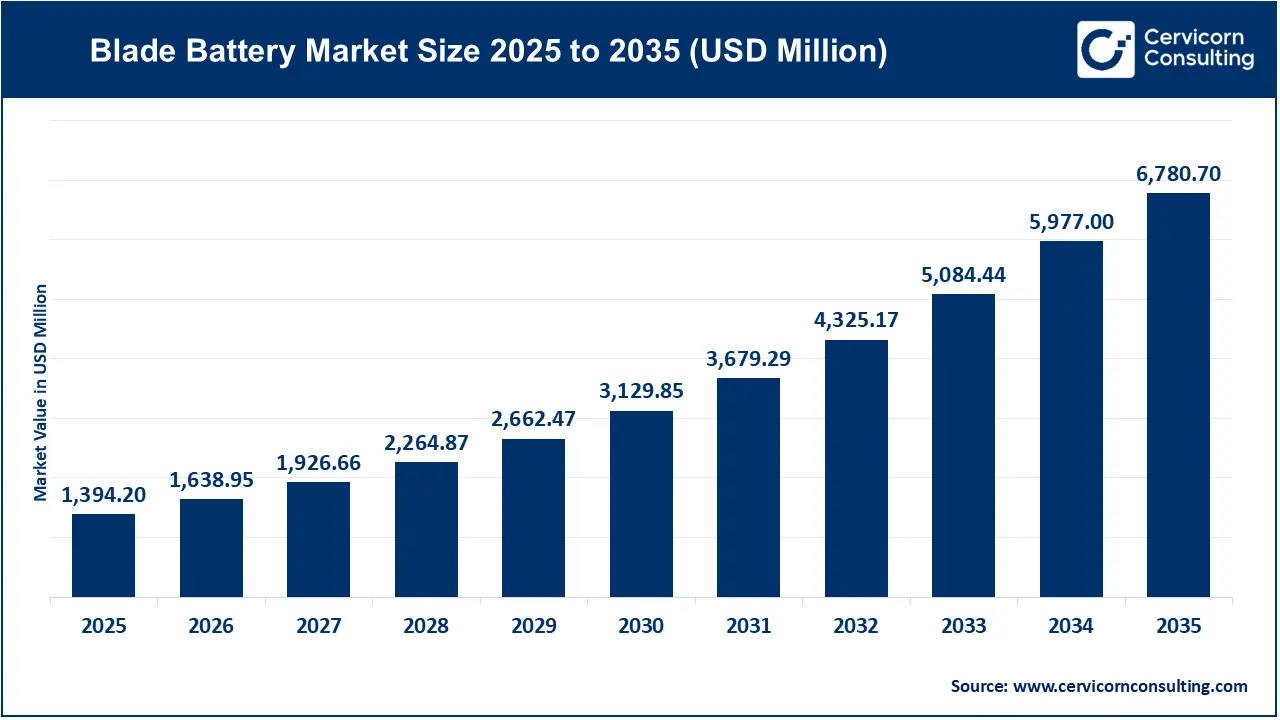
The global blade battery market was valued at approximately USD 1,394.2 million in 2025 and is projected to reach USD 6,780.70 million by 2035, expanding at a CAGR of 17.14% during the forecast period.
Blade Battery Market Growth Factors
The blade battery market is experiencing robust growth due to the rapid expansion of electric vehicle production, increasing demand for safer lithium-ion batteries, rising adoption of lithium iron phosphate (LFP) chemistry, declining battery manufacturing costs, government incentives supporting EV purchases, stricter carbon emission regulations, growing investments in battery gigafactories, improvements in energy density, increasing deployment of renewable energy storage systems, expansion of charging infrastructure, rising consumer preference for longer battery life, advancements in battery management systems, increasing localization of battery manufacturing, growing commercial electric vehicle fleets, technological innovations in cell-to-pack architecture, and strategic collaborations between battery manufacturers and automotive OEMs to develop next-generation electric mobility solutions.
What is the Blade Battery Market?
The blade battery market refers to the global industry involved in the development, manufacturing, commercialization, and deployment of blade-structured lithium-ion batteries, primarily based on lithium iron phosphate (LFP) chemistry.
Unlike conventional battery modules composed of multiple small cells assembled into battery packs, blade batteries utilize long, thin cells arranged directly within the battery pack. This innovative architecture improves space utilization while reducing unnecessary structural components.
Blade batteries offer several advantages including:
- Higher safety performance
- Improved thermal management
- Longer cycle life
- Better structural rigidity
- Reduced manufacturing complexity
- Lower production costs
- Higher volumetric efficiency
Initially introduced for electric passenger vehicles, blade batteries are now expanding into commercial transportation, buses, trucks, energy storage systems, marine applications, and industrial electrification.
Get a Free Sample: https://www.cervicornconsulting.com/sample/2710
Why is the Blade Battery Market Important?
Blade battery technology is becoming increasingly important because battery safety has become one of the biggest priorities in electric mobility.
Traditional lithium-ion batteries using nickel-rich chemistries provide high energy density but may experience thermal runaway under severe conditions. Blade batteries significantly reduce these risks due to their LFP chemistry and structural design.
The market is important because it enables:
- Safer electric vehicles
- Lower battery production costs
- Longer battery lifespan
- Improved sustainability
- Reduced dependence on expensive metals such as cobalt and nickel
- Faster EV adoption worldwide
- Better energy storage solutions
- Improved supply chain resilience
As global EV sales continue to rise, blade batteries are expected to become one of the industry’s preferred battery technologies.
Major Companies Driving the Blade Battery Market
| Company | Specialization | Key Focus Areas | Notable Features | Estimated 2025 Revenue | Estimated Market Share | Global Presence |
|---|---|---|---|---|---|---|
| BYD Co., Ltd. | Blade Battery Manufacturing, EVs | LFP Blade Batteries, EV Integration | Pioneer of Blade Battery technology | Approx. USD 115 Billion | Strong leadership in Blade Battery deployment | Asia-Pacific, Europe, Americas |
| CATL | Advanced Lithium-ion Batteries | Cell-to-Pack, Fast Charging, Sodium-ion | World’s largest EV battery supplier | Approx. USD 65 Billion | Leading global EV battery supplier | Global manufacturing footprint across Asia, Europe, and Americas |
| LG Chem Ltd. (LG Energy Solution) | EV Battery Manufacturing | High-performance lithium-ion batteries | Strong partnerships with global automakers | Approx. USD 28 Billion | Major global battery supplier | North America, Europe, Asia |
| Panasonic Corporation | Automotive Batteries | Cylindrical Batteries, Energy Storage | Long-term partnership with leading EV manufacturers | Approx. USD 58 Billion | Significant premium EV battery supplier | Japan, North America, Europe |
| Samsung SDI Co., Ltd. | Advanced Battery Technologies | High-density EV batteries | Premium battery innovation | Approx. USD 18 Billion | Strong presence in premium automotive sector | Global operations across Asia, Europe, and North America |
Leading Trends Transforming the Blade Battery Market
Expansion of Lithium Iron Phosphate (LFP) Batteries
LFP chemistry has become one of the fastest-growing battery technologies globally.
Major automakers increasingly favor LFP batteries due to:
- Lower cost
- Higher safety
- Longer cycle life
- Reduced raw material dependency
Blade battery architecture maximizes the advantages of LFP chemistry while improving energy density.
Impact
- Reduced EV prices
- Faster mass-market EV adoption
- Lower manufacturing costs
Cell-to-Pack (CTP) Integration
Manufacturers are eliminating intermediate battery modules by integrating cells directly into battery packs.
Blade batteries naturally support Cell-to-Pack architecture.
Benefits include:
- Higher energy density
- Lower weight
- Simplified manufacturing
- Better structural strength
Impact
- Improved driving range
- Higher manufacturing efficiency
- Lower battery costs
Battery Safety Becoming a Competitive Advantage
Consumers increasingly consider battery safety before purchasing EVs.
Blade batteries have demonstrated exceptional resistance to nail penetration, overheating, and thermal runaway.
Manufacturers are investing heavily in safer battery technologies.
Impact
- Higher consumer confidence
- Increased regulatory approval
- Greater adoption in commercial fleets
Gigafactory Expansion Worldwide
Battery manufacturers are rapidly expanding manufacturing capacity.
New gigafactories are being established across:
- China
- United States
- Germany
- Hungary
- India
- Southeast Asia
Impact
- Increased production capacity
- Reduced battery costs
- Improved regional supply chains
Integration into Energy Storage Systems
Blade batteries are expanding beyond automobiles into stationary energy storage.
Applications include:
- Grid stabilization
- Renewable energy storage
- Industrial backup power
- Residential battery systems
Impact
- Diversified revenue opportunities
- Improved renewable energy adoption
Successful Examples of Blade Battery Adoption Around the World
BYD Han EV (China)
The BYD Han was among the first mass-produced vehicles equipped with Blade Battery technology.
The vehicle demonstrated:
- Excellent crash safety
- Long driving range
- High charging efficiency
- Improved battery durability
It significantly enhanced global confidence in LFP batteries.
BYD Seal
The BYD Seal combines Blade Battery architecture with Cell-to-Body (CTB) technology.
Benefits include:
- Enhanced structural rigidity
- Better vehicle handling
- Increased cabin space
- Higher energy efficiency
The model has become one of BYD’s flagship global EVs.
BYD Atto 3
The Atto 3 has gained popularity across:
- Europe
- Australia
- Southeast Asia
- Latin America
- India
Its Blade Battery contributes to:
- Competitive pricing
- High safety standards
- Long battery warranty
- Excellent reliability
Electric Bus Fleets
Blade batteries are increasingly used in electric buses operating in:
- China
- Singapore
- Europe
- South America
These fleets benefit from:
- Longer battery lifespan
- Reduced maintenance
- High operational reliability
Renewable Energy Storage Projects
Blade battery technology is also entering utility-scale battery storage systems.
Applications include:
- Solar farms
- Wind farms
- Grid balancing
- Emergency backup systems
Its long cycle life makes it attractive for renewable energy integration.
Global Regional Analysis
North America
North America represents one of the fastest-growing markets for blade batteries due to increasing EV production, battery localization efforts, and government incentives.
The United States is investing billions of dollars in domestic battery manufacturing to reduce dependence on imported battery materials. Automakers are increasingly adopting LFP batteries for affordable electric vehicles, while investments in charging infrastructure and battery recycling are strengthening the regional ecosystem.
Government Initiatives and Policies
- Inflation Reduction Act (IRA) supports domestic battery manufacturing and EV tax credits.
- Department of Energy funding for battery research and advanced manufacturing.
- Incentives for battery recycling and critical mineral processing.
- State-level zero-emission vehicle mandates in California and other states.
Regional Impact
- Increased domestic battery production
- Expansion of gigafactories
- Strong investment in EV supply chains
- Growing adoption of LFP battery technology
Europe
Europe continues to prioritize battery innovation as part of its climate neutrality goals.
Countries including Germany, France, Sweden, Hungary, and Poland are attracting major battery manufacturing investments. European automakers are evaluating blade battery technology for affordable EV platforms while strengthening regional battery supply chains.
Government Initiatives and Policies
- European Green Deal promoting zero-emission transportation.
- EU Battery Regulation encouraging sustainability and recycling.
- Fit for 55 package accelerating vehicle electrification.
- Financial incentives supporting EV purchases and battery manufacturing.
Regional Impact
- Increased localization of battery production
- Rising investment in sustainable battery technologies
- Strong collaboration between automakers and battery suppliers
- Growing renewable energy storage deployment
Asia-Pacific
Asia-Pacific dominates the global blade battery market due to its leadership in EV manufacturing, battery production, and technological innovation.
China remains the largest producer and consumer of blade batteries, supported by vertically integrated supply chains and extensive charging infrastructure. Japan and South Korea continue to advance battery materials, manufacturing efficiency, and next-generation battery technologies. India is also emerging as a promising market through localization initiatives and increasing EV adoption.
Government Initiatives and Policies
- China’s New Energy Vehicle (NEV) policies supporting EV production and battery innovation.
- Subsidies and tax incentives for EV adoption across several Asia-Pacific countries.
- India’s Production Linked Incentive (PLI) scheme for advanced chemistry cell manufacturing.
- Japan’s Green Growth Strategy encouraging next-generation battery research.
- South Korea’s K-Battery Strategy supporting global battery leadership.
Regional Impact
- Largest battery manufacturing capacity globally
- Rapid commercialization of blade battery technology
- Expansion of battery exports
- Significant investments in research and development
Latin America
Latin America is gradually becoming an important market due to increasing EV adoption and abundant reserves of lithium and other critical minerals.
Countries such as Brazil, Chile, and Argentina are expanding their participation in the battery value chain through mining, processing, and EV manufacturing initiatives.
Government Initiatives and Policies
- Incentives for electric mobility in Brazil.
- National lithium development strategies in Chile and Argentina.
- Investments in renewable energy integration and battery storage projects.
Regional Impact
- Growing investment in battery raw materials
- Increasing demand for affordable EVs using LFP batteries
- Expansion of regional clean energy projects
Middle East & Africa
The Middle East & Africa region is witnessing growing interest in blade battery technology as governments diversify energy systems and promote sustainable transportation.
Countries in the Gulf Cooperation Council (GCC) are investing in electric mobility, renewable energy storage, and smart city projects. South Africa is also exploring battery manufacturing opportunities linked to its automotive sector.
Government Initiatives and Policies
- National sustainability and net-zero strategies across GCC countries.
- Investments in renewable energy storage and EV infrastructure.
- Industrial diversification programs encouraging advanced manufacturing.
Regional Impact
- Early-stage adoption of blade batteries
- Rising demand for stationary energy storage
- Increasing investment in clean transportation infrastructure
Future Outlook
The blade battery market is expected to witness substantial expansion as electric mobility becomes mainstream and battery technology continues to evolve. Ongoing improvements in LFP chemistry, cell-to-pack integration, manufacturing automation, and battery recycling will enhance performance while reducing costs. Increasing investments in gigafactories, supportive government policies, and collaborations between battery manufacturers and automakers are likely to accelerate global deployment. Beyond passenger vehicles, blade batteries are poised to play a growing role in commercial transportation, renewable energy storage, and industrial electrification, positioning the technology as a key enabler of the global transition toward cleaner and more sustainable energy systems.
To Get Detailed Overview, Contact Us: https://www.cervicornconsulting.com/contact-us
Read Report: Obesity Clinical Trials Market Revenue, Trends, and Strategic Insights by 2035