Hyperscale Computing Market Revenue, Trends, and Strategic Insights by 2035
Hyperscale Computing Market Size
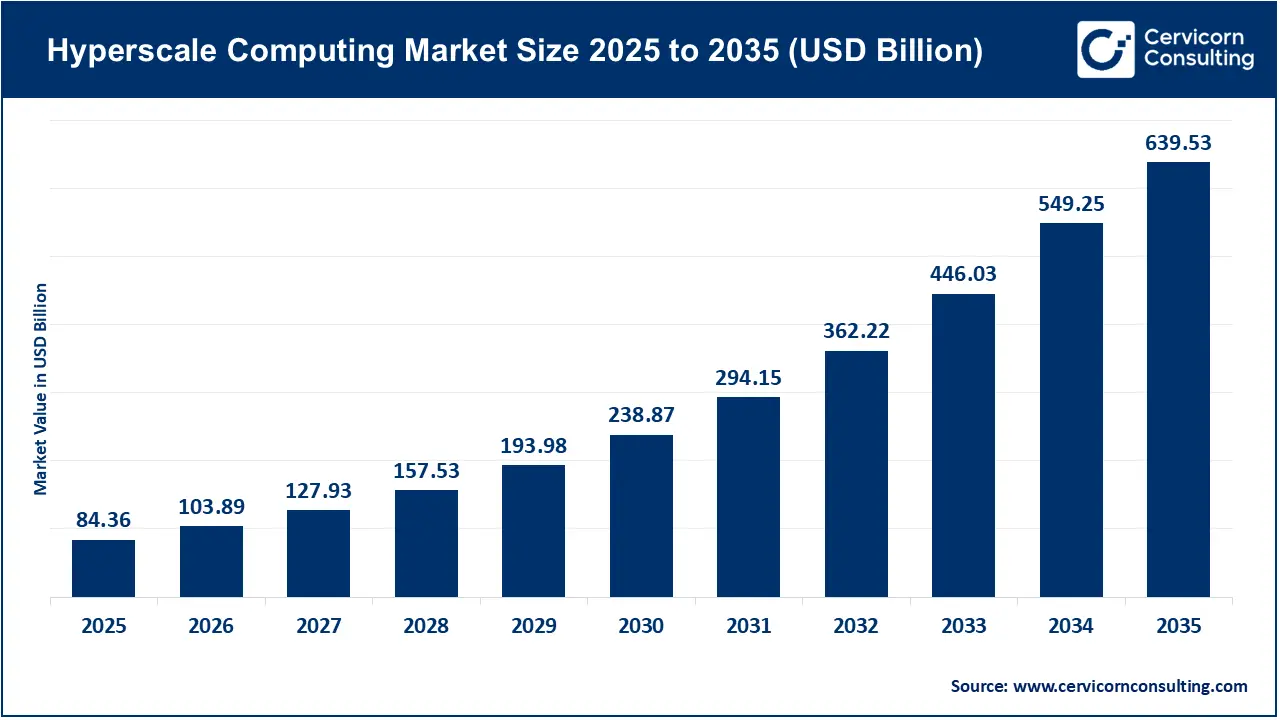
The global hyperscale computing market was valued at approximately USD 84.36 billion in 2025 and is projected to reach USD 639.53 billion by 2035, expanding at a CAGR of 22.45% during the forecast period.
Hyperscale Computing Market Growth Factors
The hyperscale computing market is witnessing remarkable growth due to the rapid expansion of cloud computing, increasing adoption of artificial intelligence (AI), machine learning (ML), big data analytics, Internet of Things (IoT), edge computing, and digital transformation initiatives across industries. Organizations are generating unprecedented volumes of structured and unstructured data, creating a strong need for scalable computing infrastructure capable of processing massive workloads efficiently.
Enterprises are increasingly migrating mission-critical applications to public, private, and hybrid cloud environments, further accelerating investments in hyperscale data centers. The growing popularity of Software-as-a-Service (SaaS), Platform-as-a-Service (PaaS), and Infrastructure-as-a-Service (IaaS) has encouraged technology providers to expand hyperscale facilities worldwide. Rising demand for high-performance computing (HPC), real-time analytics, autonomous systems, generative AI, 5G connectivity, and digital government services has also strengthened market expansion. Furthermore, sustainability initiatives promoting energy-efficient data centers, advanced liquid cooling technologies, renewable energy integration, and intelligent infrastructure management are encouraging continuous investments in hyperscale computing environments across developed and emerging economies.
What is the Hyperscale Computing Market?
The hyperscale computing market refers to the ecosystem of technologies, infrastructure, hardware, software, and services designed to build and operate extremely large-scale computing environments capable of handling enormous amounts of computing power, storage capacity, and networking resources. These infrastructures are primarily operated by major cloud service providers, internet companies, and enterprise organizations that require highly scalable digital platforms.
Hyperscale computing environments consist of thousands or even hundreds of thousands of interconnected servers operating within highly automated data centers. Unlike traditional enterprise data centers, hyperscale facilities are engineered to expand rapidly without compromising performance, reliability, or operational efficiency.
The market encompasses:
- Hyperscale data centers
- Cloud infrastructure
- Virtualization technologies
- Storage systems
- High-speed networking
- AI infrastructure
- GPU clusters
- Container platforms
- Edge computing integration
- Infrastructure management software
Major cloud providers continuously invest billions of dollars in expanding hyperscale capacity to support growing demand from enterprises, governments, financial institutions, healthcare providers, manufacturers, retailers, telecommunications companies, and digital businesses.
Get a Free Sample: https://www.cervicornconsulting.com/sample/2708
Why is the Hyperscale Computing Market Important?
Hyperscale computing has become the backbone of today’s digital economy. Almost every online service—including streaming platforms, online banking, social media, e-commerce, enterprise applications, AI platforms, and digital healthcare—relies on hyperscale infrastructure.
Its importance continues to increase because organizations require computing environments capable of delivering:
- Massive scalability
- High availability
- Low latency
- Global accessibility
- Enhanced cybersecurity
- Flexible resource allocation
- Cost optimization
- Faster innovation
Modern AI applications require enormous computational resources. Training large language models (LLMs), processing billions of user interactions, and analyzing petabytes of business data would not be feasible without hyperscale computing infrastructure.
Governments are also adopting hyperscale cloud platforms to modernize public services, improve disaster recovery capabilities, strengthen cybersecurity, and support digital governance initiatives.
Furthermore, hyperscale computing enables businesses to deploy new services within minutes instead of months, significantly improving operational agility and competitiveness.
Major Companies Operating in the Hyperscale Computing Market
| Company | Specialization | Key Focus Areas | Notable Features | Estimated 2025 Revenue* | Estimated Market Share* | Global Presence |
|---|---|---|---|---|---|---|
| Amazon Web Services (AWS) | Cloud Infrastructure | Compute, Storage, AI, Databases | Largest cloud infrastructure ecosystem with extensive global availability zones | Approximately USD 120 Billion | 30–32% | 35+ geographic regions with hundreds of availability zones and edge locations |
| Microsoft Corporation | Enterprise Cloud | Azure, AI, Hybrid Cloud | Strong enterprise integration with Microsoft ecosystem and AI services | Approximately USD 110 Billion (Azure-related business estimate) | 22–24% | Global presence across North America, Europe, Asia-Pacific, Middle East, Africa, and Latin America |
| Google LLC | AI Cloud Computing | Google Cloud Platform, AI Infrastructure | Industry-leading AI capabilities, Kubernetes innovation, and advanced networking | Approximately USD 55 Billion | 12–14% | Extensive worldwide cloud regions and subsea connectivity infrastructure |
| Oracle Corporation | Enterprise Cloud Infrastructure | Oracle Cloud Infrastructure (OCI), Databases | High-performance cloud optimized for enterprise workloads and mission-critical applications | Approximately USD 12 Billion (OCI estimate) | 3–5% | Expanding cloud regions across major global markets |
| IBM Corporation | Hybrid Cloud & AI | Hybrid Cloud, Red Hat OpenShift, AI | Strong focus on regulated industries, hybrid cloud, and enterprise modernization | Approximately USD 18 Billion (Hybrid Cloud & Consulting estimate) | 2–4% | Operations spanning more than 170 countries |
Leading Trends Shaping the Hyperscale Computing Market
Artificial Intelligence Infrastructure Expansion
Artificial intelligence has become one of the biggest growth catalysts for hyperscale computing.
Major cloud providers are investing billions in:
- AI accelerator chips
- GPU clusters
- AI supercomputers
- High-bandwidth networking
- Large-scale storage
Generative AI workloads require enormous computing capacity, making hyperscale data centers central to AI innovation.
Impact
- Increased capital expenditure
- Higher GPU demand
- Larger cloud infrastructure deployments
- New AI cloud services
Sustainable Hyperscale Data Centers
Environmental sustainability has become a strategic priority.
Operators are investing in:
- Renewable energy
- Solar power
- Wind energy
- Liquid cooling
- Waste heat recovery
- AI-powered energy optimization
Impact
- Lower operational costs
- Reduced carbon emissions
- Improved energy efficiency
- Compliance with environmental regulations
Edge Computing Integration
Businesses increasingly require real-time computing close to end users.
Hyperscale providers are integrating edge infrastructure with centralized cloud platforms.
Applications include:
- Autonomous vehicles
- Smart cities
- Industrial automation
- Connected healthcare
- Video analytics
Impact
- Reduced latency
- Better user experiences
- Faster analytics
- Enhanced operational efficiency
Multi-Cloud Adoption
Organizations are increasingly adopting multiple cloud providers rather than relying on a single vendor.
Reasons include:
- Business continuity
- Disaster recovery
- Cost optimization
- Regulatory compliance
- Vendor flexibility
Impact
- Greater demand for interoperable cloud services
- Expansion of hybrid cloud architectures
- Increased investments in cloud management platforms
High-Performance Computing (HPC)
Scientific research, pharmaceutical development, climate modeling, aerospace engineering, and financial modeling increasingly rely on hyperscale computing.
Impact
- Accelerated innovation
- Improved simulation accuracy
- Faster product development
- Better research capabilities
AI-Driven Data Center Automation
Artificial intelligence is now managing hyperscale facilities by optimizing:
- Server utilization
- Cooling systems
- Energy consumption
- Security monitoring
- Predictive maintenance
Impact
- Reduced downtime
- Lower operating expenses
- Higher efficiency
- Improved resource utilization
Advanced Networking Technologies
400G and 800G networking technologies are becoming standard within hyperscale data centers.
Software-defined networking (SDN) and network automation continue to improve scalability.
Impact
- Faster cloud services
- Better AI workload performance
- Enhanced data transfer speeds
- Lower latency
Successful Examples of Hyperscale Computing Around the World
Amazon Web Services Global Infrastructure
AWS operates one of the world’s largest hyperscale cloud infrastructures supporting millions of customers.
Its infrastructure powers:
- Netflix streaming
- Enterprise applications
- Healthcare platforms
- Government agencies
- Financial services
AWS continues expanding data center regions worldwide while integrating renewable energy initiatives.
Microsoft Azure AI Supercomputing
Microsoft has developed large-scale AI supercomputing infrastructure supporting advanced AI model training.
Its Azure cloud supports:
- Healthcare research
- Manufacturing
- Banking
- Education
- Government modernization
Strategic investments in AI infrastructure have positioned Azure among the fastest-growing hyperscale cloud platforms.
Google Cloud AI Infrastructure
Google leverages decades of experience in operating hyperscale infrastructure for search, YouTube, Gmail, and AI applications.
Google’s Tensor Processing Units (TPUs) accelerate machine learning workloads while improving energy efficiency.
Its global fiber-optic backbone enables high-speed connectivity across cloud regions.
Oracle Cloud Infrastructure
Oracle has significantly expanded OCI to support enterprise workloads requiring high security and performance.
Major industries using OCI include:
- Financial services
- Telecommunications
- Government
- Healthcare
- Manufacturing
OCI’s distributed cloud strategy allows customers to deploy cloud services in public, dedicated, sovereign, and hybrid environments.
IBM Hybrid Cloud
IBM focuses on enterprise hybrid cloud solutions combining private cloud, public cloud, and on-premises infrastructure.
Through Red Hat OpenShift, IBM enables organizations to modernize legacy applications while maintaining regulatory compliance.
Major users include:
- Banks
- Healthcare organizations
- Government agencies
- Insurance companies
Global Regional Analysis
North America
North America dominates the hyperscale computing market owing to the presence of leading cloud providers, advanced digital infrastructure, and strong investments in AI and high-performance computing. The United States hosts the largest concentration of hyperscale data centers globally, driven by continuous expansion from AWS, Microsoft, Google, Oracle, IBM, Meta, and other technology companies.
Government Initiatives and Policies
- Federal investments in AI research and advanced computing.
- Cybersecurity initiatives encouraging secure cloud adoption.
- Digital government modernization programs.
- Support for semiconductor manufacturing and supply chain resilience.
- Incentives promoting renewable energy integration into data centers.
The region also benefits from strong venture capital investments, advanced telecommunications networks, and widespread enterprise cloud adoption.
Europe
Europe represents one of the fastest-growing hyperscale computing markets due to increasing digital transformation, AI adoption, and data sovereignty requirements.
Countries including Germany, the United Kingdom, France, Ireland, and the Netherlands continue attracting major hyperscale investments.
Government Initiatives and Policies
- European digital transformation strategies.
- Investments in AI innovation.
- Green data center initiatives.
- Strong sustainability regulations.
- Data protection frameworks encouraging secure cloud services.
Europe also promotes renewable-powered data centers, improving long-term sustainability.
Asia-Pacific
Asia-Pacific is expected to experience the highest growth rate during the forecast period.
Rapid digitalization across China, India, Japan, South Korea, Singapore, Indonesia, and Australia is driving substantial investments in hyperscale infrastructure.
Growing internet penetration, expanding e-commerce, fintech innovation, AI startups, and government digitalization programs are accelerating cloud adoption.
Government Initiatives and Policies
- National AI strategies.
- Smart city programs.
- Digital economy development initiatives.
- Investments in 5G infrastructure.
- Cloud-first government policies.
- Support for domestic semiconductor manufacturing.
The region is becoming a major destination for new hyperscale data center construction.
Latin America
Latin America is experiencing steady growth as enterprises accelerate digital transformation and migrate workloads to the cloud.
Brazil, Mexico, Chile, and Colombia are emerging as important hyperscale investment destinations.
Government Initiatives and Policies
- National broadband expansion.
- Digital government modernization.
- Public cloud adoption strategies.
- Investments in smart infrastructure.
- Tax incentives supporting technology investments.
International cloud providers continue expanding regional cloud availability.
Middle East & Africa
The Middle East and Africa are rapidly emerging as important hyperscale computing markets.
Countries such as the UAE, Saudi Arabia, Qatar, and South Africa are investing heavily in cloud infrastructure to diversify their economies and support digital innovation.
Government Initiatives and Policies
- National digital transformation programs.
- Vision-based economic diversification initiatives.
- Smart city development projects.
- AI adoption strategies.
- Investments in renewable-powered data centers.
- Government cloud-first frameworks.
Increasing investments in fintech, healthcare, education, and smart infrastructure are expected to accelerate hyperscale computing adoption across the region over the coming decade.
Future Outlook of the Hyperscale Computing Market
The hyperscale computing market is expected to remain one of the fastest-evolving segments of the global technology industry as organizations increasingly depend on cloud-native applications, AI-driven services, and data-intensive workloads. Continuous innovation in processors, accelerators, networking technologies, storage architectures, and intelligent automation will enable hyperscale platforms to deliver greater efficiency and scalability. Future developments are likely to include broader adoption of quantum-inspired computing, AI-optimized infrastructure, autonomous data center operations, and carbon-neutral facilities powered by renewable energy. As governments, enterprises, and consumers continue embracing digital transformation, hyperscale computing will remain a foundational technology supporting next-generation innovation across healthcare, finance, manufacturing, telecommunications, retail, education, and public services worldwide.
To Get Detailed Overview, Contact Us: https://www.cervicornconsulting.com/contact-us
Read Report: Internet of Medical Things (IoMT) Market Revenue, Trends, and Strategic Insights by 2035