Fusion Reactor Market Revenue, Trends, and Strategic Insights by 2035
Table of Contents
ToggleFusion Reactor Market Size
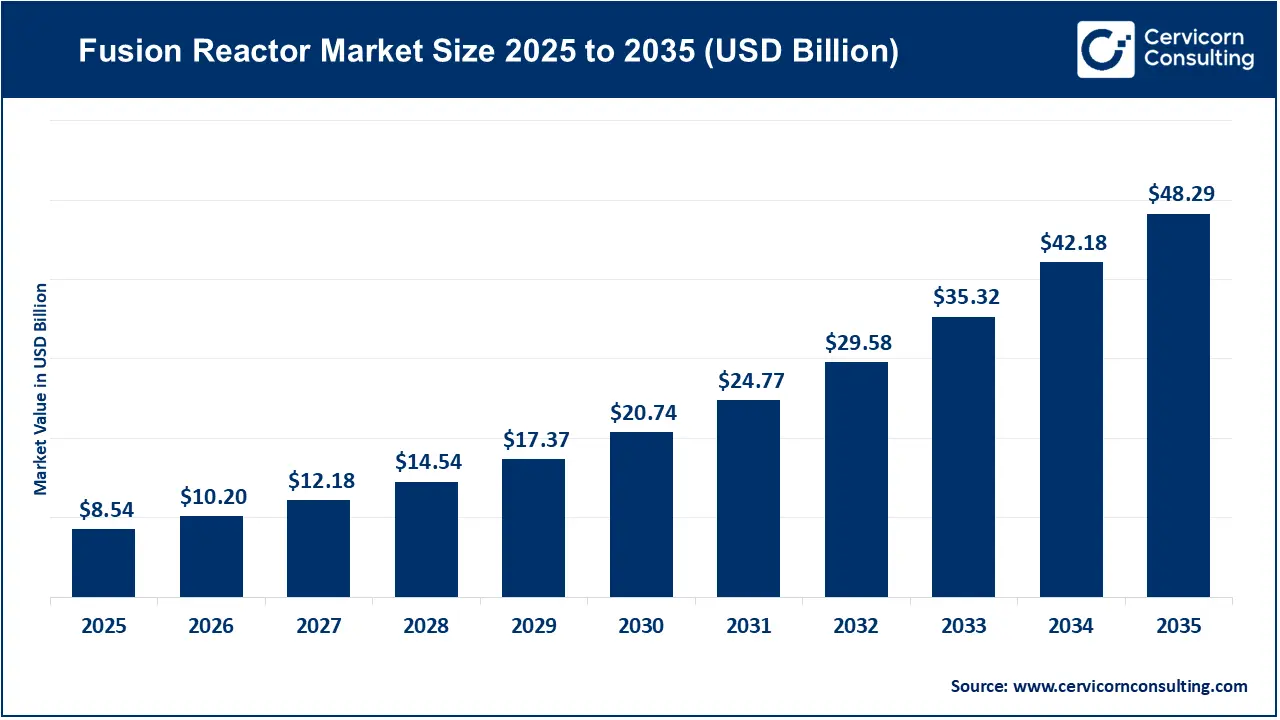
The global fusion reactor market was valued at approximately USD 8.54 billion in 2025 and is projected to reach nearly USD 48.29 billion by 2035, growing at a CAGR of 18.92%.
Fusion Reactor Market Growth Factors
The global fusion reactor market is experiencing remarkable momentum due to increasing investments in clean energy technologies, growing government support for achieving net-zero carbon emissions, rapid advancements in plasma physics and superconducting magnet technologies, and increasing participation from private investors. Rising concerns over energy security, climate change, and the limitations of conventional renewable energy sources have accelerated research into commercial fusion power. Technological breakthroughs in high-temperature superconducting (HTS) magnets, artificial intelligence-driven plasma control, advanced materials capable of withstanding extreme temperatures, and improved reactor designs have significantly enhanced the feasibility of commercial fusion. Strategic collaborations between governments, research institutions, and private companies, coupled with favorable funding initiatives in North America, Europe, and Asia-Pacific, continue to strengthen market growth.
Furthermore, the increasing commercialization efforts by startups and established technology firms, along with expanding venture capital investments and supportive regulatory frameworks, are expected to drive the fusion reactor market at a strong pace over the coming decade.
Get a Free Sample: https://www.cervicornconsulting.com/sample/2694
What is the Fusion Reactor Market?
The fusion reactor market refers to the global ecosystem involved in the research, development, manufacturing, commercialization, and deployment of nuclear fusion technologies designed to generate electricity through nuclear fusion rather than nuclear fission.
Fusion occurs when light atomic nuclei—typically isotopes of hydrogen such as deuterium and tritium—combine under extremely high temperatures and pressures to form heavier nuclei while releasing enormous amounts of energy. This process powers the sun and stars.
The market encompasses:
- Fusion reactor developers
- Plasma confinement technology providers
- High-temperature superconducting magnet manufacturers
- Advanced materials suppliers
- Cryogenic system manufacturers
- Diagnostic equipment providers
- AI-powered plasma control software
- Power conversion technologies
- Engineering and construction firms
- Research laboratories
Unlike traditional nuclear power plants, fusion reactors produce minimal radioactive waste, carry virtually no risk of runaway chain reactions, and offer nearly limitless fuel resources from seawater and lithium.
As governments seek carbon-neutral energy systems, fusion is increasingly viewed as one of the most promising long-term solutions for global electricity generation.
Why is the Fusion Reactor Market Important?
Fusion energy has the potential to fundamentally transform the global energy landscape by providing virtually unlimited, carbon-free electricity with exceptional reliability.
Its importance stems from several strategic advantages:
Carbon-Free Baseload Power
Fusion generates electricity without emitting greenhouse gases, making it an attractive solution for decarbonizing power grids.
Unlimited Fuel Availability
Deuterium can be extracted from seawater, while tritium can be bred from lithium, providing fuel supplies for thousands of years.
Energy Security
Countries can reduce dependence on imported fossil fuels and improve long-term energy independence.
Grid Stability
Unlike intermittent renewable sources such as solar and wind, fusion reactors can provide continuous 24/7 power generation.
Industrial Decarbonization
Fusion energy could supply large-scale electricity for hydrogen production, desalination, steel manufacturing, and heavy industrial processes.
Minimal Nuclear Waste
Fusion produces significantly less long-lived radioactive waste compared to conventional nuclear fission reactors.
Economic Growth
Commercial fusion is expected to create entirely new industries involving advanced manufacturing, robotics, superconductors, AI, cryogenics, and power engineering.
Fusion Reactor Market Value Chain
The market consists of several interconnected segments:
- Fundamental plasma research
- Reactor design
- Superconducting magnet development
- Vacuum vessel manufacturing
- Tritium fuel cycle systems
- Cryogenic technologies
- Plasma diagnostics
- Power conversion equipment
- Digital twins
- AI control software
- Grid integration
- Reactor maintenance services
Each stage creates opportunities for suppliers across multiple industries.
Major Companies Driving the Fusion Reactor Market
| Company | Specialization | Key Focus Areas | Notable Features | Estimated 2025 Revenue* | Estimated Market Share* | Global Presence |
|---|---|---|---|---|---|---|
| General Fusion | Magnetized Target Fusion (MTF) | Commercial fusion plants, plasma compression | Mechanical compression technology | ~$60–70 million (including grants, partnerships, and funding-related revenue) | Emerging | Canada, UK, Europe, North America |
| Tokamak Energy | Compact Spherical Tokamaks | HTS magnets, fusion energy systems | High-temperature superconducting magnet leadership | ~$45–60 million | Emerging | UK, Europe, US, Asia |
| Commonwealth Fusion Systems (CFS) | High-Field Tokamak Reactors | SPARC demonstration reactor, ARC commercial reactor | Industry-leading HTS magnet technology | ~$120–150 million | One of the leading private fusion companies | North America, Europe, Asia |
| TAE Technologies | Field-Reversed Configuration (FRC) | Hydrogen-boron fusion, advanced plasma physics | Aneutronic fusion research | ~$90–110 million | Significant | Global R&D collaborations |
| Helion Energy | Pulsed Fusion Generators | Direct electricity generation | Magneto-inertial fusion with direct power conversion | ~$80–100 million | Major emerging player | US, strategic global partnerships |
Leading Trends Transforming the Fusion Reactor Market
1. Private Investment Boom
Private investment has accelerated dramatically over the past decade. Venture capital firms, sovereign wealth funds, technology billionaires, and institutional investors are funding commercial fusion startups at unprecedented levels.
Impact
- Faster commercialization
- Larger pilot plants
- Increased competition
- Shorter innovation cycles
2. High-Temperature Superconducting Magnets
HTS magnets enable stronger magnetic fields within smaller reactor footprints.
Impact
- Compact reactors
- Lower construction costs
- Improved plasma confinement
- Higher efficiency
3. Artificial Intelligence in Plasma Control
AI algorithms continuously optimize plasma stability in real time.
Impact
- Improved reactor safety
- Higher energy output
- Reduced operational costs
- Better predictive maintenance
4. Digital Twin Technology
Digital twins simulate entire fusion reactors before physical construction.
Impact
- Reduced engineering risks
- Faster design optimization
- Lower maintenance costs
- Enhanced lifecycle management
5. Public-Private Partnerships
Governments increasingly collaborate with private developers.
Impact
- Increased funding
- Technology transfer
- Faster licensing
- Shared research infrastructure
6. Alternative Fusion Concepts
Beyond tokamaks, companies are exploring:
- Magnetized Target Fusion
- Field-Reversed Configuration
- Stellarators
- Inertial Confinement Fusion
- Pulsed Fusion
Impact
Greater technological diversity increases the likelihood of successful commercialization.
7. Advanced Materials
Researchers are developing radiation-resistant alloys and ceramic composites.
Impact
- Longer reactor lifetimes
- Lower maintenance
- Higher thermal efficiency
8. Direct Electricity Conversion
Several companies are eliminating steam turbines by converting plasma energy directly into electricity.
Impact
- Improved efficiency
- Reduced infrastructure costs
- Smaller power plants
Successful Examples Around the World
Commonwealth Fusion Systems – SPARC (United States)
SPARC aims to demonstrate net energy gain using high-field superconducting magnets. Its compact tokamak approach has attracted substantial private investment and is regarded as one of the leading commercial fusion projects globally.
Significance
- Compact reactor design
- Strong industrial partnerships
- Commercial roadmap toward ARC power plants
ITER (France)
ITER is the world’s largest international fusion collaboration involving more than 30 countries. The project seeks to demonstrate sustained burning plasma and validate technologies necessary for commercial fusion power plants.
Significance
- Global scientific collaboration
- Advanced tokamak research
- Foundation for future commercial reactors
General Fusion Demonstration Plant (United Kingdom)
General Fusion is developing a Magnetized Target Fusion demonstration system that uses mechanical compression rather than continuous magnetic confinement.
Significance
- Lower infrastructure complexity
- Innovative compression approach
- Commercial pilot development
Tokamak Energy (United Kingdom)
Tokamak Energy is developing compact spherical tokamaks utilizing proprietary HTS magnets to accelerate commercialization.
Significance
- Smaller reactors
- Lower capital costs
- Rapid technology development
TAE Technologies (United States)
TAE Technologies is pursuing aneutronic fusion using hydrogen-boron fuel, which could significantly reduce neutron radiation compared to conventional deuterium-tritium fusion.
Significance
- Cleaner fusion pathway
- Innovative plasma confinement
- Long-term commercial potential
EAST Experimental Reactor (China)
China’s Experimental Advanced Superconducting Tokamak (EAST) has repeatedly achieved record plasma confinement durations.
Significance
- Advanced superconducting technology
- Long-duration plasma experiments
- Supports China’s commercial fusion ambitions
JT-60SA (Japan)
JT-60SA is among the world’s largest superconducting tokamaks and supports international efforts to refine plasma physics and reactor operation.
Significance
- International collaboration
- Advanced plasma control
- Supports future DEMO reactors
Global Regional Analysis
North America
North America currently leads the global fusion reactor market due to strong venture capital funding, extensive government research support, advanced universities, and a thriving ecosystem of private fusion companies.
Key Drivers
- Strong startup ecosystem
- Department of Energy funding
- National laboratory expertise
- Advanced semiconductor industry
- AI integration
Government Initiatives
The United States has significantly expanded funding for fusion energy research through the Department of Energy (DOE), supporting public-private partnerships, milestone-based fusion development programs, and national laboratory collaborations. The Fusion Energy Sciences program and initiatives aimed at accelerating commercialization have strengthened the region’s leadership. Canada also supports fusion innovation through research grants and collaborations with companies such as General Fusion.
Europe
Europe maintains one of the world’s strongest scientific foundations for fusion research.
Key Drivers
- Large research infrastructure
- Strong climate policies
- Advanced manufacturing
- International collaborations
Government Initiatives
The European Union has made fusion energy a strategic priority through long-term funding under Euratom research programs and collaborative initiatives. The United Kingdom continues to support fusion commercialization through dedicated funding for prototype plants and regulatory development. France hosts ITER, one of the world’s largest international scientific projects, while Germany, Italy, and other European nations contribute advanced engineering, materials science, and plasma research expertise.
Asia-Pacific
Asia-Pacific is expected to record the fastest growth as governments rapidly expand investments in advanced energy technologies.
Key Drivers
- Industrial expansion
- Energy security concerns
- Strong manufacturing base
- Government-backed R&D
Government Initiatives
China has substantially increased investments in fusion research through national laboratories and projects such as EAST while incorporating fusion into broader science and technology strategies. Japan continues to invest in superconducting tokamaks, including JT-60SA, and supports collaborative international research. South Korea advances plasma science through the KSTAR tokamak and long-term fusion development programs. India supports fusion research through participation in ITER and national plasma research initiatives, while also developing domestic expertise in superconducting technologies and advanced materials.
Latin America
Latin America is in the early stages of fusion development but is gradually expanding its participation through academic research and international collaboration.
Key Drivers
- Growing clean energy demand
- Increasing university research
- International partnerships
Government Initiatives
Countries including Brazil and Argentina are supporting plasma physics research through universities and national research agencies. Although commercialization remains limited, governments are encouraging participation in international scientific collaborations and workforce development.
Middle East & Africa
The Middle East and Africa represent emerging opportunities for future fusion deployment, particularly as countries diversify their energy portfolios.
Key Drivers
- Economic diversification
- Clean energy transition
- Advanced research investments
- Large infrastructure projects
Government Initiatives
The United Arab Emirates has expanded investments in advanced energy research through national innovation programs and partnerships with international institutions. Saudi Arabia’s Vision 2030 strategy encourages investment in next-generation energy technologies, while South Africa continues to support plasma research through academic institutions and scientific collaborations.
Future Opportunities in the Fusion Reactor Market
Several opportunities are expected to shape the market over the next decade:
- Commercial demonstration power plants
- Grid-scale fusion electricity generation
- Fusion-powered hydrogen production
- Industrial heat applications
- Space propulsion systems
- Desalination powered by fusion
- AI-enabled autonomous reactor operations
- Export opportunities for advanced reactor components
- Expansion of superconducting magnet manufacturing
- Growth in specialized engineering, robotics, and maintenance services
As technological milestones continue to be achieved and governments strengthen policy support, the fusion reactor market is positioned to evolve from a research-driven sector into a commercially viable clean energy industry with transformative implications for global power generation, industrial decarbonization, and long-term energy security.
To Get Detailed Overview, Contact Us: https://www.cervicornconsulting.com/contact-us
Read Report: Service Robotics Market Revenue, Trends, and Strategic Insights by 2035