Bioenergy with Carbon Capture and Storage (BECCS) Market Revenue, Trends, and Strategic Insights by 2035
Table of Contents
ToggleBioenergy with Carbon Capture and Storage (BECCS) Market Size
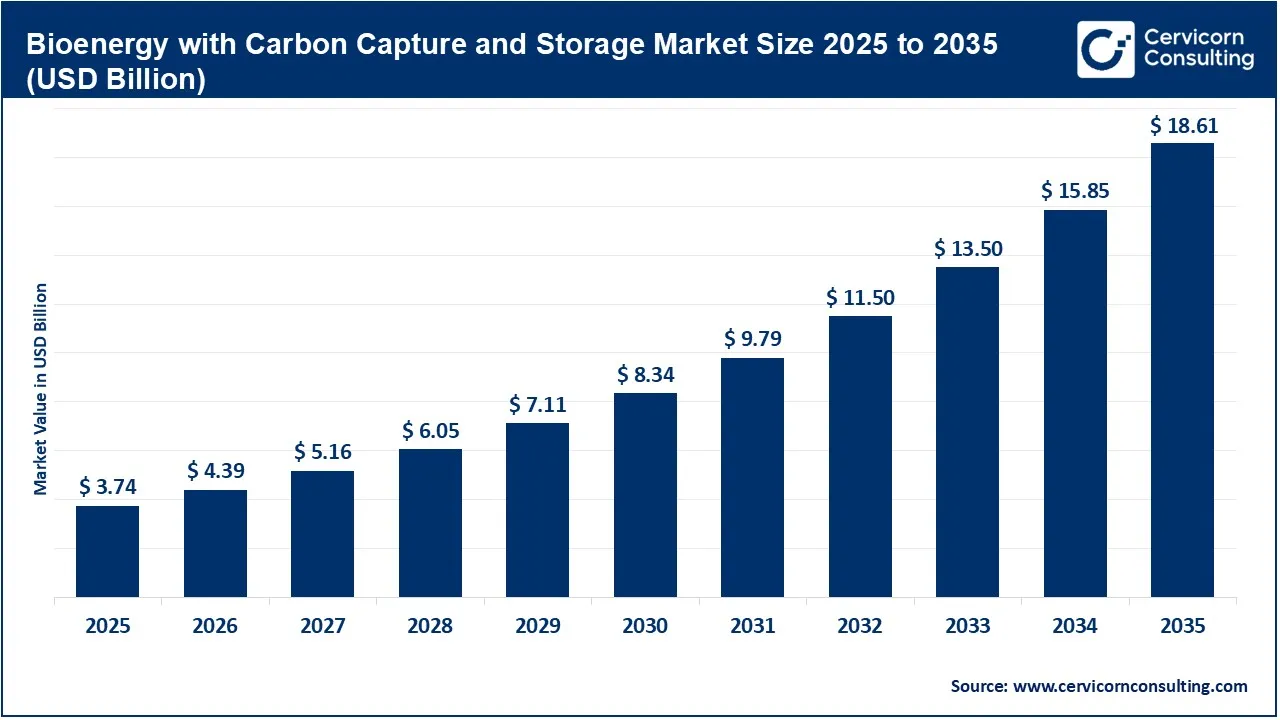
The global bioenergy with carbon capture and storage (BECCS) market was valued at approximately USD 3.74 billion in 2025 and is projected to reach nearly USD 18.61 billion by 2035, growing at a CAGR of 17.4%.
Bioenergy with Carbon Capture and Storage (BECCS) Market Growth Factors
The Bioenergy with Carbon Capture and Storage (BECCS) market is experiencing strong growth due to increasing global commitments toward achieving net-zero carbon emissions, rising investments in carbon capture infrastructure, expanding renewable energy generation, favorable government incentives for carbon removal technologies, growing demand for carbon-negative fuels, advancements in post-combustion and oxy-fuel carbon capture technologies, increasing deployment of biomass power plants, development of carbon transport and storage infrastructure, rising industrial decarbonization initiatives, growing participation in voluntary and compliance carbon markets, enhanced public-private partnerships, rapid commercialization of carbon utilization technologies, increasing adoption of sustainable biomass feedstocks, continuous innovation in geological carbon storage solutions, and stronger international climate policies encouraging negative emission technologies.
What is the Bioenergy with Carbon Capture and Storage (BECCS) Market?
Bioenergy with Carbon Capture and Storage (BECCS) refers to an integrated technology that combines biomass-based energy generation with carbon capture and long-term carbon storage. Unlike conventional renewable energy systems that simply reduce emissions, BECCS actively removes carbon dioxide from the atmosphere.
The process begins with plants absorbing atmospheric CO₂ through photosynthesis during growth. These biomass feedstocks—including agricultural residues, forestry waste, dedicated energy crops, municipal organic waste, and industrial biomass—are converted into electricity, heat, biofuels, or biogas.
During energy generation, CO₂ released from biomass combustion or gasification is captured before entering the atmosphere. The captured carbon is compressed, transported through pipelines or ships, and injected deep underground into geological formations for permanent storage.
This unique capability allows BECCS facilities to generate renewable energy while producing negative emissions, making them essential technologies for sectors where complete decarbonization remains difficult.
The BECCS market encompasses:
- Biomass power plants
- Carbon capture equipment
- Carbon transportation infrastructure
- Geological storage services
- Biofuel production facilities
- Carbon monitoring technologies
- Engineering and consulting services
- Carbon management software
Get a Free Sample: https://www.cervicornconsulting.com/sample/2993
Why is the Bioenergy with Carbon Capture and Storage (BECCS) Market Important?
BECCS has become one of the few commercially scalable technologies capable of delivering net-negative emissions. This makes it indispensable for achieving international climate goals established under the Paris Agreement.
Helps Remove Existing Atmospheric Carbon
Solar and wind energy primarily prevent future emissions. BECCS goes a step further by permanently removing carbon already circulating in the atmosphere.
Supports Net-Zero Targets
Many industries—including aviation, shipping, cement, steel, and chemicals—cannot completely eliminate emissions. BECCS offsets these unavoidable emissions through carbon removal.
Produces Renewable Energy
Unlike direct air capture, BECCS simultaneously generates:
- Renewable electricity
- Renewable heat
- Sustainable aviation fuel
- Renewable hydrogen
- Bioethanol
- Biomethane
This dual benefit improves economic viability.
Expands Carbon Credit Markets
Captured and permanently stored carbon qualifies for carbon removal credits in many regulatory and voluntary carbon markets, creating additional revenue opportunities.
Enhances Energy Security
Countries can utilize locally available agricultural and forestry residues instead of depending on imported fossil fuels.
Supports Circular Economy Goals
BECCS encourages productive utilization of agricultural waste, municipal organic waste, forestry by-products, and industrial biomass residues.
Major Companies Operating in the Bioenergy with Carbon Capture and Storage (BECCS) Market
| Company | Specialization | Key Focus Areas | Notable Features | 2025 Revenue* | Market Share* | Global Presence |
|---|---|---|---|---|---|---|
| Drax Group plc | Biomass power generation and BECCS | Negative emissions, biomass electricity | Developing one of the world’s largest BECCS power plants in the UK | Approx. USD 10 Billion | Leading commercial BECCS developer | Europe, North America |
| Ørsted A/S | Renewable energy | Carbon capture integration with biomass CHP plants | Carbon-neutral energy projects and CCS expansion | Approx. USD 12 Billion | Major renewable energy participant | Europe, North America, Asia-Pacific |
| Stockholm Exergi AB | District heating and BECCS | Bioenergy, district heating, carbon removal | Stockholm BECCS project expected to become one of Europe’s largest carbon removal facilities | Private | Emerging European leader | Europe |
| Mitsubishi Heavy Industries, Ltd. | Carbon capture technologies | Advanced CO₂ capture systems | Proprietary KM CDR Process™ widely adopted globally | Approx. USD 34 Billion | Major CCS technology supplier | Global |
| Shell plc | Integrated energy and CCS | Carbon storage, hydrogen, CCS hubs | Large-scale CCS transportation and storage infrastructure investments | Approx. USD 300 Billion | Global CCS infrastructure leader | More than 70 countries |
Leading Trends Shaping the Bioenergy with Carbon Capture and Storage (BECCS) Market
1. Commercial Deployment of Negative Emission Facilities
Governments are increasingly funding commercial-scale BECCS facilities capable of capturing millions of tons of CO₂ annually. Pilot projects are rapidly transitioning toward industrial deployment.
Impact
- Higher commercial adoption
- Lower technology costs
- Increased investor confidence
2. Carbon Credit Monetization
Carbon removal certificates are becoming an attractive revenue stream for BECCS operators. Large corporations are purchasing verified carbon removal credits to meet sustainability commitments.
Impact
- Improved project economics
- Increased private investment
- Faster commercialization
3. Integration with Sustainable Aviation Fuel (SAF)
BECCS is increasingly being integrated into biofuel production facilities that manufacture sustainable aviation fuel.
Impact
- Decarbonization of aviation
- Expansion of biofuel production
- Higher demand for biomass feedstocks
4. Development of Carbon Capture Hubs
Countries are investing in shared CO₂ transportation pipelines and storage hubs, reducing infrastructure costs for multiple industries.
Impact
- Reduced capital expenditure
- Easier market entry
- Faster project deployment
5. Advanced Carbon Capture Technologies
Next-generation solvents, membranes, cryogenic systems, and adsorption technologies are improving capture efficiency while reducing energy consumption.
Impact
- Lower operational costs
- Higher capture rates
- Greater commercial viability
6. Artificial Intelligence for Plant Optimization
AI-powered monitoring systems optimize biomass combustion, predict equipment maintenance, improve capture efficiency, and reduce operational costs.
Impact
- Improved efficiency
- Reduced downtime
- Higher plant productivity
7. Expansion of Biomass Supply Chains
Governments and private companies are investing in sustainable biomass production, pellet manufacturing, forestry management, and agricultural residue collection.
Impact
- Reliable feedstock availability
- Lower transportation costs
- Improved sustainability
8. Hydrogen Production Integration
Several projects combine biomass gasification, hydrogen production, and carbon capture to generate carbon-negative hydrogen.
Impact
- Growth of hydrogen economy
- Decarbonization of heavy industries
- Diversified revenue sources
Successful Examples of Bioenergy with Carbon Capture and Storage (BECCS) Around the World
Drax Power Station (United Kingdom)
The Drax Power Station represents one of the world’s most ambitious BECCS projects. Originally a coal-fired power station, it has largely transitioned to sustainable biomass generation. The company aims to capture millions of tonnes of CO₂ annually while generating renewable electricity, positioning the facility as a cornerstone of the UK’s negative emissions strategy.
Stockholm Exergi BECCS Project (Sweden)
Stockholm Exergi is developing a large-scale BECCS facility integrated with its biomass-powered combined heat and power plant. The project is expected to remove approximately 800,000 tonnes of CO₂ annually while supplying district heating and electricity to Stockholm.
Illinois Industrial Carbon Capture and Storage Project (United States)
The Illinois Industrial CCS project captures CO₂ generated during bioethanol production and stores it deep underground. Although focused on industrial bioenergy rather than power generation, it demonstrates the commercial feasibility of combining biomass processing with carbon storage.
Greensand Carbon Storage Project (Denmark)
Denmark is developing offshore carbon storage infrastructure that could support future BECCS facilities across Northern Europe by providing secure geological storage capacity.
Japan’s Carbon Recycling Initiatives
Japan is investing heavily in carbon capture technologies through partnerships involving Mitsubishi Heavy Industries. These initiatives support the future deployment of BECCS across biomass-fired power plants and industrial facilities.
Global Regional Analysis of the Bioenergy with Carbon Capture and Storage (BECCS) Market
North America
North America is among the leading regions for BECCS development due to extensive biomass resources, supportive tax incentives, and advanced carbon capture infrastructure. The United States and Canada are investing heavily in carbon removal technologies to meet long-term climate objectives.
Key Market Drivers
- Abundant forestry and agricultural biomass
- Established CCS infrastructure
- Strong private investments
- Federal carbon reduction incentives
- Expanding bioethanol industry
Government Initiatives and Policies
- U.S. Inflation Reduction Act supporting carbon capture deployment
- Expanded Section 45Q tax credits for carbon sequestration
- U.S. Department of Energy CarbonSAFE program
- Canada’s Investment Tax Credit for Carbon Capture, Utilization, and Storage (CCUS)
- Provincial carbon pricing programs encouraging negative emissions
Europe
Europe remains a global leader in climate policy, making it one of the fastest-growing BECCS markets. Countries including the United Kingdom, Sweden, Denmark, Norway, and the Netherlands are investing aggressively in carbon capture and storage infrastructure.
Key Market Drivers
- Net-zero legislation
- Carbon pricing mechanisms
- Biomass district heating systems
- Government-funded demonstration projects
- Mature renewable energy sector
Government Initiatives and Policies
- European Green Deal
- EU Innovation Fund
- Fit for 55 climate package
- EU Emissions Trading System (EU ETS)
- UK’s BECCS Business Model and Dispatchable Power Agreement
- Sweden’s reverse auction system for carbon removal credits
- Denmark’s national CCS funding schemes
Asia-Pacific
Asia-Pacific is expected to witness rapid growth as countries seek solutions for balancing economic development with climate commitments. China, Japan, South Korea, Australia, and India are investing in carbon capture technologies and renewable bioenergy.
Key Market Drivers
- Rising electricity demand
- Expanding biomass utilization
- Government decarbonization targets
- Industrial emission reductions
- Growing renewable energy investments
Government Initiatives and Policies
- Japan’s Green Growth Strategy
- China’s Carbon Neutrality Roadmap (2060)
- South Korea’s Carbon Neutral Strategy
- Australia’s Carbon Capture, Use and Storage Development Fund
- India’s National Bioenergy Programme and National Green Hydrogen Mission supporting biomass utilization
Latin America
Latin America possesses enormous biomass potential due to its agricultural and forestry sectors. Brazil, Argentina, Colombia, and Chile are emerging as promising BECCS markets.
Key Market Drivers
- Sugarcane ethanol industry
- Agricultural residue availability
- Expanding renewable energy generation
- Carbon offset opportunities
Government Initiatives and Policies
- Brazil’s RenovaBio Program promoting low-carbon biofuels
- National climate commitments under the Paris Agreement
- Public-private collaborations on CCS research
- Carbon market development initiatives
Middle East & Africa
The Middle East & Africa region is gradually entering the BECCS market through investments in carbon capture infrastructure and renewable energy diversification.
Key Market Drivers
- Industrial decarbonization
- Carbon storage potential
- Biomass waste utilization
- Growing sustainability investments
Government Initiatives and Policies
- Saudi Green Initiative
- UAE Net Zero by 2050 Strategy
- Abu Dhabi carbon capture expansion projects
- South Africa’s Carbon Tax Act encouraging emissions reduction
- National climate adaptation strategies supporting low-carbon technologies
To Get Detailed Overview, Contact Us: https://www.cervicornconsulting.com/contact-us
Read Report: Automotive Electronics Market Revenue, Trends, and Strategic Insights by 2035