Automotive Electronics Market Revenue, Trends, and Strategic Insights by 2035
Automotive Electronics Market Size
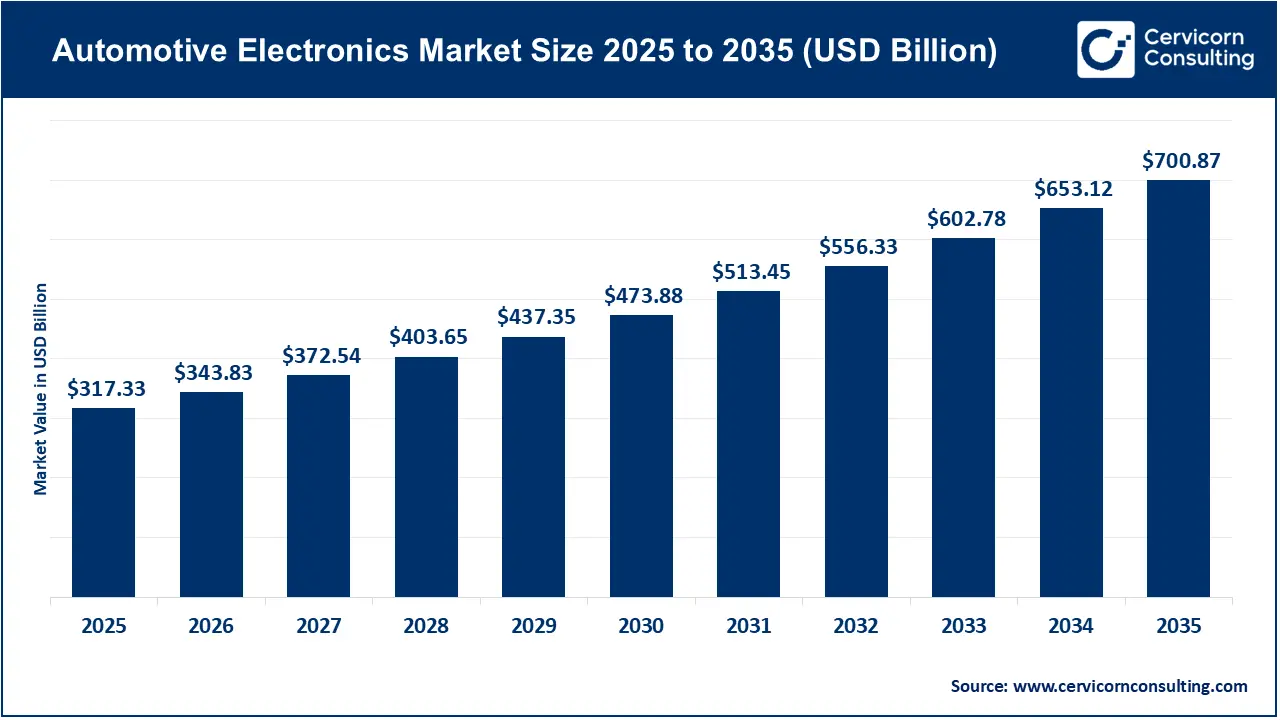
The global automotive electronics market was valued at approximately USD 317.33 billion in 2025 and is projected to reach nearly USD 700.87 billion by 2035, growing at a CAGR of 8.25%.
Automotive Electronics Market Growth Factors
The automotive electronics market is experiencing remarkable growth due to the increasing production of electric and hybrid vehicles, rising consumer demand for advanced safety technologies, growing implementation of Advanced Driver Assistance Systems (ADAS), rapid development of autonomous driving technologies, expansion of connected vehicle ecosystems, continuous innovations in semiconductor manufacturing, increasing integration of artificial intelligence and machine learning into vehicle control systems, stricter government regulations regarding vehicle safety and emission reduction.
Rising investments in automotive cybersecurity, advancements in battery management systems, adoption of software-defined vehicles, demand for premium infotainment systems, widespread use of sensors and cameras, growing popularity of over-the-air (OTA) software updates, expansion of smart mobility infrastructure, increasing deployment of vehicle-to-everything (V2X) communication technologies, and continuous research into high-performance automotive processors capable of supporting next-generation mobility solutions.
Get a Free Sample: https://www.cervicornconsulting.com/sample/2696
What is the Automotive Electronics Market?
The automotive electronics market refers to the global industry involved in designing, manufacturing, and integrating electronic components and systems used in automobiles. These systems control almost every function within a modern vehicle, ranging from engine management and braking systems to navigation, infotainment, battery management, lighting, and autonomous driving.
Automotive electronics consist of numerous components including:
- Electronic Control Units (ECUs)
- Automotive sensors
- Semiconductor chips
- Microcontrollers
- Power electronics
- Cameras
- Radar systems
- LiDAR sensors
- Battery management systems
- Vehicle communication modules
- Infotainment displays
- Electric power steering systems
Modern vehicles may contain more than 100 ECUs and thousands of semiconductor components working together to optimize performance and enhance driving experiences.
Why is the Automotive Electronics Market Important?
Automotive electronics have become central to the evolution of modern transportation.
Improved Vehicle Safety
Electronic safety systems significantly reduce accidents through technologies such as:
- Automatic Emergency Braking
- Lane Keeping Assist
- Blind Spot Detection
- Adaptive Cruise Control
- Electronic Stability Control
- Airbag Control Systems
These technologies protect passengers while reducing collision rates.
Electrification of Transportation
Electric vehicles rely almost entirely on advanced electronic systems for:
- Battery monitoring
- Thermal management
- Charging control
- Energy optimization
- Motor control
Without automotive electronics, EVs would not function efficiently.
Enhanced Driving Experience
Consumers increasingly expect:
- Large infotainment displays
- Voice assistants
- Smartphone integration
- Navigation
- Wireless updates
- Connected services
Automotive electronics deliver these premium experiences.
Reduced Emissions
Electronic engine management improves:
- Fuel efficiency
- Combustion control
- Hybrid operation
- Regenerative braking
These technologies help manufacturers comply with global emission standards.
Foundation for Autonomous Vehicles
Artificial intelligence, cameras, radar, LiDAR, sensors, and powerful processors all depend on sophisticated electronic architectures.
Automotive electronics serve as the brain of autonomous mobility.
Major Companies Operating in the Automotive Electronics Market
1. Aisin Corporation
| Category | Details |
|---|---|
| Headquarters | Japan |
| Specialization | Automotive components and electronic systems |
| Key Focus Areas | Powertrain electronics, ADAS, electric mobility |
| Notable Features | Strong Toyota partnership, integrated electronic systems |
| 2025 Revenue | Approximately USD 33–35 Billion |
| Estimated Market Share | Around 5–6% (automotive electronics components) |
| Global Presence | Asia-Pacific, Europe, North America, Latin America |
Aisin develops advanced electronic systems for braking, steering, electrification, transmission, and intelligent mobility solutions.
2. Altera Corporation
| Category | Details |
|---|---|
| Headquarters | United States |
| Specialization | FPGA semiconductor solutions |
| Key Focus Areas | Automotive AI, autonomous driving processors |
| Notable Features | High-performance programmable chips |
| 2025 Revenue | Estimated USD 2–3 Billion (FPGA business) |
| Estimated Market Share | Strong presence in automotive FPGA segment |
| Global Presence | North America, Europe, Asia |
Altera’s FPGA technologies enable real-time image processing, sensor fusion, and automotive AI applications.
3. American Axle & Manufacturing, Inc.
| Category | Details |
|---|---|
| Headquarters | United States |
| Specialization | Driveline and electric propulsion systems |
| Key Focus Areas | Electric drive units, power electronics integration |
| Notable Features | Electrified driveline technologies |
| 2025 Revenue | Approximately USD 6–7 Billion |
| Estimated Market Share | Significant supplier in driveline electronics |
| Global Presence | Americas, Europe, Asia |
The company increasingly integrates electronics into next-generation electric propulsion systems.
4. Atmel Corporation
| Category | Details |
|---|---|
| Headquarters | United States (technology integrated into Microchip Technology) |
| Specialization | Microcontrollers and embedded solutions |
| Key Focus Areas | Automotive microcontrollers, embedded processors |
| Notable Features | Low-power automotive semiconductor technologies |
| 2025 Revenue | Technology contributes within Microchip’s multi-billion-dollar semiconductor portfolio |
| Estimated Market Share | Strong automotive MCU presence |
| Global Presence | Worldwide |
Atmel technologies remain widely adopted in automotive electronics through Microchip Technology’s automotive portfolio.
5. Autoliv, Inc.
| Category | Details |
|---|---|
| Headquarters | Sweden |
| Specialization | Automotive safety electronics |
| Key Focus Areas | Airbags, seatbelts, safety sensors, radar systems |
| Notable Features | Global leader in passive safety systems |
| 2025 Revenue | Approximately USD 10–11 Billion |
| Estimated Market Share | Leading position in automotive safety electronics |
| Global Presence | More than 25 countries |
Autoliv continues investing in next-generation active safety electronics and intelligent restraint technologies.
Leading Trends Transforming the Automotive Electronics Market
1. Software-Defined Vehicles (SDVs)
Modern vehicles increasingly operate like computers on wheels. Software-defined architectures enable manufacturers to introduce new features via over-the-air updates without replacing hardware.
Impact:
- Faster innovation cycles
- Reduced maintenance costs
- Improved customer experience
- Continuous feature enhancements
2. Rapid Growth of Electric Vehicles
Electric mobility requires advanced electronics for battery management, charging systems, inverters, and electric motor control.
Impact:
- Increased semiconductor demand
- Growth in power electronics
- Expansion of battery management systems
- Higher investment in EV platforms
3. Advanced Driver Assistance Systems (ADAS)
ADAS technologies have become standard across many vehicle segments.
Major systems include:
- Adaptive Cruise Control
- Automatic Emergency Braking
- Driver Monitoring Systems
- Traffic Sign Recognition
- Parking Assistance
Impact:
Improved road safety while accelerating autonomous driving development.
4. Artificial Intelligence Integration
AI algorithms process enormous volumes of sensor data in real time.
Applications include:
- Object recognition
- Predictive maintenance
- Driver behavior monitoring
- Autonomous navigation
- Smart route optimization
5. Vehicle Connectivity
Vehicles now connect continuously with:
- Smartphones
- Cloud platforms
- Smart cities
- Charging infrastructure
- Fleet management systems
Connected vehicles enable predictive diagnostics and remote software management.
6. Vehicle-to-Everything (V2X)
V2X communication allows vehicles to exchange information with:
- Other vehicles
- Traffic signals
- Pedestrians
- Road infrastructure
This technology enhances traffic efficiency and collision avoidance.
7. Automotive Cybersecurity
As vehicles become connected, cybersecurity investments continue increasing.
Manufacturers are implementing:
- Secure boot systems
- Hardware encryption
- Secure gateways
- Intrusion detection systems
Cybersecurity has become a critical component of automotive electronics.
Leading Technologies Driving the Automotive Electronics Industry
Several advanced technologies continue transforming automotive electronics:
- Artificial Intelligence
- Machine Learning
- Edge Computing
- High-performance automotive processors
- Silicon carbide (SiC) power semiconductors
- Gallium nitride (GaN) power devices
- Automotive Ethernet
- 5G connectivity
- Digital cockpit systems
- Augmented reality head-up displays
- Smart battery management systems
- Digital twins
- Cloud-connected vehicle platforms
These innovations improve efficiency, intelligence, and reliability across modern vehicles.
Successful Examples of Automotive Electronics Around the World
Tesla
Tesla vehicles feature centralized computing architectures, over-the-air software updates, advanced battery management systems, AI-powered Autopilot, and integrated electronic control platforms, setting new standards for software-defined vehicles.
Mercedes-Benz
Mercedes-Benz has introduced the MBUX Hyperscreen, combining artificial intelligence, digital dashboards, voice recognition, and personalized driver experiences through advanced electronics.
Toyota
Toyota integrates sophisticated hybrid electronic control systems, intelligent safety technologies, and battery management solutions across its electrified vehicle lineup.
BMW
BMW utilizes high-performance automotive electronics for intelligent driving assistance, digital key technologies, cloud connectivity, and predictive maintenance.
BYD
China’s BYD combines proprietary battery management electronics, power semiconductors, electric propulsion systems, and intelligent cockpit technologies to support its rapidly expanding EV portfolio.
Hyundai Motor Group
Hyundai has invested heavily in autonomous driving electronics, connected mobility platforms, AI-powered infotainment, and electric vehicle electronic architectures.
Volvo Cars
Volvo integrates advanced radar systems, LiDAR technologies, collision avoidance electronics, and driver monitoring systems to improve passenger safety.
Nissan
Nissan’s ProPILOT technology combines sensors, cameras, radar, and electronic control units to enhance semi-autonomous driving capabilities.
Global Regional Analysis of the Automotive Electronics Market
North America
North America remains a major automotive electronics market due to strong semiconductor innovation, autonomous vehicle development, premium vehicle production, and substantial investments in electric mobility.
Key Growth Drivers
- Strong EV adoption
- AI research
- Advanced semiconductor manufacturing
- Connected vehicle deployment
- Autonomous vehicle testing
Government Initiatives and Policies
The United States has implemented multiple initiatives encouraging domestic semiconductor production through the CHIPS and Science Act. Federal EV incentives continue supporting electric vehicle adoption, while the National Highway Traffic Safety Administration (NHTSA) promotes mandatory vehicle safety technologies such as automatic emergency braking. Canada is investing in electric vehicle manufacturing, battery supply chains, and clean mobility infrastructure.
Europe
Europe represents one of the world’s largest automotive electronics manufacturing regions.
Germany, France, Sweden, Italy, and the United Kingdom continue investing heavily in intelligent mobility technologies.
Key Growth Drivers
- Premium vehicle manufacturing
- Vehicle electrification
- Strict emission standards
- Advanced safety regulations
- Smart mobility projects
Government Initiatives and Policies
The European Union’s Green Deal encourages widespread electric vehicle adoption while reducing transportation emissions. Euro NCAP continuously raises vehicle safety requirements, encouraging greater integration of advanced electronics. Several governments provide EV purchase incentives and funding for charging infrastructure.
Asia-Pacific
Asia-Pacific dominates global automotive electronics manufacturing due to large-scale vehicle production and semiconductor capabilities.
Major contributors include:
- China
- Japan
- South Korea
- India
- Taiwan
Key Growth Drivers
- Massive EV production
- Semiconductor manufacturing
- Consumer electronics expertise
- Government incentives
- Growing middle-class vehicle demand
Government Initiatives and Policies
China’s New Energy Vehicle (NEV) policies provide subsidies, tax benefits, and industrial support for EV manufacturers. Japan promotes autonomous mobility research and intelligent transportation systems. South Korea supports automotive semiconductor innovation through national technology programs. India’s Production Linked Incentive (PLI) schemes encourage domestic manufacturing of automotive electronics and semiconductor components while supporting electric mobility expansion.
Latin America
Latin America continues modernizing automotive manufacturing with increasing adoption of vehicle electronics.
Key Growth Drivers
- Expanding vehicle production
- Industrial modernization
- Growing demand for connected vehicles
- Foreign investments
Government Initiatives and Policies
Brazil provides incentives for cleaner automotive technologies under mobility modernization programs. Mexico continues attracting global automotive electronics manufacturing investments due to its strategic supply chain integration with North America.
Middle East & Africa
The region is witnessing gradual adoption of advanced automotive electronics driven by smart city initiatives and premium vehicle demand.
Key Growth Drivers
- Infrastructure development
- Electric mobility investments
- Connected transportation
- Luxury vehicle sales
Government Initiatives and Policies
The UAE promotes smart mobility through autonomous transportation initiatives, while Saudi Arabia’s Vision 2030 encourages electric mobility, intelligent transportation systems, and advanced manufacturing investments. South Africa continues supporting automotive production through industrial development policies and export-focused manufacturing incentives.
Future Outlook
The automotive electronics market is expected to remain one of the fastest-evolving segments within the global automotive industry. As vehicles become increasingly electrified, connected, autonomous, and software-driven, demand for advanced electronic systems will continue to rise. Semiconductor innovation, AI-powered vehicle intelligence, high-speed connectivity, cybersecurity enhancements, and sustainable mobility initiatives will further reshape the competitive landscape. Strategic collaborations between automakers, technology companies, and semiconductor manufacturers are expected to accelerate the commercialization of next-generation automotive electronics, enabling safer, more efficient, and highly intelligent transportation systems across global markets.
To Get Detailed Overview, Contact Us: https://www.cervicornconsulting.com/contact-us
Read Report: Robotics Market Revenue, Trends, and Strategic Insights by 2035