Polyvinyl Chloride (PVC) Market Revenue, Trends, and Strategic Insights by 2035
Table of Contents
TogglePolyvinyl Chloride (PVC) Market Size
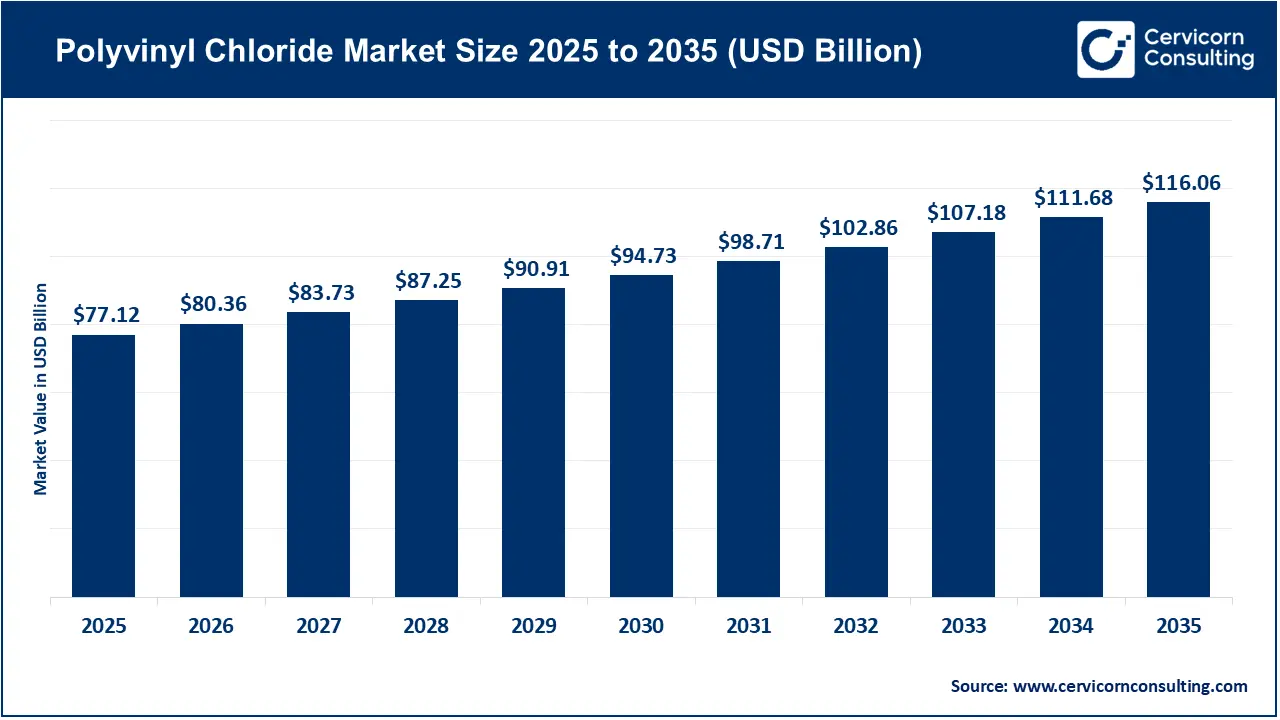
The global polyvinyl chloride market was valued at approximately USD 77.12 billion in 2025 and is projected to reach nearly USD 116.06 billion by 2035, growing at a CAGR of 4.17%.
What is the Polyvinyl Chloride (PVC) Market?
The Polyvinyl Chloride (PVC) market encompasses the production, distribution, and application of PVC resin and related products used across multiple industrial sectors. PVC is a synthetic polymer manufactured primarily from vinyl chloride monomer (VCM) and is available in rigid and flexible forms.
Rigid PVC is commonly used in pipes, window frames, doors, cable insulation, roofing membranes, and industrial equipment. Flexible PVC, produced by adding plasticizers, is widely utilized in medical devices, flooring, automotive interiors, packaging materials, and consumer products.
PVC remains one of the world’s most consumed plastics because of its cost-effectiveness, long lifespan, recyclability, and versatility in manufacturing applications.
Polyvinyl Chloride Market Growth Factors
The growth of the polyvinyl chloride market is driven by increasing urbanization and infrastructure development worldwide, rising demand for durable construction materials, expansion of water supply and wastewater management projects, growing investments in affordable housing, increasing use of PVC in healthcare applications such as blood bags and medical tubing, rising adoption in automotive lightweighting initiatives, expanding electrical and electronics sectors.
Growing demand for renewable energy infrastructure including solar panel components and cable insulation, advancements in PVC recycling technologies, increasing industrialization in emerging economies, and supportive government policies promoting sustainable and energy-efficient building materials. Additionally, the material’s excellent durability, corrosion resistance, low maintenance requirements, and cost advantages compared to alternative materials continue to strengthen its adoption across diverse industries.
Get a Free Sample: https://www.cervicornconsulting.com/sample/2686
Why is the Polyvinyl Chloride Market Important?
PVC plays a significant role in global economic development because it supports critical infrastructure, housing, healthcare, and industrial manufacturing sectors.
Infrastructure Development
PVC pipes are extensively used in water distribution, sewage systems, irrigation networks, and drainage applications. Their corrosion resistance and long service life make them ideal for public infrastructure projects.
Affordable Housing
PVC windows, doors, flooring, and roofing materials help reduce construction costs while improving energy efficiency and durability.
Healthcare Advancement
Medical-grade PVC is widely used in blood storage bags, IV containers, oxygen masks, and medical tubing due to its flexibility and sterilization compatibility.
Electrical Safety
PVC insulation protects electrical cables and wires in residential, commercial, and industrial environments.
Sustainability Benefits
Modern PVC products are increasingly recyclable and contribute to resource efficiency through longer product lifecycles and reduced maintenance requirements.
Major Companies Operating in the Polyvinyl Chloride Market
Competitive Landscape Overview
The PVC market features a combination of global chemical manufacturers, integrated petrochemical companies, and specialty materials producers. Leading companies are focusing on capacity expansion, sustainability initiatives, recycling technologies, and regional market penetration.
| Company | Specialization | Key Focus Areas | Notable Features | 2025 Revenue (Approx.) | Market Share (Estimated) | Global Presence |
|---|---|---|---|---|---|---|
| Hanwha Group | Petrochemicals and PVC Production | Chlor-alkali operations, PVC resins | Strong Asia-Pacific manufacturing network | USD 55+ Billion | 3-4% | Asia, Europe, Americas |
| Ineos | Chemicals and Vinyls | PVC, chlor-alkali, specialty chemicals | One of Europe’s largest PVC producers | USD 70+ Billion | 5-6% | Europe, North America, Asia |
| Ercros | Chemical Manufacturing | PVC compounds, chlor-alkali products | Strong presence in Southern Europe | USD 1+ Billion | 1% | Europe, exports globally |
| Occidental Petroleum Corporation | Integrated Energy and Chemicals | PVC and chlor-alkali through OxyChem | Large-scale North American production | USD 28+ Billion | 4-5% | Americas, Europe, Asia |
| Orbia | Infrastructure and Building Solutions | PVC pipes, construction materials | Strong water infrastructure portfolio | USD 8+ Billion | 3-4% | Americas, Europe, Asia-Pacific |
Hanwha Group
Hanwha Group is among South Korea’s leading industrial conglomerates with substantial investments in petrochemicals and PVC manufacturing. The company produces PVC resin for construction, industrial, and consumer applications while continuously investing in sustainable production technologies.
Key Strengths
- Strong integration across chemical value chains
- Large-scale manufacturing capabilities
- Growing investments in green technologies
- Significant Asia-Pacific market presence
Ineos
Ineos is one of the world’s largest chemical companies and a major producer of PVC and chlor-alkali products. The company supplies high-performance PVC materials to construction, healthcare, automotive, and industrial sectors.
Key Strengths
- Extensive production capacity
- Strong European market leadership
- Advanced manufacturing technologies
- Diverse global customer base
Ercros
Ercros is a Spanish chemical manufacturer with expertise in PVC compounds and chlorine derivatives. The company serves construction, industrial, and specialty applications across Europe.
Key Strengths
- Specialized PVC product portfolio
- Strong regional distribution network
- Focus on operational efficiency
- Established customer relationships
Occidental Petroleum Corporation (OxyChem)
Occidental Petroleum, through its subsidiary OxyChem, remains one of North America’s largest producers of PVC, caustic soda, and chlorine products.
Key Strengths
- Vertical integration
- Strong North American manufacturing footprint
- Extensive chlor-alkali operations
- Advanced environmental compliance systems
Orbia
Orbia has emerged as a global leader in infrastructure solutions and PVC-based products, particularly in water management and construction applications.
Key Strengths
- Leadership in pipe systems
- Sustainable infrastructure focus
- Global manufacturing presence
- Strong innovation in water technologies
Leading Trends Transforming the Polyvinyl Chloride Market
1. Sustainable PVC Production
Manufacturers are increasingly investing in low-carbon production technologies, renewable energy integration, and circular economy initiatives.
Impact
- Reduced environmental footprint
- Improved regulatory compliance
- Increased customer acceptance
- Enhanced ESG performance
2. PVC Recycling Expansion
Mechanical and chemical recycling technologies are helping increase recycled PVC content across various applications.
Impact
- Lower raw material consumption
- Reduced landfill waste
- Enhanced sustainability credentials
- Greater circular economy adoption
3. Smart Infrastructure Development
Urban infrastructure modernization projects are driving demand for PVC pipes, conduits, and building materials.
Impact
- Increased PVC consumption
- Higher demand for premium-grade materials
- Growth in utility infrastructure projects
4. Growth of Green Buildings
Energy-efficient buildings increasingly use PVC windows, insulation systems, and roofing membranes.
Impact
- Improved energy performance
- Reduced construction costs
- Stronger demand from commercial real estate
5. Medical PVC Innovations
Healthcare applications continue expanding due to increasing demand for disposable medical devices.
Impact
- New product development opportunities
- Higher healthcare sector demand
- Increased investment in specialty PVC grades
6. Expansion of Renewable Energy Infrastructure
PVC is increasingly used in solar farms, wind power installations, and electrical cable systems.
Impact
- Rising demand for cable insulation
- Growth in renewable energy projects
- New market opportunities globally
Successful Examples of the Polyvinyl Chloride Market Around the World
Europe’s Water Infrastructure Modernization
European countries continue replacing aging metal and concrete water pipelines with PVC systems. These projects improve water efficiency while reducing maintenance costs and leakage rates.
Outcome
- Improved water distribution reliability
- Reduced infrastructure expenses
- Long-term sustainability benefits
China’s Urban Development Boom
China’s rapid urbanization has generated significant demand for PVC pipes, window profiles, flooring materials, and electrical systems.
Outcome
- Massive PVC consumption growth
- Expansion of domestic production capacity
- Strong construction sector demand
India’s Jal Jeevan Mission
India’s nationwide water supply initiative has significantly increased PVC pipe demand for rural and urban water distribution systems.
Outcome
- Improved access to clean drinking water
- Expansion of domestic PVC manufacturing
- Increased infrastructure investments
North American Residential Construction
The United States and Canada continue utilizing PVC products extensively in residential housing developments.
Outcome
- Higher building durability
- Reduced maintenance costs
- Enhanced energy efficiency
Middle East Smart City Projects
Major smart city developments across Saudi Arabia and the UAE rely heavily on PVC infrastructure materials.
Outcome
- Large-scale infrastructure deployment
- Increased demand for advanced PVC products
- Enhanced sustainability performance
Global Regional Analysis of the Polyvinyl Chloride Market
North America
North America remains a major PVC production and consumption hub, supported by abundant shale gas resources and advanced petrochemical infrastructure.
Market Drivers
- Housing construction growth
- Water infrastructure upgrades
- Renewable energy investments
- Industrial manufacturing expansion
Government Initiatives and Policies
United States Infrastructure Investment Programs
Federal infrastructure funding supports modernization of water systems, wastewater facilities, transportation projects, and public utilities, increasing demand for PVC products.
Energy Efficiency Regulations
Building efficiency standards encourage adoption of durable and energy-saving construction materials including PVC windows and insulation systems.
Environmental Compliance Frameworks
Manufacturers are adopting cleaner production methods to meet evolving environmental regulations.
Europe
Europe represents one of the most mature PVC markets globally, emphasizing sustainability, recycling, and circular economy principles.
Market Drivers
- Green construction projects
- Infrastructure renovation
- Water conservation initiatives
- Advanced recycling programs
Government Initiatives and Policies
European Green Deal
The Green Deal promotes sustainable construction materials and resource efficiency, encouraging innovation within the PVC industry.
Circular Economy Action Plan
European policies support PVC recycling and waste reduction efforts across member states.
Energy Performance of Buildings Directive
The directive promotes energy-efficient building materials, supporting PVC-based windows and insulation systems.
Asia-Pacific
Asia-Pacific dominates global PVC consumption and production due to rapid industrialization, urbanization, and infrastructure development.
Market Drivers
- Population growth
- Affordable housing programs
- Industrial expansion
- Transportation infrastructure investments
Government Initiatives and Policies
China’s Urbanization Strategy
Government-backed urban development projects continue driving substantial demand for PVC building materials and utility infrastructure.
India’s Smart Cities Mission
Smart city investments stimulate PVC demand across construction, water management, and electrical applications.
Make in India Program
Manufacturing incentives encourage domestic production of PVC products and related infrastructure materials.
Southeast Asian Infrastructure Investments
Governments across Indonesia, Vietnam, Thailand, and Malaysia are investing heavily in transportation and utility networks.
Latin America
Latin America is experiencing increasing PVC demand driven by infrastructure modernization and urban housing development.
Market Drivers
- Water infrastructure expansion
- Housing construction growth
- Agricultural irrigation projects
- Industrial development
Government Initiatives and Policies
Public Infrastructure Programs
Countries such as Brazil, Mexico, and Chile continue investing in transportation, sanitation, and water supply projects.
Housing Development Initiatives
Affordable housing programs increase PVC consumption in doors, windows, flooring, and piping systems.
Water Resource Management Projects
Government efforts to improve water access are driving demand for PVC pipe networks.
Middle East and Africa
The Middle East and Africa represent emerging growth markets supported by large-scale infrastructure investments and economic diversification efforts.
Market Drivers
- Smart city developments
- Desalination projects
- Commercial construction
- Industrial expansion
Government Initiatives and Policies
Saudi Vision 2030
Saudi Arabia’s economic transformation strategy includes significant investments in infrastructure, housing, utilities, and industrial development.
UAE Smart Infrastructure Programs
The UAE continues investing in sustainable buildings, transportation systems, and utility infrastructure.
African Urban Development Initiatives
Many African nations are expanding water distribution networks, sanitation systems, and housing projects utilizing PVC products.
Water Security Investments
Governments throughout the region are prioritizing water infrastructure projects that rely heavily on PVC piping systems.
Future Opportunities Emerging Across the PVC Industry
Several emerging opportunities are expected to shape the next phase of market expansion:
- Bio-based and low-carbon PVC production technologies
- Advanced recycling and circular economy solutions
- Smart water infrastructure systems
- Renewable energy applications
- High-performance medical-grade PVC products
- Sustainable building materials
- Digital manufacturing and automation
- Lightweight automotive components
- Electrification infrastructure development
- Green urbanization projects
As infrastructure spending, urban development, healthcare investments, and sustainability initiatives continue accelerating worldwide, the polyvinyl chloride market is expected to remain a foundational component of global industrial and economic growth, supporting critical applications across construction, utilities, transportation, healthcare, and renewable energy sectors.
To Get Detailed Overview, Contact Us: https://www.cervicornconsulting.com/contact-us
Read Report: Maritime Market Revenue, Trends, and Strategic Insights by 2035