Robotics Market Revenue, Trends, and Strategic Insights by 2035
Robotics Market Size
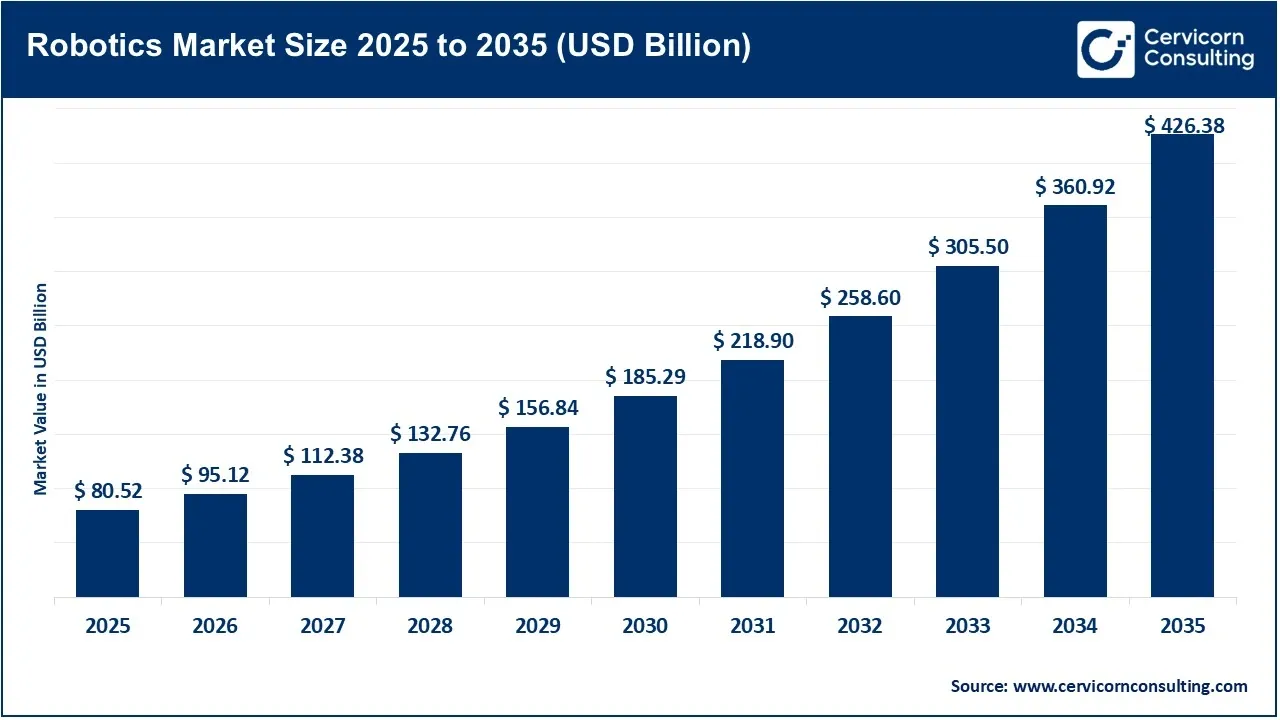
The global robotics market was valued at approximately USD 80.52 billion in 2025 and is projected to reach nearly USD 426.38 billion by 2035, growing at a CAGR of 18.14%.
Robotics Market Growth Factors
The robotics market is witnessing remarkable growth due to the rapid adoption of Industry 4.0 technologies, increasing automation across manufacturing industries, rising labor shortages in developed economies, growing investments in warehouse automation and smart logistics, expanding use of collaborative robots (cobots), advancements in artificial intelligence and machine vision, increasing demand for precision manufacturing, supportive government initiatives promoting smart factories, rapid expansion of e-commerce fulfillment centers, higher investments in healthcare robotics.
Growing applications in agriculture and food processing, continuous improvements in robotic sensors and software, declining costs of robotic hardware, increasing deployment of autonomous mobile robots (AMRs), stronger focus on workplace safety, and the growing need for high-quality, consistent production across industries. These factors are encouraging organizations worldwide to accelerate robotic deployment while improving operational efficiency, productivity, flexibility, and long-term profitability.
What is the Robotics Market?
The robotics market refers to the global ecosystem involved in the design, manufacturing, integration, deployment, software development, maintenance, and commercialization of robotic systems that automate physical tasks with minimal human intervention. The market encompasses industrial robots, collaborative robots, autonomous mobile robots, service robots, medical robots, warehouse robots, agricultural robots, defense robots, and humanoid robots.
Modern robots combine advanced hardware with intelligent software, allowing them to perceive their environment, analyze data, make decisions, and execute tasks autonomously or collaboratively with human workers. Robotics has evolved far beyond traditional automotive assembly lines and is now widely used across electronics manufacturing, pharmaceuticals, healthcare, food processing, logistics, construction, mining, energy, retail, hospitality, and space exploration.
Get a Free Sample: https://www.cervicornconsulting.com/sample/2991
Why is the Robotics Market Important?
Robotics has become a cornerstone of modern industrial development because it enables organizations to achieve higher productivity while maintaining exceptional quality standards. Robots perform repetitive, hazardous, and precision-intensive tasks that would otherwise expose workers to safety risks or reduce production efficiency.
Some of the major reasons why robotics is becoming increasingly important include:
- Improving manufacturing productivity through 24/7 operations.
- Reducing operational costs over the long term.
- Addressing labor shortages in developed economies.
- Enhancing workplace safety by handling dangerous tasks.
- Increasing manufacturing flexibility through collaborative robots.
- Improving product quality with highly accurate automation.
- Supporting smart factory initiatives and Industry 4.0 transformation.
- Enabling precision surgery and advanced healthcare applications.
- Accelerating warehouse automation for growing e-commerce demand.
- Reducing waste through accurate and repeatable manufacturing processes.
- Supporting sustainable manufacturing with optimized energy consumption.
- Improving supply chain resilience through automated operations.
As industries continue their digital transformation journey, robotics is becoming a strategic technology rather than simply a manufacturing tool.
Leading Robotics Companies
| Company | Specialization | Key Focus Areas | Notable Features | 2025 Revenue* | Estimated Market Share | Global Presence |
|---|---|---|---|---|---|---|
| ABB Ltd. | Industrial automation and robotics | Smart factories, welding, painting, material handling, AI-enabled automation | Wide industrial robot portfolio, RobotStudio software, integrated automation solutions | US$33.2 Billion (company revenue) | ~10–12% (industrial robotics) | Operations in over 100 countries |
| FANUC Corporation | Industrial robots and CNC automation | Factory automation, CNC systems, industrial robots, machine tools | Industry-leading reliability, extensive installed robot base | Approx. ¥880 Billion (FY2025/26 company revenue) | ~15–18% | Presence in more than 100 countries |
| KUKA AG | Industrial robotics and intelligent automation | Automotive automation, logistics, healthcare, digital manufacturing | Strong automotive expertise and flexible automation systems | Approx. €4–4.5 Billion (company revenue) | ~8–10% | Operations in over 50 countries |
| Yaskawa Electric Corporation | Motion control and industrial robotics | Servo motors, drives, welding robots, handling robots | Global leader in motion control and Motoman robots | ¥542.1 Billion (FY ended Feb. 2026) | ~9–11% | Presence in over 30 countries |
| Universal Robots A/S | Collaborative robots (Cobots) | SME automation, collaborative manufacturing, packaging, inspection | Pioneer of commercial cobots with easy programming | Privately held (revenue not publicly disclosed for 2025) | Leading global cobot supplier (~35–40% of cobot segment) | Deployed in more than 100 countries |
Leading Trends Shaping the Robotics Market and Their Impact
1. Artificial Intelligence-Powered Robotics
Artificial intelligence is transforming robots from programmable machines into intelligent systems capable of learning, adapting, and making decisions in real time. AI enables predictive maintenance, autonomous navigation, object recognition, speech interaction, and adaptive manufacturing.
Impact
- Higher automation intelligence
- Improved production efficiency
- Reduced operational downtime
- Better decision-making
2. Collaborative Robots (Cobots)
Collaborative robots are increasingly replacing traditional industrial robots in small and medium-sized enterprises because they can safely work alongside humans without extensive safety barriers.
Impact
- Faster automation adoption
- Lower implementation costs
- Greater workforce collaboration
- Flexible manufacturing
3. Autonomous Mobile Robots (AMRs)
AMRs are transforming warehouses, hospitals, and manufacturing facilities by autonomously transporting goods using AI-based navigation.
Impact
- Faster logistics operations
- Lower labor dependency
- Improved inventory accuracy
- Higher warehouse productivity
4. Digital Twins in Robotics
Manufacturers are increasingly using digital twins to simulate robotic systems before deployment.
Impact
- Reduced commissioning time
- Improved production planning
- Lower implementation risks
- Better predictive maintenance
5. AI Vision Systems
Computer vision enables robots to inspect products, identify defects, recognize objects, and perform quality assurance automatically.
Impact
- Improved product quality
- Reduced inspection costs
- Higher manufacturing precision
- Better customer satisfaction
6. Healthcare Robotics Expansion
Hospitals are increasingly investing in robotic surgery, rehabilitation robots, pharmacy automation, and laboratory robotics.
Impact
- Better patient outcomes
- Increased surgical precision
- Reduced recovery time
- Improved hospital efficiency
7. Humanoid Robotics
Recent advancements in AI, actuators, and sensors are accelerating the commercialization of humanoid robots for industrial and service applications.
Impact
- Expansion into labor-intensive sectors
- Support for aging populations
- New automation opportunities
- Future workforce augmentation
Successful Examples of Robotics Market Adoption Around the World
Amazon Warehouses (United States)
Amazon has deployed hundreds of thousands of mobile robots across its fulfillment centers to automate inventory movement, order picking, sorting, and package transportation. Robotics has significantly improved warehouse productivity while reducing delivery times and operational costs.
Tesla Gigafactories (United States)
Tesla extensively uses industrial robots for battery manufacturing, welding, painting, assembly, and quality inspection. Robotics enables high-volume EV production while maintaining consistent product quality.
Toyota Manufacturing Plants (Japan)
Toyota integrates industrial robots with lean manufacturing principles to optimize vehicle production, welding, painting, and assembly operations. Automation has helped improve efficiency, safety, and manufacturing precision.
Siemens Smart Factories (Germany)
Siemens combines robotics, AI, Industrial IoT, and digital twins to create highly automated smart factories capable of predictive maintenance and real-time production optimization.
Ocado Smart Warehouses (United Kingdom)
Ocado operates highly automated fulfillment centers where fleets of robots coordinate inventory management, order fulfillment, and packaging using AI-driven logistics systems.
Da Vinci Surgical System (Global)
Robotic-assisted surgical platforms have transformed minimally invasive procedures across hospitals worldwide by improving surgical precision, reducing complications, and shortening patient recovery times.
Global Regional Analysis
North America
North America remains one of the most technologically advanced robotics markets due to strong investments in artificial intelligence, manufacturing automation, defense robotics, warehouse automation, and healthcare innovation. The United States leads regional demand as manufacturers increasingly adopt robotics to improve productivity and address labor shortages. Growth is also driven by the expansion of semiconductor manufacturing, electric vehicle production, and large-scale e-commerce logistics.
Government Initiatives and Policies
- The U.S. CHIPS and Science Act supports domestic semiconductor manufacturing, encouraging greater deployment of robotics and advanced automation in fabrication facilities.
- Federal programs promoting advanced manufacturing, AI research, and smart manufacturing strengthen robotics innovation.
- Canada supports robotics commercialization through advanced manufacturing initiatives and research funding.
Europe
Europe represents a mature robotics market with widespread adoption across automotive manufacturing, electronics, pharmaceuticals, food processing, and logistics. Germany, Italy, France, Sweden, and the Netherlands continue investing heavily in Industry 4.0 technologies and digital manufacturing.
Government Initiatives and Policies
- The European Union’s Digital Europe Programme promotes AI, robotics, cybersecurity, and digital transformation.
- Horizon Europe funds collaborative robotics, AI, and industrial automation research.
- Germany’s Industry 4.0 strategy encourages smart factory implementation through robotics and connected manufacturing.
Asia-Pacific
Asia-Pacific dominates the global robotics market due to its extensive manufacturing base, electronics production, automotive industry, and government-led industrial modernization programs. China, Japan, South Korea, and Singapore are among the world’s largest adopters and manufacturers of industrial robots.
China continues investing aggressively in robotics to reduce labor dependency while strengthening domestic manufacturing capabilities. Japan remains a global leader in industrial robot production, while South Korea has one of the highest robot densities worldwide.
Government Initiatives and Policies
- China’s “Made in China 2025” strategy prioritizes robotics, smart manufacturing, and industrial automation.
- Japan promotes robotics through its Robot Revolution Initiative and Society 5.0 vision.
- South Korea supports intelligent manufacturing through its Manufacturing Innovation Strategy and smart factory expansion.
- Singapore’s Smart Nation initiative encourages robotics adoption across logistics, healthcare, and urban services.
- India’s National Strategy for AI and Production Linked Incentive (PLI) programs encourage automation and advanced manufacturing investments.
Latin America
Latin America is gradually increasing robotics adoption across automotive manufacturing, food processing, mining, agriculture, and logistics. Brazil and Mexico remain the region’s largest robotics markets due to strong automotive production and expanding industrial automation investments.
Government Initiatives and Policies
- Brazil supports Industry 4.0 modernization through manufacturing innovation programs.
- Mexico encourages advanced manufacturing investments through industrial development initiatives and integration with North American supply chains.
Middle East & Africa
The Middle East and Africa are witnessing growing investments in robotics across oil & gas, logistics, healthcare, construction, mining, and smart city projects. Gulf Cooperation Council (GCC) countries are rapidly adopting automation as part of their economic diversification strategies.
Government Initiatives and Policies
- Saudi Arabia’s Vision 2030 promotes industrial automation, AI, robotics, and smart manufacturing.
- The UAE National AI Strategy supports robotics deployment across healthcare, transportation, government services, and smart infrastructure.
- South Africa continues expanding robotics adoption in mining automation and industrial manufacturing.
Future Outlook
The robotics market is expected to witness sustained long-term growth as artificial intelligence, machine learning, cloud robotics, digital twins, collaborative robots, and autonomous systems continue to mature. Manufacturing industries will remain the largest adopters, while healthcare, agriculture, logistics, retail, construction, defense, and service robotics are expected to experience significant expansion. Continuous improvements in affordability, software intelligence, sensor technologies, and human-robot collaboration will further accelerate global adoption, making robotics an essential pillar of next-generation digital economies.
To Get Detailed Overview, Contact Us: https://www.cervicornconsulting.com/contact-us
Read Report: Water Pump Market Revenue, Trends, and Strategic Insights by 2035