Red Biotechnology Market Revenue, Trends, and Strategic Insights by 2035
Table of Contents
ToggleRed Biotechnology Market Size
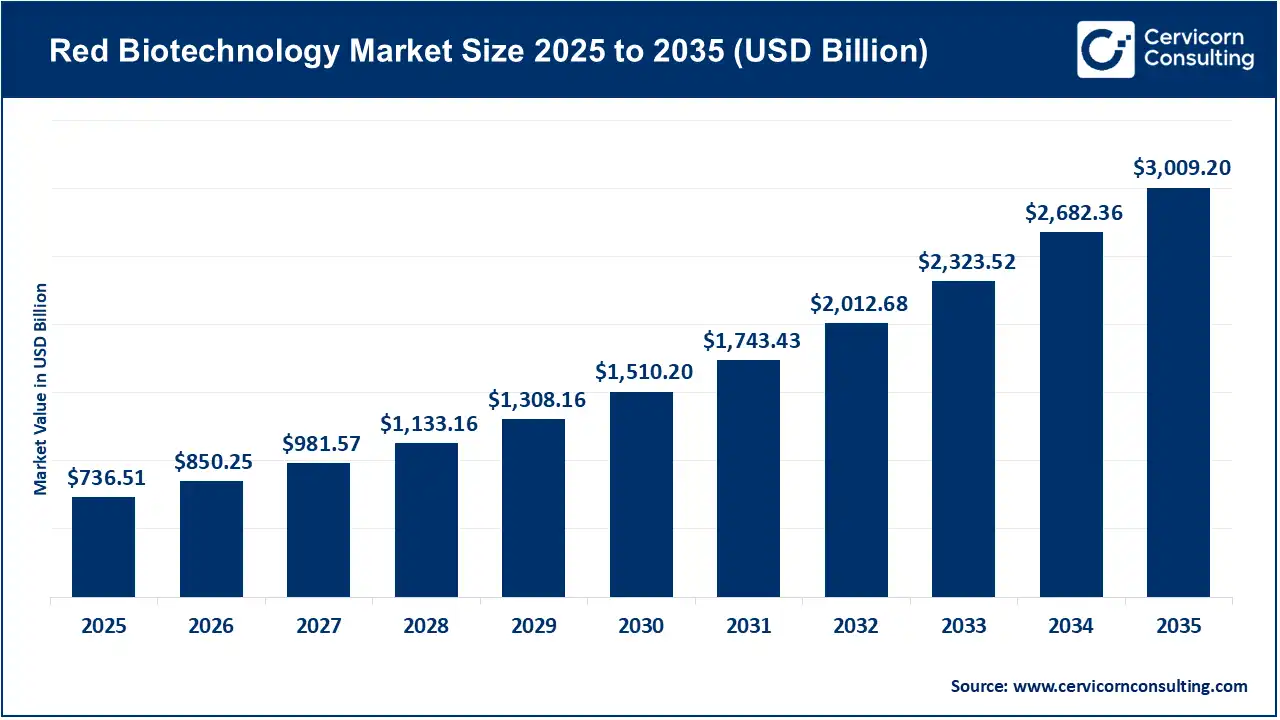
The global red biotechnology market was valued at approximately USD 736.51 billion in 2025 and is projected to reach nearly USD 3,009.20 billion by 2035, growing at a CAGR of 15.11%.
Red Biotechnology Market Growth Factors
The growth of the red biotechnology market is primarily driven by the rising prevalence of chronic diseases such as cancer, diabetes, cardiovascular disorders, and autoimmune conditions, increasing demand for personalized medicine, rapid advancements in genetic engineering and molecular biology, expanding investments in biopharmaceutical research, growing adoption of biologics and biosimilars, breakthroughs in cell and gene therapy, increasing healthcare expenditure across developed and emerging economies, supportive regulatory frameworks for biotechnology innovation, expanding applications of CRISPR and gene-editing technologies, rising demand for regenerative medicine, growing collaborations between pharmaceutical companies and biotech firms, enhanced diagnostic capabilities through genomic technologies, and increasing government funding for biotechnology research and development worldwide.
What is the Red Biotechnology Market?
Red biotechnology refers to the application of biotechnology in the healthcare and medical sectors. It encompasses a wide range of technologies and products designed to improve human health through biological processes, genetic engineering, molecular diagnostics, regenerative medicine, vaccines, and therapeutic drug development.
The red biotechnology market includes:
- Biopharmaceuticals
- Gene therapy
- Cell therapy
- Vaccines
- Molecular diagnostics
- Tissue engineering
- Regenerative medicine
- Personalized medicine
- Stem cell research
- Monoclonal antibodies
Unlike traditional pharmaceutical approaches that rely heavily on chemical synthesis, red biotechnology utilizes living organisms, biological systems, or genetically modified cells to create innovative healthcare solutions.
Modern red biotechnology has significantly transformed disease management by enabling targeted therapies, reducing treatment side effects, and improving patient outcomes. From cancer immunotherapy to mRNA vaccines and gene-editing treatments, red biotechnology continues to redefine modern medicine.
Get a Free Sample: https://www.cervicornconsulting.com/sample/2667
Why is Red Biotechnology Important?
Red biotechnology plays a critical role in addressing some of the world’s most pressing healthcare challenges.
Improved Disease Treatment
Biotechnology-based therapies provide highly targeted treatment options for diseases such as cancer, rheumatoid arthritis, multiple sclerosis, and rare genetic disorders.
Personalized Medicine
Advances in genomics enable healthcare providers to tailor treatments based on individual genetic profiles, improving therapeutic effectiveness and minimizing adverse effects.
Enhanced Vaccine Development
Biotechnology has accelerated vaccine development processes, as demonstrated by the rapid development of COVID-19 vaccines using advanced biotechnology platforms.
Regenerative Medicine
Stem cell therapies and tissue engineering technologies are opening new possibilities for repairing damaged tissues and treating degenerative diseases.
Early Disease Detection
Molecular diagnostics enable earlier and more accurate diagnosis of diseases, improving treatment outcomes and reducing healthcare costs.
Addressing Rare Diseases
Gene therapies and advanced biologics are helping treat rare genetic disorders that previously had limited or no treatment options.
Major Companies Driving the Red Biotechnology Market
The red biotechnology market is highly competitive and innovation-driven. Several leading biotechnology and pharmaceutical companies continue to shape the industry’s future through substantial investments in research and development.
| Company | Specialization | Key Focus Areas | Notable Features | Estimated 2025 Revenue | Market Share* | Global Presence |
|---|---|---|---|---|---|---|
| Amgen Inc. | Biotechnology and Biopharmaceuticals | Oncology, Inflammation, Rare Diseases | Pioneer in biologics and biosimilars | Approx. USD 34 Billion | Significant Global Share | North America, Europe, Asia-Pacific |
| Gilead Sciences, Inc. | Antiviral and Specialty Medicines | HIV, Oncology, Liver Diseases | Leader in antiviral therapeutics | Approx. USD 29 Billion | Strong Biopharma Position | More than 35 Countries |
| Biogen | Neurology and Neuroscience | Alzheimer’s, Multiple Sclerosis, Rare Diseases | Strong neurological treatment portfolio | Approx. USD 10 Billion | Key Neuroscience Share | Global Operations |
| Pfizer Inc. | Pharmaceuticals and Biotechnology | Vaccines, Oncology, Immunology | Extensive vaccine and biologics portfolio | Approx. USD 65 Billion | Major Global Player | Over 125 Countries |
| Novartis AG | Innovative Medicines and Gene Therapy | Oncology, Cardiovascular, Cell Therapy | Strong gene therapy capabilities | Approx. USD 53 Billion | Leading Market Position | More than 150 Countries |
Company Profiles
Amgen Inc.
Amgen is one of the world’s largest biotechnology companies and a pioneer in biologic therapies. The company focuses on developing innovative medicines for oncology, cardiovascular diseases, inflammation, bone health, and rare diseases.
Key Strengths:
- Advanced biologics portfolio
- Strong biosimilar business
- Significant R&D investments
- Global commercialization network
Amgen’s expertise in protein therapeutics and monoclonal antibodies has positioned the company as a major contributor to red biotechnology advancements.
Gilead Sciences, Inc.
Gilead Sciences is recognized for its leadership in antiviral therapies and oncology innovations. The company transformed HIV treatment and continues to expand its biotechnology capabilities through cell therapies and precision medicine.
Key Strengths:
- HIV treatment leadership
- Oncology innovations
- Cell therapy expansion
- Strong global research collaborations
Its investment in advanced therapies supports the broader growth of biotechnology-based healthcare solutions.
Biogen
Biogen specializes in neuroscience and neurodegenerative disease treatments. The company has played a major role in developing therapies for multiple sclerosis and Alzheimer’s disease.
Key Strengths:
- Neurological disease expertise
- Precision medicine research
- Rare disease therapeutics
- Advanced clinical development programs
Biogen continues to invest heavily in biomarker-based diagnostics and personalized treatment approaches.
Pfizer Inc.
Pfizer remains one of the most influential pharmaceutical and biotechnology companies globally. Its success in vaccine development and biologics has strengthened its position within the red biotechnology market.
Key Strengths:
- Vaccine leadership
- Oncology pipeline
- Biologic therapeutics
- Global manufacturing network
The company continues to leverage biotechnology platforms to develop next-generation therapies.
Novartis AG
Novartis has become a major innovator in gene therapy, cell therapy, and precision medicine. The company focuses on developing transformative therapies for complex diseases.
Key Strengths:
- CAR-T cell therapies
- Gene therapy development
- Oncology leadership
- Digital healthcare integration
Its extensive research ecosystem continues to support biotechnology breakthroughs worldwide.
Leading Trends Shaping the Red Biotechnology Market
Expansion of Gene Therapy
Gene therapy has emerged as one of the most transformative developments in modern medicine. Technologies such as CRISPR-Cas9, viral vectors, and genome editing are enabling treatment of inherited disorders at the genetic level.
Impact
- New treatment opportunities for rare diseases
- Long-term therapeutic benefits
- Reduced dependence on lifelong medications
- Growth in precision medicine markets
Rising Adoption of Cell Therapy
Cell-based therapies, particularly CAR-T therapies, are revolutionizing cancer treatment by modifying patient immune cells to target tumors.
Impact
- Improved cancer survival rates
- Expansion of immunotherapy applications
- Increased biotechnology investments
- Growth in regenerative medicine
Growth of Personalized Medicine
Advances in genomic sequencing and biomarker research are driving personalized treatment approaches.
Impact
- Higher treatment effectiveness
- Reduced adverse reactions
- Improved patient outcomes
- More efficient healthcare delivery
Artificial Intelligence in Drug Discovery
AI and machine learning technologies are accelerating the identification of drug candidates and improving clinical trial efficiency.
Impact
- Reduced drug development timelines
- Lower research costs
- Improved success rates
- Enhanced molecular analysis
Expansion of mRNA Technology
The success of mRNA vaccines has expanded research into applications beyond infectious diseases.
Impact
- Cancer vaccine development
- Faster vaccine production
- Improved pandemic preparedness
- Expanded therapeutic possibilities
Biosimilars Market Growth
Patent expirations of major biologics are creating opportunities for biosimilars.
Impact
- Increased treatment accessibility
- Lower healthcare costs
- Expanded biologics adoption
- Greater competition in healthcare markets
Regenerative Medicine Advancements
Stem cell therapies and tissue engineering are creating innovative treatment pathways.
Impact
- Tissue regeneration capabilities
- Treatment for degenerative disorders
- Reduced organ transplant dependence
- New healthcare opportunities
Successful Examples of Red Biotechnology Around the World
CAR-T Cell Therapy Success in the United States
The United States has become a global leader in CAR-T cell therapy development. Treatments such as those developed for leukemia and lymphoma patients have demonstrated remarkable clinical outcomes.
Achievements
- High remission rates
- Personalized cancer treatment
- Expansion into multiple cancer types
Gene Therapy for Rare Diseases in Europe
European biotechnology companies have pioneered gene therapies targeting rare inherited disorders.
Achievements
- Treatment of previously incurable diseases
- Improved patient quality of life
- Reduced long-term healthcare burden
mRNA Vaccine Innovation
The rapid development and deployment of mRNA vaccines demonstrated the power of biotechnology-driven healthcare innovation.
Achievements
- Accelerated vaccine development
- Global vaccination campaigns
- New therapeutic platform creation
Stem Cell Research in Japan
Japan has become a global leader in regenerative medicine through extensive stem cell research initiatives.
Achievements
- Tissue regeneration breakthroughs
- Advanced clinical research programs
- Strong government support
Precision Medicine Programs in Singapore
Singapore has invested heavily in genomics and precision medicine research.
Achievements
- National genomics initiatives
- Personalized healthcare development
- Biotechnology ecosystem expansion
Global Regional Analysis of the Red Biotechnology Market
North America
North America represents the largest red biotechnology market globally due to its advanced healthcare infrastructure, strong biotechnology ecosystem, and substantial R&D investments.
Key Market Drivers
- Presence of leading biotech companies
- High healthcare expenditure
- Strong venture capital investments
- Advanced clinical research infrastructure
Government Initiatives and Policies
The United States government supports biotechnology through:
- National Institutes of Health (NIH) funding programs
- Biomedical Advanced Research and Development Authority (BARDA) initiatives
- FDA fast-track and breakthrough therapy designations
- Precision Medicine Initiative
Canada supports biotechnology growth through:
- Strategic Innovation Fund
- Genome Canada programs
- Biomanufacturing and Life Sciences Strategy
Market Outlook
North America is expected to maintain market leadership due to continuous innovation and strong commercialization capabilities.
Europe
Europe remains a major biotechnology hub supported by strong research institutions and collaborative innovation frameworks.
Key Market Drivers
- Strong pharmaceutical industry
- Advanced research networks
- Growing demand for biologics
- Favorable regulatory environment
Government Initiatives and Policies
The European Union supports biotechnology through:
- Horizon Europe research funding
- European Medicines Agency (EMA) innovation pathways
- European Biotechnology Strategy
- National genomics programs
Countries such as Germany, France, Switzerland, and the United Kingdom continue to invest heavily in biotechnology innovation.
Market Outlook
Europe is expected to experience strong growth driven by precision medicine, gene therapies, and biosimilar adoption.
Asia-Pacific
Asia-Pacific is projected to be the fastest-growing regional market due to expanding healthcare infrastructure and increasing biotechnology investments.
Key Market Drivers
- Large patient population
- Rising healthcare spending
- Expanding biotechnology manufacturing
- Increasing government support
Government Initiatives and Policies
China
- Made in China 2025 biotechnology initiatives
- National biotechnology innovation programs
- Increased funding for genomic research
Japan
- Regenerative medicine promotion policies
- Fast-track approval pathways
- Stem cell research support
India
- Biotechnology Industry Research Assistance Council (BIRAC)
- National Biotechnology Development Strategy
- Genome India Project
South Korea
- Bioeconomy development plans
- Precision medicine initiatives
- Cell therapy support programs
Market Outlook
Asia-Pacific is expected to become a major global biotechnology innovation and manufacturing center over the next decade.
Latin America
Latin America is gradually expanding its biotechnology capabilities with increasing investments in healthcare innovation.
Key Market Drivers
- Rising chronic disease burden
- Improving healthcare systems
- Growing pharmaceutical manufacturing
Government Initiatives and Policies
Brazil, Mexico, and Argentina are implementing policies to:
- Support biotechnology startups
- Expand healthcare research
- Improve access to advanced therapies
Market Outlook
The region offers long-term growth opportunities as biotechnology adoption increases.
Middle East and Africa
The Middle East and Africa region is witnessing growing interest in biotechnology-driven healthcare transformation.
Key Market Drivers
- Healthcare modernization initiatives
- Increasing investment in life sciences
- Growing prevalence of chronic diseases
Government Initiatives and Policies
Saudi Arabia
- Vision 2030 healthcare transformation
- Biotechnology investment programs
- Research and innovation funding
United Arab Emirates
- National Genome Program
- Biotechnology innovation initiatives
- Healthcare digitalization strategies
South Africa
- Biotechnology Regional Innovation Centers
- National biotechnology strategy
- Research commercialization programs
Market Outlook
The region is expected to experience gradual but significant growth as governments continue investing in biotechnology infrastructure and healthcare innovation.
To Get Detailed Overview, Contact Us: https://www.cervicornconsulting.com/contact-us
Read Report: Cardiovascular Devices Market Revenue, Trends, and Strategic Insights by 2035