Agentic AI Market Revenue, Trends, and Strategic Insights by 2035
Agentic AI Market Size
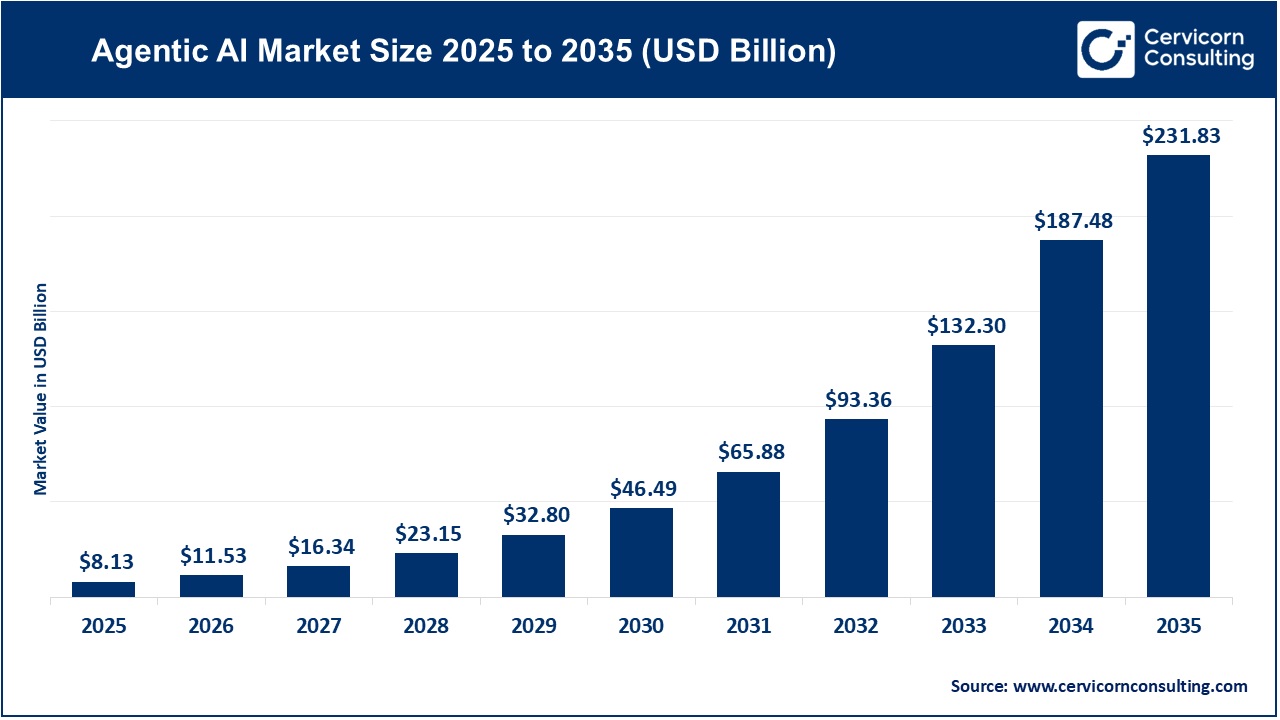
The global agentic AI market was valued at approximately USD 8.13 billion in 2025 and is projected to reach nearly USD 231.83 billion by 2035, growing at a CAGR of 45.1%.
What is the Agentic AI Market?
The Agentic AI market refers to the ecosystem of technologies, platforms, software, and services that enable artificial intelligence systems to autonomously perceive, reason, plan, execute tasks, and continuously improve with minimal human intervention. Unlike traditional AI models that primarily respond to prompts or perform predefined tasks, agentic AI systems can independently make decisions, coordinate multiple actions, interact with digital tools, communicate with other AI agents, and accomplish complex business objectives. These intelligent agents leverage large language models (LLMs), machine learning, reinforcement learning, knowledge graphs, automation frameworks, and enterprise data to deliver autonomous decision-making across industries.
As organizations increasingly pursue digital transformation, hyperautomation, and intelligent workflows, the demand for agentic AI platforms is expanding rapidly across healthcare, banking, manufacturing, retail, logistics, cybersecurity, telecommunications, and public services.
Agentic AI Market Growth Factors
The growth of the agentic AI market is being driven by the rapid adoption of generative AI across enterprises, increasing demand for intelligent business automation, rising investments in AI infrastructure, advancements in large language models (LLMs), growing cloud computing capabilities, widespread digital transformation initiatives, increasing enterprise demand for autonomous decision-making, expansion of AI copilots and digital assistants, growing integration of AI with IoT and robotics, improvements in multimodal AI technologies, increasing adoption of workflow orchestration platforms.
Rising cybersecurity automation requirements, favorable government investments in AI innovation, expanding use of AI agents in customer service and software development, continuous improvements in AI reasoning capabilities, growing availability of enterprise data, increased venture capital funding for AI startups, and the emergence of autonomous enterprise ecosystems capable of reducing operational costs while significantly improving productivity and decision-making efficiency.
Get a Free Sample: https://www.cervicornconsulting.com/sample/2659
Why is Agentic AI Important?
Agentic AI represents the next evolution of artificial intelligence because it moves beyond simple content generation toward autonomous execution. Organizations are no longer seeking AI that only answers questions—they increasingly require AI systems capable of completing entire workflows.
Its importance can be understood through several business advantages:
Increased Productivity
Agentic AI automates repetitive and knowledge-intensive tasks, allowing employees to focus on strategic activities.
Faster Decision-Making
AI agents continuously analyze data from multiple sources and recommend or execute actions in real time.
Cost Optimization
Businesses can reduce operational expenses by minimizing manual intervention while improving efficiency.
Enhanced Customer Experience
Autonomous AI agents provide 24/7 customer support, personalized recommendations, and faster issue resolution.
Scalable Operations
Unlike human teams, AI agents can scale instantly across thousands of workflows simultaneously.
Intelligent Collaboration
Modern agentic AI systems coordinate with enterprise applications, APIs, databases, cloud platforms, and even other AI agents, creating intelligent digital workforces.
Market Drivers Accelerating Industry Expansion
Several macroeconomic and technological factors continue to reshape the global market.
Enterprise Automation
Organizations increasingly deploy AI agents for HR, finance, procurement, software engineering, marketing, and customer support.
Large Language Models
The evolution of advanced foundation models has dramatically improved reasoning, planning, coding, and natural language understanding.
Cloud Infrastructure
Scalable cloud computing enables businesses of all sizes to deploy AI agents without significant infrastructure investments.
AI Governance
Growing regulatory frameworks encourage responsible AI deployment while improving enterprise confidence.
Industry-Specific Solutions
Healthcare, banking, retail, manufacturing, and logistics increasingly require customized autonomous AI solutions.
Leading Companies in the Agentic AI Market
| Company | Specialization | Key Focus Areas | Notable Features | 2025 Revenue* | Estimated Market Position | Global Presence |
|---|---|---|---|---|---|---|
| Amazon.com, Inc. | Cloud AI & Autonomous Agents | AWS AI services, Bedrock, enterprise automation | Amazon Q, Bedrock, Nova models, cloud-native AI agents | Approx. US$716.9 Billion | Leading hyperscaler | North America, Europe, Asia-Pacific, Latin America, Middle East & Africa |
| Ampcome Technologies Private Limited | AI Software & Intelligent Automation | Enterprise AI solutions, digital transformation | Customized AI implementations, workflow automation | Private (Not Publicly Disclosed) | Emerging player | India with expanding international projects |
| Google LLC | Foundation Models & AI Platforms | Gemini ecosystem, Vertex AI, enterprise AI | Gemini models, multimodal AI, AI Studio | Parent company Alphabet revenue exceeded US$400 Billion | Global AI leader | Worldwide |
| Microsoft Corporation | Enterprise AI & Cloud | Azure AI, Copilot, autonomous enterprise solutions | Microsoft Copilot, Azure AI Foundry, AI Agents | Approx. US$281.7 Billion | Leading enterprise AI provider | Worldwide |
| The AnyLogic Company | Simulation & Digital Twins | AI simulation, supply chain optimization | Hybrid simulation, digital twin modeling | Private (Not Publicly Disclosed) | Specialized simulation leader | More than 100 countries |
Leading Trends Transforming the Agentic AI Market
1. Multi-Agent Systems
Organizations increasingly deploy multiple AI agents that collaborate to complete complex workflows. Rather than relying on a single model, enterprises create specialized agents for planning, coding, analytics, customer support, compliance, and reporting.
Impact
- Improved scalability
- Faster workflow completion
- Better enterprise coordination
2. AI Copilots Becoming Autonomous
AI copilots are evolving into fully autonomous digital workers capable of scheduling meetings, writing reports, generating software, analyzing business intelligence, and communicating with enterprise systems.
Impact
- Higher employee productivity
- Reduced administrative workload
- Improved decision support
3. Enterprise Workflow Automation
Businesses increasingly integrate AI agents into ERP, CRM, HR, procurement, and finance systems.
Impact
- Reduced operational costs
- Better workflow visibility
- Faster business processes
4. Multimodal AI
Modern AI agents process text, images, video, speech, documents, spreadsheets, and structured databases simultaneously.
Impact
- Better contextual understanding
- Improved enterprise intelligence
- Enhanced customer interactions
5. AI Governance and Security
Responsible AI deployment has become a major investment priority.
Organizations now emphasize:
- Explainable AI
- Human oversight
- Bias monitoring
- AI auditing
- Data privacy
Impact
Greater enterprise trust and wider adoption.
6. AI Agents for Software Development
Software engineering has become one of the largest application areas.
AI agents now:
- Generate code
- Test software
- Debug applications
- Review security
- Optimize performance
Impact
Development cycles are becoming significantly shorter while improving code quality.
7. Industry-Specific AI Agents
Instead of generic chatbots, organizations now develop specialized AI agents for:
- Healthcare diagnostics
- Financial advisory
- Manufacturing optimization
- Retail merchandising
- Supply chain planning
- Legal documentation
Impact
Higher ROI through domain-specific intelligence.
Successful Examples of Agentic AI Around the World
Microsoft Copilot Ecosystem
Microsoft has embedded autonomous AI capabilities across productivity software, enabling intelligent document generation, workflow automation, meeting summarization, coding assistance, and enterprise collaboration.
Business Impact
- Improved workplace productivity
- Enhanced enterprise automation
- Strong adoption across global enterprises
Amazon AWS AI Agents
Amazon continues expanding AI capabilities through AWS, enabling organizations to build autonomous applications using foundation models, intelligent orchestration, and enterprise-grade cloud infrastructure.
Business Impact
- Accelerated enterprise AI deployment
- Simplified cloud-native automation
- Increased scalability
Google’s Gemini Ecosystem
Google integrates autonomous AI across search, productivity applications, cloud services, developer platforms, and enterprise solutions.
Business Impact
- Smarter enterprise search
- Improved developer productivity
- Advanced multimodal reasoning
Healthcare AI Agents
Hospitals increasingly deploy AI agents for:
- Patient scheduling
- Medical documentation
- Clinical decision support
- Diagnostic assistance
Countries including the United States, the United Kingdom, Singapore, and Japan continue expanding AI-enabled healthcare initiatives.
Financial Services
Banks deploy AI agents for:
- Fraud detection
- Risk assessment
- Customer onboarding
- Loan processing
- Investment advisory
Leading financial institutions report improved efficiency while reducing manual workloads.
Manufacturing
Smart factories increasingly use autonomous AI agents for:
- Predictive maintenance
- Production scheduling
- Inventory optimization
- Quality inspection
- Supply chain coordination
This improves operational efficiency while minimizing downtime.
Global Regional Analysis Including Government Initiatives and Policies
North America
North America remains the largest regional market due to advanced AI infrastructure, significant investments by technology companies, strong venture capital funding, and early enterprise adoption.
Government Initiatives
- Continued federal investments in AI research and development.
- Expansion of public-private AI innovation partnerships.
- AI safety, cybersecurity, and responsible AI governance initiatives.
- Increasing procurement of AI solutions across defense and healthcare sectors.
Market Highlights
- Largest concentration of AI startups.
- Major cloud providers driving commercialization.
- Strong enterprise software ecosystem.
- Rapid adoption of autonomous business workflows.
Europe
Europe is emphasizing trustworthy AI supported by comprehensive regulations and ethical governance.
Government Policies
- Implementation of comprehensive AI regulatory frameworks focused on transparency, accountability, and risk management.
- Increased funding through regional innovation and digital transformation programs.
- National AI strategies supporting research, manufacturing, healthcare, and public-sector modernization.
Market Highlights
- Growing industrial automation.
- Strong manufacturing AI adoption.
- Increasing investment in sustainable AI.
- Expansion of AI research collaborations.
Asia-Pacific
Asia-Pacific is expected to experience the fastest market growth due to rapid digitalization, expanding cloud infrastructure, and increasing government support.
Government Initiatives
China
- Large-scale AI development strategies.
- Investments in intelligent manufacturing.
- AI integration across smart cities.
India
- National AI programs encouraging responsible AI innovation.
- Expansion of AI startup ecosystems.
- Digital public infrastructure supporting AI adoption.
Japan
- AI integration into robotics.
- Healthcare automation.
- Smart manufacturing initiatives.
South Korea
- AI semiconductor investments.
- Intelligent factory development.
- National AI competitiveness programs.
Market Highlights
- Rapid enterprise AI adoption.
- Expanding AI talent pool.
- Increasing manufacturing automation.
- Strong government investments.
Latin America
Digital transformation is creating new opportunities across banking, retail, healthcare, and telecommunications.
Government Support
Several countries are introducing national AI strategies focused on innovation, digital government, startup development, and workforce upskilling.
Market Opportunities
- Customer service automation.
- Digital banking.
- Retail AI.
- Public sector modernization.
Middle East & Africa
Governments across the Middle East increasingly position AI as a strategic economic diversification priority.
Government Initiatives
Countries including the UAE and Saudi Arabia continue investing in national AI programs, smart city development, digital government services, AI education, cloud infrastructure, and innovation hubs to attract global technology investments.
Market Highlights
- Smart city projects.
- Energy sector optimization.
- Public sector digitalization.
- Increasing AI startup investments.
In Africa, expanding digital infrastructure, mobile connectivity, fintech innovation, and government-backed digital transformation initiatives are encouraging gradual adoption of agentic AI across healthcare, agriculture, education, financial inclusion, and public administration.
To Get Detailed Overview, Contact Us: https://www.cervicornconsulting.com/contact-us
Read Report: Mental Health Technology Market Revenue, Trends, and Strategic Insights by 2035