Multimodal Transport Market Revenue, Trends, and Strategic Insights by 2035
Table of Contents
ToggleMultimodal Transport Market Size
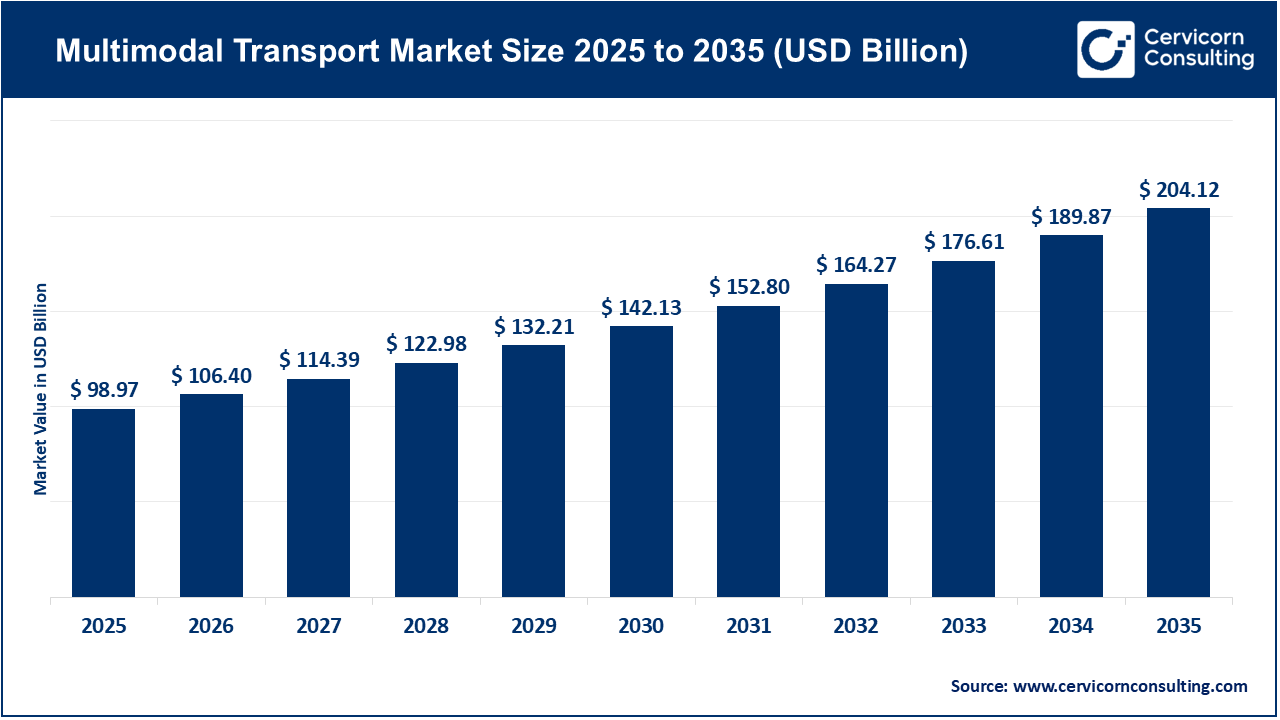
The global multimodal transport market was valued at approximately USD 98.97 billion in 2025and is expected to reach around USD 204.12 billion by 2035, growing at a compound annual growth rate (CAGR) of about 7.5% during the forecast period.
This growth reflects the increasing importance of efficient logistics infrastructure and digital supply chain management systems. Companies across industries—from manufacturing to retail and pharmaceuticals—are adopting multimodal transport strategies to reduce transit times, lower costs, and enhance supply chain resilience.
What is the Multimodal Transport Market?
The multimodal transport market refers to the logistics and freight transportation industry that integrates two or more transportation modes—such as road, rail, sea, and air—under a single contract or management system to move goods efficiently from origin to destination. Instead of relying on a single mode of transportation, multimodal systems combine the strengths of different modes to optimize cost, speed, and reliability across supply chains. In this model, cargo may travel by ship across oceans, transfer to rail for inland movement, and finally reach its destination via road transport. The logistics provider manages the entire journey as one coordinated operation, ensuring smooth transitions between transport modes.
Multimodal transport has become a critical component of modern global trade and supply chains, particularly as international commerce, cross-border trade, and e-commerce shipments continue to grow. The market has expanded significantly in recent years due to the increasing demand for integrated logistics solutions and improved connectivity between ports, rail networks, airports, and highways.
Multimodal Transport Market Growth Factors
The growth of the multimodal transport market is driven by several interconnected factors, including the rapid expansion of global trade, increasing complexity in supply chains, and rising demand for efficient logistics solutions. As international commerce continues to expand, businesses require flexible transportation networks capable of handling large shipment volumes while maintaining reliability and cost efficiency. Multimodal transport enables companies to combine different transport modes to optimize delivery routes and minimize transit delays. The rapid growth of e-commerce has further accelerated demand for integrated logistics systems capable of supporting high-volume cross-border deliveries. Government investments in infrastructure such as rail corridors, ports, highways, and logistics parks are strengthening connectivity between transportation networks and enabling smoother transitions between transport modes.
Additionally, digital logistics platforms, real-time cargo tracking, and AI-based route optimization tools are improving operational efficiency and supply chain transparency. Sustainability concerns are also driving adoption, as companies increasingly shift freight from road transport to lower-carbon modes such as rail and sea to reduce emissions. These factors collectively support steady market expansion and make integrated transport networks essential for modern global supply chains.
Get a Free Sample: https://www.cervicornconsulting.com/sample/2909
Why the Multimodal Transport Market is Important
The multimodal transport market plays a crucial role in supporting global economic activity by enabling efficient and reliable movement of goods across long distances and multiple regions. In today’s interconnected global economy, businesses rely heavily on logistics networks capable of managing complex supply chains involving different countries, transportation systems, and distribution centers.
One of the main advantages of multimodal transport is cost efficiency. By combining various transportation modes, logistics providers can choose the most economical route for each stage of the journey. For example, ocean freight may be used for long-distance transportation because it is cost-effective, while trucks handle final delivery to customers.
Another important benefit is supply chain reliability and flexibility. Multimodal transport systems provide alternative transportation options in case of disruptions, delays, or congestion. This flexibility helps businesses maintain stable supply chains even during unexpected global challenges.
Multimodal transport also supports environmental sustainability goals. Rail and maritime transport typically generate lower carbon emissions compared to road transport, making multimodal logistics a more environmentally friendly option. Governments and corporations are increasingly adopting multimodal transport strategies as part of broader sustainability initiatives.
Furthermore, multimodal logistics improves global trade connectivity by linking ports, rail networks, highways, and airports into integrated transportation systems. These connections enable businesses to access new markets and expand international trade operations more efficiently.
Major Companies in the Multimodal Transport Market
Deutsche Post AG (DHL Group)
- Specialization: Global logistics, freight forwarding, and supply chain management
- Key Focus Areas: Multimodal logistics, international shipping, e-commerce logistics, and integrated supply chain solutions
- Notable Features: Extensive logistics network with advanced digital shipment tracking systems
- 2024 Revenue: Approximately USD 90+ billion
- Market Share: One of the largest logistics providers globally
- Global Presence: Operations in more than 220 countries and territories
DHL Group, a subsidiary of Deutsche Post AG, is one of the world’s largest logistics and freight companies. It offers integrated multimodal transport services that combine air, sea, rail, and road freight solutions to support complex global supply chains.
Kuehne + Nagel
- Specialization: Sea freight, air freight, and contract logistics
- Key Focus Areas: Integrated supply chain management and multimodal logistics services
- Notable Features: Strong digital logistics platforms with real-time cargo tracking and route optimization
- 2024 Revenue: Approximately USD 27–30 billion
- Market Share: Leading global freight forwarding company
- Global Presence: Operations in more than 100 countries
Kuehne + Nagel is a major logistics provider specializing in multimodal freight forwarding services. The company focuses on integrated logistics solutions that combine multiple transportation modes to improve delivery speed and cost efficiency.
DB Schenker
- Specialization: Global logistics and supply chain management
- Key Focus Areas: Land transport, rail logistics, contract logistics, and multimodal freight services
- Notable Features: Extensive rail freight operations and digital freight management platforms
- 2024 Revenue: Approximately USD 25–30 billion
- Market Share: Major presence in global logistics markets
- Global Presence: Operations in more than 130 countries
DB Schenker is a global logistics leader known for its integrated multimodal transport networks. The company provides efficient freight solutions connecting road, rail, air, and ocean transport systems worldwide.
A.P. Moller–Maersk
- Specialization: Ocean shipping and integrated logistics services
- Key Focus Areas: Container shipping, supply chain integration, and multimodal logistics solutions
- Notable Features: One of the world’s largest container shipping companies with a strong global logistics network
- 2024 Revenue: Approximately USD 50–55 billion
- Market Share: Significant share of global container shipping and logistics markets
- Global Presence: Operations across more than 130 countries
Maersk has evolved from a traditional shipping company into a comprehensive logistics provider offering multimodal transport services that integrate sea, rail, road, and air freight operations.
DSV A/S
- Specialization: Freight forwarding and supply chain solutions
- Key Focus Areas: Multimodal logistics, global freight networks, and digital freight management
- Notable Features: Strong global expansion strategy supported by acquisitions
- 2024 Revenue: Approximately USD 25 billion
- Market Share: One of the fastest-growing logistics companies globally
- Global Presence: Operations in more than 90 countries
DSV provides integrated logistics services and multimodal transportation solutions designed to support large-scale global supply chains and international trade operations.
Leading Trends in the Multimodal Transport Market and Their Impact
Digital Logistics Platforms
Digital transformation is reshaping the multimodal transport industry. Logistics control towers, cloud-based management platforms, and real-time cargo monitoring systems allow companies to track shipments, monitor delivery schedules, and manage transport networks more efficiently.
Artificial Intelligence and Data Analytics
AI-driven analytics are improving route optimization, cargo planning, and demand forecasting. These technologies help logistics providers minimize delays, optimize resource utilization, and reduce operational costs.
Sustainability and Green Logistics
Environmental sustainability is becoming a major priority in the logistics sector. Companies are increasingly shifting freight transportation from trucks to rail or sea routes to reduce carbon emissions and support global climate targets.
Expansion of Logistics Infrastructure
Governments worldwide are investing heavily in infrastructure projects such as ports, rail corridors, highways, and multimodal logistics hubs. These developments improve connectivity between transportation modes and strengthen global supply chains.
E-Commerce Logistics Growth
The rapid growth of global e-commerce has significantly increased demand for efficient logistics systems capable of handling large shipment volumes and supporting fast delivery times.
Successful Examples of Multimodal Transport Around the World
China–Europe Rail Freight Corridors
The China–Europe rail freight corridor connects Asian manufacturing centers with European markets through an integrated rail logistics network. This corridor significantly reduces shipping times compared to traditional maritime routes and has become an important trade link between the two regions.
Port of Rotterdam Multimodal Logistics Network
The Port of Rotterdam in the Netherlands operates one of the most advanced multimodal logistics networks in the world. Goods arriving by sea can be transferred quickly to rail, inland waterways, or road networks for distribution across Europe.
India’s Dedicated Freight Corridors
India has developed major freight corridors linking industrial hubs with ports and logistics centers. These corridors integrate rail and road networks to improve cargo movement efficiency and reduce logistics costs.
North American Intermodal Rail Networks
The United States and Canada have extensive intermodal rail systems that connect ports with inland logistics hubs. Containers can move seamlessly between ships, trains, and trucks, supporting efficient freight distribution across the continent.
Global Regional Analysis and Government Initiatives
North America
North America represents a significant share of the multimodal transport market due to its advanced transportation infrastructure and strong international trade networks. The United States operates one of the world’s largest intermodal rail systems, connecting major ports with manufacturing centers and distribution hubs. Government investments in infrastructure modernization and logistics technology are strengthening multimodal transport capabilities across the region.
Europe
Europe has one of the most integrated multimodal transport systems globally. The European Union actively promotes sustainable freight transportation by encouraging the use of rail and inland waterways. Infrastructure programs focus on improving cross-border connectivity between European countries and enhancing logistics efficiency.
Asia-Pacific
The Asia-Pacific region dominates the global multimodal transport market due to rapid industrialization, expanding trade activities, and strong manufacturing industries. Countries such as China, Japan, India, and South Korea are investing heavily in logistics infrastructure including ports, rail corridors, highways, and multimodal logistics parks.
Government initiatives supporting manufacturing growth and international trade are strengthening regional transport networks and accelerating adoption of multimodal logistics systems.
Latin America
Latin America is gradually expanding its logistics infrastructure to support multimodal transportation. Countries such as Brazil, Mexico, and Chile are investing in port modernization, rail networks, and transportation corridors to improve freight movement and support regional trade growth.
The Middle East and Africa region is emerging as a strategic logistics hub connecting Asia, Europe, and Africa. Governments in countries such as the United Arab Emirates and Saudi Arabia are investing heavily in ports, logistics zones, and transportation corridors to enhance global trade connectivity and support economic diversification.
To Get Detailed Overview, Contact Us: https://www.cervicornconsulting.com/contact-us
Read Report: Robotaxi Market Revenue, Trends, and Strategic Insights by 2035