U.S. Hospital Services Market Revenue, Trends, and Strategic Insights by 2035
U.S. Hospital Services Market Size
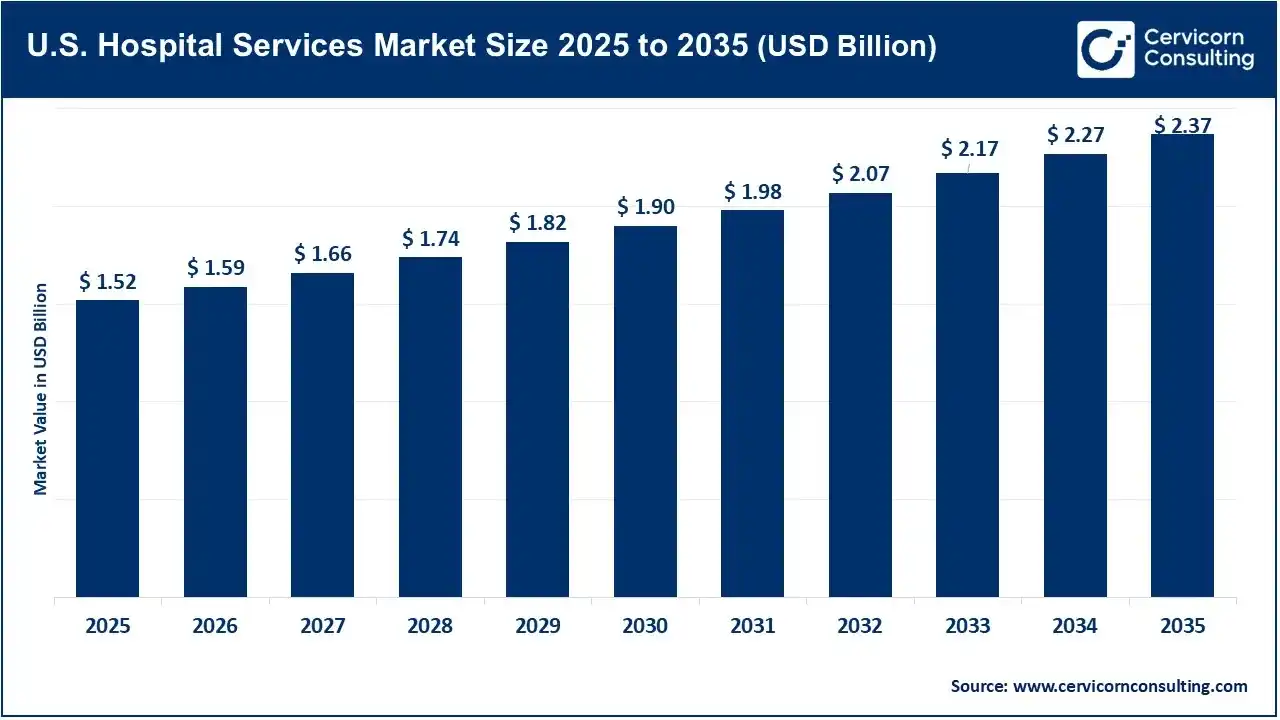
The U.S. hospital services market size was valued at USD 1.52 trillion in 2025 and projects it to reach USD 2.37 trillion by 2035, representing a 4.54% CAGR.
U.S. hospital services market growth factors
The U.S. hospital services market is being driven by rising healthcare utilization, an aging population, increasing prevalence of chronic and complex diseases, growing demand for emergency and specialty care, expansion of outpatient services, technological modernization, and continued investment in hospital infrastructure. The U.S. hospital system remains one of the world’s largest and most sophisticated healthcare ecosystems, supported by more than 6,100 hospitals and more than 907,000 staffed hospital beds according to the American Hospital Association’s latest statistics. In 2025, inpatient hospital volumes increased 5.3%, while outpatient visits increased 9.8%, demonstrating continued demand for both acute and ambulatory care.
At the same time, hospitals are investing heavily in artificial intelligence, digital health, robotic surgery, advanced imaging, remote monitoring, electronic health records, and data analytics to improve clinical outcomes and operational efficiency. Growing demand for cardiovascular, oncology, orthopedic, behavioral health, emergency, and diagnostic services is further supporting market expansion. The transition toward value-based care, accountable care organizations, bundled payments, and population health management is also changing how hospitals deliver and monetize services.
Meanwhile, hospital consolidation, physician alignment, ambulatory surgery center expansion, and strategic acquisitions are allowing large healthcare organizations to expand their geographic and service footprints.
Get a Free Sample: https://www.cervicornconsulting.com/sample/3027
What is the U.S. hospital services market?
The U.S. hospital services market encompasses the broad range of healthcare services delivered through hospitals and affiliated hospital-based facilities across the United States. These services include inpatient care, outpatient care, emergency services, surgical procedures, intensive care, diagnostic imaging, laboratory services, cardiovascular treatment, oncology, maternity care, behavioral and psychiatric care, rehabilitation, specialty care, and other clinical and ancillary services.
The market includes hospitals operated by nonprofit organizations, government entities, and for-profit healthcare companies. It also increasingly overlaps with ambulatory surgery centers, outpatient clinics, physician networks, urgent care facilities, virtual care platforms, and other healthcare delivery channels.
The U.S. market is particularly diverse because healthcare delivery is influenced by Medicare, Medicaid, commercial insurance, employer-sponsored coverage, self-pay patients, and various state and federal reimbursement programs. This creates a complex operating environment in which hospitals must balance clinical demand, reimbursement levels, labor costs, technology investments, regulatory requirements, and patient experience.
Why is the U.S. hospital services market important?
Hospital services are fundamental to the U.S. healthcare system because hospitals provide high-acuity and specialized care that cannot be delivered through many lower-intensity healthcare settings. Emergency departments, intensive care units, operating rooms, trauma centers, cancer centers, cardiac units, neonatal services, and advanced diagnostic departments make hospitals critical components of the national healthcare infrastructure.
The scale of the sector is significant. The American Hospital Association’s 2026 statistics identify approximately 6,100 hospitals, more than 907,000 staffed beds, and more than 35.6 million admissions across U.S. hospitals. Community hospitals account for the majority of the country’s hospital infrastructure.
The sector is also economically important. Hospitals employ physicians, nurses, technicians, pharmacists, administrators, engineers, information technology professionals, and numerous support workers. At the same time, hospitals create demand for pharmaceuticals, medical devices, diagnostic equipment, healthcare software, construction, facilities management, food services, logistics, and other supporting industries.
Hospital services are also becoming increasingly important as the patient population becomes more medically complex. The American Hospital Association reported that approximately 19% of hospital expense growth between 2019 and 2024 reflected treatment of sicker and more complex patients, while approximately 36% reflected treating more patients.
U.S. hospital services market: major companies
The competitive landscape includes large investor-owned hospital operators as well as major nonprofit health systems. HCA Healthcare, Tenet Healthcare, Universal Health Services, Community Health Systems, and CommonSpirit Health represent important participants across different segments of the U.S. hospital ecosystem.
| Company | Specialization | Key Focus Areas | Notable Features | 2025 Revenue | Indicative Revenue Share* |
|---|---|---|---|---|---|
| HCA Healthcare | Acute and general hospital services | Emergency care, surgery, cardiovascular care, oncology, outpatient services | Large multi-state hospital network | $75.6B | ~2.9% |
| Tenet Healthcare Corporation | Acute care and ambulatory services | Hospitals, ambulatory surgery, surgical specialties, physician services | Large USPI ambulatory platform | $21.31B | ~0.8% |
| Universal Health Services (UHS) | Acute and behavioral healthcare | Acute care, behavioral health, emergency and outpatient care | Strong behavioral-health presence | $17.4B | ~0.7% |
| Community Health Systems (CHS) | Community hospital services | Acute care, emergency services, outpatient care, rural/community markets | Focus on community-based hospitals | $12.49B | ~0.5% |
| CommonSpirit Health | Nonprofit integrated hospital services | Acute care, specialty care, community health, ambulatory services | Large nonprofit health system | ~$40B | ~1.5% |
*Indicative revenue share calculated against the USD 2.64 trillion 2025 U.S. hospital services market estimate. Company revenues are not directly comparable with the market definition because reporting scopes include activities beyond hospital services. These figures should therefore not be interpreted as official company market-share statistics.
HCA Healthcare
HCA Healthcare is one of the largest investor-owned healthcare providers in the United States, operating a broad network of hospitals and related healthcare facilities. Its services include emergency care, inpatient and outpatient treatment, surgery, intensive care, cardiovascular services, oncology, diagnostic services, women’s services, and other specialties.
HCA reported $75.6 billion in revenue in 2025, up from $70.6 billion in 2024. Consolidated admissions increased 2.7%, while emergency-room visits increased 1.6% during the year. The company operated 190 hospitals at the end of 2025.
HCA’s scale enables it to invest in facilities, clinical technology, service-line expansion, workforce, and digital infrastructure. Its large geographic footprint also provides exposure to different regional healthcare markets.
Tenet Healthcare Corporation
Tenet Healthcare Corporation operates across hospital and ambulatory healthcare markets. Its Hospital Operations segment includes acute-care and specialty hospitals, imaging centers, ancillary outpatient facilities, micro-hospitals, and physician practices.
Tenet generated $21.31 billion in net operating revenue in 2025, including $16.14 billion from Hospital Operations and $5.17 billion from its Ambulatory Care segment. Its United Surgical Partners International business had interests in 533 ambulatory surgery centers and 26 surgical hospitals at the end of 2025.
The company’s increasing emphasis on ambulatory surgery illustrates a broader industry movement toward shifting appropriate procedures away from traditional inpatient settings.
Universal Health Services
Universal Health Services (UHS) operates acute-care hospitals, behavioral-health facilities, outpatient facilities, emergency departments, physician networks, and related healthcare services. Its business is differentiated by its substantial behavioral-health platform alongside acute hospital operations.
UHS reported approximately $17.4 billion in 2025 revenue, while serving patients through 5.8 million encounters and employing approximately 101,500 people globally. Its acute-care division recorded more than 347,700 inpatient admissions and 1.7 million emergency-room visits in 2025.
UHS is also investing in technology and artificial intelligence. The company reported launching agentic AI applications in 2025 to support post-discharge services and reduce readmissions.
Community Health Systems
Community Health Systems (CHS) focuses on community-based healthcare and operates hospitals and related facilities across numerous U.S. markets. Its model has historically emphasized community hospitals, particularly in markets where local access to acute and emergency care is important.
CHS reported $12.485 billion in net operating revenue for 2025. Its portfolio stood at 69 hospitals at the end of 2025, with 10,458 licensed beds. Outpatient revenue represented 52.1% of total net operating revenue, compared with 47.9% for inpatient revenue.
The company’s financial and operational developments also illustrate how hospital operators are adjusting portfolios through divestitures, reimbursement optimization, and greater focus on same-store performance.
CommonSpirit Health
CommonSpirit Health is a major nonprofit health system with a broad presence across the United States. Its activities span hospitals, outpatient care, specialty services, community health programs, physician services, and other healthcare activities.
CommonSpirit reported approximately $40 billion in FY2025 revenue, representing an 8.5% increase from the prior year. Its consolidated financial statements reported $39.116 billion in total operating revenues for the fiscal year ended June 30, 2025, including $34.575 billion in net patient revenue.
Its scale allows the organization to operate comprehensive care networks while investing in clinical services, facilities, technology, workforce, and community programs.
Leading trends and their impact
1. Shift toward outpatient and ambulatory care
One of the most important changes in the U.S. hospital services market is the movement of suitable procedures from inpatient hospitals toward outpatient facilities and ambulatory surgery centers. Improvements in minimally invasive procedures, anesthesia, imaging, remote monitoring, and same-day recovery are supporting this transition.
AHA benchmark data show outpatient visits increased 9.8% in 2025, substantially highlighting the growing role of outpatient care.
For hospital operators, the trend is encouraging investment in ambulatory surgery centers, outpatient diagnostic centers, urgent care facilities, and physician networks.
2. Artificial intelligence and digital transformation
AI is becoming increasingly relevant across hospital operations. Hospitals are using AI for medical imaging, clinical decision support, patient scheduling, predictive analytics, revenue-cycle management, documentation, staffing, and patient engagement.
AI-enabled systems can help hospitals analyze large datasets and identify operational bottlenecks. Generative AI is also being explored for clinical documentation and administrative workflows.
The impact extends beyond diagnosis. Hospitals are increasingly looking at AI as an enterprise technology that can improve workflow efficiency, patient communication, discharge planning, and resource allocation.
3. Rising labor and operating costs
Workforce expenditure remains one of the largest challenges facing hospitals. The AHA reported that approximately 60% of hospital expenses in 2025 were associated with workforce spending, while workforce costs increased 5.6%. Total hospital expenses increased 7.5%, compared with hospital price growth of 3.3%.
Drug and supply costs also increased rapidly. Hospital supply expenses rose 9.9%, while drug expenses increased 13.6% in 2025.
This environment is encouraging hospitals to invest in automation, workforce optimization, supply-chain management, clinical productivity tools, and technology-enabled administrative processes.
4. Growth of specialty and high-acuity care
Demand for oncology, cardiovascular services, orthopedics, neurology, behavioral health, and other specialized services continues to influence hospital investment strategies.
As patients present with more complex conditions, hospitals are expanding specialty departments, advanced diagnostic capabilities, intensive care capacity, surgical technologies, and multidisciplinary care programs.
5. Value-based care
Value-based care is changing hospital incentives by linking reimbursement more closely to outcomes, quality, readmissions, patient experience, and cost management.
Accountable care organizations, bundled-payment models, population health programs, and other alternative payment arrangements encourage hospitals to coordinate care beyond the traditional inpatient episode.
The result is increasing emphasis on prevention, discharge planning, care coordination, remote monitoring, and post-acute services.
6. Hospital consolidation and strategic partnerships
Mergers, acquisitions, joint ventures, and partnerships continue to influence the structure of the U.S. hospital industry. Large systems can use consolidation to expand geographic coverage, develop specialized services, strengthen purchasing capabilities, and build integrated physician networks.
However, consolidation also remains an important area of regulatory and policy scrutiny because policymakers and researchers examine its potential effects on prices, competition, access, and healthcare quality.
Successful examples from the U.S. hospital services market around the world
Although the focus of this market is the United States, several U.S. hospital operating models have broader international relevance.
Integrated hospital and ambulatory networks
Tenet’s combination of hospital operations with a substantial ambulatory surgery platform illustrates how healthcare providers can develop integrated networks spanning inpatient and outpatient settings. Its USPI platform had interests in hundreds of ambulatory surgery centers by the end of 2025.
This model demonstrates how hospital organizations can respond to changing procedure volumes by building care delivery capabilities outside conventional inpatient facilities.
Large-scale multi-state hospital systems
HCA Healthcare provides another example of large-scale hospital-network management. Its 190-hospital portfolio at the end of 2025 demonstrates how standardized operational systems, clinical programs, technology investments, and centralized capabilities can be deployed across geographically diverse markets.
Behavioral-health integration
UHS demonstrates the growing importance of combining acute-care and behavioral-health services within a large healthcare organization. Its extensive behavioral-health network provides an example of diversification into services experiencing sustained demand.
Nonprofit integrated healthcare
CommonSpirit represents another operating model in which hospital services are combined with community health, specialty care, outpatient services, and broader healthcare activities. Its FY2025 revenue of approximately $40 billion illustrates the scale of large nonprofit health systems.
These U.S. models are relevant internationally because healthcare systems in other countries are also exploring integrated care, outpatient expansion, digital health, specialty centers, and coordinated population-health models.
Government initiatives and policies shaping the market
Hospital price transparency
Hospital price transparency is one of the most significant federal policy developments affecting the sector. CMS requires hospitals operating in the United States to publish standard-charge information through a machine-readable file and provide consumer-friendly information for shoppable services.
The policy is intended to give patients greater visibility into healthcare costs and facilitate comparison of hospital prices.
CMS has also continued to strengthen transparency requirements. The CY 2026 Hospital Outpatient Prospective Payment System and Ambulatory Surgical Center final rule introduced additional changes concerning the accuracy, comparability, and disclosure of hospital pricing information.
Medicare hospital payment policies
Medicare reimbursement remains a major influence on hospital economics. CMS periodically updates inpatient and outpatient payment systems, quality programs, reimbursement rates, and reporting requirements.
Changes to prospective payment systems can affect hospital revenue, service-line economics, investment decisions, and the attractiveness of inpatient versus outpatient delivery models.
Medicaid and supplemental payment programs
Medicaid is particularly important for hospitals serving lower-income populations and communities with high Medicaid enrollment. State-directed payments, supplemental programs, and Medicaid reimbursement policies can materially affect hospital financial performance.
For example, HCA reported approximately $6.2 billion in revenue from Medicaid state-directed and supplemental payment programs in 2025, highlighting the financial relevance of these mechanisms for large hospital operators.
Value-based purchasing and quality programs
Federal healthcare policy increasingly links reimbursement to quality and performance measures. Hospital quality programs can evaluate factors such as patient outcomes, safety, readmissions, patient experience, and care coordination.
These policies encourage healthcare providers to invest in clinical analytics, quality management systems, patient engagement, and coordinated care.
Digital health and interoperability
Government policies concerning electronic health records, interoperability, health information exchange, cybersecurity, and patient access to health information are shaping hospital technology investments.
Hospitals are increasingly required to manage healthcare data securely while making appropriate information available to patients, providers, and authorized organizations.
Healthcare workforce policies
Workforce availability remains a strategic issue because hospitals depend heavily on physicians, nurses, technicians, therapists, pharmacists, and other skilled professionals.
Federal and state workforce initiatives, immigration rules, nursing education programs, reimbursement policies, and professional licensing frameworks can therefore influence hospital capacity and operating costs.
Increasing emphasis on healthcare affordability
Federal policymakers continue to focus on healthcare affordability, transparency, reimbursement, and patient access. For hospitals, this creates pressure to demonstrate value while managing increasing costs associated with labor, pharmaceuticals, supplies, infrastructure, technology, and increasingly complex patients.
The combination of higher patient volumes, increasing acuity, and rising operating expenses is likely to keep cost management and operational efficiency at the center of hospital strategy. The AHA reported that hospitals spent approximately $43 billion in 2025 attempting to collect payments for care already delivered, reflecting the administrative complexity associated with insurer claims, prior authorization, and payment processes.
To Get Detailed Overview, Contact Us: https://www.cervicornconsulting.com/contact-us
Read Report: Automotive MOSFET Market Revenue, Trends, and Strategic Insights by 2035