Spatial Computing Market Revenue, Trends, and Strategic Insights by 2035
Spatial Computing Market Size
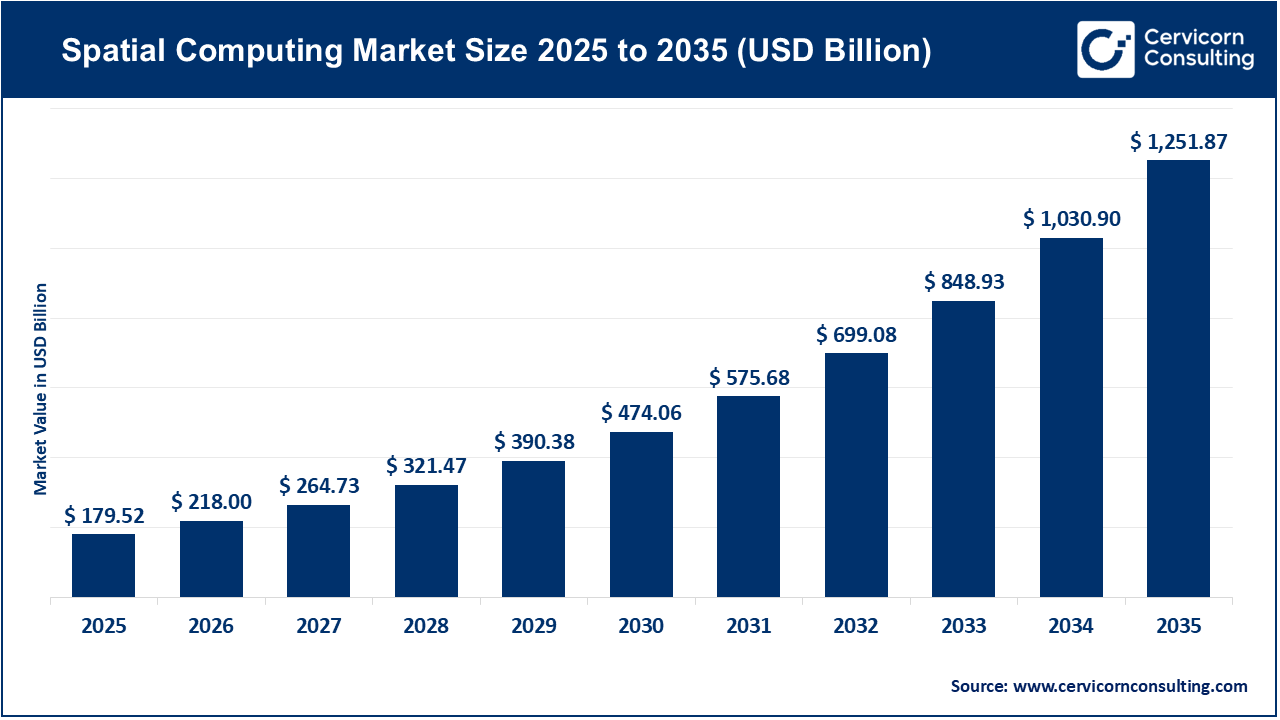
The global spatial computing market size was worth USD 179.52 billion in 2025 and is anticipated to expand to around USD 1,251.87 billion by 2035, registering a compound annual growth rate (CAGR) of 21.4% from 2026 to 2035.
What Is the Spatial Computing Market?
The spatial computing market encompasses the development, deployment, and commercialization of technologies that merge the physical and digital environments through real-time spatial awareness. It integrates augmented reality (AR), virtual reality (VR), mixed reality (MR), artificial intelligence (AI), computer vision, sensors, edge computing, and spatial mapping technologies to enable immersive human-computer interactions. Unlike traditional computing, which relies on flat, two-dimensional interfaces, spatial computing operates in three-dimensional space, allowing users to interact with digital information using gestures, voice, gaze, and movement.
The market includes hardware components such as AR/VR headsets, smart glasses, sensors, and projection systems, as well as software platforms, development tools, and services that support spatial data processing, visualization, and application deployment. Together, these solutions enable real-time environment understanding, digital twin creation, immersive collaboration, and intelligent automation.
Why Is Spatial Computing Important?
Spatial computing is important because it fundamentally changes how humans interact with data, machines, and environments. By embedding digital intelligence into physical spaces, spatial computing enhances productivity, improves decision-making, and creates new modes of engagement. In enterprise settings, it enables hands-free access to critical information, reduces training time through immersive simulations, and improves operational accuracy. In consumer markets, it transforms entertainment, shopping, gaming, and education by delivering highly interactive and personalized experiences.
From a strategic perspective, spatial computing is critical for enabling next-generation technologies such as digital twins, autonomous systems, and smart cities. It supports real-time visualization of complex data, improves remote collaboration, and enhances situational awareness in high-risk environments. As businesses seek competitive differentiation and governments aim to improve public services, spatial computing is becoming a key enabler of innovation and efficiency.
Get a Free Sample: https://www.cervicornconsulting.com/sample/2874
Spatial Computing Market Growth Factors
The growth of the spatial computing market is driven by increasing adoption of augmented, virtual, and mixed reality technologies across enterprise and consumer sectors; rapid advancements in artificial intelligence, computer vision, and sensor technologies; expanding deployment of 5G networks and edge computing infrastructure enabling low-latency, real-time experiences; rising demand for immersive training, simulation, and remote collaboration solutions; growing use of digital twins and smart infrastructure projects; increased investment in Industry 4.0 and smart manufacturing initiatives; and supportive government policies promoting digital transformation, innovation funding, and advanced technology adoption across healthcare, education, defense, and urban development sectors.
Spatial Computing Market Size and Outlook
The global spatial computing market has reached a significant valuation in 2024, with estimates placing it in the range of tens to over one hundred billion US dollars. The market is expected to experience strong double-digit compound annual growth over the next decade, driven by expanding enterprise adoption, consumer interest in immersive experiences, and continuous technological advancements. As spatial computing evolves from early adoption to mainstream deployment, software platforms and services are expected to grow faster than hardware, reflecting increasing demand for scalable, interoperable, and cloud-enabled spatial solutions.
Key Companies in the Spatial Computing Market
Microsoft Corporation
- Specialization: Enterprise-grade mixed reality, cloud-based spatial computing platforms
- Key Focus Areas: Mixed reality headsets, immersive collaboration, spatial cloud services
- Notable Features: Advanced spatial mapping, hand and eye tracking, integration with productivity and cloud ecosystems
- 2024 Revenue: Over USD 200 billion total corporate revenue; spatial computing revenue not separately disclosed
- Market Share: Leading presence in enterprise and defense-oriented spatial computing solutions
- Global Presence: Strong global footprint across North America, Europe, Asia Pacific, and emerging markets
Microsoft plays a pivotal role in advancing enterprise spatial computing by combining hardware innovation with cloud infrastructure and collaboration software. Its solutions are widely adopted in healthcare, manufacturing, training, and remote collaboration environments.
Seiko Epson Corporation
- Specialization: Optical systems and wearable display technologies
- Key Focus Areas: Micro-projection engines, AR display modules, smart glasses components
- Notable Features: Compact, energy-efficient, and high-resolution display technologies
- 2024 Revenue: Approximately USD 8–9 billion total corporate revenue
- Market Share: Strong supplier presence in AR hardware ecosystems
- Global Presence: Extensive operations across Asia, Europe, and North America
Seiko Epson is a critical technology enabler in the spatial computing market, particularly in AR hardware, supplying display components that enhance visual clarity and user comfort.
Lenovo Group Limited
- Specialization: Enterprise hardware and extended reality platforms
- Key Focus Areas: AR/VR devices, enterprise computing, spatial collaboration tools
- Notable Features: Integration of XR hardware with enterprise IT ecosystems
- 2024 Revenue: Approximately USD 70–80 billion total corporate revenue
- Market Share: Growing presence in enterprise spatial computing hardware
- Global Presence: Operations in over 160 countries worldwide
Lenovo leverages its manufacturing scale and enterprise customer base to expand spatial computing adoption across industrial, educational, and professional environments.
Avegant Corporation
- Specialization: Advanced wearable display technology
- Key Focus Areas: Retinal and light-field display systems for AR and VR
- Notable Features: Focus on visual comfort, realism, and immersive display quality
- 2024 Revenue: Privately held; specific revenue figures not publicly disclosed
- Market Share: Niche innovator in high-end display technology
- Global Presence: Limited but influential presence within specialized AR/VR markets
Avegant focuses on pushing the boundaries of display technology, contributing to improved user experience in spatial computing hardware.
Blippar Group Limited
- Specialization: Augmented reality software and spatial marketing platforms
- Key Focus Areas: Markerless AR, spatial advertising, interactive content creation
- Notable Features: Computer vision-based AR experiences without physical markers
- 2024 Revenue: Privately held; financial details not publicly disclosed
- Market Share: Recognized player in AR content and marketing solutions
- Global Presence: Strong presence in Europe with expanding global partnerships
Blippar enables brands and organizations to create immersive, location-aware experiences, driving adoption of spatial computing in marketing and consumer engagement.
Leading Trends in the Spatial Computing Market and Their Impact
Enterprise Adoption of AR and Mixed Reality
Enterprises are increasingly deploying spatial computing solutions to enhance productivity, reduce operational errors, and improve workforce training. AR-based guided workflows, immersive remote assistance, and virtual collaboration environments are becoming standard tools in manufacturing, healthcare, and engineering.
Integration with Artificial Intelligence and Machine Learning
AI enhances spatial computing by enabling real-time object recognition, environment understanding, predictive analytics, and intelligent interaction. This convergence improves accuracy, personalization, and automation across spatial applications.
Shift from Hardware-Centric to Platform-Centric Models
While hardware adoption remains important, the market is shifting toward software platforms, developer tools, and managed services. This trend enables scalable deployment, cross-device compatibility, and faster innovation cycles.
Expansion of Digital Twins and Smart Infrastructure
Spatial computing is a foundational technology for digital twins, enabling real-time visualization and simulation of physical assets and environments. This trend supports smart cities, infrastructure planning, logistics optimization, and predictive maintenance.
Consumerization of Spatial Experiences
Improved device affordability and usability are driving consumer adoption in gaming, entertainment, retail, and education, expanding the addressable market beyond enterprise use cases.
Successful Examples of Spatial Computing Around the World
- Healthcare: Immersive surgical planning, medical training simulations, and AR-assisted procedures improve accuracy and reduce risk.
- Manufacturing: AR-guided assembly, quality inspection, and maintenance workflows reduce downtime and training costs.
- Retail and E-Commerce: Virtual product visualization and try-before-you-buy experiences enhance customer engagement and conversion rates.
- Education: Virtual classrooms, interactive simulations, and immersive learning environments improve comprehension and retention.
- Smart Cities: Spatial analytics and digital twins support urban planning, traffic management, and infrastructure monitoring.
- Aerospace and Defense: Advanced simulation, mission planning, and training environments improve preparedness and safety.
Global Regional Analysis Including Government Initiatives and Policies
North America
North America represents a mature and innovation-driven spatial computing market, supported by strong R&D investment, early enterprise adoption, and the presence of leading technology companies. Government funding for defense, healthcare innovation, and smart infrastructure accelerates adoption.
Europe
Europe emphasizes responsible innovation, data protection, and sustainability. Government-backed digital transformation programs and research initiatives support spatial computing adoption in industrial automation, healthcare, and smart city projects.
Asia-Pacific
Asia-Pacific is the fastest-growing regional market due to large-scale digitalization efforts, expanding 5G infrastructure, and strong government support for smart manufacturing and urban development. Countries such as China, Japan, South Korea, and India are investing heavily in immersive technologies.
Middle East and Africa
Adoption in this region is driven by smart city initiatives, infrastructure modernization, and digital transformation programs in countries such as the UAE and Saudi Arabia. Spatial computing is increasingly used in construction, energy, and public services.
Latin America
Latin America is an emerging market with growing adoption in retail, education, and entertainment. Government investments in digital infrastructure and innovation ecosystems are expected to support future growth.
To Get Detailed Overview, Contact Us: https://www.cervicornconsulting.com/contact-us
Read Report: Over the Top (OTT) Market Revenue, Trends, and Strategic Insights by 2035