Protein Therapeutics Market Outlook: Monoclonal Antibodies, Metabolic Therapies, Advanced Drug Delivery, and Biomanufacturing Innovation
Protein Therapeutics Market: Strategic Priorities for Biopharma Companies as Biologics Demand Expands
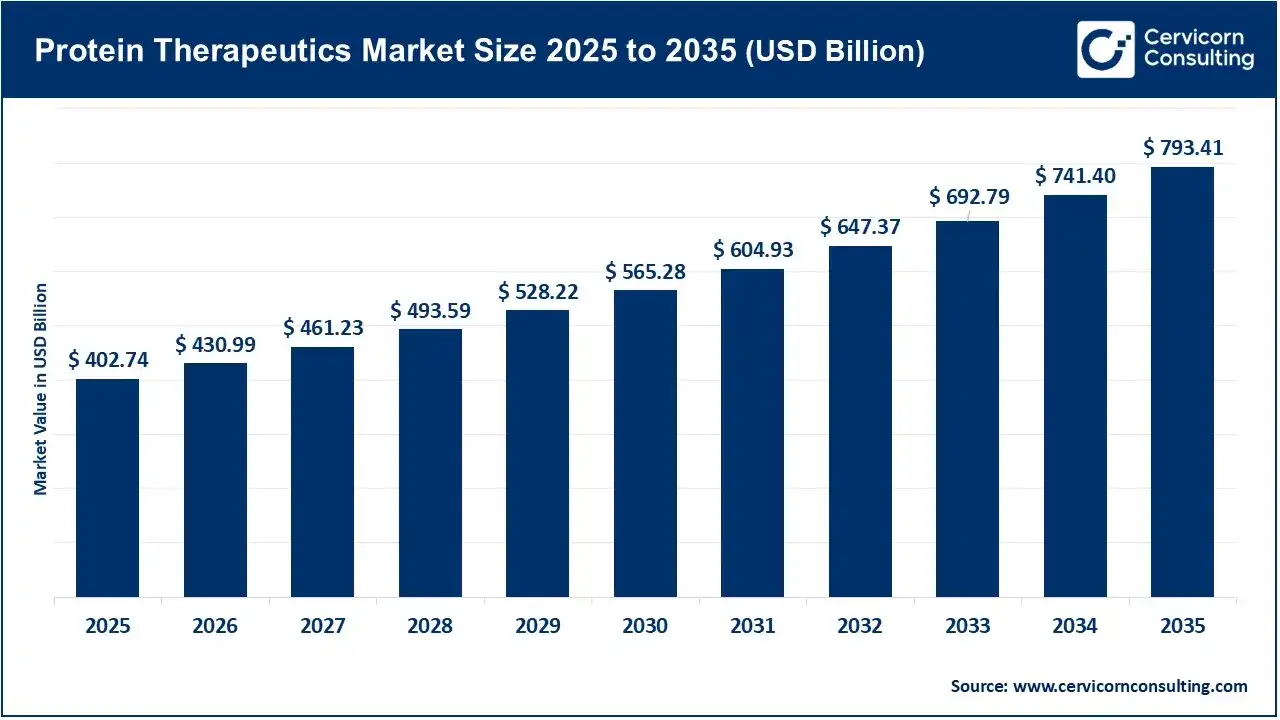
The global protein therapeutics market was valued at USD 402.74 billion in 2025 and is projected to grow from USD 430.99 billion in 2026 to approximately USD 793.41 billion by 2035, registering a CAGR of 7.1% during 2026–2035. Growth is supported by increasing demand for biologic medicines, expanding applications in oncology and metabolic disorders, and advances in protein engineering and recombinant production technologies.
For pharmaceutical and biotechnology companies, this expansion presents opportunities beyond developing new therapeutic candidates. Decisions involving protein platform selection, manufacturing scalability, drug delivery, biosimilar development, and geographic investment will increasingly influence competitive positioning.
However, market growth is not uniform across product categories, therapeutic applications, or regions. Companies need to identify where demand is accelerating and whether their existing development and manufacturing capabilities can capture emerging opportunities.
Monoclonal Antibodies Remain the Core Market, but Portfolio Diversification Is Becoming Important
Monoclonal antibodies accounted for approximately 38% of global protein therapeutics revenue in 2025, making them the leading product category. Their established applications in oncology, autoimmune disorders, and immunological conditions continue to support demand.
However, continued dependence on conventional antibody portfolios may limit opportunities as therapeutic development moves toward more specialized protein-based treatments. Bispecific antibodies, antibody-drug conjugates, fusion proteins, and engineered proteins are creating additional opportunities for companies seeking differentiation.
Recent industry developments illustrate this shift. In May 2026, Pfizer and Innovent Biologics announced a collaboration covering 12 early-stage cancer medicines, including antibody-drug conjugates and multispecific antibodies. Regeneron’s collaboration with Parabilis Medicines also highlights growing interest in combining antibody capabilities with novel peptide-based platforms.
Strategic considerations for companies:
- Evaluate opportunities in multispecific antibodies and antibody-drug conjugates alongside established monoclonal antibody portfolios.
- Assess therapeutic areas where engineered proteins can provide differentiated clinical benefits.
- Identify licensing and research collaboration opportunities to expand access to emerging protein technologies.
- Balance investment in established commercial products with next-generation biologics pipelines.
Get a Free Sample: https://www.cervicornconsulting.com/sample/3083
Metabolic Disorders Are Creating a New Investment Priority
Oncology represented approximately 30% of protein therapeutics revenue in 2025, maintaining its position as the largest therapeutic application. However, metabolic disorders are expected to record the fastest growth during the forecast period.
The increasing prevalence of diabetes and obesity, together with demand for long-term disease management, is creating opportunities for protein-based treatments. Insulin and insulin analogs are also projected to be the fastest-growing product category.
For pharmaceutical companies, this creates a need to reassess how R&D resources are distributed across therapeutic areas. Established oncology portfolios continue to offer significant commercial opportunities, but metabolic therapies could provide additional growth avenues.
Strategic considerations for companies:
- Assess investment opportunities in insulin analogs and advanced protein formulations.
- Evaluate the commercial potential of protein therapeutics targeting diabetes, obesity, and related metabolic conditions.
- Monitor clinical pipelines and competing treatment approaches to identify areas with unmet medical needs.
- Consider partnerships that strengthen capabilities in metabolic drug development and delivery technologies.
Subcutaneous Delivery Is Changing Product Development Priorities
Subcutaneous administration accounted for approximately 48% of the protein therapeutics market in 2025 and is expected to remain the fastest-growing administration route through 2035.
The increasing preference for convenient treatment options, home-based care, and reduced dependence on hospital visits is encouraging pharmaceutical companies to improve protein formulations and delivery systems.
For manufacturers, this shift has implications beyond the administration route itself. Formulation stability, injection volume, device compatibility, patient convenience, and product differentiation are becoming important considerations during development.
Companies with strong formulation and drug delivery capabilities may be better positioned to develop patient-friendly biologic products and extend the commercial value of existing therapies.
Strategic considerations for companies:
- Evaluate opportunities to transition suitable intravenous therapies toward subcutaneous formulations.
- Invest in formulation technologies that improve protein stability and administration convenience.
- Assess compatibility with prefilled syringes, autoinjectors, and other drug delivery devices.
- Consider patient adherence and administration costs when evaluating product development strategies.
Recombinant Production and Protein Engineering Will Influence Manufacturing Competitiveness
Recombinant sources accounted for approximately 78% of protein therapeutics revenue in 2025, reflecting their established role in producing therapeutic proteins with consistent quality and scalability.
Recombinant DNA technology remains the leading production technology, while protein engineering is expected to be the fastest-growing technology segment.
These developments are increasing the importance of manufacturing capabilities, particularly as companies expand biologics pipelines and develop more complex protein structures.
Unlike conventional pharmaceutical manufacturing, protein production requires careful control of biological processes, product characterization, purification, and quality parameters. Even relatively small changes in manufacturing conditions can influence product characteristics and performance.
Consequently, expanding production capacity without addressing process consistency and quality requirements may create operational challenges.
Strategic considerations for companies:
- Evaluate investments in recombinant expression systems and advanced protein engineering capabilities.
- Assess the scalability of existing upstream and downstream manufacturing processes.
- Strengthen analytical characterization and quality control capabilities.
- Compare in-house production investments with contract development and manufacturing partnerships.
- Identify manufacturing technologies that can improve production efficiency and batch consistency.
Asia Pacific Is Emerging as an Important Expansion Market
North America accounted for approximately 42% of global protein therapeutics revenue in 2025, supported by its established pharmaceutical industry, biotechnology research infrastructure, and adoption of advanced biologic medicines.
However, Asia Pacific is expected to register the fastest regional growth during 2026–2035.
The region’s expanding pharmaceutical manufacturing capabilities, increasing biotechnology investment, improving healthcare infrastructure, and growing adoption of biologic treatments are creating opportunities for market participants.
The Asia Pacific protein therapeutics market was valued at approximately USD 92.63 billion in 2025 and is projected to reach USD 182.48 billion by 2035.
India is also strengthening its biopharmaceutical ecosystem through the Biopharma SHAKTI initiative, which focuses on improving domestic biologics manufacturing, clinical research, and regulatory capabilities. The initiative includes plans to support the development of 100 biologics by 2047.
For multinational pharmaceutical companies and emerging biotechnology manufacturers, these developments make regional investment decisions increasingly important.
Strategic considerations for companies:
- Evaluate China, India, Japan, and other Asia Pacific markets based on manufacturing capabilities, healthcare demand, and regulatory conditions.
- Assess opportunities for local manufacturing partnerships and technology transfer.
- Identify regional demand for biosimilars and advanced biologic treatments.
- Consider market access, pricing, and reimbursement conditions before committing to commercial expansion.
Biosimilars and Advanced Manufacturing Could Reshape Competitive Strategies
The expansion of biologics markets is also increasing opportunities in biosimilar development and advanced biomanufacturing.
As established protein therapeutics face patent expirations and competitive pressure, biosimilars can create opportunities for manufacturers seeking to enter established treatment categories. However, successful commercialization requires more than production capabilities.
Companies must evaluate regulatory requirements, analytical comparability, manufacturing costs, intellectual property considerations, and market access strategies.
At the same time, improvements in biomanufacturing technologies can support more efficient production and potentially strengthen the economics of biologic development.
Companies that align manufacturing investment with regulatory and commercial requirements may be better positioned to compete in increasingly crowded biologics markets.
Key Business Decisions for Protein Therapeutics Companies
The expansion of the protein therapeutics market presents several interconnected decisions for pharmaceutical and biotechnology companies.
- Portfolio allocation: Should companies continue prioritizing established monoclonal antibodies or increase investment in engineered proteins, antibody-drug conjugates, and multispecific antibodies?
- Therapeutic focus: Which opportunities in oncology, metabolic disorders, autoimmune diseases, and rare diseases offer the strongest commercial and clinical potential?
- Delivery innovation: How should companies adapt existing products to meet growing demand for subcutaneous and patient-friendly administration?
- Manufacturing strategy: Is investment in recombinant production, protein engineering, and advanced biomanufacturing necessary to support future pipelines?
- Regional expansion: Which Asia Pacific markets offer the most attractive combination of demand growth, manufacturing infrastructure, and regulatory readiness?
- Competitive positioning: How should manufacturers balance innovative biologic development with biosimilar opportunities and potential licensing partnerships?
Addressing these decisions requires an understanding of both market-level growth and the competitive dynamics within individual product and therapeutic segments.
Outlook: Aligning Biologics Investment With Long-Term Market Opportunities
The protein therapeutics market is expected to approach USD 793.41 billion by 2035, supported by expanding biologics applications, growing demand for advanced treatments, and continued progress in biotechnology.
However, the next phase of growth will depend on how effectively companies translate scientific innovation into scalable manufacturing, commercially viable products, and accessible treatment options.
Monoclonal antibodies will continue to represent an important market foundation, while metabolic therapies, protein engineering, subcutaneous delivery, and biosimilar development offer additional opportunities.
For pharmaceutical and biotechnology companies, the priority should be to align R&D investment, manufacturing capacity, and regional expansion with the segments demonstrating the strongest long-term potential. Understanding these shifts early can help companies make more informed decisions about pipeline development, partnerships, technology investment, and competitive positioning.
To Get Detailed Overview, Contact Us: https://www.cervicornconsulting.com/contact-us