Pharmacy Benefit Management Market Revenue, Trends, and Strategic Insights by 2035
Pharmacy Benefit Management Market Size
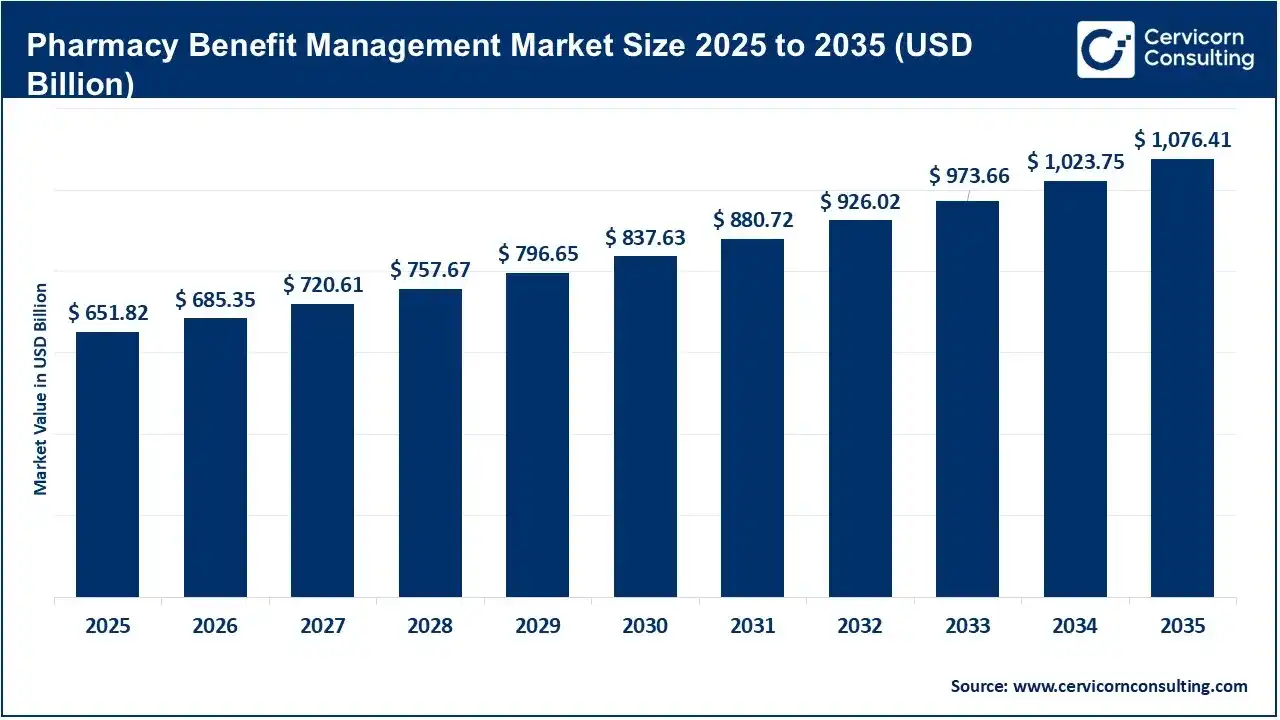
The global pharmacy benefit management market was valued at approximately USD 651.82 billion in 2025 and is projected to reach around USD 1,076.41 billion by 2035, expanding at a CAGR of approximately 5.1% during the forecast period.
Pharmacy Benefit Management Market Growth Factors
The pharmacy benefit management (PBM) market is expanding as healthcare systems, employers, insurers, governments, and patients seek greater control over rapidly increasing prescription drug expenditure. Key growth factors include the rising prevalence of chronic diseases that require long-term medication, increasing utilization of specialty drugs and biologics, growing prescription volumes among aging populations, expansion of employer-sponsored and government-funded pharmacy benefits, increasing adoption of mail-order and specialty pharmacy services, demand for formulary optimization and medication adherence programs, wider use of digital pharmacy platforms, and the growing need to negotiate pharmaceutical prices and rebates.
The increasing complexity of drug pricing is also strengthening demand for PBMs because these organizations can negotiate with manufacturers, establish pharmacy networks, manage formularies, process prescription claims, and implement utilization-management strategies on behalf of health plans. In the United States, the market is particularly concentrated: CVS Caremark, Express Scripts, and Optum Rx together accounted for roughly 79% of U.S. prescriptions in 2023, demonstrating the scale at which leading PBMs operate.
At the same time, rising regulatory scrutiny over rebates, spread pricing, pharmacy reimbursement, vertical integration, and transparency is reshaping competitive strategies and encouraging PBMs to develop more transparent pricing models and value-based pharmacy solutions.
Get a Free Sample: https://www.cervicornconsulting.com/sample/3013
What Is the Pharmacy Benefit Management Market?
The pharmacy benefit management market comprises companies that administer prescription-drug benefits on behalf of health insurers, employers, government programs, and other healthcare organizations.
PBMs function as intermediaries between pharmaceutical manufacturers, health plans, pharmacies, and patients. Their responsibilities can include negotiating manufacturer rebates, developing drug formularies, establishing pharmacy networks, processing prescription claims, managing specialty drugs, operating mail-order pharmacies, supporting medication adherence, conducting utilization management, and helping health plans control pharmacy expenditure.
A typical PBM ecosystem involves several interconnected stakeholders. Pharmaceutical manufacturers supply medications, wholesalers distribute products, pharmacies dispense prescriptions, insurers and employers finance healthcare benefits, and PBMs coordinate several commercial and administrative functions connecting these participants.
Modern PBMs increasingly operate within vertically integrated healthcare organizations. Express Scripts is part of Cigna’s Evernorth business, CVS Caremark operates within CVS Health, and Optum Rx is part of UnitedHealth Group’s Optum platform. This integration allows major organizations to combine PBM services with insurance, specialty pharmacy, retail pharmacy, healthcare delivery, data analytics, and other services.
The scale of the industry illustrates its importance. The Federal Trade Commission reported that the six largest PBMs managed nearly 95% of prescriptions filled in the United States, highlighting the highly concentrated structure of the market.
Why Is the Pharmacy Benefit Management Market Important?
PBMs are important because prescription drug spending is becoming increasingly complex. New specialty medicines, biologics, high-cost therapies, and personalized treatments can create significant financial pressure for insurers, employers, and patients.
PBMs seek to manage this pressure through several mechanisms.
Formulary management is one of the most important. PBMs evaluate medications based on clinical effectiveness, safety, cost, and negotiated pricing and place products into preferred or non-preferred tiers.
Manufacturer negotiations represent another major function. PBMs and their affiliated purchasing organizations negotiate rebates and discounts with pharmaceutical manufacturers. These arrangements can influence which medicines receive preferred formulary placement.
Pharmacy network management enables PBMs to negotiate reimbursement arrangements with retail, specialty, mail-order, and other pharmacies.
Claims administration allows health plans to process prescriptions electronically and determine eligibility, copayments, deductibles, and coverage requirements.
Specialty pharmacy management is becoming increasingly important because specialty medicines often represent a disproportionate share of pharmaceutical spending.
PBMs also support medication adherence, prior authorization, step therapy, generic substitution, fraud detection, and clinical management programs.
However, the industry is facing increasing scrutiny. The FTC has investigated the business practices of major PBMs, including concerns involving rebates, affiliated pharmacies, markups, and competitive effects. In January 2025, the FTC reported that the Big 3 PBMs—Caremark, Express Scripts, and Optum Rx—generated more than $7.3 billion in revenue above estimated acquisition costs from dispensing certain specialty generic drugs through affiliated pharmacies during 2017–2022.
This regulatory environment is becoming an important factor influencing the future structure of the market.
Leading Companies in the Pharmacy Benefit Management Market
| Company | Specialization | Key Focus Areas | Notable Features | 2025 Revenue* | 2025 Market Share | Global Presence |
|---|---|---|---|---|---|---|
| Express Scripts | Large-scale PBM and pharmacy services | Formulary management, specialty pharmacy, home delivery, claims, network management | Part of Evernorth; large commercial and government business | Evernorth Health Services: $235.0B total revenue | 31% | Primarily U.S., with Cigna/Evernorth international operations |
| CVS Caremark | Integrated PBM and pharmacy services | Formulary management, specialty pharmacy, mail order, retail network, clinical services | Integrated with CVS Pharmacy and CVS Health | Health Services: $190.4B | 26% | Primarily U.S.; CVS Health has broader international sourcing and business relationships |
| Optum Rx | PBM, specialty and home-delivery pharmacy | Pharmacy services, specialty medicines, digital pharmacy, clinical management | Part of UnitedHealth Group’s Optum platform | $154.7B | 23% | Primarily U.S., supported by UnitedHealth’s international operations |
| Humana Pharmacy Solutions | Health-plan-focused pharmacy benefits | Medicare, specialty pharmacy, mail delivery, clinical pharmacy | Integrated with Humana and CenterWell | $13.0B pharmacy-solutions revenue* | 7% | Primarily U.S. |
| MedImpact Healthcare Systems | Independent PBM | Benefit administration, specialty pharmacy, clinical programs, analytics | Large independent PBM with diversified payer relationships | Not publicly disclosed | 5% | U.S. and selected international markets |
Express Scripts
Express Scripts, operated under Cigna’s Evernorth Health Services platform, is one of the largest PBMs globally. Its core capabilities include prescription benefit administration, formulary management, pharmacy network contracting, home delivery, specialty pharmacy, clinical services, and medication-management programs.
Express Scripts held an estimated 31% of U.S. equivalent prescription claims in 2025, making it the leading PBM by prescription volume.
Evernorth Health Services reported approximately $235 billion in 2025 total revenue, although this includes services beyond the standalone Express Scripts PBM operation. Cigna’s filing shows that Evernorth generated $219.4 billion in pharmacy revenues in 2025.
CVS Caremark
CVS Caremark combines PBM services with CVS Health’s extensive pharmacy and healthcare infrastructure. Its specialization includes formulary development, pharmacy network management, mail-order services, specialty pharmacy, medication adherence, clinical programs, and prescription claims administration.
CVS Health reported approximately 87 million PBM plan members at the end of 2025, while its Health Services segment processed approximately 1.9 billion prescriptions on a 30-day equivalent basis during the year.
CVS Caremark’s estimated 2025 prescription-claim market share was 26%, according to Drug Channels Institute data reported by Becker’s Hospital Review.
Optum Rx
Optum Rx, part of UnitedHealth Group, provides PBM, specialty pharmacy, home-delivery, clinical, and technology-enabled pharmacy services.
Optum Rx is particularly positioned to benefit from the integration of pharmacy services with UnitedHealthcare insurance and the broader Optum ecosystem.
UnitedHealth reported $154.7 billion in Optum Rx revenue in 2025, representing a 16% increase year over year.
Optum Rx accounted for approximately 23% of U.S. equivalent prescription claims in 2025, making it the third-largest PBM by prescription volume behind Express Scripts and CVS Caremark.
Humana Pharmacy Solutions
Humana Pharmacy Solutions focuses strongly on pharmacy benefits for Humana’s insurance membership, particularly Medicare-oriented populations. Its capabilities include specialty pharmacy, home delivery, medication adherence, formulary management, clinical pharmacy programs, and prescription-benefit administration.
Humana reported $1.218 billion in external pharmacy-solutions revenue and $11.741 billion in intersegment pharmacy-solutions revenue in 2025, demonstrating the importance of pharmacy services within its integrated business model.
Humana Pharmacy Solutions held an estimated 7% U.S. PBM prescription-claim share in 2025.
MedImpact Healthcare Systems
MedImpact Healthcare Systems is a major independent PBM offering pharmacy benefit administration, clinical programs, specialty pharmacy support, analytics, network management, and customized benefit solutions.
Unlike the largest vertically integrated PBMs, MedImpact’s independent positioning allows it to serve multiple health plans and payer organizations without being directly owned by a major national health insurer.
MedImpact accounted for approximately 5% of U.S. equivalent prescription claims in 2025. Its revenue is not publicly disclosed in the same way as the publicly traded companies above.
Leading Trends and Their Impact on the Pharmacy Benefit Management Market
1. Increasing Specialty Drug Utilization
Specialty medicines are one of the most important growth areas for PBMs. Treatments for cancer, autoimmune diseases, rare diseases, and genetic disorders frequently carry high costs and require specialized distribution.
Impact: PBMs are expanding specialty pharmacy networks, clinical management, prior authorization, utilization management, and patient-support services.
2. Growing Use of Biosimilars
Biosimilars are creating opportunities for PBMs to reduce spending on expensive biologic therapies.
Impact: PBMs are increasingly incorporating biosimilar strategies into formularies and negotiating manufacturer arrangements to improve affordability.
3. Expansion of Home Delivery and Digital Pharmacy
Consumers increasingly expect prescription services to be convenient and digitally accessible.
Impact: PBMs are investing in mobile applications, automated refill services, home delivery, digital adherence tools, virtual pharmacist support, and personalized medication management.
4. Greater Transparency Pressure
Transparency has become one of the industry’s defining issues. Employers, regulators, policymakers, independent pharmacies, and consumers are demanding greater visibility into rebates, fees, spread pricing, and pharmacy reimbursement.
Impact: PBMs are facing pressure to provide clearer pricing structures, pass through more negotiated savings, and demonstrate measurable value to plan sponsors.
5. Regulatory Intervention
Regulatory scrutiny is intensifying, particularly in the United States. The FTC’s investigation has focused on concentration, vertical integration, rebates, affiliated pharmacies, and pricing practices.
In 2026, the FTC also reached settlements with Express Scripts and Caremark that require changes related to transparency, patient costs, and community-pharmacy treatment.
Impact: Regulatory changes could alter rebate structures, contracting practices, pharmacy reimbursement, and the economics of vertically integrated PBMs.
6. Value-Based Pharmacy Management
PBMs are increasingly moving beyond simple prescription-cost reduction toward outcomes-oriented models.
Impact: Greater emphasis is being placed on adherence, prevention, clinical outcomes, medication optimization, and total healthcare-cost reduction.
7. Artificial Intelligence and Advanced Analytics
AI and data analytics are increasingly being applied to identify medication adherence risks, inappropriate utilization, fraud, drug interactions, and high-cost treatment patterns.
Impact: Technology can improve clinical decision-making while allowing PBMs to personalize interventions for large member populations.
Successful Examples of Pharmacy Benefit Management Around the World
United States: Integrated PBM Models
The United States represents the world’s most mature PBM environment. Express Scripts, CVS Caremark, and Optum Rx have built large integrated platforms combining PBM services with insurance, pharmacy, specialty care, home delivery, and healthcare analytics.
The concentration of these companies demonstrates how scale can support extensive pharmacy networks and large-scale manufacturer negotiations. At the same time, the model has generated significant policy debate. Research published in JAMA found that CVS Caremark, Express Scripts, and Optum Rx together accounted for 73.6% of retail prescriptions across U.S. payer types in 2023.
Canada: Public and Private Drug Benefit Administration
Canada provides a different model, combining publicly funded drug programs with private employer-sponsored benefits. Pharmacy benefit administration is often linked to insurers, third-party administrators, and provincial drug programs.
The Canadian model demonstrates how drug-benefit management can coexist with government reimbursement frameworks and private supplemental coverage.
United Kingdom: NHS-Led Medicines Management
The United Kingdom’s National Health Service relies less on the traditional U.S.-style PBM structure. Instead, centralized and regional procurement, prescribing guidelines, health technology assessment, and medicines optimization play major roles.
The UK’s model illustrates how governments can perform some functions that PBMs undertake in the United States, particularly around evidence-based medicine selection and cost-effective procurement.
Australia: Pharmaceutical Benefits Scheme
Australia’s Pharmaceutical Benefits Scheme (PBS) provides another important example of centralized prescription-drug benefit management. The government evaluates medicines and subsidizes eligible prescriptions under a nationally administered framework.
The Australian model highlights the role of centralized negotiation and reimbursement policies in improving access while managing public pharmaceutical expenditure.
Global Regional Analysis
North America
North America dominates the global pharmacy benefit management landscape, primarily because of the scale and maturity of the U.S. PBM industry.
The United States has a highly developed ecosystem involving employers, commercial insurers, Medicare, Medicaid, pharmaceutical manufacturers, retail pharmacies, specialty pharmacies, and PBMs.
Government programs are particularly influential. Medicare Part D reforms under the Inflation Reduction Act have changed the economics of prescription-drug coverage, including redesigned beneficiary cost sharing and federal drug-price negotiation provisions. CVS Health reported that the IRA’s impact on Medicare Part D contributed significantly to its government-business revenue changes in 2025.
The region is also experiencing intense regulatory pressure. The FTC’s investigations into PBMs are encouraging greater attention to rebate practices, vertical integration, affiliated pharmacies, and transparency.
Canada is developing alongside a combination of public and private drug-benefit programs, with national and provincial initiatives supporting affordability and access.
Europe
Europe has a more fragmented PBM environment than the United States because many countries rely on national or regional healthcare systems that directly regulate pharmaceutical reimbursement.
Government agencies frequently use health technology assessment, reference pricing, generic substitution, procurement frameworks, reimbursement negotiations, and prescribing guidelines to control pharmaceutical expenditure.
In the United Kingdom, NHS medicines-management systems and National Institute for Health and Care Excellence assessments influence the adoption and reimbursement of medicines.
In countries such as Germany and France, statutory healthcare systems and negotiated reimbursement frameworks play a significant role.
Impact on the market: Rather than creating U.S.-style PBM giants, European policy tends to distribute PBM-like functions among insurers, government agencies, procurement organizations, pharmacies, and healthcare providers.
Asia-Pacific
Asia-Pacific represents an important long-term opportunity because of population growth, aging demographics, increasing chronic disease prevalence, rising healthcare expenditure, and expanding health insurance coverage.
Japan has a highly regulated pharmaceutical reimbursement system, with national pricing and reimbursement decisions playing a central role.
Australia uses the Pharmaceutical Benefits Scheme to subsidize medicines, while centralized policy and reimbursement mechanisms influence pharmaceutical utilization.
China has expanded centralized pharmaceutical procurement, including volume-based procurement, which aims to lower medicine prices through large-scale purchasing.
India is experiencing increasing demand for organized pharmacy benefits as private health insurance, employer healthcare programs, digital pharmacies, and specialty medicines expand. Government initiatives such as the Ayushman Bharat ecosystem are also increasing attention toward healthcare affordability and access.
Impact: The Asia-Pacific market is likely to evolve toward a combination of digital pharmacy platforms, insurance-linked pharmacy benefits, government procurement, centralized price negotiation, and technology-driven medication management rather than simply replicating the U.S. PBM model.
Latin America
Latin America is characterized by a mixture of public healthcare systems, private insurers, employer-sponsored health benefits, and pharmacy networks.
Countries such as Brazil and Mexico represent important markets because of their large populations and increasing demand for chronic-disease medications.
Government policies focusing on universal healthcare, generic medicines, pharmaceutical procurement, and price regulation can influence PBM-like activities.
Impact: Growth opportunities are particularly strong for digital claims management, medication adherence programs, pharmacy networks, and employer-sponsored prescription benefits.
Middle East & Africa
The Middle East & Africa market is developing from a smaller base but presents long-term opportunities due to healthcare modernization, insurance expansion, digitization, and rising chronic diseases.
Gulf countries are investing heavily in digital healthcare infrastructure and private health insurance systems. Governments are also increasingly focused on improving pharmaceutical procurement and healthcare efficiency.
In Africa, fragmented healthcare financing and limited insurance coverage remain challenges, but national health-insurance expansion and digital-health initiatives could create opportunities for pharmacy-benefit administration.
Impact: PBM-related services in the region are likely to develop around claims processing, insurance administration, pharmacy network management, generic substitution, medication adherence, and digital prescription management.
Government Initiatives and Policies Shaping the Market
Government policy is becoming one of the most influential forces affecting PBM market development.
In the United States, the Inflation Reduction Act is transforming Medicare Part D through changes to beneficiary cost sharing and prescription-drug pricing policy. The federal government’s Medicare drug-price negotiation program is also introducing negotiated prices for selected high-cost medicines.
The Federal Trade Commission’s PBM investigation is another major development. The FTC has examined the practices of six major PBMs and has raised concerns regarding market concentration and vertical integration.
The FTC’s 2025 report specifically examined specialty generic drugs and found substantial markups involving affiliated pharmacies of the largest PBMs.
In Canada, provincial and federal drug programs influence eligibility, reimbursement, formularies, and pharmaceutical access.
In the United Kingdom, NHS medicines policies and health technology assessment influence whether medicines are adopted and reimbursed.
In Australia, the Pharmaceutical Benefits Scheme remains a central mechanism for subsidizing prescription medicines.
In China, centralized procurement policies have put pressure on pharmaceutical manufacturers to reduce prices while increasing procurement efficiency.
Across emerging markets, governments are increasingly introducing digital prescription systems, national health-insurance programs, centralized procurement, generic-drug policies, and pharmaceutical price controls.
These policies are gradually shifting the PBM industry from a model centered primarily on claims administration and rebate negotiation toward a broader healthcare-management model focused on affordability, clinical outcomes, transparency, and patient experience.
The competitive environment is therefore likely to remain dynamic. The largest PBMs benefit from scale, data, pharmacy networks, specialty capabilities, and integration with insurers and healthcare providers, while independent PBMs can compete through transparency, customized benefit design, and flexible client relationships. At the same time, regulatory reforms may encourage new business models and increase competition across prescription-benefit administration.
To Get Detailed Overview, Contact Us: https://www.cervicornconsulting.com/contact-us
Read Report: Primary Care Market Revenue, Trends, and Strategic Insights by 2035