Long-term care is moving beyond nursing homes: Where are the next growth and investment opportunities?
Long-Term Care Market: Where are the next growth and investment opportunities?
Long-term care is shifting from a predominantly institutional model toward a broader continuum that includes home healthcare, community-based services, assisted living, nursing care, rehabilitation, hospice and technology-enabled monitoring.
The change is being driven by two forces at the same time: populations are living longer, while chronic conditions are increasing the amount of support required over extended periods. For providers, insurers, technology companies and investors, this makes the long-term care market increasingly dependent on how efficiently care can be delivered outside traditional facilities.
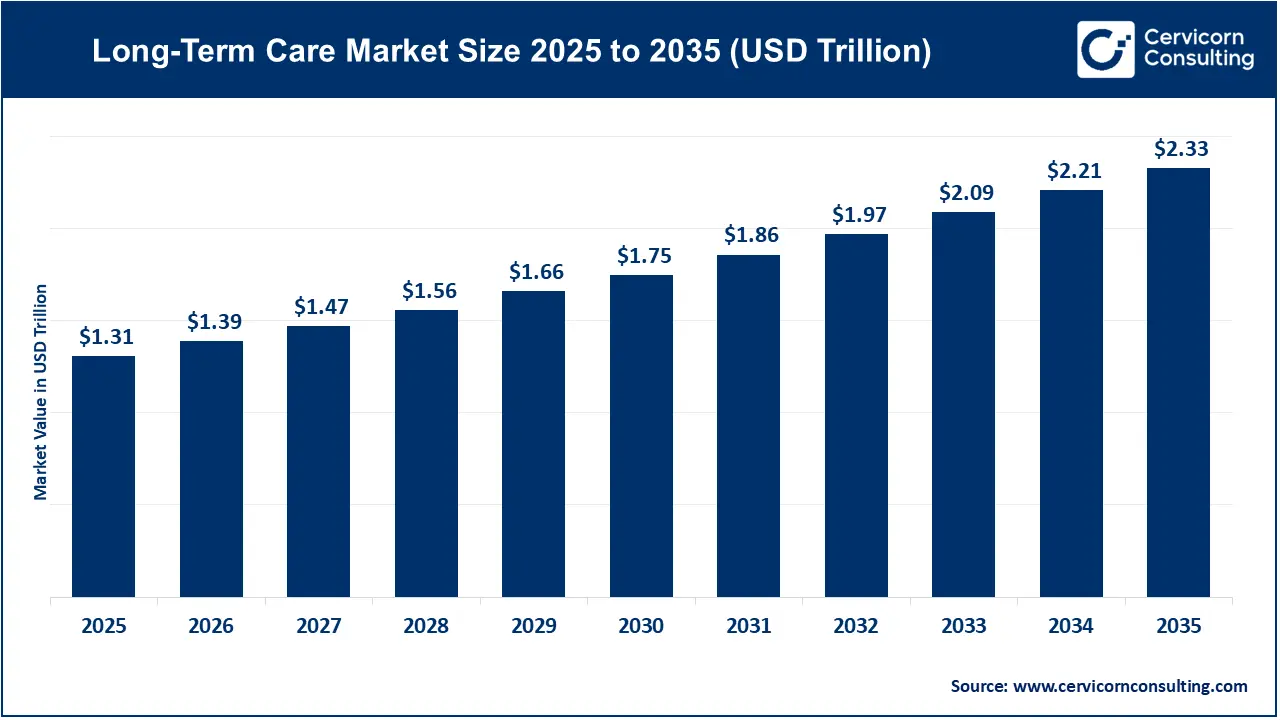
The global long-term care market was valued at USD 1.31 trillion in 2025 and is projected to reach USD 2.33 trillion by 2035, expanding at a 5.93% CAGR from 2026 to 2035. North America represented about 44.5% of global revenue in 2025, while Asia-Pacific is projected to be the fastest-growing regional market.
The market is moving closer to the home
Home care already represented approximately 39.5% of long-term care revenue in 2025, making it the largest application segment in Cervicorn’s analysis. Nursing care accounted for about 41.7% of revenue by service type.
This combination points to an important shift: demand for professional care is not disappearing, but the location where that care is delivered is changing.
Home-based models can reduce dependence on high-cost institutional settings while allowing patients to remain in familiar environments. This creates opportunities for companies providing:
- Remote patient monitoring
- Home nursing and rehabilitation
- Medication management
- Telehealth
- Wearable monitoring devices
- Home diagnostics
- Care coordination platforms
- Digital records and scheduling systems
The commercial opportunity therefore extends beyond nursing homes and senior living operators into the wider healthcare technology and services ecosystem.
Get a Free Sample: https://www.cervicornconsulting.com/sample/2779
Ageing is creating a longer care continuum
Ageing demographics are increasing demand not simply for medical treatment but for continuous support with mobility, chronic disease management, rehabilitation and daily activities.
India illustrates how quickly this requirement can become an infrastructure issue. India’s government reported in February 2026 that 23.8% of people aged 60 and above have at least one limitation in activities of daily living, indicating varying levels of care dependency.
The opportunity is broader than institutional eldercare. India’s National Programme for Health Care of the Elderly already envisions integrated preventive, curative and rehabilitative services for older adults.
For companies entering emerging markets, the relevant question is therefore not simply how many elderly people there will be, but which care services will be required, where they will be delivered and who will pay for them.
Workforce availability could determine scalability
Long-term care is highly labour-intensive. Growth in patient demand does not automatically translate into scalable revenue if providers cannot recruit, train and retain enough qualified caregivers.
WHO’s 2026 draft Global Standards for Long-Term Care places workforce, financing, governance, quality monitoring and both home/community and facility-based care within the same framework. The consultation reflects how workforce capacity is becoming a structural issue for LTC systems rather than only an operational concern.
India is also moving toward greater professionalisation of caregiving. In August 2026, NITI Aayog released a report calling for an organised, professional and future-ready caregiving system, while highlighting the need for a larger trained caregiver workforce.
For operators and investors, workforce metrics can therefore become as important as bed capacity when evaluating expansion opportunities.
Technology is changing the economics of care
Long-term care providers are increasingly combining AI, IoT, connected devices, electronic health records and point-of-care diagnostics to monitor patients continuously rather than relying entirely on periodic clinical assessments.
Cervicorn’s analysis identifies miniaturised diagnostics and AI/IoT integration as important market trends. Connected diagnostic and monitoring systems can potentially move testing closer to the patient while reducing unnecessary transfers and improving the availability of real-time information.
The strongest technology opportunities are likely to be those that address measurable operating requirements, such as:
Earlier intervention → fewer avoidable hospital visits → better staff utilisation → improved continuity of care.
This makes interoperability increasingly important. A wearable, diagnostic device or AI system has limited operational value if its data cannot be integrated into the provider’s existing clinical workflow.
India is becoming an important investment market
India’s long-term care ecosystem remains relatively underdeveloped compared with mature markets, but that gap is attracting increasing attention.
A 2026 Colliers assessment estimated India’s senior living market could exceed INR 1 trillion by 2030, with demand potentially reaching around 3 million senior-housing units. It also identified more than INR 130 billion of potential investment by developers and investors over the following three to four years.
The opportunity is not limited to metropolitan cities. Colliers expects 30–40% of anticipated new senior-living project launches to be concentrated in Tier II and Tier III cities and spiritual hubs.
For investors, this creates an important distinction between senior housing and long-term care infrastructure. The strongest models may increasingly combine accommodation with healthcare, rehabilitation, assisted living and home/community care.
Asia-Pacific offers a different growth equation
North America currently dominates the market, with Cervicorn estimating a 44.5% revenue share in 2025. However, Asia-Pacific is expected to experience the fastest growth, supported by ageing populations, increasing healthcare expenditure and expanding private-sector participation.
The region also contains very different care systems. Japan has a mature elderly-care ecosystem, while India and other emerging economies are still developing organised home-care, assisted-living and community-care infrastructure.
That creates opportunities for companies that can adapt their models to local purchasing power, caregiver availability, insurance penetration and urban-rural differences, rather than simply transferring Western LTC models into Asian markets.
Financing will shape the next phase of growth
The payer structure is another important consideration. Cervicorn estimates that private insurance accounted for approximately 54.3% of long-term care revenue in 2025, while public insurance and out-of-pocket payments remain important across different markets.
This creates different commercial models across countries.
In markets with strong insurance coverage, providers may focus on reimbursement, network participation and clinical outcomes. In markets where households pay a larger share directly, affordability and home-based delivery become much more important.
For investors and healthcare companies, understanding who ultimately pays for care can therefore be as important as estimating the number of potential patients.
What companies should watch next
The next stage of the long-term care market will be shaped by several connected developments:
- Home-based care: Expansion of professional services outside institutional facilities.
- Caregiver capacity: Training, retention, productivity and professionalisation of care workers.
- Digital monitoring: Wider deployment of connected devices and remote patient monitoring.
- AI-enabled care: Predictive analytics for risk identification, scheduling and clinical decision support.
- Senior living: Integration of housing, healthcare and assisted-living services.
- Diagnostics: Greater use of portable and point-of-care testing.
- Financing: New insurance, public-private and out-of-pocket payment models.
- Emerging markets: Increasing investment in organised eldercare infrastructure, particularly across Asia-Pacific.
The central investment question is moving beyond how large the ageing population will become. Companies increasingly need to determine where care will be delivered, how many caregivers will be required, which technologies can improve productivity, and which payment models can support sustainable margins.
With the global market projected to reach USD 2.33 trillion by 2035, these decisions will increasingly influence healthcare providers, senior-living operators, insurers, diagnostics companies, medical-device manufacturers, digital-health companies and infrastructure investors.
To Get Detailed Overview, Contact Us: https://www.cervicornconsulting.com/contact-us
Read Report: CRISPR gene editing: What will determine its shift from research to scalable precision medicine?