Industry 4.0 in Aerospace and Defense Market Revenue, Trends, and Strategic Insights by 2035
Industry 4.0 in Aerospace and Defense Market Size
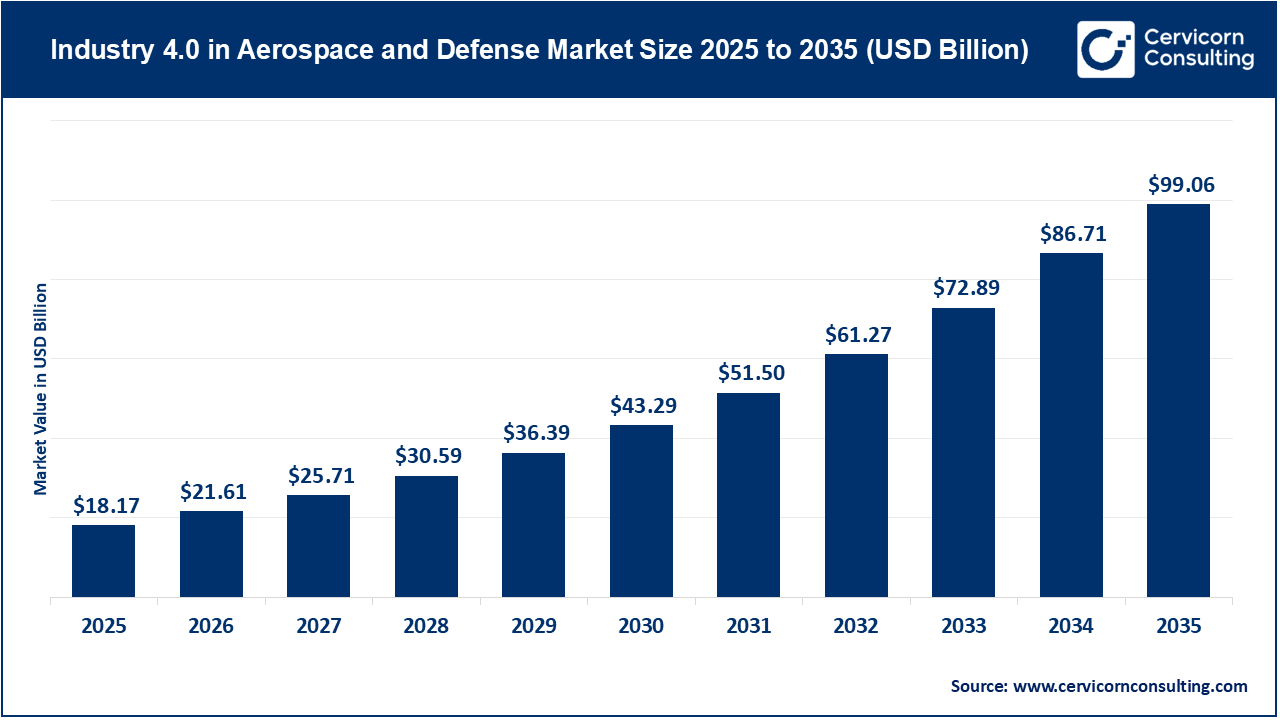
The global industry 4.0 in aerospace and defense market was valued at approximately USD 18.17 billion in 2025 and is projected to reach nearly USD 99.06 billion by 2035, growing at a CAGR of 18.48%.
Industry 4.0 in Aerospace and Defense Market Growth Factors
The global Industry 4.0 in aerospace and defense market is witnessing remarkable growth due to increasing adoption of artificial intelligence (AI), Industrial Internet of Things (IIoT), digital twins, robotics, cloud computing, additive manufacturing, big data analytics, and autonomous systems across aerospace manufacturing and defense operations. Rising investments in smart factories, predictive maintenance technologies, connected production systems, cybersecurity, and intelligent supply chain management are transforming aircraft production and military equipment manufacturing. Governments worldwide are allocating larger defense budgets to modernize military infrastructure while commercial aerospace manufacturers continue investing in automation to improve production efficiency and product quality.
Growing demand for real-time data analytics, reduced manufacturing costs, improved operational efficiency, enhanced mission readiness, sustainable manufacturing, and faster product development cycles further accelerates market expansion. The increasing use of digital engineering, simulation technologies, edge computing, and collaborative robotics enables manufacturers to reduce downtime, improve asset utilization, and enhance lifecycle management, making Industry 4.0 one of the most significant technological revolutions in the aerospace and defense sector.
What is the Industry 4.0 in Aerospace and Defense Market?
Industry 4.0 in aerospace and defense refers to the integration of advanced digital technologies into aircraft manufacturing, defense equipment production, maintenance operations, logistics, and supply chain management. It combines cyber-physical systems, IoT-enabled devices, AI-driven analytics, cloud platforms, digital twins, robotics, automation, machine learning, augmented reality (AR), virtual reality (VR), and advanced sensors to create intelligent manufacturing ecosystems.
Unlike conventional manufacturing, Industry 4.0 enables every machine, production line, sensor, and software application to communicate continuously, generating valuable operational insights. Aerospace manufacturers use these technologies to monitor production quality, optimize workflows, reduce waste, and improve equipment reliability.
Defense organizations leverage Industry 4.0 for predictive maintenance of military assets, digital battlefield simulations, autonomous systems, secure communications, and rapid manufacturing of mission-critical components.
The market includes hardware, software, connectivity solutions, industrial automation platforms, cybersecurity solutions, cloud infrastructure, industrial analytics, smart manufacturing equipment, and consulting services.
Get a Free Sample: https://www.cervicornconsulting.com/sample/2632
Why is Industry 4.0 Important in Aerospace and Defense?
Industry 4.0 has become a strategic necessity for aerospace manufacturers and defense organizations due to increasing operational complexity and global competition.
Major reasons for its importance include:
- Faster aircraft production through intelligent automation
- Reduced manufacturing defects using AI-powered quality inspection
- Predictive maintenance that minimizes equipment failures
- Improved supply chain visibility through IoT connectivity
- Lower operational costs through automation
- Enhanced workforce productivity with collaborative robots
- Better product lifecycle management using digital twins
- Faster defense equipment modernization
- Improved cybersecurity for connected industrial systems
- Real-time decision-making using advanced analytics
- Sustainable manufacturing with optimized energy consumption
- Increased flexibility for customized aircraft production
For defense organizations, Industry 4.0 significantly improves operational readiness, logistics efficiency, and mission success by integrating real-time intelligence into manufacturing and maintenance operations.
Major Companies Operating in the Industry 4.0 in Aerospace and Defense Market
| Company | Specialization | Key Focus Areas | Notable Features | 2025 Revenue* | Estimated Market Share** | Global Presence |
|---|---|---|---|---|---|---|
| Boeing | Commercial aircraft, defense, digital aviation | Smart factories, digital twins, predictive maintenance, automation | Extensive use of digital engineering and connected manufacturing | Approximately US$78 billion | 12–15% | North America, Europe, Asia-Pacific, Middle East, Latin America |
| Lockheed Martin | Defense systems and aerospace | AI-enabled manufacturing, digital engineering, autonomous systems | Strong investment in Industry 4.0-enabled defense production | US$75.05 billion | 10–12% | More than 50 countries |
| RTX (formerly Raytheon Technologies) | Aerospace systems, engines, defense electronics | Smart manufacturing, connected factories, AI analytics | Advanced digital manufacturing across commercial and defense operations | US$88.6 billion | 10–11% | More than 180 countries |
| Airbus | Commercial aircraft, defense, helicopters, space | Digital factories, additive manufacturing, AI-driven production | Highly automated manufacturing facilities across Europe | €73.4 billion | 11–13% | More than 150 countries |
| Northrop Grumman | Defense systems, space technologies | Digital engineering, automation, advanced manufacturing | Strong focus on intelligent defense production systems | US$41.95 billion | 6–8% | Global defense programs across North America, Europe, Indo-Pacific |
Leading Trends and Their Impact
1. Digital Twin Adoption
Digital twins allow manufacturers to create virtual replicas of aircraft, engines, satellites, and manufacturing facilities.
Impact:
- Faster product design
- Reduced testing costs
- Improved maintenance planning
- Higher production accuracy
2. AI-Powered Predictive Maintenance
Machine learning algorithms continuously analyze equipment performance to predict failures before they occur.
Benefits include:
- Reduced aircraft downtime
- Lower maintenance costs
- Increased operational availability
- Improved fleet reliability
3. Smart Factory Automation
Modern aerospace factories are increasingly deploying:
- Autonomous robots
- Automated guided vehicles (AGVs)
- Computer vision systems
- Connected production equipment
These technologies significantly increase manufacturing efficiency while reducing defects.
4. Additive Manufacturing
3D printing has become an essential component of Industry 4.0.
Applications include:
- Lightweight aircraft components
- Rapid prototyping
- Spare part manufacturing
- Military equipment production
The technology reduces production time while lowering material waste.
5. Industrial Internet of Things (IIoT)
Thousands of connected sensors collect operational data from:
- Aircraft assembly lines
- Production equipment
- Supply chains
- Warehouses
- Military manufacturing facilities
The collected data enables real-time operational optimization.
6. Cloud-Based Manufacturing Platforms
Cloud technologies provide centralized access to manufacturing information.
Advantages include:
- Global collaboration
- Remote monitoring
- Faster decision-making
- Improved supply chain coordination
7. Cybersecurity Integration
As manufacturing becomes increasingly connected, cybersecurity has become a top priority.
Manufacturers are investing in:
- Zero Trust architecture
- Industrial cybersecurity platforms
- Secure IoT devices
- AI-driven threat detection
8. Sustainable Manufacturing
Industry 4.0 technologies help organizations:
- Reduce energy consumption
- Lower carbon emissions
- Improve material utilization
- Minimize production waste
Sustainability has become an important competitive advantage.
Successful Examples of Industry 4.0 in Aerospace and Defense Around the World
Boeing (United States)
Boeing has integrated digital engineering, robotics, AI-based quality inspection, digital twins, and predictive maintenance into aircraft manufacturing. Connected production systems improve manufacturing precision while reducing production delays.
Airbus (Europe)
Airbus operates highly automated smart factories using IoT-enabled equipment, collaborative robots, AI-based production planning, and additive manufacturing to improve production efficiency and reduce operational costs.
Lockheed Martin (United States)
Lockheed Martin uses digital engineering platforms to accelerate defense system development, improve simulation capabilities, and streamline manufacturing of advanced military aircraft and missile systems.
RTX (United States)
RTX employs AI-powered manufacturing analytics, automated inspection systems, and predictive maintenance technologies across its aerospace and defense operations, improving productivity and reliability.
Northrop Grumman (United States)
Northrop Grumman has embraced advanced digital manufacturing, intelligent automation, and model-based engineering to support production of next-generation aircraft, missile systems, and space technologies.
Rolls-Royce (United Kingdom)
Rolls-Royce has pioneered digital twin technology for aircraft engines, enabling continuous monitoring of engine performance and predictive maintenance.
GE Aerospace (United States)
GE Aerospace extensively uses additive manufacturing, AI, industrial analytics, and digital engineering to improve engine performance and manufacturing efficiency.
Mitsubishi Heavy Industries (Japan)
The company integrates robotics, automation, digital manufacturing, and smart production systems for aerospace component manufacturing.
Global Regional Analysis
North America
North America dominates the Industry 4.0 aerospace and defense market.
Growth drivers include:
- Strong defense spending
- Advanced aerospace manufacturing
- AI innovation
- Smart factory investments
- Presence of leading manufacturers
- Extensive government-funded R&D
The United States continues to lead global adoption of digital engineering and intelligent manufacturing technologies.
Government Initiatives
- U.S. Department of Defense digital engineering strategy
- Manufacturing USA innovation institutes
- Advanced Manufacturing National Program
- Industrial AI research funding
- Smart manufacturing modernization initiatives
Europe
Europe represents one of the largest Industry 4.0 markets due to its advanced aerospace ecosystem.
Major contributors include:
- Germany
- France
- United Kingdom
- Italy
- Spain
European manufacturers increasingly invest in:
- Digital twins
- Robotics
- AI
- Sustainable manufacturing
- Connected production systems
Government Policies
- European Union Digital Europe Programme
- Horizon Europe research funding
- Industry 5.0 initiatives
- Green Deal manufacturing policies
- European Defence Fund supporting digital defense technologies
Asia-Pacific
Asia-Pacific is expected to experience the fastest market growth.
Key countries include:
- China
- Japan
- India
- South Korea
- Singapore
- Australia
Rapid industrialization, expanding commercial aviation, rising defense budgets, and government-led smart manufacturing initiatives are accelerating Industry 4.0 adoption.
Government Initiatives
China
- Made in China 2025
- Smart manufacturing programs
- AI industrial development strategy
Japan
- Society 5.0
- Robotics innovation programs
- Advanced manufacturing investments
India
- Make in India
- Digital India
- Defence Industrial Corridors
- Production Linked Incentive (PLI) schemes
- Increasing investment in indigenous aerospace manufacturing
South Korea
- Smart Factory Initiative
- AI manufacturing programs
- Advanced robotics investments
Latin America
Latin America is gradually adopting Industry 4.0 technologies, particularly within aerospace manufacturing and aircraft maintenance.
Brazil leads regional growth due to its strong aerospace manufacturing capabilities and increasing automation investments.
Government-supported industrial modernization and digital transformation initiatives continue to encourage technology adoption.
Middle East & Africa
The Middle East is emerging as an important market due to rising defense modernization programs and investments in aerospace manufacturing.
Countries including the UAE and Saudi Arabia are investing heavily in:
- AI
- Smart manufacturing
- Industrial automation
- Defense localization
- Digital transformation
Government Policies
- Saudi Vision 2030
- UAE Industry 4.0 Strategy
- Defense localization initiatives
- Smart manufacturing investment programs
These policies are creating favorable conditions for long-term market expansion.
Future Outlook
The future of the Industry 4.0 in aerospace and defense market will be defined by increasingly autonomous manufacturing environments, AI-driven engineering, hyper-connected supply chains, and resilient digital ecosystems. Greater adoption of edge computing, generative AI, advanced robotics, quantum-enabled optimization, and secure industrial networks is expected to shorten product development cycles while enhancing operational resilience. As governments continue prioritizing defense modernization and aerospace companies pursue higher efficiency and sustainability, Industry 4.0 technologies will remain central to improving production quality, mission readiness, and global competitiveness.
To Get Detailed Overview, Contact Us: https://www.cervicornconsulting.com/contact-us
Read Report: AI Data Centre Market Revenue, Trends, and Strategic Insights by 2035