Hydrogen Internal Combustion Engine Market: Which Applications Offer the Strongest Commercial Opportunities?
Hydrogen Internal Combustion Engine Market: Where Should Companies Invest as Hydrogen Mobility Moves Toward Commercial Deployment?
The hydrogen internal combustion engine (H₂-ICE) market is moving beyond technology development toward early fleet deployment, particularly in heavy-duty transportation, port operations and industrial applications. For vehicle manufacturers, engine suppliers, hydrogen producers and fleet operators, the strategic question is no longer simply whether hydrogen can power an internal combustion engine. It is which applications can support commercially viable deployment, given fuel costs, infrastructure availability, operating requirements and emissions regulations.
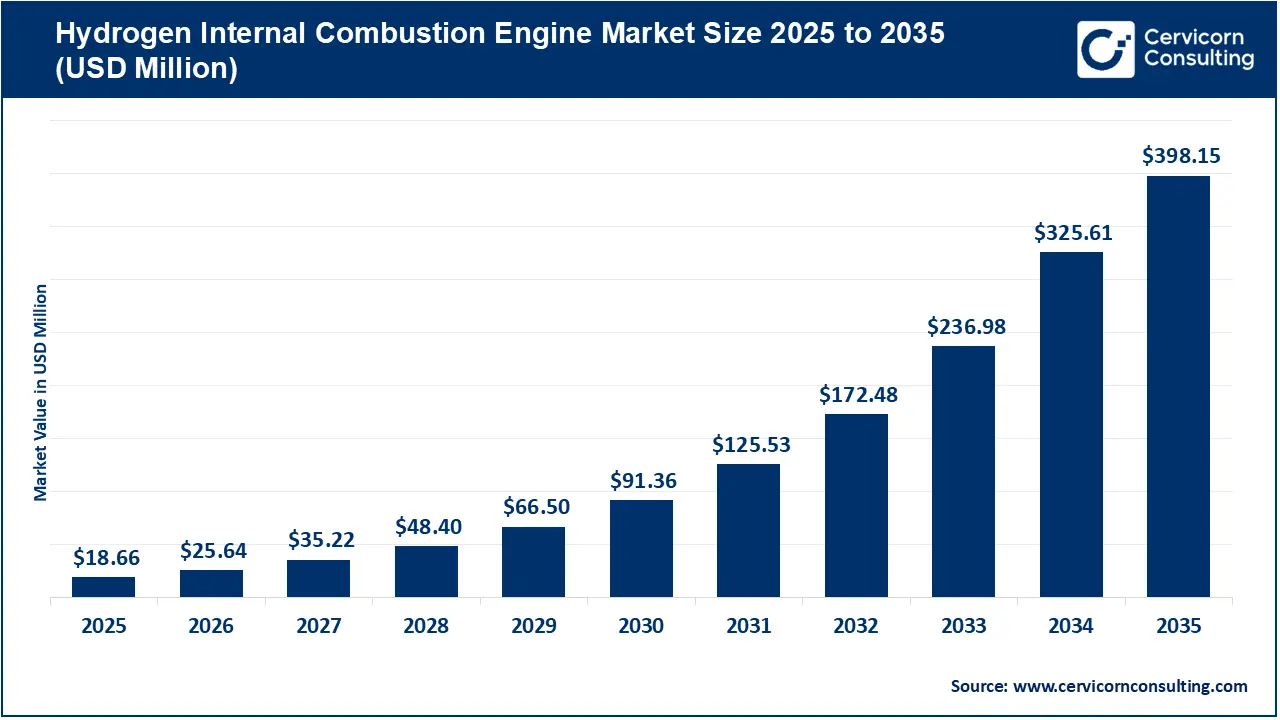
The global hydrogen internal combustion engine market was valued at USD 18.66 million in 2025 and is projected to reach USD 398.15 million by 2035, expanding at a CAGR of 35.8% from 2026 to 2035. Although the projected growth is substantial, the relatively small starting market indicates that commercialization, rather than immediate mass adoption, remains central to investment decisions.
1. Heavy-Duty Transport Could Provide an Early Commercialization Pathway
Hydrogen combustion engines are attracting interest in applications where high power output, demanding duty cycles and operational continuity are important. Heavy-duty trucks, port vehicles, construction equipment and selected industrial machinery provide potential entry points, particularly where centralized operations make hydrogen refuelling easier to organize.
India is beginning to establish real-world deployment opportunities. In February 2026, Tata Motors signed a memorandum of understanding with V.O. Chidambaranar Port Authority in Tamil Nadu to deploy 40 green-hydrogen-powered H₂-ICE, heavy-duty prime movers. The project is expected to progress through trials and phased deployment over two years.
For manufacturers and component suppliers, this development highlights the potential value of targeting captive fleets before pursuing broad consumer adoption. Ports, mining operations, logistics hubs and industrial facilities can offer predictable routes, centralized maintenance and concentrated fuel demand.
Business implication: Engine manufacturers should evaluate fleet operators with repeatable duty cycles and identifiable hydrogen supply plans. Suppliers of fuel injection, ignition, engine controls, thermal management and hydrogen-compatible components can assess opportunities to participate in these early deployment programs.
2. Hydrogen Availability and Fuel Economics Will Determine Commercial Viability
Vehicle performance alone will not establish a sustainable market for hydrogen combustion engines. The delivered cost of hydrogen, refuelling availability, storage requirements and annual vehicle utilization will directly influence operating economics.
India’s National Green Hydrogen Mission has an outlay of ₹19,744 crore and targets the development of green hydrogen production, domestic demand and associated infrastructure. Transport pilots under the mission are helping test the practical requirements of hydrogen-powered buses and trucks. In July 2026, the government announced 12 pilot projects involving 70 hydrogen-powered vehicles across 21 routes, alongside 16 hydrogen refuelling stations. The vehicles include both fuel-cell electric vehicles and hydrogen internal combustion engine vehicles.
These initiatives indicate growing institutional support, but announced projects should not be confused with fully developed commercial refuelling networks. Companies must determine whether hydrogen supply will be available at the locations and times required for their operations.
For fleet owners, the relevant assessment should include:
- Delivered hydrogen cost per kilogram, including transportation and storage.
- Fuel consumption per kilometre or operating hour under actual duty cycles.
- Refuelling station availability, capacity and redundancy.
- Vehicle acquisition, maintenance and financing costs.
- Hydrogen production pathway and lifecycle greenhouse-gas emissions.
Business implication: Hydrogen producers, refuelling infrastructure developers and vehicle manufacturers should coordinate investment around identifiable fleet demand. For fleet operators, a pilot should establish the total cost per kilometre or tonne-kilometre under realistic operating conditions before large-scale procurement.
3. H₂-ICE Versus Fuel Cells and Battery-Electric Vehicles: Where Does Each Technology Fit?
Hydrogen combustion engines compete with other low-emission powertrain options, but the technologies have different operating characteristics. The appropriate choice depends on the application, available energy infrastructure, vehicle utilization and regulatory requirements.
| Decision factor | Hydrogen ICE | Hydrogen fuel cell | Battery-electric |
|---|---|---|---|
| Energy conversion | Combusts hydrogen in an engine | Converts hydrogen into electricity | Uses stored electricity to power an electric motor |
| Manufacturing opportunity | Potential reuse of selected engine and powertrain capabilities | Fuel-cell stacks, power electronics and electric drivetrains | Battery packs, motors and charging systems |
| Refuelling or charging | Requires hydrogen storage and refuelling | Requires hydrogen storage and refuelling | Requires charging infrastructure |
| Key evaluation criteria | Fuel consumption, engine efficiency, NOx control and durability | System cost, hydrogen use, stack durability and efficiency | Battery cost, charging time, payload and duty cycle |
| Potential areas to assess | Heavy-duty, off-highway and selected industrial applications | Heavy-duty mobility and applications requiring electric drive | Urban delivery, predictable routes and suitable depot-based fleets |
Hydrogen ICE technology may appeal to manufacturers with established engine-development capabilities. However, combustion still produces nitrogen oxides (NOx), which must be controlled, and hydrogen production can generate substantial emissions when based on fossil fuels without effective carbon management.
Fuel-cell vehicles have different efficiency and emissions characteristics, while battery-electric systems may be more practical where charging access and operating patterns are favourable. No single technology is automatically the most economical across every vehicle category.
Business implication: OEMs and fleet operators should compare technologies using total cost of ownership, energy consumption, emissions compliance, infrastructure requirements and vehicle availability. Investment decisions based solely on powertrain purchase price or projected market growth may overlook the costs that determine long-term competitiveness.
4. Component Suppliers Should Prepare for Platform-Specific Demand
The expansion of hydrogen combustion technology could create opportunities beyond complete engine manufacturing. However, the commercial potential of individual components will depend on engine architecture, production volumes, technical qualification and the extent to which existing designs can be adapted.
Areas worth assessing include:
- Hydrogen fuel injection: Components capable of handling hydrogen’s distinctive combustion and delivery requirements.
- Engine management and sensors: Systems for combustion control, diagnostics, monitoring and performance optimization.
- Ignition and combustion systems: Technologies that support stable combustion across different loads and operating conditions.
- Emissions control: Solutions for controlling NOx and meeting applicable vehicle and equipment standards.
- Storage and fuel delivery: Hydrogen-compatible valves, regulators, piping and safety systems.
- Testing and validation: Equipment and engineering services for durability, safety and performance certification.
Suppliers should distinguish between components that can be adapted from existing engine platforms and those requiring new engineering, materials or validation processes. This distinction influences capital expenditure, development timelines and the commercial scale needed to achieve acceptable returns.
Business implication: Component manufacturers can prioritize partnerships with engine developers and OEMs that have active demonstration programs, identifiable production plans and clear technical specifications. Early qualification may create an advantage, but prototype participation should not be treated as evidence of guaranteed volume demand.
5. Which Applications Offer the Most Relevant Investment Opportunities?
The hydrogen ICE market covers multiple end-use categories, but their commercial readiness and infrastructure needs differ.
Heavy-duty commercial vehicles: Trucks and buses operating on defined routes provide opportunities to measure fuel consumption, vehicle uptime, maintenance needs and refuelling performance. Fleet-based deployment is particularly relevant where hydrogen supply can be concentrated at depots or logistics hubs.
Ports and industrial logistics: Port tractors, prime movers and other heavy-duty vehicles can operate within controlled environments. Concentrated demand may help infrastructure developers coordinate hydrogen production, storage and refuelling investments with vehicle deployment.
Construction, mining and off-highway machinery: These applications warrant evaluation where equipment operates for long periods, performs energy-intensive tasks or works at sites where conventional charging infrastructure is difficult to establish. Fuel supply logistics and equipment utilization remain decisive factors.
Marine and stationary power applications: Hydrogen combustion may be relevant to selected vessels, engines and distributed power systems. Feasibility depends on equipment requirements, hydrogen storage, safety rules, operating economics and the availability of alternative technologies.
For each application, investors should examine the number of addressable units, expected annual utilization, achievable hydrogen supply cost, regulatory requirements and the likelihood that pilot projects will translate into repeat orders.
6. A Practical Investment Framework for 2026–2030
Rather than committing capital based only on long-term market forecasts, companies can use a staged approach to manage commercialization risk.
| Investment stage | Priority action | Evidence required to progress |
|---|---|---|
| Market screening | Identify target vehicle categories, fleet operators and regions | Addressable demand, policy direction and competing technologies |
| Technical validation | Test engine performance, fuel consumption and emissions | Reliable results under representative operating conditions |
| Pilot deployment | Run vehicles in controlled commercial settings | Uptime, maintenance costs, refuelling reliability and operating data |
| Infrastructure alignment | Secure fuel supply and refuelling arrangements | Contracted supply, delivered cost and sufficient station capacity |
| Commercial scaling | Expand production, sourcing and customer coverage | Repeat orders, validated unit economics and credible utilization forecasts |
The staged approach is especially relevant for companies entering a market where long-term growth expectations may be strong but current volumes remain comparatively small. It also allows component suppliers, infrastructure developers and vehicle manufacturers to align capital commitments with evidence of demand.
What Companies Should Monitor Before Expanding
Four indicators deserve particular attention over the next several years:
- Fleet deployment beyond pilots: Whether announced projects lead to sustained vehicle utilization and repeat procurement.
- Delivered hydrogen economics: Whether supply costs become competitive for specific operating profiles and regions.
- Infrastructure utilization: Whether refuelling stations attract sufficient demand to support viable operations.
- Regulatory and emissions performance: Whether hydrogen combustion platforms can satisfy applicable NOx, safety and lifecycle-emissions requirements.
Together, these indicators can provide a more actionable view of commercial readiness than market growth projections alone.
Conclusion
The hydrogen internal combustion engine market presents opportunities for OEMs, engine component suppliers, hydrogen producers, infrastructure developers and fleet operators. Yet the strongest near-term opportunities are likely to depend on application-specific economics, concentrated fleet demand and coordinated infrastructure development rather than uniform adoption across transportation.
Companies considering entry should prioritize applications where operating requirements are well understood, hydrogen supply can be secured and performance can be validated under real-world conditions. For suppliers, early collaboration with OEMs and demonstration programs can help identify qualification requirements and potential customer demand before committing to large-scale capacity expansion.
The central investment question is therefore not simply how quickly the market will grow, but which applications, customers and supply-chain positions can support commercially sustainable deployment.
To Get Detailed Overview, Contact Us: https://www.cervicornconsulting.com/contact-us
Read Report: Smart Retail Market: How Should Retailers Prioritize Technology Investments for Better Store Economics?