Hydrogen Aircraft Market Revenue, Trends, and Strategic Insights by 2035
Hydrogen Aircraft Market Size
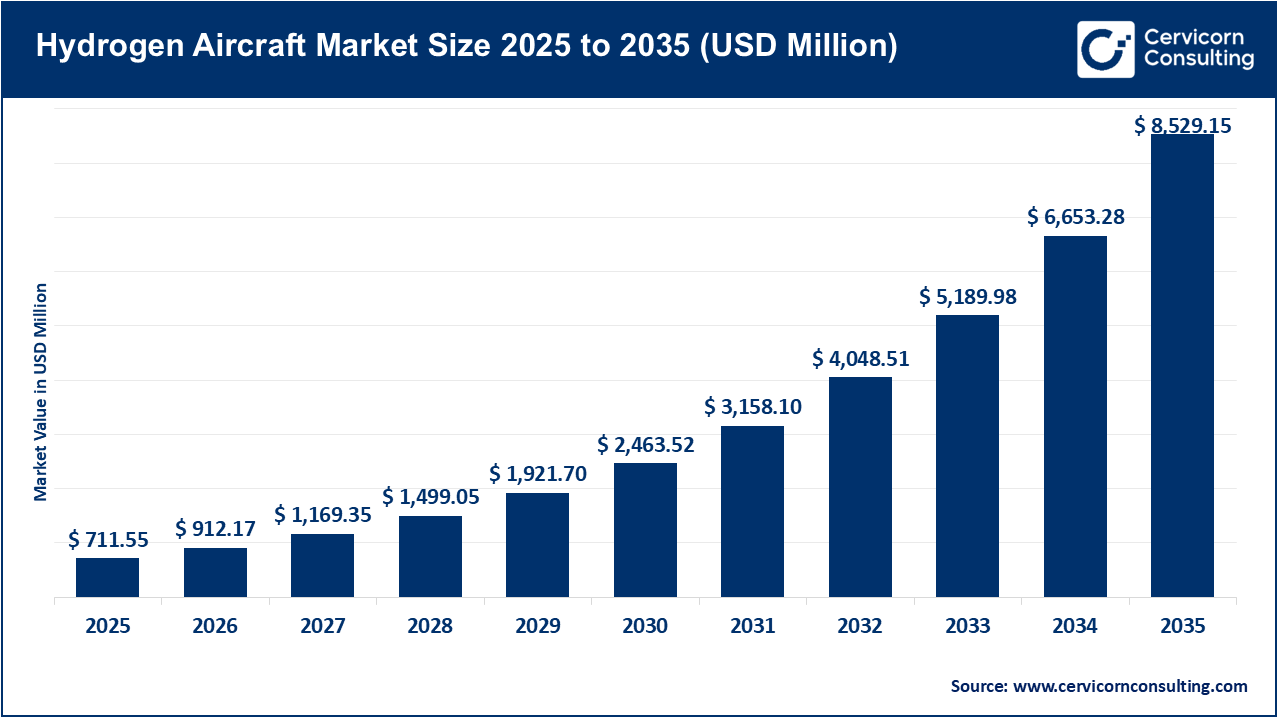
The global hydrogen aircraft market was valued at approximately USD 711.55 million in 2025 and is projected to reach nearly USD 8,529.15 million by 2035, expanding at a compound annual growth rate (CAGR) of about 28.2% between 2026 and 2035.
What is the Hydrogen Aircraft Market?
The hydrogen aircraft market refers to the development, manufacturing, and commercialization of aircraft that use hydrogen as a primary energy source for propulsion. These aircraft typically operate using either hydrogen combustion engines or hydrogen fuel cells that convert hydrogen into electricity to power electric motors. Unlike conventional jet fuel-powered aircraft, hydrogen aircraft produce little to zero carbon emissions, with water vapor being the primary byproduct. This emerging market includes passenger aircraft, unmanned aerial vehicles (UAVs), and cargo planes, as well as the supporting infrastructure such as hydrogen production, storage, and refueling systems. The market is still in its early stages but is gaining strong momentum due to the urgent need for sustainable aviation solutions.
Why is the Hydrogen Aircraft Market Important?
The importance of the hydrogen aircraft market lies in its potential to decarbonize one of the most emission-intensive industries—aviation. Aviation currently contributes a notable share of global greenhouse gas emissions, and with rising air travel demand, these emissions are expected to grow. Hydrogen offers a promising alternative due to its high energy-to-mass ratio and ability to significantly reduce emissions compared to fossil fuels. Studies suggest hydrogen can reduce aviation-related emissions by up to nearly 75% under certain conditions, making it a critical solution for achieving global climate targets.
Additionally, hydrogen-powered aircraft can enable longer flight ranges compared to battery-electric alternatives, making them suitable for both regional and long-haul flights. As governments, airlines, and environmental organizations push for net-zero emissions by 2050, hydrogen aviation is becoming a cornerstone of future aviation strategies.
Get a Free Sample: https://www.cervicornconsulting.com/sample/2944
Hydrogen Aircraft Market Growth Factors
The hydrogen aircraft market is experiencing rapid growth driven by a combination of environmental, technological, and economic factors. Increasing global pressure to reduce carbon emissions in aviation is one of the primary drivers, alongside stringent environmental regulations and net-zero commitments by governments and airlines. Significant investments from both public and private sectors are accelerating research and development in hydrogen propulsion technologies, particularly fuel cells, which are becoming more efficient and viable for aviation use. The parallel development of hydrogen infrastructure, including production, storage, and airport refueling systems, is further enabling market expansion.
Additionally, advancements in lightweight materials, aerodynamics, and cryogenic storage systems are improving aircraft performance and feasibility. Growing consumer demand for sustainable travel and the aviation industry’s shift toward cleaner energy alternatives are also contributing to the market’s strong growth trajectory, which is projected to expand at a CAGR of over 38% between 2024 and 2030.
Key Companies in the Hydrogen Aircraft Market
1. Airbus SE
- Specialization: Commercial aircraft manufacturing, aerospace innovation
- Key Focus Areas: Hydrogen-powered aircraft (ZEROe project), sustainable aviation, advanced aerodynamics
- Notable Features: Development of hydrogen fuel-cell aircraft concepts; focus on zero-emission aviation
- 2024 Revenue: Approx. $65–70 billion (overall aerospace operations)
- Market Share: One of the largest global aircraft manufacturers
- Global Presence: Strong presence across Europe, North America, and Asia
2. The Boeing Company
- Specialization: Commercial jets, defense, and aerospace systems
- Key Focus Areas: Sustainable aviation fuels, hydrogen propulsion research, next-gen aircraft
- Notable Features: Investment in alternative fuels and hydrogen research programs
- 2024 Revenue: Approx. $70–77 billion
- Market Share: Leading global aerospace manufacturer alongside Airbus
- Global Presence: Extensive operations across North America, Europe, and Asia-Pacific
3. ZeroAvia, Inc.
- Specialization: Hydrogen-electric propulsion systems
- Key Focus Areas: Fuel-cell engines for regional aircraft
- Notable Features: Successful test flights of hydrogen-electric aircraft; partnerships with airlines
- 2024 Revenue: Early-stage startup (limited commercial revenue)
- Market Share: Emerging innovator in hydrogen propulsion
- Global Presence: U.S., U.K., and Europe
4. Universal Hydrogen Co.
- Specialization: Hydrogen fuel logistics and modular storage systems
- Key Focus Areas: Hydrogen distribution and retrofitting aircraft
- Notable Features: Modular hydrogen capsules for easy transport and refueling
- 2024 Revenue: Early-stage (pilot-scale operations)
- Market Share: Niche but growing
- Global Presence: North America and Europe
5. H2FLY GmbH
- Specialization: Hydrogen-electric propulsion systems
- Key Focus Areas: Fuel-cell technology for small and medium aircraft
- Notable Features: HY4 aircraft demonstrations and liquid hydrogen-powered flight tests
- 2024 Revenue: Startup-level revenue
- Market Share: Strong R&D-driven player
- Global Presence: Germany and broader Europe
Leading Trends and Their Impact
The hydrogen aircraft market is shaped by several transformative trends. One of the most significant is the advancement of hydrogen fuel cell technology, which is improving energy efficiency and enabling longer flight durations. Another key trend is the development of hydrogen infrastructure, including airport refueling systems and supply chains, which is essential for large-scale adoption. Governments are also introducing supportive policies such as subsidies and research grants, which are accelerating innovation.
Another emerging trend is the focus on short-haul hydrogen aircraft as an entry point for commercialization. These aircraft require less fuel and simpler infrastructure, making them ideal for early adoption. Additionally, collaborations between aerospace companies, energy providers, and governments are increasing, leading to faster technological breakthroughs and ecosystem development.
However, challenges such as high costs, infrastructure limitations, and technological complexity still impact the pace of adoption. For example, delays in hydrogen aircraft programs highlight the need for further advancements in production, storage, and regulatory frameworks.
Successful Examples of Hydrogen Aircraft Around the World
Several successful initiatives demonstrate the growing potential of hydrogen aviation:
- ZeroAvia Test Flights: Successfully flew a hydrogen-electric 19-seat aircraft, marking a major milestone in zero-emission aviation.
- Airbus ZEROe Concept: Airbus has developed multiple hydrogen-powered aircraft concepts targeting commercial deployment in the future.
- H2FLY HY4 Aircraft: One of the first hydrogen-powered passenger aircraft prototypes, demonstrating feasibility.
- American Airlines & ZeroAvia Partnership: Agreement for hydrogen-electric engines for regional aircraft, signaling commercial adoption potential.
These examples highlight that hydrogen aviation is transitioning from concept to real-world application, particularly in regional and short-haul segments.
Global Regional Analysis
North America
North America holds a significant share of the hydrogen aircraft market, driven by strong investments in clean aviation technologies and the presence of leading companies. The U.S. government supports hydrogen innovation through funding programs and sustainability initiatives. The region accounted for over 41% of the market share in 2023, reflecting its leadership in technological development and commercialization.
Europe
Europe is a key hub for hydrogen aviation, with countries like Germany, France, and the U.K. investing heavily in research and infrastructure. The European Union has introduced policies such as the Green Deal and hydrogen strategies to promote sustainable aviation. Companies like Airbus and H2FLY are leading innovation in the region, supported by strong regulatory frameworks and funding.
Asia-Pacific
The Asia-Pacific region is emerging as a fast-growing market due to increasing air travel demand and government initiatives promoting green energy. Countries such as China, Japan, and India are investing in hydrogen technologies and infrastructure. The region is expected to witness rapid growth as governments push for decarbonization and energy transition.
Middle East & Africa
This region is expected to experience the fastest growth due to investments in hydrogen production and renewable energy. Countries like the UAE and Saudi Arabia are focusing on becoming global hydrogen hubs, which could support aviation applications in the future.
Latin America
Latin America is gradually adopting hydrogen technologies, with Brazil and other countries exploring sustainable aviation solutions. However, the market is still in its early stages compared to other regions.
Government Initiatives and Policies Shaping the Market
Governments worldwide are playing a crucial role in shaping the hydrogen aircraft market through policies, funding, and regulatory frameworks. Many countries have set ambitious net-zero emission targets, which include reducing aviation emissions. Initiatives such as subsidies, tax incentives, and research grants are encouraging companies to invest in hydrogen technologies.
In Europe, the EU Hydrogen Strategy and Clean Aviation programs are driving innovation and collaboration. In the United States, federal funding supports hydrogen research and infrastructure development. Similarly, countries in Asia and the Middle East are investing in hydrogen production and export capabilities.
Regulatory bodies are also working on establishing safety standards and certification processes for hydrogen-powered aircraft, which is essential for commercial deployment. These policies not only accelerate technological development but also create a supportive ecosystem for market growth.
To Get Detailed Overview, Contact Us: https://www.cervicornconsulting.com/contact-us
Read Report: AI EDA Market Revenue, Trends, and Strategic Insights by 2035