Gas Sensors Market Revenue, Trends, and Strategic Insights by 2035
Gas Sensors Market Size
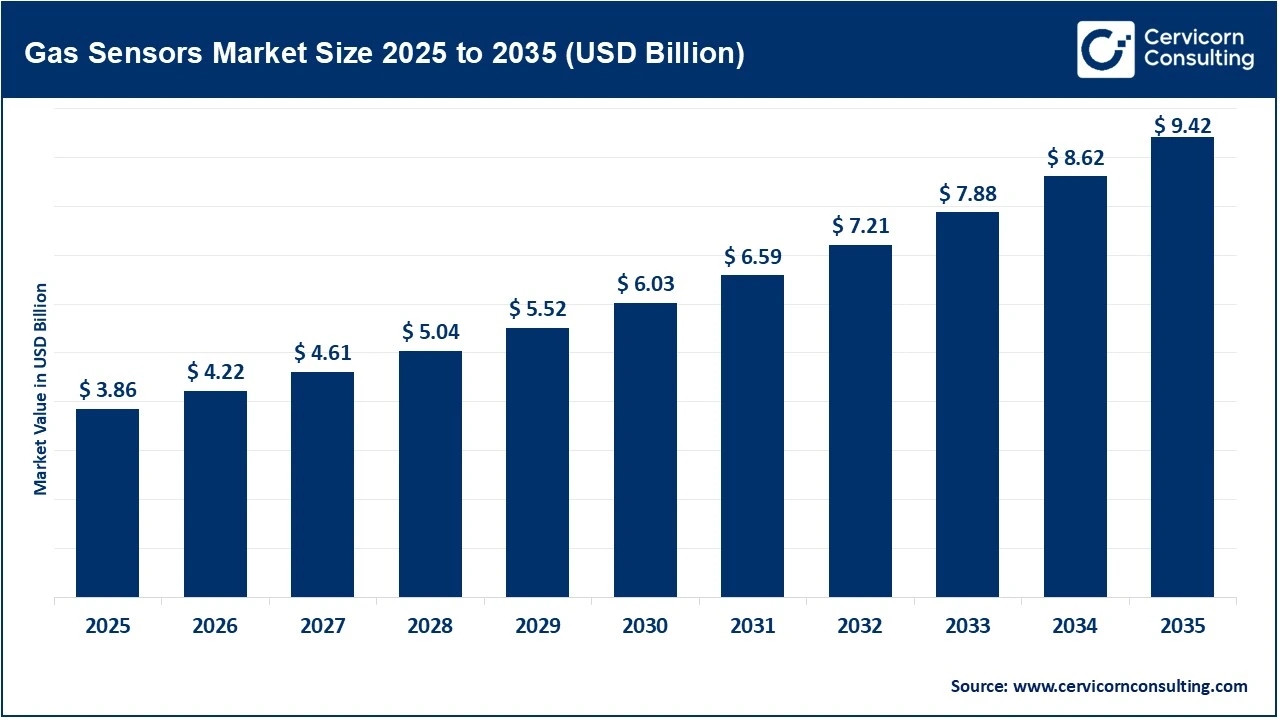
In 2025, the global gas sensors market was valued at approximately USD 3.86 billion and is projected to reach nearly USD 9.42 billion by 2035, expanding at a compound annual growth rate (CAGR) of about 9.33%.
Gas Sensors Market Growth Factors
The gas sensors market is expanding steadily due to the rising demand for workplace safety monitoring across industries such as oil & gas, chemicals, mining, and manufacturing; increasing global awareness regarding air pollution and indoor air quality management; stricter environmental regulations requiring continuous emissions monitoring; rapid adoption of smart infrastructure and industrial automation technologies; integration of Internet of Things (IoT) and wireless connectivity into sensing platforms; miniaturization enabled by MEMS and nanotechnology; growing deployment in consumer electronics and smart homes; expansion of electric and hybrid vehicle ecosystems requiring emission monitoring; and rising investments in environmental monitoring programs by governments worldwide.
Additionally, the transition toward predictive maintenance, cloud-based monitoring platforms, and smart city deployments continues to accelerate demand for advanced gas detection solutions across both developed and emerging economies.
What Is the Gas Sensors Market?
The gas sensors market refers to the global industry involved in the development, manufacturing, integration, and deployment of sensing technologies designed to detect and monitor the presence of gases such as carbon monoxide (CO), methane (CH₄), nitrogen oxides (NOx), oxygen (O₂), ammonia (NH₃), and volatile organic compounds (VOCs).
Gas sensors function by identifying gas concentrations in real time and transmitting signals for monitoring, alerts, or automation responses. These sensors are widely deployed across:
- Industrial safety systems
- Environmental monitoring networks
- Automotive emission control systems
- Medical equipment
- Smart homes and buildings
- Consumer electronics
- Oil & gas infrastructure
- Mining operations
- Agriculture facilities
Globally, the gas sensor market is experiencing steady expansion supported by increasing safety requirements, environmental monitoring initiatives, and smart infrastructure development.
Get a Free Sample: https://www.cervicornconsulting.com/sample/2919
Why the Gas Sensors Market Is Important
Gas sensors play a crucial role in modern industrial ecosystems and public health systems. Their importance can be understood across several operational dimensions.
1. Industrial Safety and Worker Protection
Industries such as petrochemicals, mining, and power generation rely heavily on gas detection systems to prevent exposure to toxic or explosive gases. Continuous monitoring helps reduce accidents and ensures regulatory compliance.
2. Environmental Protection and Emissions Monitoring
Governments worldwide are enforcing stricter emission standards. Gas sensors support monitoring greenhouse gases and pollutants, improving sustainability reporting and compliance performance.
3. Smart Buildings and Indoor Air Quality
Carbon dioxide and VOC sensors are essential for maintaining indoor air quality in offices, hospitals, schools, and residential buildings.
4. Automotive Emission Control
Modern vehicles use sensors to monitor exhaust emissions and support catalytic conversion systems that meet emission standards.
5. Healthcare Applications
Gas sensors are integrated into ventilators, anesthesia equipment, and respiratory monitoring systems to ensure patient safety.
6. Smart Cities and IoT Infrastructure
Connected gas sensors enable real-time pollution monitoring, predictive analytics, and urban safety improvements.
Company Profiles in the Gas Sensors Market
Below are leading companies shaping the global gas sensors ecosystem.
Honeywell International
Specialization: Industrial safety technologies, automation solutions, and environmental sensing systems
Key Focus Areas:
- Industrial gas detection systems
- Portable gas monitors
- Smart building sensors
- Fire and safety monitoring platforms
Notable Features:
Honeywell offers advanced electrochemical, infrared, and catalytic sensors capable of detecting hazardous gases across industrial environments. Its solutions integrate seamlessly with cloud monitoring systems and predictive maintenance platforms.
2024 Revenue: Approximately USD 36+ billion (company-wide)
Market Share: Estimated mid-single-digit share within global gas detection ecosystem
Global Presence: Operations across North America, Europe, Asia-Pacific, and the Middle East with strong industrial safety deployments worldwide
Honeywell Analytics is among the most recognized brands in industrial gas detection infrastructure.
MSA Safety
Specialization: Personal protective equipment (PPE) and industrial gas detection solutions
Key Focus Areas:
- Portable gas detectors
- Fixed gas detection systems
- Firefighter safety monitoring
- Industrial worker protection platforms
Notable Features:
MSA Safety’s wearable gas detection devices support real-time monitoring in hazardous environments such as confined spaces, offshore platforms, and mining operations.
2024 Revenue: Approximately USD 1.7 billion (company-wide)
Market Share: Strong presence in portable gas detection segment globally
Global Presence: Active across more than 140 countries with manufacturing in the United States, Europe, and Asia
MSA Safety is particularly strong in occupational safety applications.
Amphenol Corporation
Specialization: Sensor technologies, interconnect systems, and industrial electronics
Key Focus Areas:
- Gas sensing modules
- Environmental monitoring sensors
- Automotive emission sensors
- Industrial automation sensing platforms
Notable Features:
Amphenol integrates gas detection capabilities into compact sensor platforms optimized for automotive, aerospace, and industrial environments.
2024 Revenue: Approximately USD 12+ billion (company-wide)
Market Share: Growing presence in embedded sensing solutions
Global Presence: Manufacturing and engineering footprint across North America, Europe, China, and India
Amphenol benefits from strong integration capabilities within connected electronics systems.
Emerson Electric
Specialization: Industrial automation and process management systems
Key Focus Areas:
- Industrial gas analyzers
- Process safety monitoring
- Refinery and petrochemical monitoring
- Smart plant instrumentation
Notable Features:
Emerson provides gas analyzers integrated with predictive maintenance and digital twin infrastructure platforms for large-scale industrial facilities.
2024 Revenue: Approximately USD 17+ billion
Market Share: Strong presence in process-industry gas monitoring segment
Global Presence: Extensive deployment across energy, utilities, and chemical industries globally
Emerson’s sensing platforms support Industry 4.0 transformation strategies.
General Electric
Specialization: Industrial monitoring, aviation sensors, and energy infrastructure analytics
Key Focus Areas:
- Gas turbine monitoring systems
- Industrial emissions monitoring
- Energy infrastructure analytics
- Smart grid environmental sensing
Notable Features:
GE integrates gas sensing into predictive analytics systems for power plants and aviation safety platforms.
2024 Revenue: Approximately USD 68+ billion (company-wide across segments)
Market Share: Significant influence in energy-sector sensing deployments
Global Presence: Strong installations across North America, Europe, Asia-Pacific, and the Middle East
GE supports gas monitoring across power generation ecosystems.
Leading Trends in the Gas Sensors Market and Their Impact
1. Integration with IoT Platforms
Gas sensors are increasingly connected to cloud infrastructure for real-time monitoring and predictive analytics.
Impact:
- Remote monitoring
- Automated alerts
- Predictive maintenance capabilities
- Smart city deployments
2. Miniaturization Through MEMS Technology
MEMS-based sensors allow compact integration into portable devices and consumer electronics.
Impact:
- Expansion into wearable monitoring
- Personal safety devices
- Indoor air quality monitors
- Smartphone-based sensing
3. Wireless Sensor Networks
Wireless connectivity is replacing traditional wired systems across industrial plants.
Impact:
- Reduced installation costs
- Flexible deployment
- Increased scalability
- Improved worker mobility
4. Environmental Monitoring Expansion
Governments are deploying large-scale pollution monitoring systems.
Impact:
- Urban monitoring networks
- Climate tracking infrastructure
- Smart transportation emission tracking
5. Automotive Emission Compliance Technologies
Stricter emission standards globally are driving adoption of NOx and oxygen sensors.
Impact:
- Cleaner engines
- Regulatory compliance
- Reduced environmental footprint
Successful Examples of Gas Sensors Market Applications Around the World
Example 1: Smart City Air Monitoring in Europe
European municipalities deploy dense air quality sensor networks to monitor pollutants such as nitrogen dioxide and particulate matter in real time.
Result:
Improved public health monitoring and policy-driven traffic regulation.
Example 2: Methane Leak Detection in the United States Oil & Gas Sector
Oil companies deploy infrared methane sensors across pipelines and refineries.
Result:
Reduced explosion risks and improved environmental compliance.
Example 3: Industrial Safety Monitoring in Australian Mining Operations
Mining companies deploy wearable gas detection devices to monitor oxygen and toxic gases underground.
Result:
Enhanced worker safety and regulatory compliance.
Example 4: Indoor Air Quality Monitoring in Asian Smart Buildings
Commercial buildings integrate carbon dioxide sensors into HVAC automation systems.
Result:
Energy efficiency improvements and better occupant health outcomes.
Example 5: Automotive Emission Monitoring in Germany and Japan
Automakers deploy nitrogen oxide sensors for selective catalytic reduction systems.
Result:
Compliance with strict emission standards and reduced pollution output.
Global Regional Analysis Including Government Initiatives and Policies Shaping the Market
North America
North America represents a mature market driven by environmental regulation enforcement and smart infrastructure investments.
Key Growth Drivers
- Workplace safety standards
- Smart home adoption
- Automotive emission regulations
- Industrial automation investments
Government Initiatives
- Clean Air Act enforcement
- Methane emissions monitoring programs
- Smart infrastructure funding initiatives
These policies promote adoption across utilities and manufacturing sectors.
Europe
Europe leads in emission regulation compliance and environmental monitoring infrastructure deployment.
Key Growth Drivers
- Euro 6 and Euro 7 emission standards
- Carbon neutrality targets
- Industrial safety directives
- Smart building energy efficiency frameworks
Government Initiatives
- European Green Deal
- Air Quality Directive enforcement
- Hydrogen economy investments
These programs accelerate demand for advanced sensing technologies.
Asia-Pacific
Asia-Pacific dominates the global gas sensors market with the largest share due to rapid industrialization and urbanization.
Key Growth Drivers
- Smart city programs
- Manufacturing expansion
- Rising pollution awareness
- Infrastructure development
China, India, Japan, and South Korea represent high-growth markets.
Government Initiatives
China
National air quality monitoring expansion programs
India
National Clean Air Programme (NCAP)
Smart Cities Mission deployments
Japan
Automotive emission control standards
These initiatives accelerate sensor deployment across industrial and urban environments.
Latin America
Latin America is experiencing moderate adoption growth driven by mining, oil & gas, and environmental monitoring.
Key Growth Drivers
- Worker safety enforcement
- Mining industry modernization
- Industrial emissions tracking
Government Initiatives
Brazil and Mexico continue strengthening environmental monitoring policies supporting adoption.
Middle East & Africa
The Middle East & Africa market is strongly influenced by oil & gas infrastructure safety requirements.
Key Growth Drivers
- Refinery monitoring systems
- Pipeline safety investments
- Smart infrastructure expansion
Government Initiatives
Countries such as Saudi Arabia and the United Arab Emirates are integrating environmental monitoring technologies into smart city strategies aligned with long-term national transformation programs.
To Get Detailed Overview, Contact Us: https://www.cervicornconsulting.com/contact-us
Read Report: Heat Pump Market Revenue, Trends, and Strategic Insights by 2035