Ethanol 2.0 Market: 5 Decisions That Can Help Companies Maximize Returns on Intelligent Energy Management
Ethanol 2.0: What Should Companies Evaluate Before Investing in Intelligent Energy Management?
Energy-intensive businesses are increasingly looking for ways to reduce operating costs, improve equipment reliability and achieve efficiency targets. However, many facilities still depend on disconnected systems for energy monitoring, equipment maintenance and process control, making it difficult to identify inefficiencies before they affect productivity.
Ethanol 2.0 is gaining attention as businesses explore more advanced approaches to energy management, combining connected monitoring, predictive maintenance, artificial intelligence (AI) and process automation. The commercial opportunity lies in how effectively these technologies improve operational performance and support better investment decisions.
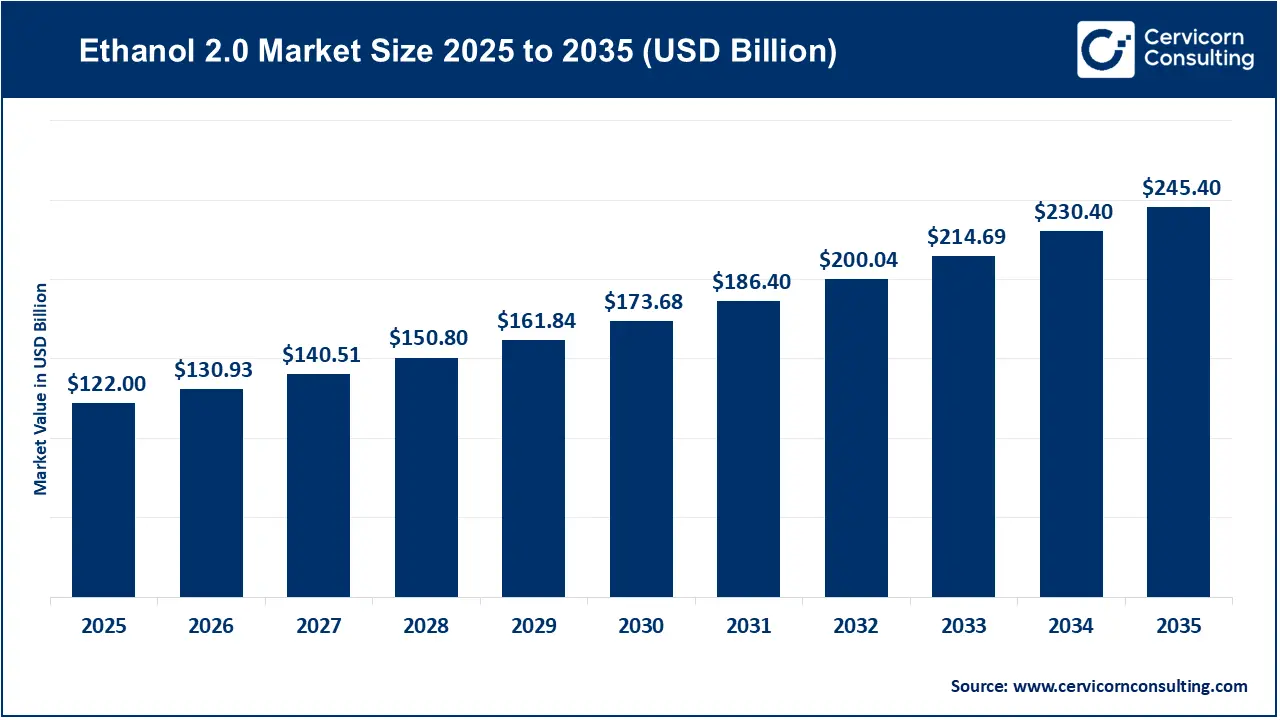
The global ethanol 2.0 market was valued at USD 122.00 billion in 2025 and is projected to reach USD 245.40 billion by 2035, expanding at a CAGR of 7.24% from 2026 to 2035. This growth outlook highlights the importance of evaluating emerging technologies, investment priorities and implementation requirements as the market evolves.
For manufacturers, utilities and commercial infrastructure operators, the central question is not simply whether to adopt intelligent energy systems. It is determining which applications justify investment, how new technologies fit existing infrastructure and how quickly measurable operational benefits can be achieved.
1. Where Can Intelligent Energy Management Deliver the Greatest Value?
Different facilities experience different energy and operational challenges. A manufacturing plant struggling with unexpected equipment failures may prioritize predictive maintenance, while a commercial building with high electricity consumption may focus on energy monitoring and automated controls.
Companies should identify their most significant operational inefficiencies before selecting a technology platform.
Three applications deserve particular attention:
- Predictive maintenance: Uses equipment data and analytics to identify potential failures, reduce unplanned downtime and improve maintenance planning.
- Energy management: Tracks consumption across equipment, production lines and facilities to identify avoidable energy expenditure.
- Emissions and process monitoring: Helps operators monitor performance indicators, identify deviations and support environmental compliance.
The strongest investment opportunities are those that address measurable operational problems rather than introducing additional technology without a defined business objective.
2. How Should Companies Evaluate the Return on Investment?
The financial case for an intelligent energy platform should extend beyond projected energy savings. Implementation costs, integration requirements, maintenance expenses and workforce training can significantly affect the final return.
Before approving a project, decision-makers should evaluate:
- Baseline energy consumption: Measure energy use per unit of production, operating hour or occupied area.
- Avoidable downtime: Estimate the financial impact of equipment failures and maintenance-related interruptions.
- Implementation costs: Include sensors, meters, software licences, connectivity, integration and commissioning.
- Ongoing expenses: Account for system support, upgrades, cybersecurity and employee training.
- Measurable benefits: Track reductions in energy consumption, maintenance costs, downtime and emissions intensity.
For example, a manufacturer considering predictive maintenance should compare the cost of the platform with the expected reduction in equipment failures and production interruptions. A system that generates more alerts without improving maintenance decisions may deliver limited financial value.
The key investment question is whether verified operational savings can justify the total cost of ownership over the project’s expected life.
3. Should Companies Choose AI-Driven Analytics, IoT or Digital Twins?
Technologies associated with intelligent energy management serve different operational requirements. Selecting a platform based solely on its technological sophistication can result in unnecessary expenditure.
IoT-enabled monitoring is useful when companies lack reliable, real-time information about energy consumption, equipment conditions or process performance. Its effectiveness depends on sensor coverage, data quality and connectivity.
AI-driven analytics can help identify abnormal operating patterns, forecast maintenance requirements and improve energy optimization. However, its performance depends on sufficient historical data, appropriate model validation and integration into everyday operating decisions.
Digital twins and process automation support operational simulation, scenario testing and automated control. These capabilities may be particularly valuable in complex facilities, although implementation can require substantial engineering and integration effort.
Cloud-based platforms can centralize monitoring across multiple facilities, but companies must evaluate data governance, cybersecurity, connectivity and dependence on external service providers.
A practical approach is to begin with the capability that addresses the most expensive operational problem, then expand the technology deployment as the business case becomes clearer.
4. Can Existing Infrastructure Support the Transition?
Legacy equipment remains a significant challenge for digital energy transformation. Industrial facilities may operate machinery from different manufacturers, use incompatible communication protocols or depend on control systems that were never designed for advanced analytics.
Before selecting a vendor, companies should determine whether the proposed solution can integrate with existing meters, building management systems, industrial control platforms and enterprise software.
The evaluation should cover:
- Compatibility with existing equipment and communication standards.
- Availability and reliability of historical operating data.
- Integration costs and potential production disruption.
- Data ownership, access controls and cybersecurity requirements.
- Scalability across additional production lines, buildings or locations.
A platform with extensive functionality may be less attractive than a simpler alternative if it requires expensive infrastructure replacement or creates long-term vendor dependence.
For multi-site operators, standardization is especially important. Common performance indicators and reporting methods make it easier to compare facilities, identify underperforming assets and prioritize capital expenditure.
5. How Should Companies Measure Performance After Deployment?
An intelligent energy system should be evaluated against operational outcomes rather than installation milestones or the number of connected devices.
Companies should establish baseline measurements before deployment and track performance after implementation.
Useful indicators include:
- Energy consumption per unit of production.
- Equipment downtime and mean time between failures.
- Maintenance expenditure per asset.
- Peak electricity demand and associated costs.
- Emissions intensity and compliance-related performance.
- Payback period and realized return on investment.
Results should be adjusted for relevant changes in production volume, operating hours, weather or facility utilization. Without these adjustments, apparent improvements may reflect changing operating conditions rather than the technology itself.
Pilot projects can help validate performance before a company commits to a broader rollout. The most useful pilot tests a clearly defined business problem under representative operating conditions, with measurable targets established in advance.
6. What Market Factors Should Influence Investment Timing?
The projected expansion of the Ethanol 2.0 market creates opportunities for technology providers and businesses evaluating new operational capabilities. However, overall market growth does not automatically translate into an attractive investment for every company.
Decision-makers should examine four factors when assessing the opportunity.
Operational readiness: Facilities with reliable data collection and established maintenance processes may be better positioned to capture value from advanced analytics.
Technology maturity: Companies should distinguish between proven applications with measurable operational results and emerging capabilities that still require validation.
Vendor economics: Pricing models, implementation support, integration expertise and long-term service costs can influence the attractiveness of competing platforms.
Regulatory and customer requirements: Energy reporting, emissions management and efficiency obligations may increase the value of monitoring and measurement capabilities in specific industries.
Market analysis should therefore go beyond overall growth forecasts. Segment-level adoption, regional infrastructure, competitive positioning and end-user investment priorities can provide a more useful basis for product development, market entry and expansion decisions.
For technology suppliers, understanding which customer segments face the greatest operational challenges can help prioritize product development and commercial resources. For end users, comparing solutions against facility-specific requirements can reduce the risk of investing in capabilities that are not immediately necessary.
7. A Practical Framework for Investment Decisions
Before committing capital, companies can organize their evaluation around five questions:
- Business need: Which operational inefficiency creates the greatest financial or compliance risk?
- Technology fit: Which solution addresses that problem without unnecessary complexity?
- Financial viability: What are the expected savings, total implementation costs and payback period?
- Execution risk: Can the system integrate with existing infrastructure and operating procedures?
- Expansion potential: Can a successful pilot be replicated across other facilities or business units?
This framework helps procurement teams, operations leaders and technology executives compare alternatives using consistent criteria rather than relying primarily on vendor demonstrations or headline efficiency claims.
Conclusion
The Ethanol 2.0 market is projected to grow from USD 122.00 billion in 2025 to USD 245.40 billion by 2035, reflecting a forecast CAGR of 7.24% during 2026–2035. For companies evaluating this opportunity, market expansion is only one part of the investment decision.
The practical priorities are identifying operational inefficiencies, validating financial returns, assessing integration requirements and selecting technologies that can scale with business needs. Predictive maintenance, connected energy monitoring, AI analytics and digital twins can create value, but the results depend on how effectively each capability addresses a specific business problem.
Companies that establish clear performance baselines, validate savings through pilot projects and assess implementation costs before scaling are better positioned to avoid investments that fail to deliver expected returns.
The long-term opportunity lies not simply in connecting more equipment, but in turning operational data into decisions that improve efficiency, reliability and resource utilization.
To Get Detailed Overview, Contact Us: https://www.cervicornconsulting.com/contact-us