Cell Culture Market Revenue, Trends, and Strategic Insights by 2035
Table of Contents
ToggleCell Culture Market Size
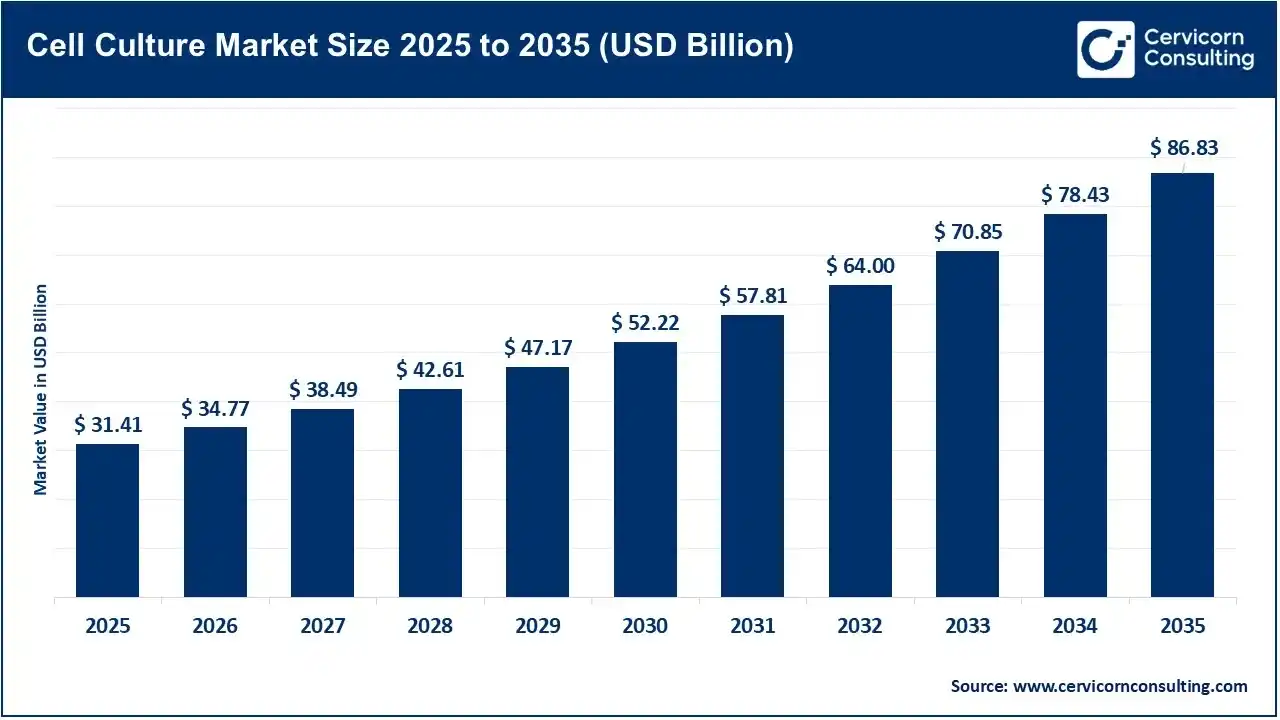
The global cell culture market was valued at approximately USD 31.41 billion in 2025 and is projected to reach USD 86.83 billion by 2035, expanding at a CAGR of 10.7% during the forecast period.
Cell Culture Market Growth Factors
The global cell culture market is experiencing remarkable expansion due to increasing investments in biotechnology and pharmaceutical research, rapid growth in biologics and biosimilars production, rising demand for cell-based therapies, expanding vaccine manufacturing capabilities, and significant advancements in regenerative medicine. The growing prevalence of chronic diseases, cancer, and infectious diseases has accelerated research involving mammalian cell cultures for drug discovery and personalized medicine. Government funding for life science research, increasing adoption of three-dimensional (3D) cell culture technologies, automation in laboratory workflows, artificial intelligence-assisted cell analysis, and improvements in culture media formulations continue to strengthen market growth.
Furthermore, increasing partnerships between biotechnology companies, academic institutions, and pharmaceutical manufacturers are expanding innovation across stem cell research, gene therapy, and tissue engineering, making cell culture an indispensable technology for the future of healthcare.
What is the Cell Culture Market?
According to Cervicorn Consulting, the global Cell Culture Market represents one of the fastest-growing segments within life sciences and biotechnology. The market encompasses products, technologies, instruments, media, reagents, consumables, and services used to grow, maintain, and manipulate cells under controlled laboratory conditions.
Cell culture enables researchers to cultivate animal, human, plant, and microbial cells outside their natural environment, supporting research, drug development, vaccine production, toxicity testing, and regenerative medicine. The market includes culture media, sera, bioreactors, incubators, culture vessels, cell lines, reagents, and laboratory automation systems.
With increasing emphasis on biologics manufacturing, personalized medicine, CAR-T therapies, monoclonal antibodies, and stem cell research, cell culture technologies have become foundational across modern biomedical innovation.
Get a Free Sample: https://www.cervicornconsulting.com/sample/3001
Why is the Cell Culture Market Important?
Cell culture technologies are essential because they enable scientists to study living cells in highly controlled environments, reducing reliance on animal testing while improving research precision.
Its importance spans numerous healthcare applications, including:
- Vaccine development
- Cancer research
- Monoclonal antibody production
- Stem cell therapy
- Gene therapy
- Regenerative medicine
- Drug toxicity testing
- Precision medicine
- Tissue engineering
- Cell-based diagnostics
The COVID-19 pandemic demonstrated the critical role of cell culture in rapid vaccine development, highlighting its strategic importance for global healthcare preparedness.
As biotechnology companies increasingly focus on biologics rather than traditional small-molecule drugs, demand for scalable, high-quality cell culture systems continues to rise.
Major Companies Shaping the Cell Culture Market
| Company | Specialization | Key Focus Areas | Notable Features | 2025 Revenue (Approx.) | Estimated Market Share | Global Presence |
|---|---|---|---|---|---|---|
| Thermo Fisher Scientific Inc. | Cell culture media, reagents, laboratory instruments | Biopharma manufacturing, research solutions | Extensive product portfolio and global manufacturing network | Approximately USD 44–45 Billion | ~18–20% | 50+ countries |
| Merck KGaA | Cell culture media, process solutions, bioprocessing | Biopharmaceutical production, life science tools | Strong upstream bioprocess expertise | Approximately USD 23–24 Billion | ~13–15% | 65+ countries |
| Danaher Corporation | Bioprocess technologies, diagnostics | Cell therapy, biologics manufacturing | Through Cytiva and Pall Corporation | Approximately USD 24–25 Billion | ~12–14% | 60+ countries |
| Sartorius AG | Bioprocess equipment, single-use technologies | Cell expansion, biologics manufacturing | Market leader in bioprocess automation | Approximately USD 4–5 Billion | ~8–10% | 60+ countries |
| Corning Incorporated | Cell culture vessels and laboratory consumables | Research laboratories, biotechnology | Industry-leading cell culture plastics | Approximately USD 13–14 Billion | ~6–8% | 40+ countries |
Leading Trends Transforming the Cell Culture Market
Growing Adoption of 3D Cell Culture Models
Traditional two-dimensional cell cultures are increasingly being replaced by 3D culture systems that more accurately mimic human tissue architecture. Pharmaceutical companies are adopting these systems to improve drug screening accuracy and reduce clinical trial failures.
Impact:
- Better disease modeling
- Improved drug efficacy prediction
- Reduced R&D costs
- Faster regulatory approvals
Expansion of Cell and Gene Therapy
The commercialization of CAR-T therapies, stem cell treatments, and gene editing technologies has significantly increased demand for advanced cell culture platforms capable of producing therapeutic-grade cells.
Impact:
- Higher demand for GMP-compliant manufacturing
- Increased investment in bioprocessing facilities
- Greater need for scalable cell expansion technologies
Rise of Serum-Free and Chemically Defined Media
Researchers are increasingly replacing animal-derived serum with chemically defined media to improve reproducibility and regulatory compliance.
Impact:
- Reduced contamination risk
- Better manufacturing consistency
- Improved product quality
- Easier regulatory approval
Automation and Digital Laboratories
Robotics, automated incubators, AI-driven image analysis, and cloud-based laboratory management systems are transforming cell culture workflows.
Impact:
- Increased productivity
- Lower human error
- Higher reproducibility
- Reduced operating costs
Single-Use Bioprocess Technologies
Disposable bioreactors and single-use culture systems are rapidly replacing stainless-steel manufacturing equipment.
Impact:
- Faster facility setup
- Lower contamination risks
- Reduced cleaning requirements
- Flexible manufacturing
Artificial Intelligence in Cell Analysis
Machine learning algorithms are increasingly being integrated into imaging systems to automate cell counting, morphology assessment, and viability analysis.
Impact:
- Faster research
- Improved data quality
- Predictive process optimization
- Enhanced laboratory efficiency
Personalized Medicine
Patient-derived cell cultures are becoming central to personalized drug development, enabling customized therapies based on individual biological characteristics.
Impact:
- Better treatment outcomes
- Reduced adverse reactions
- Precision oncology advancements
- Expansion of companion diagnostics
Successful Examples of the Cell Culture Market Around the World
United States: Biopharmaceutical Manufacturing Leadership
The United States remains the world’s largest cell culture market due to substantial investments in biologics manufacturing and advanced research. Major pharmaceutical companies utilize large-scale mammalian cell culture systems to produce monoclonal antibodies, vaccines, and cell therapies.
Success factors include:
- Strong NIH funding
- Advanced biotechnology ecosystem
- Leading pharmaceutical companies
- Robust regulatory framework
Germany: Industrial Bioprocess Innovation
Germany has established itself as a European leader in cell culture technologies through strong collaboration between research institutions and biotechnology manufacturers.
Companies continue investing in:
- Single-use bioreactors
- Continuous bioprocessing
- Cell therapy manufacturing
- Stem cell research
China: Rapid Expansion of Biotechnology Infrastructure
China has significantly increased investments in life sciences through government-backed biotechnology initiatives.
Major developments include:
- New GMP manufacturing facilities
- Domestic biologics production
- Large-scale vaccine manufacturing
- National biotechnology innovation programs
Japan: Regenerative Medicine Excellence
Japan has become a global leader in regenerative medicine following supportive regulatory reforms that accelerate commercialization of stem cell therapies.
Key strengths include:
- Induced pluripotent stem cell (iPSC) research
- Advanced tissue engineering
- Clinical translation
- Government-supported regenerative medicine programs
South Korea: Cell Therapy Commercialization
South Korea has rapidly expanded its cell therapy capabilities through strong government funding and biotechnology innovation.
The country supports:
- Stem cell manufacturing
- Biopharmaceutical exports
- Advanced clinical research
- Global biotechnology partnerships
Global Regional Analysis
North America
North America dominates the global cell culture market owing to its mature biotechnology ecosystem, advanced pharmaceutical manufacturing infrastructure, and significant research funding. The United States accounts for the majority of regional revenue, supported by leading biotechnology companies, contract research organizations, academic institutions, and government-funded biomedical research.
Government Initiatives
- National Institutes of Health (NIH) funding for biomedical research
- Support for regenerative medicine innovation
- FDA initiatives accelerating cell and gene therapy approvals
- Public-private partnerships supporting vaccine manufacturing
These initiatives encourage innovation across biologics production, precision medicine, and advanced therapeutic development.
Europe
Europe represents one of the most technologically advanced markets for cell culture products.
Countries including Germany, France, the United Kingdom, Switzerland, and the Netherlands continue investing heavily in life sciences research.
Government Policies
- Horizon Europe research funding
- European Medicines Agency (EMA) support for advanced therapies
- National biotechnology investment strategies
- Funding for sustainable bioprocess manufacturing
European governments also promote ethical research practices and encourage alternatives to animal testing, increasing adoption of advanced cell culture systems.
Asia-Pacific
Asia-Pacific is projected to experience the fastest market growth throughout the forecast period.
Rapid industrialization, expanding pharmaceutical manufacturing, increasing healthcare expenditure, and rising biotechnology investments continue driving demand.
China, Japan, South Korea, Singapore, and India remain major growth engines.
Government Initiatives
China
- Biotechnology included among strategic emerging industries
- Investments in biologics manufacturing
- National innovation funding
Japan
- Support for regenerative medicine commercialization
- Fast-track approval pathways
- Public funding for stem cell research
South Korea
- Bioeconomy development strategies
- Cell therapy commercialization incentives
- Research grants for advanced biologics
India
- Biotechnology Industry Research Assistance Council (BIRAC) programs
- Expansion of biotechnology parks
- Support for vaccine manufacturing
- Production-linked initiatives encouraging pharmaceutical manufacturing
These government initiatives continue strengthening regional competitiveness while attracting multinational investments.
Latin America
Latin America is gradually expanding its biotechnology capabilities through increasing healthcare investments and academic research.
Brazil and Mexico remain the leading regional markets.
Government Support
- Public funding for biotechnology research
- Expansion of pharmaceutical manufacturing
- University-industry collaborations
- Improved regulatory frameworks
Although infrastructure remains comparatively smaller than developed markets, increasing foreign investment is expected to support long-term market expansion.
Middle East & Africa
The Middle East & Africa region is witnessing steady adoption of advanced cell culture technologies as healthcare systems modernize.
Countries such as the United Arab Emirates, Saudi Arabia, Israel, and South Africa continue investing in biotechnology infrastructure.
Government Policies
- National biotechnology development programs
- Healthcare diversification initiatives
- Investments in precision medicine
- International research collaborations
Growing emphasis on local pharmaceutical manufacturing is expected to further accelerate market growth across the region.
Future Outlook
The future of the cell culture market is closely tied to innovations in biologics, regenerative medicine, synthetic biology, and precision healthcare. Continuous improvements in automation, artificial intelligence, scalable bioprocessing, and chemically defined media are expected to enhance manufacturing efficiency while reducing production costs. As governments and private organizations continue increasing investments in biotechnology infrastructure, the demand for advanced cell culture technologies is likely to remain strong across pharmaceutical development, vaccine production, tissue engineering, and next-generation therapeutic applications. Emerging economies are also expected to play a larger role in global market expansion by strengthening research capabilities, manufacturing capacity, and supportive regulatory environments, creating new opportunities for technology providers and life science companies worldwide.
To Get Detailed Overview, Contact Us: https://www.cervicornconsulting.com/contact-us
Read Report: Embodied AI Market Revenue, Trends, and Strategic Insights by 2035