Biomarker Discovery Market Revenue, Trends, and Strategic Insights by 2035
Biomarker Discovery Market Size
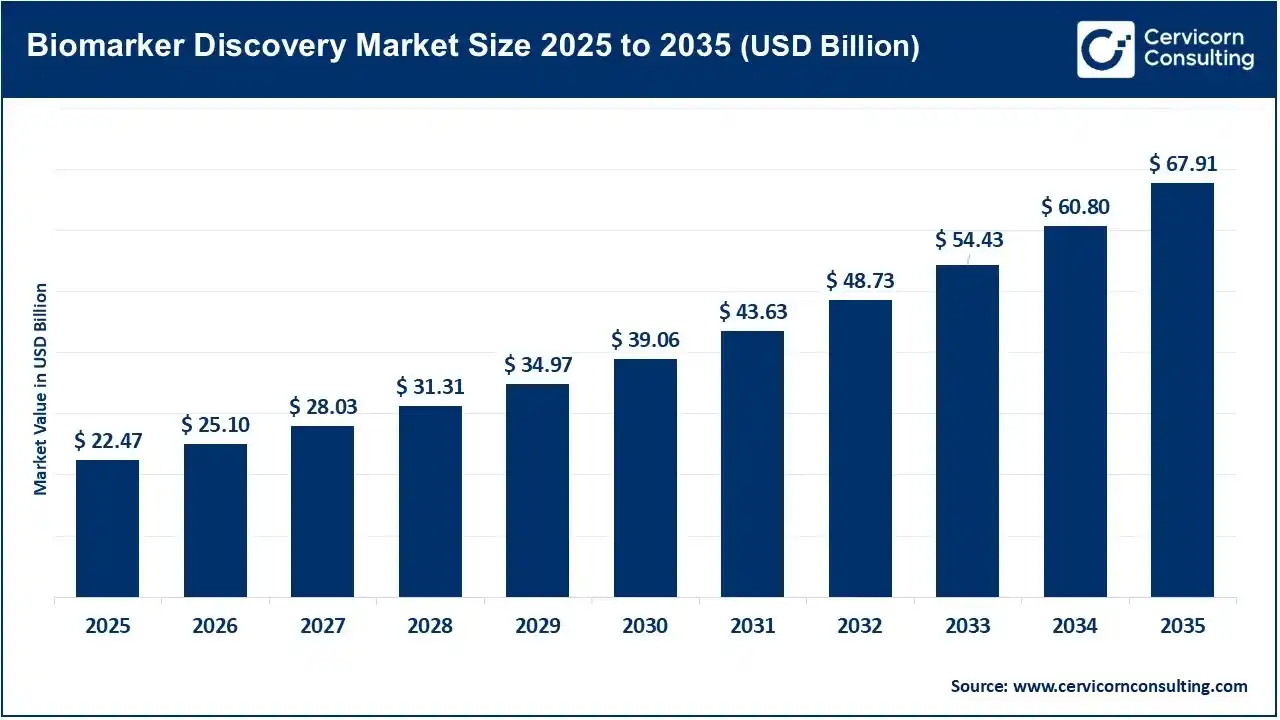
The global biomarker discovery market size was valued at approximately USD 22.47 billion in 2025 and is projected to reach USD 67.91 billion by 2035, representing a 11.7% CAGR from 2026 to 2035.
Biomarker discovery market growth factors
The global biomarker discovery market is being driven by the increasing adoption of precision medicine, rising prevalence of cancer and chronic diseases, growing pharmaceutical and biotechnology research, and rapid advances in genomics, proteomics, metabolomics, transcriptomics and other multi-omics technologies. Growing demand for early disease detection and more accurate diagnosis is encouraging researchers and healthcare organizations to identify molecular signatures that can indicate disease risk, progression or therapeutic response.
At the same time, pharmaceutical companies are increasingly using biomarkers to identify suitable patient populations, improve clinical-trial design and support companion diagnostics. The expansion of next-generation sequencing, high-resolution mass spectrometry, multiplex assays, liquid biopsy technologies and AI-enabled bioinformatics is making it possible to analyze larger and more complex biological datasets. Rising investments in biobanks, population-scale genomic projects and precision oncology are also expanding the availability of samples and clinical data for biomarker research. In addition, increasing interest in minimally invasive biomarkers from blood, urine and other biological fluids is creating opportunities for translational research.
Get a Free Sample: https://www.cervicornconsulting.com/sample/3035
What is the biomarker discovery market?
The biomarker discovery market comprises technologies, instruments, consumables, software, services and research solutions used to identify and characterize biological markers associated with diseases, biological processes or responses to treatments. A biomarker can be a measurable biological characteristic, including a gene, genetic variant, protein, metabolite, cell, molecular signature or other measurable biological feature.
Biomarker discovery commonly involves collecting biological samples such as blood, plasma, serum, urine or tissue and analyzing them using technologies including genomics, proteomics, metabolomics, transcriptomics, epigenomics and lipidomics. Researchers then compare biological profiles between disease and control populations to identify candidate biomarkers.
The process generally progresses from discovery to verification and validation. During discovery, researchers identify potentially relevant molecular signatures. Verification determines whether candidate biomarkers can be consistently detected and quantified, while validation assesses whether they have sufficient clinical relevance and performance for a particular application.
Modern biomarker discovery is increasingly becoming a multi-omics activity. Instead of examining only one biological layer, researchers can combine genomic, transcriptomic, proteomic and metabolomic information to develop a more comprehensive understanding of disease mechanisms.
Why is biomarker discovery important?
Biomarker discovery is important because it provides a foundation for earlier diagnosis, disease monitoring, patient stratification and personalized treatment. Traditional healthcare approaches often depend on symptoms and broad disease classifications, whereas biomarkers can provide molecular information about an individual disease or treatment response.
In oncology, for example, molecular biomarkers can help distinguish cancer subtypes and identify patients who may benefit from particular targeted therapies. NIH describes precision oncology as an approach in which molecular characteristics of tumors can be used to divide cancers into more precise subtypes and guide treatment decisions.
Biomarkers are also important in pharmaceutical research. Drug developers can use them to identify appropriate patient populations, monitor biological responses during clinical trials and investigate why some patients respond differently to the same treatment.
The increasing availability of large genomic and clinical datasets is further expanding the role of biomarkers. Population-scale programs such as the U.S. National Institutes of Health’s All of Us Research Program combine genomic information, electronic health records, physical measurements, surveys and other data to support precision-medicine research.
Leading companies in the biomarker discovery market
| Company | Specialization | Key Focus Areas | Notable Features | 2025 Revenue | Biomarker Discovery Market Position | Global Presence |
|---|---|---|---|---|---|---|
| Thermo Fisher Scientific | Life-science instruments, mass spectrometry, proteomics, genomics and laboratory solutions | Proteomics, genomics, mass spectrometry, sample preparation, biomarker validation | Broad end-to-end research workflow and Olink proteomics capabilities | USD 44.56 billion | Leading participant; biomarker-specific share not separately disclosed | Global operations and customers across major life-science markets |
| Danaher Corporation | Life sciences, biotechnology and diagnostics | Genomics, proteomics, flow cytometry, molecular biology, bioinformatics and research tools | Portfolio includes SCIEX, Molecular Devices, IDT, Abcam and other life-science businesses | USD 24.57 billion | Major diversified participant; biomarker-specific share not separately disclosed | Global; high-growth markets represented about 29% of 2025 sales |
| Agilent Technologies | Analytical instruments, mass spectrometry, chromatography and laboratory solutions | Proteomics, metabolomics, mass spectrometry and molecular analysis | Strong analytical measurement capabilities and translational research applications | USD 6.95 billion | Established analytical technology participant; biomarker-specific share not separately disclosed | Global operations across major scientific markets |
| Bio-Rad Laboratories | Life-science research and clinical diagnostics | PCR, digital PCR, immunoassays, genomics, proteomics and diagnostics | Strong research and clinical diagnostics portfolio | USD 2.58 billion | Established life-science participant; biomarker-specific share not separately disclosed | Operations in more than 36 countries outside the U.S. |
| QIAGEN | Molecular biology, sample preparation, molecular diagnostics and bioinformatics | Genomics, NGS, sample technologies, bioinformatics and molecular testing | More than 5,200 instruments placed worldwide and products sold in more than 160 countries | USD 2.09 billion | Major molecular-analysis participant; biomarker-specific share not separately disclosed | More than 160 countries |
Thermo Fisher Scientific
Thermo Fisher Scientific provides instruments, reagents, software and services supporting biomarker research across proteomics, genomics and mass spectrometry. Its biomarker-discovery portfolio includes high-resolution mass spectrometry, sample preparation and proteomics solutions. The company has also expanded its protein-analysis capabilities through Olink. In 2025, the UK Biobank Pharma Proteomics Project selected the Olink Explore platform for a study involving more than 5,400 proteins and 600,000 samples, demonstrating the growing role of high-throughput proteomics in population-scale biomarker research.
Thermo Fisher reported full-year 2025 revenue of USD 44.56 billion. Its biomarker-discovery-specific revenue and market share are not separately disclosed in its corporate financial reporting.
Danaher Corporation
Danaher participates in biomarker discovery through a broad portfolio of life-science businesses covering genomics, proteomics, flow cytometry, molecular biology, bioinformatics and analytical technologies. Its life-sciences portfolio includes businesses such as SCIEX, Molecular Devices, Integrated DNA Technologies and Abcam.
Danaher’s Life Sciences segment generated USD 7.33 billion in 2025, while total company revenue from continuing operations reached USD 24.57 billion. The company’s life-science products are used to study DNA, RNA, proteins, metabolites and cells, making the portfolio relevant to multiple biomarker-discovery workflows.
Agilent Technologies
Agilent Technologies supports biomarker discovery through analytical instrumentation and technologies used in mass spectrometry, chromatography, molecular analysis and proteomics. Its solutions are relevant to protein biomarker discovery, metabolomics and validation workflows.
Agilent reported 2025 net revenue of USD 6.948 billion for the fiscal year ended October 31, 2025. Its Life Sciences and Diagnostics Markets segment generated USD 2.726 billion. Agilent’s biomarker-specific market share is not separately disclosed.
Bio-Rad Laboratories
Bio-Rad Laboratories operates across life-science research and clinical diagnostics, with technologies including PCR, digital PCR, immunoassays, electrophoresis and other molecular-analysis platforms. These capabilities support biomarker research, assay development and translational diagnostics.
Bio-Rad generated USD 2.583 billion in 2025 revenue, including approximately USD 1.021 billion from its Life Science segment and USD 1.562 billion from Clinical Diagnostics. The company also expanded its digital PCR capabilities through the integration of Stilla Technologies and advanced oncology diagnostic partnerships during 2025.
QIAGEN
QIAGEN provides sample technologies, molecular assays, next-generation sequencing solutions and bioinformatics platforms used across biomarker discovery and molecular research. Its QIAGEN Digital Insights portfolio supports genomic data analysis and interpretation.
QIAGEN reported USD 2.09 billion in 2025 net sales. Consumables and related revenues accounted for approximately 90% of total sales, while instruments and related services represented about 10%. The company sold products in more than 160 countries in 2025, providing substantial international reach for molecular-analysis technologies.
Leading trends and their impact
1. Multi-omics integration
Multi-omics is becoming one of the most important developments in biomarker discovery. Researchers are combining genomics, transcriptomics, proteomics and metabolomics data to understand disease mechanisms across multiple biological layers.
The impact is significant because a biomarker identified through a single molecular layer may not fully explain disease biology. Integrating multiple datasets can help researchers identify more robust molecular signatures and improve candidate selection for clinical validation.
2. AI-powered biomarker discovery
Artificial intelligence and machine learning are increasingly being used to analyze large-scale molecular datasets. AI can identify relationships among genetic variants, protein expression, metabolic changes and clinical outcomes that may be difficult to detect through conventional analysis.
AI is also supporting automated data processing, candidate prioritization and biomarker classification. As datasets become larger, AI-enabled bioinformatics is expected to become increasingly important for reducing analysis time and improving the scalability of discovery workflows.
3. Growth of proteomics
Proteomics is expanding rapidly because proteins often provide direct information about biological activity and disease processes. High-resolution mass spectrometry and multiplexed protein-analysis platforms are allowing researchers to measure thousands of proteins across large sample cohorts.
Large-scale projects are demonstrating this potential. The UK Biobank Pharma Proteomics Project selected Thermo Fisher’s Olink platform to analyze more than 5,400 proteins across 600,000 samples, creating opportunities for identifying disease-associated protein biomarkers.
4. Liquid biopsy and minimally invasive biomarkers
Liquid biopsy is increasing interest in biomarkers that can be detected through blood or other accessible biological fluids. Researchers are studying circulating tumor DNA, circulating proteins, extracellular vesicles and other molecular signals.
The trend could expand biomarker applications in oncology and other chronic diseases because blood-based approaches can potentially enable repeated monitoring without requiring invasive tissue collection.
5. Biomarkers in precision oncology
Cancer remains a major application area for biomarker discovery. Molecular profiling can identify genetic mutations, protein signatures and other characteristics that help researchers classify tumors and investigate targeted therapies.
The increasing use of companion diagnostics is strengthening the relationship between biomarker discovery and drug development. Biomarkers can help pharmaceutical companies identify patients whose tumors have specific molecular characteristics and evaluate treatment response.
6. Expansion of population-scale biobanks
Large biobanks are creating new opportunities for biomarker discovery by connecting biological samples with genomic, clinical and lifestyle information. These resources allow researchers to study biomarkers across larger and more diverse populations.
Population-scale datasets can also help identify biomarkers that are more representative of different genetic backgrounds and disease populations.
7. Increasing role of bioinformatics
As biomarker research generates increasingly complex datasets, bioinformatics is becoming essential for processing, integrating and interpreting results. Cloud platforms, knowledge databases and AI-supported analytics can help researchers connect molecular observations with biological pathways and clinical outcomes.
Successful examples of biomarker discovery around the world
U.S. precision oncology and Cancer Moonshot
The United States has developed extensive infrastructure for biomarker research through NIH and NCI programs. The Cancer Moonshot, originally launched in 2016 and reestablished in 2022, has supported research, collaboration and data-sharing activities aimed at accelerating progress in cancer prevention, diagnosis and treatment.
The Cancer Moonshot Biobank has also collected blood and tissue samples from patients during treatment, allowing researchers to study how cancers change over time and investigate biomarkers associated with treatment and disease progression.
UK Biobank Pharma Proteomics Project
The UK Biobank Pharma Proteomics Project represents a major example of population-scale protein biomarker research. The project aims to analyze more than 5,400 proteins from 600,000 samples, supporting research into disease prediction, diagnosis and treatment.
Its scale demonstrates how large biobanks combined with high-throughput proteomics can create substantial datasets for biomarker discovery and validation.
European 1+ Million Genomes initiative
The European Union’s 1+ Million Genomes initiative is designed to facilitate secure access to genomic and clinical data across participating European countries. Its objectives include supporting research, disease prevention and personalized healthcare.
The initiative illustrates how cross-border genomic infrastructure can create larger datasets for identifying disease-associated genetic signatures and supporting precision medicine.
GenomeIndia
India’s GenomeIndia Project is another major population-scale example. Funded by the Department of Biotechnology, the project has collected more than 20,000 samples representing 83 diverse populations and completed whole-genome sequencing for more than 10,000 samples.
The resulting genomic resources are intended to support research into Indian genetic diversity, disease-associated variants, affordable genomic diagnostics and precision medicine.
Global regional analysis including government initiatives and policies
North America
North America represented approximately 48.5% of global biomarker discovery market revenue in 2025, according to the cited market estimate. The region benefits from a mature pharmaceutical and biotechnology ecosystem, advanced laboratory infrastructure, extensive clinical research activity and substantial investment in precision medicine.
In the United States, the NIH All of Us Research Program is an important government-backed initiative. It aims to build a large and diverse health research resource containing genomic information, electronic health records, physical measurements, surveys and other data. The program is designed to accelerate research into how genetic, environmental and lifestyle factors affect health.
The Cancer Moonshot and NCI programs further support biomarker research, particularly in oncology. Together, these initiatives increase access to large datasets and biological samples while encouraging collaboration among government agencies, academic institutions, healthcare organizations and private-sector researchers.
Europe
Europe is another major biomarker discovery market, supported by advanced healthcare systems, pharmaceutical research and coordinated genomics initiatives.
The European 1+ Million Genomes initiative is focused on secure and federated access to genomic and associated clinical data. Its 2023–2027 roadmap emphasizes infrastructure, governance, data standards and implementation of genomic medicine.
The EU Cancer Mission also supports personalized prevention, omics technologies and cross-border collaboration. European networks are being developed around areas including personalized prevention and omics technologies, supporting the translation of biomarker research into cancer care.
Asia-Pacific
Asia-Pacific is expected to experience rapid growth in biomarker discovery, supported by increasing healthcare expenditure, growing biotechnology capabilities, government-backed genomic programs and expanding diagnostic infrastructure.
China is developing capabilities in precision oncology, molecular diagnostics and genomics, while Japan and South Korea continue investing in advanced biomedical research and healthcare technologies. The region’s large patient populations and expanding biopharmaceutical sectors provide significant opportunities for biomarker studies.
Government support for genomic research and precision medicine can increase access to biological datasets, sequencing infrastructure and research funding, supporting wider adoption of biomarker technologies.
India
India represents an important emerging market because of its large and genetically diverse population and growing biotechnology ecosystem. The GenomeIndia Project is a major government-backed initiative funded by the Department of Biotechnology.
The project has completed whole-genome sequencing for more than 10,000 samples and established a biobank containing more than 20,000 samples. Its genomic resources are intended to support affordable diagnostics and precision medicine tailored to India’s population.
The availability of Indian genomic reference data can also support biomarker research by helping researchers identify genetic variants and disease associations that may be underrepresented in global databases.
Latin America
Latin America is gradually expanding its biomarker discovery capabilities through investments in genomics, molecular diagnostics, clinical research and precision medicine. Brazil, Mexico and other major markets are developing research infrastructure and increasing collaboration between academic institutions, healthcare providers and biotechnology companies.
Growth in chronic diseases and cancer, together with greater adoption of molecular diagnostics, is expected to create additional demand for biomarker technologies. Partnerships with multinational life-science companies and the expansion of clinical research networks can further improve access to advanced biomarker-discovery platforms.
Middle East and Africa
The Middle East and Africa represent developing opportunities for biomarker discovery as governments increase investments in healthcare modernization, genomics and precision medicine. Countries such as Saudi Arabia and the United Arab Emirates have expanded genomics and advanced healthcare initiatives, while research institutions across the region are increasing capabilities in molecular diagnostics.
The development of genomic databases reflecting local populations can support more representative biomarker research. However, infrastructure costs, access to advanced laboratory technologies, data-governance requirements and shortages of specialized expertise remain important considerations for market development.
Biomarker discovery market outlook
The biomarker discovery market is increasingly moving from individual biomarker identification toward integrated, data-intensive discovery platforms. The combination of next-generation sequencing, high-resolution mass spectrometry, multiplex proteomics, liquid biopsy, AI and multi-omics is expanding the range of biological signals that can be evaluated.
Pharmaceutical and biotechnology companies are likely to remain important users as biomarkers become more integrated into drug discovery, clinical trials and companion diagnostics. At the same time, academic institutions, contract research organizations, hospitals and diagnostic laboratories are expected to increase adoption of advanced biomarker technologies.
The development of large population-scale genomic resources is also changing the research landscape. Programs such as All of Us, the European 1+ Million Genomes initiative, UK Biobank-related proteomics research and GenomeIndia are creating datasets that can support the identification and validation of biomarkers across broader populations.
As biomarker discovery becomes more closely connected with precision medicine, the market is expected to increasingly emphasize not only finding potential biomarkers but also validating their clinical utility, improving reproducibility and translating discoveries into reliable diagnostic and therapeutic applications.
To Get Detailed Overview, Contact Us: https://www.cervicornconsulting.com/contact-us
Read Report: Data Centre Certification Market Revenue, Trends, and Strategic Insights by 2035