Amino Acids Market Outlook: Specialty Amino Acids, Fermentation Technology, Pharmaceutical Applications, and Animal Nutrition
Amino Acids Market: How Should Manufacturers Prioritize Product, Production and End-Use Opportunities?
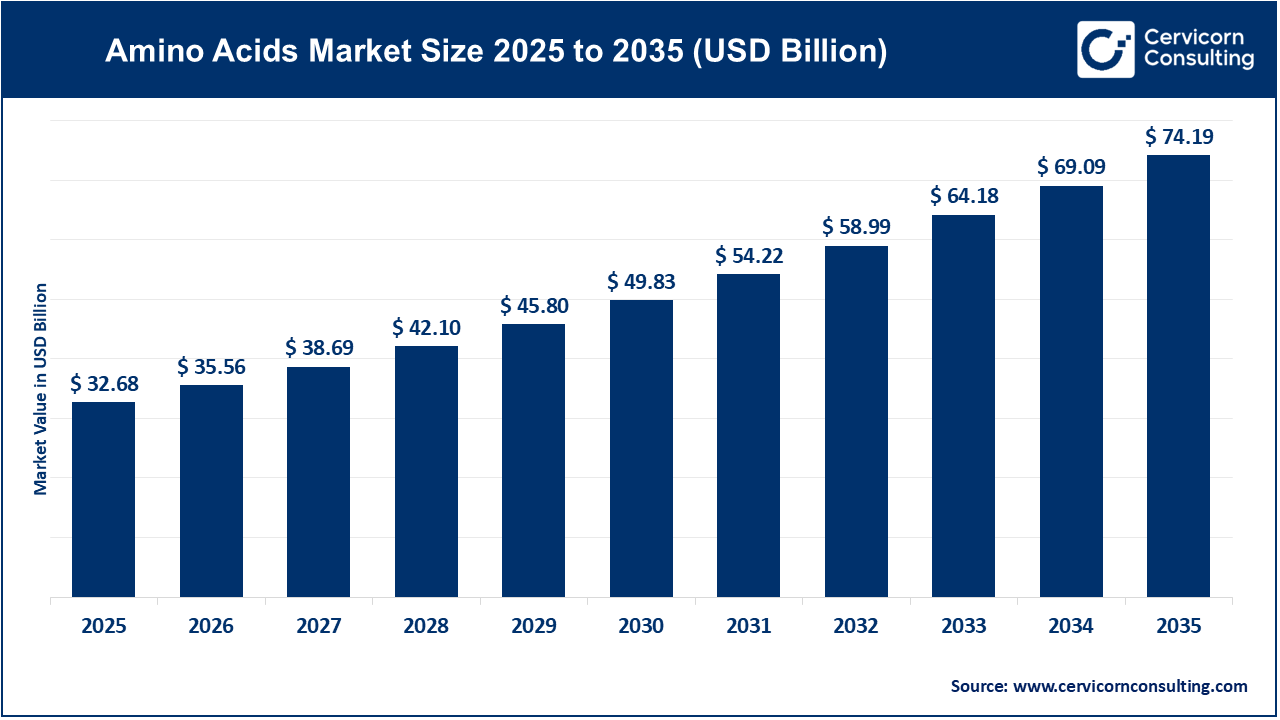
The global amino acids market was valued at USD 32.68 billion in 2025 and is projected to reach USD 74.19 billion by 2035, expanding at a CAGR of 8.54% from 2026 to 2035. This growth is creating opportunities across animal nutrition, functional foods, dietary supplements, pharmaceuticals and medical nutrition.
However, for manufacturers and investors, the opportunity is not simply about increasing amino acid production. The more important decisions involve selecting the right amino acid categories, identifying attractive end-use industries, managing fermentation costs, and determining where additional production capacity can generate sustainable returns.
As demand expands across industries with different quality requirements, pricing structures and regulatory expectations, companies need to evaluate the market at the product and application level before committing to capacity expansion or diversification.
1. Which Amino Acid Categories Should Manufacturers Prioritize?
Amino acids serve different commercial purposes depending on their chemical properties, nutritional functions and industrial applications. Lysine, methionine and threonine are particularly important in animal feed, while glutamine, glycine, citrulline and branched-chain amino acids have applications in nutrition, healthcare and specialty formulations.
Manufacturers should assess product opportunities based on demand stability, production economics, competitive intensity and the possibility of developing higher-value applications.
-
Lysine: Demand is closely connected to livestock and poultry feed production. Manufacturers should evaluate feed industry growth, regional consumption, corn and sugar-based input costs, and competitive pricing before expanding capacity.
-
Methionine: Its importance in animal nutrition makes it an attractive category for companies targeting feed efficiency and balanced livestock diets. Production technology, raw material sourcing and supply reliability are important competitive factors.
-
Threonine: Increasing attention to precision animal nutrition creates opportunities for threonine suppliers. Companies should assess feed formulation trends and the adoption of amino acid supplementation across poultry and swine production.
-
Glutamic Acid: Its established use in food ingredients and flavor enhancement provides access to a broad food processing market. Manufacturers should evaluate food industry demand, production scale and opportunities in specialty applications.
-
Tryptophan and Phenylalanine: These amino acids serve food, nutritional and pharmaceutical applications. Their commercial attractiveness depends on purity requirements, manufacturing economics and the ability to serve specialized customers.
-
Glycine, Glutamine and Citrulline: These categories offer opportunities in pharmaceutical formulations, sports nutrition, dietary supplements and specialized health products, where product quality and application-specific specifications can influence supplier selection.
Business implication: Companies should avoid evaluating amino acids as a single product category. A product-level assessment can help identify where high-volume production, specialty-grade positioning or application diversification offers the strongest commercial opportunity.
Get a Free Sample: https://www.cervicornconsulting.com/sample/2410
2. How Should Companies Balance Feed, Food and Pharmaceutical Demand?
The commercial opportunity differs significantly across end-use industries. Companies need to determine whether they should prioritize high-volume applications, differentiated ingredients or specialized customers with more demanding quality requirements.
Three major application areas deserve attention.
Animal feed: Competing on production economics and supply reliability
Animal feed remains an important demand center for amino acids, particularly lysine, methionine and threonine. Their use helps livestock producers improve protein utilization, feed conversion and nutritional balance.
For manufacturers, the main considerations include:
-
Demand from poultry, swine and cattle feed producers.
-
Expansion of commercial livestock and aquaculture production.
-
Price sensitivity among feed manufacturers and large-volume buyers.
-
Opportunities to develop integrated supply agreements with feed companies.
-
Competition from established producers with large-scale fermentation capabilities.
Companies targeting this segment should focus on manufacturing efficiency, distribution networks and long-term customer relationships rather than relying exclusively on market growth.
Food and beverages: Developing differentiated ingredient applications
The food and beverage industry offers opportunities through flavor enhancement, nutritional fortification and functional food development. Glutamic acid, glycine and other amino acids are used in different food formulations, while growing interest in protein-rich products creates additional opportunities.
Manufacturers should evaluate:
-
Demand for fortified beverages, functional foods and protein-enriched products.
-
Opportunities in plant-based and alternative protein formulations.
-
Food safety requirements and ingredient traceability.
-
Consumer acceptance of amino acid-based ingredients.
-
Partnerships with food processing companies and ingredient distributors.
The strategic opportunity lies in developing ingredients that address specific formulation requirements instead of competing only on commodity pricing.
Pharmaceuticals and medical nutrition: Targeting higher-value applications
Pharmaceutical applications require greater attention to purity, consistency, traceability and regulatory compliance. Amino acids are used in pharmaceutical formulations, parenteral nutrition and specialized medical nutrition products.
Companies considering this segment should evaluate:
-
Demand for high-purity amino acids.
-
Pharmaceutical customer qualification requirements.
-
Quality management and manufacturing compliance.
-
Long-term supply agreements with pharmaceutical companies.
-
Investment requirements for specialized production and quality-control infrastructure.
The higher technical requirements can create differentiation opportunities, but manufacturers must assess qualification timelines, production costs and customer acquisition requirements before entering this segment.
Business implication: Feed applications can offer volume opportunities, food applications can support ingredient diversification, and pharmaceutical applications can provide access to specialized markets. A balanced portfolio can reduce dependence on a single customer industry, provided the investment requirements are commercially justified.
3. Should Manufacturers Invest in Fermentation Technology or Alternative Production Routes?
Production technology is becoming an important competitive factor in the amino acids industry. Fermentation-based manufacturing enables the production of several commercially important amino acids at industrial scale, while advances in biotechnology and enzyme engineering offer opportunities to improve yields, consistency and resource utilization.
However, technology investments should be evaluated against their actual impact on production economics.
Key considerations include:
-
Fermentation efficiency: Companies should assess strain performance, product yield, fermentation cycle time and batch consistency.
-
Raw material sourcing: Corn, sugar and other agricultural inputs influence manufacturing costs. Greater exposure to commodity price volatility can affect operating margins.
-
Energy and water consumption: Fermentation, separation, purification and downstream processing can require substantial utilities. Improving resource efficiency can strengthen cost competitiveness.
-
Production scalability: A process that performs well in laboratory conditions may encounter different yield, contamination and quality challenges during commercial-scale production.
-
Waste management: Wastewater treatment, by-product utilization and emissions management should be incorporated into capacity expansion decisions.
For manufacturers, the important question is not simply whether fermentation is an established production method. It is whether a particular technology, feedstock and facility configuration can deliver competitive costs at the required quality and scale.
Companies should also assess whether technology partnerships, licensing arrangements or process optimization investments offer better returns than building entirely new production facilities.
4. Which Product Grades Offer the Strongest Commercial Positioning?
Product grade directly influences the customers a manufacturer can serve, the specifications it must meet and the investment required to enter a particular application.
The amino acids market includes food-grade, feed-grade, pharmaceutical-grade and other specialized grades.
Feed-grade amino acids are primarily supplied to animal nutrition manufacturers and feed producers. Their commercial positioning depends on product consistency, nutritional performance, competitive pricing and reliable bulk availability.
Food-grade amino acids must meet applicable food safety and quality requirements. Manufacturers should consider ingredient functionality, purity, documentation and compatibility with food processing applications.
Pharmaceutical-grade amino acids require stringent controls over purity, impurities, manufacturing consistency and traceability. Companies entering this segment must evaluate regulatory expectations, quality systems and customer qualification requirements.
The distinction is commercially important because a manufacturer cannot assume that production capabilities for feed-grade products automatically translate into pharmaceutical-grade competitiveness.
According to the market estimates, pharmaceutical-grade amino acids accounted for 39.10% of market revenue in 2025, indicating the importance of higher-specification products in the industry.
Business implication: Manufacturers should evaluate grade-level profitability rather than assuming that higher selling prices automatically translate into higher margins. Quality-control investments, validation costs, production yields and customer qualification requirements must all be considered.
5. Where Should Companies Expand Their Amino Acids Operations?
Regional expansion decisions should account for both demand growth and manufacturing competitiveness. A region with substantial consumption may not necessarily be the most attractive location for new production facilities.
According to the market estimates, Asia-Pacific accounted for 47.90% of global amino acids market revenue in 2025, making it the leading regional market.
Regional market outlook
| Region | 2025 market size | 2035 projection | CAGR |
|---|---|---|---|
| Asia-Pacific | USD 15.65B | USD 35.54B | 9.50% |
| Europe | USD 7.71B | USD 17.51B | 8.60% |
| North America | USD 6.27B | USD 14.24B | 8.90% |
| LAMEA | USD 3.04B | USD 6.90B | — |
Asia-Pacific offers the strongest combination of market size and projected regional growth. China, Japan and India are important markets, supported by food processing, animal nutrition, pharmaceutical manufacturing and growing consumption of nutritional products.
Companies should examine:
-
Proximity to agricultural feedstock suppliers.
-
Access to established fermentation and biotechnology infrastructure.
-
Domestic demand from feed, food and pharmaceutical manufacturers.
-
Export opportunities and regional distribution networks.
-
Competitive pressure from established Asian producers.
Europe: Focusing on quality and specialized applications
Europe offers opportunities in pharmaceutical-grade amino acids, food ingredients and animal nutrition. Germany, France and the United Kingdom are important markets.
Companies evaluating this region should consider stringent product quality requirements, regulatory compliance, sustainability expectations and customer qualification processes.
North America: Targeting nutrition and pharmaceutical demand
North America is projected to grow at a CAGR of 8.90% through 2035. Demand from dietary supplements, animal feed, functional nutrition and pharmaceutical applications supports regional opportunities.
Manufacturers should evaluate the economics of local production versus imports, customer proximity, distribution costs and opportunities to serve specialized ingredient requirements.
LAMEA: Assessing emerging consumption opportunities
Brazil, Mexico and South Africa offer opportunities associated with livestock production, food processing and nutritional products. However, companies should assess purchasing power, distribution infrastructure, import dependence and local regulatory requirements before committing resources.
Business implication: Asia-Pacific presents the strongest regional growth opportunity in the current forecast, but companies should compare production costs, customer access and competitive intensity before choosing between manufacturing expansion and regional distribution investments.
6. How Can Companies Strengthen Their Competitive Position?
The amino acids industry includes established ingredient manufacturers, biotechnology companies and specialized suppliers. Competition is influenced by production scale, fermentation expertise, product quality, raw material access and customer relationships.
Some important companies operating in the market include:
-
Ajinomoto Co., Inc.: A major participant in amino acid production, food ingredients and biotechnology applications.
-
CJ CheilJedang: Active in biotechnology-based ingredients and amino acid manufacturing.
-
Evonik Industries: Focuses on specialty chemicals and amino acids for animal nutrition and industrial applications.
-
Adisseo: Has an established presence in animal nutrition and specialty feed ingredients.
-
ADM: Participates in food ingredients, nutrition and agricultural supply chains.
-
Kyowa Hakko Bio: Focuses on biotechnology, amino acids and health-related ingredients.
-
DAESANG: Participates in food ingredients and fermentation-based products.
Other industry participants include DSM, AMINO GmbH, Blue Star Corporation, Global Bio-chem Technology Group and Novus International.
For companies evaluating their competitive position, four areas deserve particular attention:
-
Capacity and cost competitiveness: Compare production capacities, utilization rates, manufacturing costs and regional supply advantages.
-
Product portfolio differentiation: Identify whether competitors are concentrated in bulk amino acids or are expanding into specialized nutritional and pharmaceutical applications.
-
Technology and innovation: Monitor fermentation improvements, biotechnology partnerships and investments in sustainable production.
-
Customer and regional positioning: Evaluate supplier relationships, export exposure, distribution networks and the ability to serve large industrial customers.
Understanding competitor positioning can help companies identify underserved applications, potential acquisition targets and opportunities for product portfolio expansion.
7. What Risks Should Manufacturers Consider Before Expanding Capacity?
Despite favorable demand projections, amino acid manufacturers face several operational and commercial challenges.
Raw material price volatility
Fermentation-based amino acid production depends on agricultural inputs such as corn and sugar. Price fluctuations, crop availability and supply chain disruptions can affect manufacturing costs.
Companies should evaluate alternative feedstock sourcing, procurement strategies and the potential benefits of long-term supply agreements.
Intense price competition
Large-scale manufacturers can benefit from production efficiencies and established distribution networks. Smaller companies may face difficulties competing in high-volume amino acids without comparable cost structures.
Differentiation through specialized grades, technical support and application-specific products can help reduce dependence on commodity pricing.
High capital and operating expenditure
Fermentation facilities require investment in production equipment, utilities, purification systems and quality infrastructure. Capacity expansion without sufficient demand visibility can increase financial exposure.
Manufacturers should evaluate expected utilization, customer commitments, production economics and investment payback periods before approving new projects.
Regulatory and quality requirements
Food and pharmaceutical applications require compliance with relevant safety, quality and documentation requirements. Differences between regional regulations can also increase the complexity of international market entry.
Environmental sustainability
Industrial fermentation and downstream processing can involve significant water, energy and waste management requirements. Manufacturers need to assess environmental performance alongside production costs when planning facility upgrades.
These challenges make capacity planning, supplier diversification and technology selection important elements of long-term competitiveness.
8. Strategic Priorities for Amino Acid Manufacturers Through 2035
The projected expansion of the amino acids market creates opportunities for existing manufacturers, new entrants and companies looking to diversify their ingredient portfolios. However, investment decisions should be based on specific commercial opportunities rather than overall market growth alone.
The following priorities can help companies translate market expansion into actionable business strategies:
-
Manufacturers: Assess capacity utilization, production economics and the feasibility of expanding lysine, methionine and specialty amino acid production.
-
Ingredient suppliers: Identify opportunities in functional foods, nutritional supplements and pharmaceutical formulations.
-
Pharmaceutical companies: Evaluate high-purity amino acid sourcing, supplier qualification and opportunities in medical nutrition.
-
Animal nutrition companies: Assess the growing role of precision feed formulation and amino acid supplementation in livestock productivity.
-
Investors: Compare regional demand growth, competitive intensity, manufacturing costs and the capital requirements of new production facilities.
-
New market entrants: Identify specialized amino acid categories and customer applications where technical differentiation can provide a stronger entry position than competing in established commodity markets.
The most important consideration is aligning product selection, production technology and regional strategy with the requirements of target customers.
Conclusion
The amino acids market is expected to expand from USD 32.68 billion in 2025 to USD 74.19 billion by 2035, creating opportunities across food and beverages, animal nutrition, pharmaceuticals and specialized nutritional applications.
However, market expansion will not benefit every product category and manufacturer equally. Companies that understand differences in product demand, production economics, quality requirements and regional competition will be better positioned to identify attractive investment opportunities.
For manufacturers, the key priorities should be improving production efficiency, strengthening supply chain resilience, developing specialized product capabilities and targeting end-use industries with sustainable demand potential.
Market growth provides the opportunity, but product-level competitiveness, manufacturing economics and customer alignment will determine which companies capture the greatest value.
To Get Detailed Overview, Contact Us: https://www.cervicornconsulting.com/contact-us