AI in Networks Market Revenue, Trends, and Strategic Insights by 2035
Table of Contents
ToggleAI in Networks Market Size
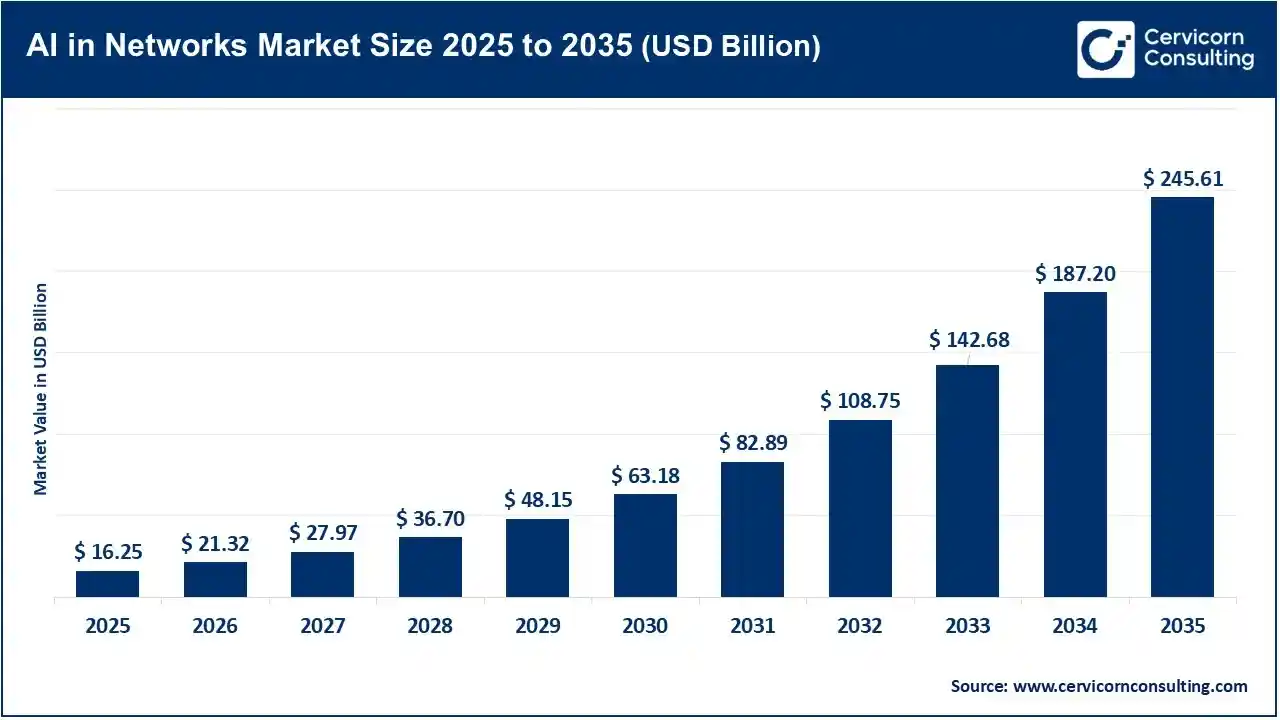
The global AI in networks market size was valued at USD 16.25 billion in 2025 and is projected to reach USD 245.61 billion by 2035, representing a 31.2% CAGR.
AI in Networks Market Growth Factors
The AI in networks market is expanding as enterprises, telecommunications operators, cloud providers, and data-center operators integrate artificial intelligence into network monitoring, optimization, security, automation, and resource management. Rapid growth in generative AI, large language models, AI agents, edge computing, 5G-Advanced, and hyperscale data centers is creating significantly higher requirements for bandwidth, low latency, network reliability, and intelligent traffic management. AI is increasingly being used for predictive maintenance, anomaly detection, automated configuration, dynamic routing, network slicing, capacity planning, cybersecurity, and energy optimization.
At the same time, the expansion of AI workloads is creating demand for networks designed specifically for AI, including high-speed Ethernet, optical networking, advanced switching, GPU interconnects, and intelligent data-center fabrics. NVIDIA reported that its fiscal 2025 networking revenue reached about $13.0 billion, while Cisco received more than $2 billion in AI infrastructure orders from webscale customers during fiscal 2025, demonstrating the growing commercial importance of AI-oriented networking infrastructure. Telecommunications operators are also moving toward autonomous and AI-native networks, with a 2026 NVIDIA telecom survey reporting that 65% of operators said AI was driving network automation and 77% expected AI-native networks before 6G deployment.
Get a Free Sample: https://www.cervicornconsulting.com/sample/3032
What Is the AI in Networks Market?
The AI in networks market refers to technologies, software, hardware, platforms, and services that use artificial intelligence and machine learning to build, operate, optimize, secure, and manage communication and computing networks.
The market covers two closely connected areas. The first is AI for networks, where AI is applied to existing telecommunications, enterprise, cloud, and data-center networks. Applications include automated network configuration, traffic prediction, fault detection, cybersecurity, predictive maintenance, network optimization, and intelligent resource allocation.
The second is networks for AI, where networking infrastructure is specifically designed to support demanding AI workloads. AI training and inference require extremely high data-transfer rates between GPUs, servers, storage systems, and data centers. This is driving demand for high-speed switches, Ethernet, InfiniBand, optical networks, data-center interconnects, and intelligent network-management platforms.
As AI workloads become more distributed, networking is increasingly becoming a fundamental part of the AI infrastructure stack rather than simply a connectivity layer. Industry organizations such as the GSMA are therefore working on AI-ready networks capable of supporting low-latency, data-intensive workloads and moving telecommunications infrastructure toward AI-native architectures.
Why Is AI in Networks Important?
AI-enabled networks are important because conventional network management becomes increasingly difficult as infrastructure grows in scale and complexity. Modern enterprises can operate thousands of devices, cloud environments, applications, edge locations, and connected endpoints. Manually identifying congestion, configuration errors, security threats, and equipment failures can result in slower response times and higher operating costs.
AI can continuously analyze network telemetry and identify patterns that may not be obvious to human operators. Predictive analytics can identify potential failures before they affect services, while machine-learning algorithms can dynamically allocate bandwidth according to changing traffic requirements.
AI is also becoming important for network security. Networks generate enormous quantities of logs and telemetry that can be analyzed to identify unusual behavior, suspicious traffic, and potential attacks. Combining AI with security platforms can improve threat detection and accelerate incident response.
For telecommunications operators, AI can support autonomous network operations, energy optimization, customer-experience management, radio-resource optimization, and predictive maintenance. For data centers, AI networking enables high-speed communication between thousands of accelerators and helps prevent network bottlenecks from reducing computing efficiency.
Key Companies in the AI in Networks Market
| Company | Specialization | Key Focus Areas | Notable Features | 2025 Revenue | Market Share | Global Presence |
|---|---|---|---|---|---|---|
| NVIDIA Corporation | AI computing and networking infrastructure | AI data-center networking, Ethernet, GPU interconnects, accelerated computing | Spectrum-X, InfiniBand, NVLink, AI factories | USD 130.5 billion | AI-networking-specific share not separately disclosed | North America, Europe, Asia-Pacific and other global markets |
| Cisco Systems, Inc. | Enterprise and data-center networking | AI networking, switching, security, observability, automation | Silicon One, Nexus, Splunk integration, AI infrastructure solutions | USD 56.7 billion | AI-networking-specific share not separately disclosed | Global enterprise, telecom, government and cloud markets |
| Hewlett Packard Enterprise (HPE) | Enterprise IT, networking and hybrid cloud | AI infrastructure, data-center networking, automation, edge | HPE Aruba Networking, HPE Juniper portfolio, AI infrastructure | USD 34.3 billion | AI-networking-specific share not separately disclosed | Global |
| Arista Networks, Inc. | Cloud and data-center networking | AI clusters, Ethernet switching, cloud networking, automation | High-performance switches, CloudVision, AI networking | USD 9.006 billion | AI-networking-specific share not separately disclosed | North America, Europe, Asia-Pacific and other regions |
| Nokia Corporation | Telecommunications and network infrastructure | AI-native networks, optical networking, IP networking, AI-RAN | 800G optical technologies, IP routing, AI-RAN, Bell Labs | EUR 19.889 billion | AI-networking-specific share not separately disclosed | Approximately 130 countries |
NVIDIA Corporation
NVIDIA has expanded from accelerated computing into a broader AI infrastructure provider, including networking technologies that connect GPUs and AI computing systems. Its portfolio includes InfiniBand, Spectrum-X Ethernet, NVLink, networking switches, and data-center platforms.
NVIDIA’s fiscal 2025 revenue was USD 130.5 billion, representing 114% year-over-year growth. Its fiscal 2025 fourth-quarter networking revenue was approximately USD 3 billion, with growth in Ethernet for AI, including the Spectrum-X platform.
Specialization: Accelerated computing and AI infrastructure
Key focus areas: AI data centers, GPU networking, Ethernet, InfiniBand, high-performance computing
Notable features: Spectrum-X, NVLink, InfiniBand, AI networking platforms
Market share: NVIDIA does not separately disclose an AI-in-networks market-share figure in its financial reporting.
Global presence: NVIDIA serves hyperscalers, enterprises, research organizations, and governments globally.
Cisco Systems, Inc.
Cisco combines enterprise networking, data-center switching, cybersecurity, observability, and software with AI infrastructure. Its Silicon One architecture and data-center networking portfolio are being positioned to support AI workloads.
Cisco generated USD 56.7 billion in fiscal 2025 revenue, up 5% year over year. The company reported more than USD 2 billion in AI infrastructure orders from webscale customers during the fiscal year.
Specialization: Enterprise, cloud and data-center networking
Key focus areas: AI networking, security, observability, automation and switching
Notable features: Silicon One, Nexus, Splunk integration, AI infrastructure partnerships
Market share: Cisco does not disclose a separate AI-in-networks market-share percentage.
Global presence: Broad global presence across enterprises, service providers, governments and cloud customers.
Hewlett Packard Enterprise (HPE)
HPE combines computing, networking, hybrid cloud, edge technologies, and AI infrastructure. Its networking capabilities were strengthened through the integration of the Juniper Networks portfolio, expanding its reach across data-center, enterprise, campus, and AI networking environments.
HPE recorded USD 34.296 billion in fiscal 2025 revenue, compared with USD 30.127 billion in fiscal 2024. Networking contributed significantly to the year’s revenue increase.
Specialization: Enterprise IT, networking and hybrid cloud
Key focus areas: AI infrastructure, networking automation, data centers and edge computing
Notable features: HPE Aruba Networking, AI infrastructure, networking and automation technologies
Market share: A separate AI-in-networks share is not publicly disclosed.
Global presence: Global enterprise and service-provider operations.
Arista Networks, Inc.
Arista focuses heavily on high-performance cloud and data-center networking. Its technology is particularly relevant to AI clusters, where large numbers of GPUs must communicate efficiently.
Arista reported USD 9.006 billion in 2025 revenue, an increase of 28.6% from 2024. The company stated that it exceeded its AI-networking goals in 2025.
Specialization: Cloud and data-center networking
Key focus areas: AI clusters, Ethernet switching, cloud networking, automation
Notable features: High-speed switches and CloudVision network-management platform
Market share: Arista does not publicly disclose a standalone AI-in-networks market-share figure.
Global presence: Strong presence among cloud providers, hyperscalers, enterprises, and large data centers worldwide.
Nokia Corporation
Nokia is positioned across telecommunications infrastructure, optical networking, IP routing and switching, mobile networks, and AI-native wireless infrastructure. The company has increasingly emphasized the connection between AI workloads and next-generation connectivity.
Nokia reported EUR 19.889 billion in 2025 net sales. Its 2025 annual report identified AI and Cloud as a EUR 17 billion serviceable addressable market, up 28% year over year, and stated that nine of the world’s top ten hyperscalers use Nokia optical technology.
Specialization: Telecommunications and network infrastructure
Key focus areas: Optical networking, AI-RAN, IP networking, 5G/6G and autonomous networks
Notable features: 800G optical technology, AI-RAN, Bell Labs research and data-center networking
Market share: Nokia does not report a separate global AI-in-networks market-share percentage.
Global presence: Nokia operates in approximately 130 countries and had about 78,000 employees in 2025.
Leading Trends and Their Impact on the AI in Networks Market
1. AI-Native and Autonomous Networks
Telecommunications companies are moving from AI-assisted network management toward autonomous networks that can detect problems, determine appropriate actions, and optimize infrastructure with limited human intervention.
Agentic AI is emerging as another development, with specialized AI agents potentially handling tasks such as fault diagnosis, root-cause analysis, configuration, and optimization. GSMA initiatives are focused on moving these concepts from experimentation toward production-grade telecommunications applications.
Impact: Increased automation can reduce manual network operations and enable faster responses to network events.
2. AI Data-Center Networking
Large AI models require massive communication between processors. As AI clusters scale, network performance can become a bottleneck. This is increasing demand for high-speed Ethernet, InfiniBand, optical interconnects, advanced switches, and congestion-management technologies.
Industry coverage in 2025 highlighted increasing requirements for lossless transport, adaptive routing, high-speed 800G connectivity, and increasingly 1.6T networking.
Impact: AI is transforming data centers into highly interconnected computing environments where networking performance directly influences AI workload efficiency.
3. Growth of AI Over Ethernet
Ethernet is becoming increasingly important for AI clusters because of its scalability, interoperability, and existing ecosystem. Technologies such as NVIDIA Spectrum-X are designed to optimize Ethernet for AI workloads.
Impact: Increased AI adoption could expand demand for Ethernet switches, network interface technologies, optical modules, and network-management software.
4. AI-Driven Network Security
AI is being incorporated into network security platforms to identify anomalous traffic and emerging threats. The increasing use of AI agents also creates new security requirements because autonomous systems can generate additional network traffic and introduce new attack surfaces.
Cisco, for example, is integrating networking, security, observability, and Splunk capabilities as part of its strategy for AI-era infrastructure.
Impact: AI networking and cybersecurity are becoming increasingly interconnected, supporting demand for integrated security and network-analytics platforms.
5. AI-RAN and 5G-Advanced
Telecommunications operators are beginning to integrate AI capabilities directly into radio access networks. Nokia’s partnership with NVIDIA is aimed at AI-native wireless infrastructure and AI-RAN, combining NVIDIA accelerated computing with Nokia’s RAN portfolio.
Impact: AI-RAN can create new opportunities for network optimization, edge AI, intelligent radio management, and future 6G architectures.
6. Optical Networking for AI
AI data centers require enormous quantities of data to move between computing facilities. This is increasing demand for higher-speed optical technologies.
Nokia reported that its AI and Cloud serviceable addressable market reached EUR 17 billion in 2025, driven partly by data-center networking expansion and higher-bandwidth requirements.
Impact: Optical networking is becoming a strategic component of AI infrastructure, particularly for hyperscale data centers and inter-data-center connectivity.
Successful Examples of AI in Networks Around the World
NVIDIA and AI Networking in Hyperscale Data Centers
NVIDIA’s Spectrum-X and InfiniBand technologies demonstrate how networking is being integrated directly into AI computing infrastructure. The company’s transition toward large-scale NVLink and Spectrum-X configurations illustrates the growing importance of high-performance networking in AI clusters.
Cisco AI Infrastructure Deployments
Cisco reported more than USD 2 billion in AI infrastructure orders from webscale customers in fiscal 2025, more than twice its original target. Its collaboration with NVIDIA combines computing and networking capabilities for enterprise AI deployments.
Nokia AI-Native Wireless Networks
Nokia and NVIDIA announced a strategic partnership in 2025 involving a USD 1 billion NVIDIA investment in Nokia, aimed at accelerating AI-native mobile networks and AI-RAN. Nokia also identified T-Mobile US as a participant in AI-RAN testing and use cases.
AI Networking Across European AI Factories
Europe’s AI Factories are being developed as interconnected environments combining supercomputing, data, AI models, and talent. The European Commission notes that AI Gigafactories will require large-scale computing, reliable energy, advanced networking, and automation.
These projects illustrate how networking is becoming an integral component of national and regional AI infrastructure rather than a standalone IT function.
Global Regional Analysis
North America
North America remains a major center for AI networking because of its concentration of hyperscalers, AI developers, cloud providers, semiconductor companies, and large data-center operators. The United States is seeing significant investment in AI computing and networking infrastructure.
In January 2025, the U.S. government issued Executive Order 14141 on Advancing United States Leadership in Artificial Intelligence Infrastructure, emphasizing the development of domestic AI infrastructure and reducing strategic dependence on foreign infrastructure.
The United States is also developing AI infrastructure partnerships with international markets. In 2025, the U.S. and India committed to developing a roadmap for accelerating AI infrastructure, including data centers, computing, processors, and related investment.
Market impact: Demand is being driven by hyperscale AI data centers, cloud expansion, enterprise AI adoption, high-speed Ethernet, optical networks, and cybersecurity.
Europe
Europe is focusing on AI infrastructure while emphasizing digital sovereignty, responsible AI, energy efficiency, and secure data ecosystems. The AI Continent Action Plan includes AI Factories and plans for large-scale AI computing infrastructure. The European Commission says the EU plans at least 19 AI Factories and up to five AI Gigafactories, with an InvestAI facility intended to mobilize EUR 20 billion for AI Gigafactories.
In 2025, additional AI Factories were selected across countries including Austria, Bulgaria, France, Germany, Poland, and Slovenia, with combined national and EU investment of approximately EUR 485 million for that second wave.
The EU AI Act also establishes a risk-based regulatory framework for artificial intelligence, creating requirements that can influence how AI-enabled network and infrastructure technologies are developed and deployed.
Market impact: European demand is expected to center on AI Factories, sovereign infrastructure, optical networking, secure connectivity, energy-efficient data centers, and AI governance.
Asia-Pacific
Asia-Pacific is a major growth region because of rapid digitalization, 5G deployment, cloud expansion, semiconductor investment, and increasing AI adoption. China, Japan, South Korea, India, Singapore, and Australia are developing AI ecosystems involving data centers, cloud platforms, telecommunications infrastructure, and high-performance computing.
China’s 2025 AI Plus policy framework promotes deeper integration of AI across the economy and calls for development of new infrastructure, technology systems, and AI ecosystems.
India is also building AI infrastructure through the IndiaAI Mission. The government’s program initially targeted more than 10,000 GPUs through public-private partnerships, while subsequent government announcements reported 34,381 GPUs provisioned through the IndiaAI Compute Portal.
India’s AI infrastructure roadmap is complemented by initiatives supporting indigenous foundation models, datasets, skills, startups, and responsible AI.
Market impact: Asia-Pacific is generating demand for AI-enabled telecom networks, data-center networking, edge computing, AI infrastructure, and high-speed connectivity.
Latin America
Latin America is gradually expanding AI infrastructure as cloud adoption, digital services, fintech, telecommunications modernization, and data-center investment increase. Countries such as Brazil, Mexico, Chile, and Colombia are developing stronger digital infrastructure ecosystems.
The regional market is expected to see applications in telecommunications automation, cybersecurity, smart cities, cloud services, financial services, and enterprise networking. Greater availability of cloud-based AI platforms can also allow organizations to adopt AI networking without making the same level of upfront infrastructure investment as hyperscale operators.
Middle East & Africa
The Middle East is emerging as an important AI infrastructure investment region, supported by national digital-transformation strategies, sovereign AI initiatives, data-center projects, and telecommunications modernization. Saudi Arabia and the UAE are developing large-scale AI ecosystems and partnerships with international technology companies.
Cisco reported partnerships involving HUMAIN in Saudi Arabia and G42 in the UAE as part of its fiscal 2025 AI infrastructure strategy.
Africa’s AI networking development is more varied, with investment concentrated in major economies and connectivity hubs. Improvements in subsea cables, cloud infrastructure, mobile broadband, data centers, and edge computing can support further adoption.
Market impact: Growth opportunities include telecommunications optimization, sovereign cloud infrastructure, smart-city networks, cybersecurity, data-center interconnects, and AI-enabled enterprise networks.
To Get Detailed Overview, Contact Us: https://www.cervicornconsulting.com/contact-us
Read Report: AI in Diagnostics Market Revenue, Trends, and Strategic Insights by 2035