Cloud Computing Market Outlook: AI Infrastructure, Cost Optimization, and Hybrid Cloud Strategies
Cloud Computing Market Outlook: How Should Enterprises Balance AI Investments, Cloud Costs, and Infrastructure Flexibility?
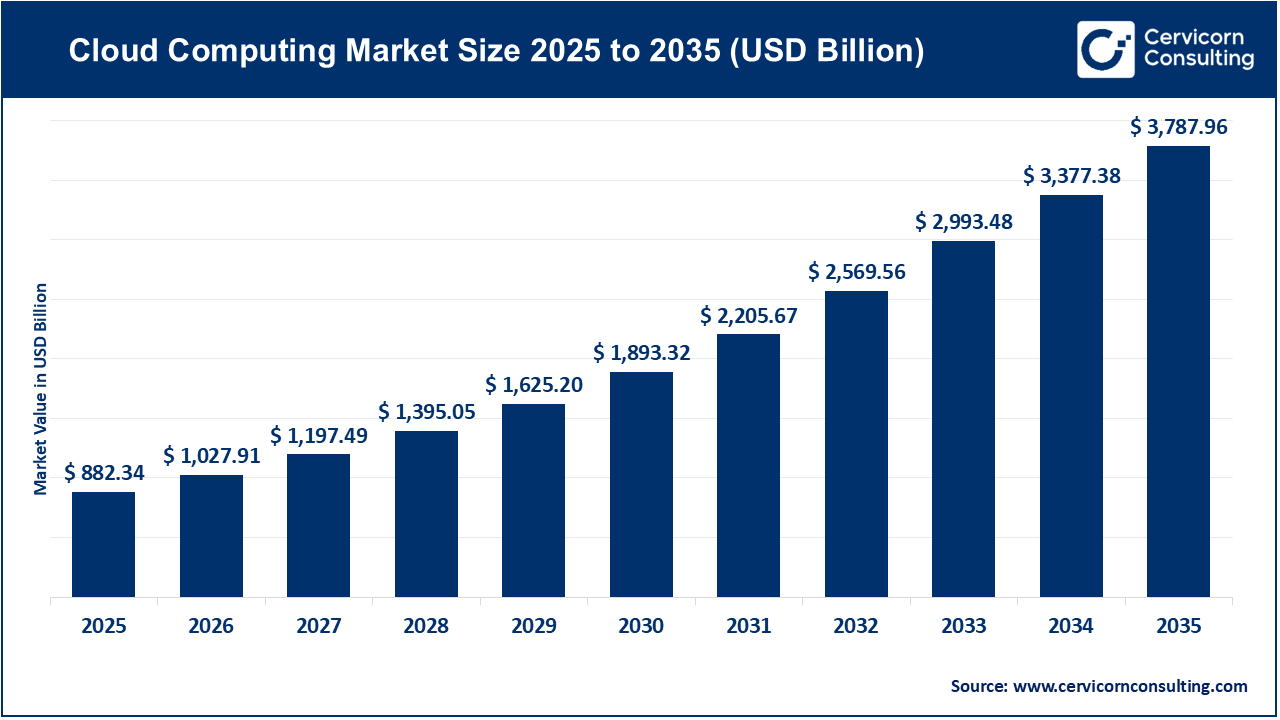
The global cloud computing market was valued at USD 882.34 billion in 2025 and is projected to reach approximately USD 3,787.96 billion by 2035, expanding at a CAGR of 15.68% from 2026 to 2035. The market is estimated to reach USD 1,027.91 billion in 2026, supported by enterprise digital transformation, AI infrastructure requirements, application modernization, and growing adoption of cloud-based business applications.
Cloud computing is moving beyond infrastructure migration toward becoming a strategic investment in business scalability, artificial intelligence, data management, and operational resilience. However, increasing cloud expenditure, complex deployment environments, cybersecurity requirements, and vendor dependency are changing how enterprises evaluate their cloud strategies.
For technology companies, cloud service providers, IT infrastructure vendors, and enterprise decision-makers, the next phase of market growth will depend not only on adoption but also on the ability to deliver measurable business value from cloud investments.
AI Infrastructure Is Changing Cloud Investment Priorities
Artificial intelligence is becoming a major driver of cloud infrastructure demand. Generative AI applications, machine learning models, enterprise automation, and real-time analytics require high-performance computing, scalable storage, advanced networking, and GPU-intensive infrastructure.
This is creating opportunities for cloud providers to expand infrastructure-as-a-service (IaaS) and platform-as-a-service (PaaS) offerings. Enterprises are also evaluating whether their existing cloud environments can support increasingly demanding AI workloads without creating excessive infrastructure costs.
According to Gartner, public cloud spending in India is forecast to reach USD 17.5 billion in 2026, increasing 28.1% from USD 13.7 billion in 2025. IaaS spending is expected to grow by 40%, reflecting the increasing requirement for AI-ready infrastructure.
Business implications:
-
Cloud providers should evaluate investments in GPU infrastructure, high-performance computing, and AI-enabled platforms.
-
Enterprise IT teams need to assess whether existing infrastructure can accommodate AI workloads without significant performance limitations.
-
Technology vendors should identify opportunities in AI infrastructure management, cloud security, data integration, and workload optimization.
-
Investors should distinguish between infrastructure expansion and sustainable revenue generation from AI-related cloud services.
The important consideration is whether AI infrastructure investments can generate sufficient utilization, recurring revenue, and long-term customer value.
Get a Free Sample: https://www.cervicornconsulting.com/sample/2414
Cloud Cost Optimization Is Becoming a Competitive Requirement
The pay-as-you-go model has made cloud computing accessible to businesses of different sizes. However, increasing workloads, data transfer requirements, storage consumption, and premium infrastructure services can create substantial long-term expenses.
For enterprises operating across multiple cloud environments, controlling expenditure is becoming more complicated. Unused computing capacity, inefficient resource allocation, duplicate services, and unpredictable workloads can reduce the financial benefits of cloud adoption.
This creates opportunities for FinOps platforms, cloud cost management software, automated resource allocation, and performance monitoring solutions.
Business implications:
-
Enterprises should evaluate total cost of ownership rather than comparing cloud providers solely on initial pricing.
-
Cloud service providers need transparent pricing models and better cost visibility tools.
-
Software vendors can target demand for automated cloud optimization and resource management.
-
Procurement teams should assess storage, networking, licensing, migration, and support costs before signing long-term agreements.
The competitive advantage will increasingly depend on delivering predictable cloud economics alongside performance and scalability.
Hybrid and Multi-Cloud Strategies Are Reshaping Enterprise Architecture
Enterprises are increasingly evaluating public, private, and hybrid cloud environments based on workload requirements rather than adopting a single deployment model.
The market’s 2025 deployment breakdown highlights this shift:
-
Private cloud: 47.20% revenue share.
-
Public cloud: 34.30% revenue share.
-
Hybrid cloud: 19.50% revenue share.
Private cloud adoption remains important for organizations handling sensitive information, regulated workloads, and business-critical applications. Public cloud offers scalability and flexible resource utilization, while hybrid cloud enables companies to balance infrastructure control with cloud flexibility.
However, multi-cloud adoption introduces additional challenges involving workload portability, data synchronization, infrastructure monitoring, and security management.
Business implications:
-
Enterprises should determine which workloads require private infrastructure and which can operate efficiently on public cloud platforms.
-
Cloud providers should strengthen interoperability and integration capabilities.
-
Managed service providers can target enterprises requiring hybrid and multi-cloud management.
-
Technology companies should evaluate demand for cloud orchestration, workload portability, and centralized monitoring solutions.
The key investment consideration is how to provide infrastructure flexibility without increasing operational complexity.
Data Security and Regulatory Compliance Will Influence Provider Selection
As businesses migrate sensitive information and critical applications to cloud environments, security and compliance are becoming central purchasing considerations.
Financial institutions, healthcare organizations, government agencies, and telecommunications companies have specific requirements involving data residency, access controls, encryption, and regulatory reporting.
Cloud providers must therefore compete on more than computing capacity and pricing. Their ability to deliver secure infrastructure, regulatory compliance, identity management, and disaster recovery capabilities will influence enterprise procurement decisions.
Business implications:
-
Cloud providers should strengthen security-by-design capabilities and compliance certifications.
-
Enterprises should evaluate data residency, encryption, access management, and incident response policies before selecting providers.
-
Cybersecurity vendors can expand opportunities through cloud-native security, threat detection, and identity management solutions.
-
Companies operating internationally should assess differences in regional data protection requirements before expanding cloud infrastructure.
Security capabilities are increasingly becoming a differentiating factor in enterprise cloud procurement.
Regional Expansion Creates Different Investment Opportunities
Cloud computing adoption varies across regions because of differences in digital infrastructure, enterprise IT spending, regulatory environments, and AI investment.
North America accounted for 40.4% of the global cloud computing market in 2025, making it the largest regional market. The region benefits from established cloud infrastructure, major technology providers, and strong enterprise demand.
Asia-Pacific, valued at USD 183.53 billion in 2025, is projected to reach USD 787.90 billion by 2035. Rapid digitalization, growing enterprise technology expenditure, and expanding data center infrastructure are supporting regional opportunities.
India is particularly important to this expansion. Gartner forecasts that public cloud spending in the country will reach USD 17.5 billion in 2026, with demand supported by AI infrastructure, application modernization, and digital transformation.
Business implications:
-
Cloud providers should evaluate infrastructure expansion in high-growth Asia-Pacific markets.
-
Data center operators should assess regional demand, power availability, connectivity, and enterprise requirements.
-
International technology vendors should consider localization, data sovereignty, and regulatory requirements.
-
Investors should distinguish between mature markets offering established enterprise demand and emerging markets offering higher expansion potential.
Regional expansion strategies should account for infrastructure readiness and customer purchasing requirements rather than relying exclusively on market growth rates.
SaaS, PaaS, and IaaS Providers Face Different Growth Opportunities
The cloud computing market offers different opportunities across its service models.
In 2025, SaaS accounted for 53.20% of market revenue, followed by IaaS at 31.70% and PaaS at 15.10%. Each segment addresses different enterprise requirements and competitive priorities.
Software as a Service (SaaS): SaaS providers benefit from recurring subscription revenue and enterprise demand for CRM, ERP, human capital management, collaboration, and productivity applications. However, competition, subscription optimization, and customer retention remain important challenges.
Infrastructure as a Service (IaaS): IaaS providers are positioned to benefit from AI workloads, data storage, computing requirements, and infrastructure modernization. Differentiation will increasingly depend on performance, availability, pricing, and infrastructure efficiency.
Platform as a Service (PaaS): PaaS providers can capture opportunities from application development, analytics, data management, and AI integration. Developer experience, platform interoperability, and reduced infrastructure complexity will influence adoption.
Business implications:
-
SaaS companies should prioritize customer retention, product differentiation, and expansion into specialized enterprise applications.
-
IaaS providers should evaluate investments in AI-ready infrastructure and high-performance computing.
-
PaaS vendors should strengthen developer tools, AI integration, and enterprise data management capabilities.
-
Technology investors should compare revenue models, customer acquisition costs, recurring revenue, and competitive positioning across service categories.
Competitive Positioning Will Depend on More Than Infrastructure Scale
Competition in the cloud computing market is intensifying as established technology companies expand their infrastructure, AI capabilities, and enterprise service portfolios.
Major companies operating in this market include:
-
Amazon Web Services: Focuses on cloud infrastructure, computing, storage, databases, and AI services.
-
Microsoft: Strengthens its position through Azure, enterprise software integration, and AI infrastructure.
-
Google Cloud: Competes through data analytics, AI platforms, cloud infrastructure, and enterprise applications.
-
IBM: Focuses on hybrid cloud, enterprise modernization, and managed infrastructure.
-
Oracle: Competes in enterprise cloud applications, databases, and cloud infrastructure.
-
Alibaba Cloud: Provides cloud infrastructure and enterprise technology services, particularly across Asian markets.
-
Rackspace Technology: Focuses on managed cloud, hybrid cloud, and multicloud services.
Other relevant participants include Akamai Technologies, Deutsche Telekom, SAP, Salesforce, Intel, and Lumen Technologies.
The competitive landscape creates opportunities for specialized providers that can address industry-specific requirements, improve cloud interoperability, and deliver managed services.
For smaller cloud technology companies, competing directly with hyperscalers on infrastructure scale may be difficult. Instead, differentiation through cybersecurity, industry-specific cloud platforms, edge computing, migration services, and workload optimization can provide more focused market opportunities.
What Should Companies Evaluate Before Making Their Next Cloud Investment?
Cloud computing investments increasingly involve interconnected decisions across infrastructure, software, security, and enterprise operations.
Before committing capital or expanding market presence, companies should evaluate the following areas:
-
Infrastructure demand: Identify which workloads are driving demand for computing, storage, networking, and AI infrastructure.
-
Deployment strategy: Assess the commercial viability of public, private, and hybrid cloud offerings across target industries.
-
Pricing and profitability: Examine infrastructure costs, utilization rates, customer acquisition expenses, and recurring revenue potential.
-
Regional opportunities: Compare market maturity, regulatory requirements, digital infrastructure, and enterprise spending across geographies.
-
Technology differentiation: Evaluate opportunities in AI integration, cloud security, edge computing, automation, and multicloud management.
-
Competitive positioning: Benchmark established providers and specialized competitors to identify underserved customer requirements.
-
Long-term scalability: Assess whether infrastructure investments and service portfolios can support future workload growth without compromising margins.
These considerations are particularly important for cloud service providers, data center operators, enterprise software companies, cybersecurity vendors, and investors evaluating opportunities across the cloud computing ecosystem.
Outlook: Cloud Computing Moves Toward AI-Driven and Industry-Specific Infrastructure
The cloud computing market is entering a phase in which infrastructure performance, AI readiness, cost optimization, and enterprise-specific requirements will increasingly determine competitive positioning.
The expansion of generative AI, connected devices, enterprise automation, and data-intensive applications will continue creating demand for scalable cloud infrastructure. At the same time, increasing operational costs, cybersecurity risks, and multicloud complexity will require providers to strengthen their service differentiation.
For enterprises, the priority will be selecting cloud environments that support business growth while maintaining cost efficiency, regulatory compliance, and operational flexibility. For technology vendors and investors, identifying the most commercially attractive service models, customer industries, and regional markets will be essential to making informed investment decisions.
Understanding these market developments, competitive strategies, service-level opportunities, and regional growth patterns will help companies identify where cloud computing investments can generate sustainable business value.
To Get Detailed Overview, Contact Us: https://www.cervicornconsulting.com/contact-us
Read Report: AI Data Center Power Infrastructure Market Outlook: UPS, Grid Infrastructure, Battery Storage, and On-Site Generation