Data Center Solutions Market Outlook: AI Infrastructure, Power, Cooling, and Scalability
Data Center Solutions Market: Infrastructure Investment Decisions for the AI-Driven Data Center Era
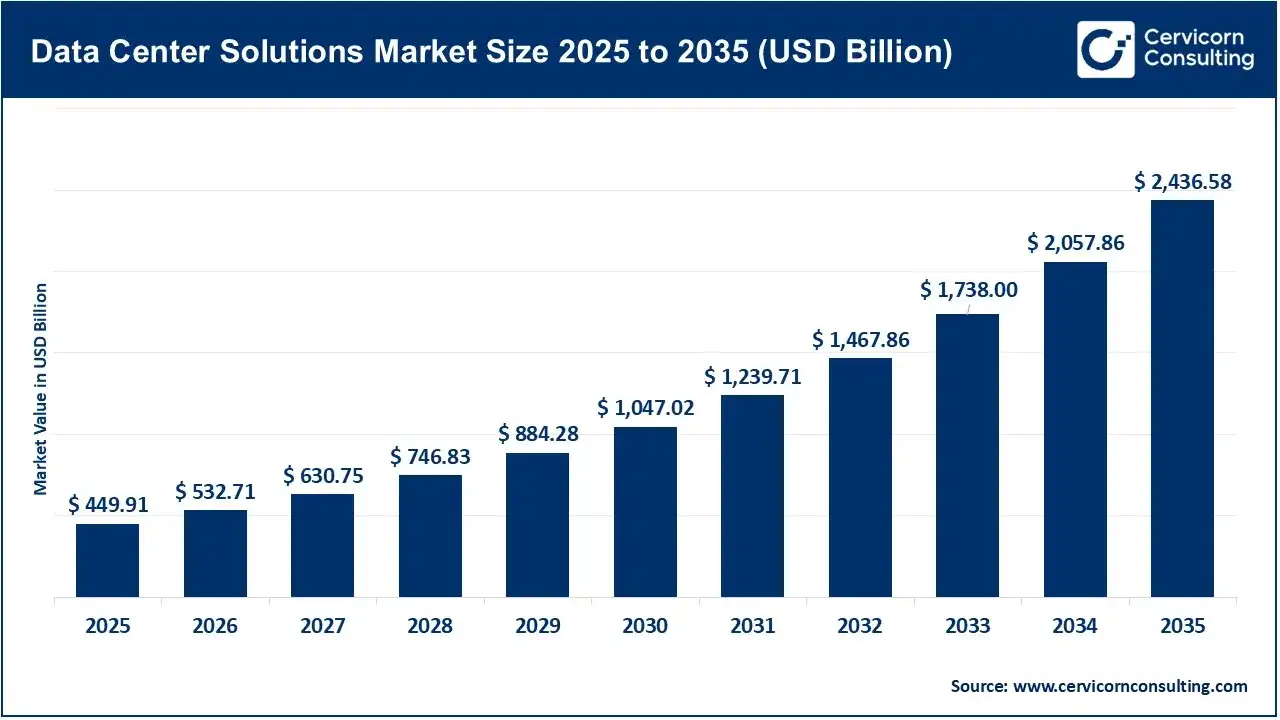
The global data center solutions market was valued at USD 449.91 billion in 2025 and is projected to grow from USD 532.71 billion in 2026 to approximately USD 2,436.58 billion by 2035, registering a CAGR of 18.4% during 2026–2035. Rising investments in artificial intelligence (AI), cloud computing, hyperscale infrastructure, and enterprise digitalization are increasing demand for integrated data center solutions. However, the next phase of market expansion will depend not only on computing capacity but also on how effectively operators manage power availability, cooling efficiency, infrastructure scalability, and operational costs.
As AI workloads become more resource-intensive, conventional data center configurations are facing new limitations. Higher rack densities, increasing electricity requirements, and growing thermal loads are changing infrastructure investment priorities. For data center operators, equipment manufacturers, technology providers, and investors, the central challenge is determining which infrastructure capabilities require immediate investment and which technologies will deliver long-term operational value.
AI Infrastructure Is Changing Data Center Investment Priorities
AI adoption is increasing demand for high-performance servers, GPU accelerators, high-speed networking, and advanced storage systems. Unlike conventional enterprise workloads, AI training and inference can require significantly higher computing capacity and power density. This is creating demand for infrastructure that can accommodate changing workload requirements without compromising reliability.
The investment implications extend across the entire data center ecosystem:
- Computing infrastructure: Increasing deployment of GPU-based servers and AI accelerators is creating opportunities for high-performance computing platforms.
- Networking infrastructure: Higher data transfer requirements are increasing demand for high-speed interconnects, advanced networking equipment, and low-latency connectivity.
- Power infrastructure: AI facilities require reliable electricity distribution, backup systems, UPS solutions, and advanced power monitoring.
- Cooling infrastructure: Higher equipment density is accelerating demand for liquid cooling, cooling distribution units, and advanced thermal management.
- Physical infrastructure: Modern racks, enclosures, monitoring systems, and building management technologies are becoming increasingly important.
For technology suppliers, this shift creates opportunities to develop integrated infrastructure offerings rather than compete exclusively on individual equipment specifications. For operators, investment decisions should consider compatibility between computing, power, cooling, and networking systems.
Get a Free Sample: https://www.cervicornconsulting.com/sample/3089
Five Infrastructure Decisions That Will Shape Data Center Investments
1. Should Operators Prioritize Liquid Cooling Over Conventional Air Cooling?
Cooling infrastructure is becoming one of the most important investment considerations as AI servers and high-performance computing systems generate greater amounts of heat. Air-cooled systems continue to support conventional data center environments because of their established deployment base and relatively straightforward maintenance requirements. However, their suitability may become limited as rack densities increase.
Liquid cooling is emerging as a strategic alternative for high-density computing environments. Direct-to-chip liquid cooling, cooling distribution units, and rear-door heat exchangers can help manage thermal loads more effectively.
Business considerations:
- Evaluate rack density and anticipated computing workloads before selecting a cooling architecture.
- Compare the total cost of ownership of air and liquid cooling, including installation, maintenance, and energy consumption.
- Assess retrofit requirements for existing facilities rather than assuming that complete infrastructure replacement is necessary.
- Consider hybrid cooling architectures that accommodate both conventional and AI-intensive workloads.
The market opportunity is particularly significant for cooling equipment manufacturers, thermal management providers, and infrastructure engineering companies. Mechanical and cooling infrastructure is expected to be the fastest-growing infrastructure category, with liquid cooling among its key growth areas.
2. How Should Companies Manage Rising Power Requirements?
Power availability is increasingly influencing data center site selection, facility expansion, and infrastructure procurement. AI computing, cloud services, and hyperscale deployments are increasing electricity requirements, while grid connection delays and energy costs can affect project timelines and operating margins.
Operators therefore need to consider power infrastructure as a strategic investment rather than simply a supporting facility requirement.
Critical power systems accounted for the largest share of the power infrastructure segment in 2025, reflecting the importance of uninterrupted operations. Power storage systems are expected to record the fastest growth as operators seek additional flexibility and reliability.
Business considerations:
- Evaluate grid availability and the reliability of electricity supply before committing to new facilities.
- Assess the capacity requirements of UPS systems, generators, and backup power infrastructure.
- Examine battery energy storage systems for power reliability and energy management applications.
- Compare centralized and distributed power architectures based on facility size and operational requirements.
- Evaluate opportunities to integrate renewable energy and more efficient power management systems.
Companies supplying UPS systems, generators, battery storage, power distribution equipment, and energy management technologies should assess demand across both new data center construction and existing facility modernization.
3. Should Companies Invest in Modular Infrastructure or Conventional Expansion?
Data center development requires substantial capital, long construction timelines, and coordination across multiple infrastructure suppliers. Modular and prefabricated data center solutions offer an alternative for organizations seeking faster deployment and flexible capacity expansion.
These solutions can support phased development by allowing operators to add power, cooling, and IT infrastructure according to actual demand. They are particularly relevant for edge computing, regional deployments, and organizations with changing capacity requirements.
However, modular infrastructure is not automatically the most economical option for every project. Facility scale, workload characteristics, land availability, power access, and future expansion requirements should determine the investment approach.
Business considerations:
- Compare initial capital expenditure and deployment timelines across modular and conventional facilities.
- Assess whether phased infrastructure deployment can reduce underutilized capacity.
- Evaluate standardization and compatibility with existing IT and facility management systems.
- Consider modular solutions for edge deployments and geographically distributed operations.
For infrastructure manufacturers and engineering companies, modular designs can create opportunities to serve customers seeking scalable solutions without committing to large upfront infrastructure investments.
4. Where Should Companies Prioritize IT and Networking Investments?
IT and networking infrastructure represented approximately 40% of the data center solutions market in 2025, making it the largest infrastructure category. Servers accounted for 32% of this segment, reflecting their essential role in enterprise computing, cloud platforms, data processing, and application hosting.
However, AI adoption is changing the composition of future infrastructure demand. GPU and AI accelerators are expected to be among the fastest-growing components, while high-speed interconnects and advanced networking solutions are becoming increasingly important.
Companies must therefore balance investments in conventional computing infrastructure with emerging AI requirements.
Business considerations:
- Assess whether existing server infrastructure can support anticipated AI and high-performance computing workloads.
- Evaluate GPU deployment requirements based on workload utilization and expected computing demand.
- Prioritize networking capacity to prevent connectivity bottlenecks as computing density increases.
- Consider storage performance, scalability, and data accessibility when modernizing infrastructure.
- Compare the operational benefits of hyperconverged infrastructure with conventional infrastructure architectures.
Technology vendors should also consider the growing importance of integrated server, storage, networking, and accelerator solutions in competitive positioning.
5. How Can Monitoring and Automation Improve Operational Efficiency?
As data centers become more complex, managing power consumption, cooling performance, equipment utilization, and system reliability requires greater operational visibility.
Intelligent monitoring and measurement systems can help operators track infrastructure conditions, identify inefficiencies, and anticipate equipment-related issues. AI-enabled automation can further support workload optimization, predictive maintenance, and resource allocation.
For operators managing multiple facilities, these capabilities can improve consistency and provide better visibility into infrastructure performance.
Business considerations:
- Evaluate monitoring systems that integrate power, cooling, environmental, and equipment performance data.
- Identify opportunities to automate repetitive facility management activities.
- Use predictive maintenance to reduce unexpected equipment downtime.
- Monitor energy utilization and infrastructure efficiency across facilities.
- Assess interoperability with existing building management and data center infrastructure management platforms.
Monitoring and measurement systems are expected to be among the fastest-growing areas within physical data center infrastructure, creating opportunities for software providers, automation companies, and equipment manufacturers.
Regional Investment Opportunities: North America or Asia Pacific?
Regional investment decisions are becoming increasingly important as data center demand, electricity availability, regulatory conditions, and digital infrastructure development vary across markets.
North America: The region accounted for approximately 40% of global data center solutions market revenue in 2025. Its established hyperscale ecosystem, cloud service providers, technology companies, and advanced digital infrastructure continue to support demand. The North American market is projected to increase from USD 179.96 billion in 2025 to USD 974.63 billion by 2035.
For infrastructure suppliers, opportunities extend across power management, cooling technologies, servers, networking equipment, and large-scale facility modernization.
Asia Pacific: The region’s data center solutions market was valued at USD 130.47 billion in 2025 and is projected to reach USD 706.61 billion by 2035. Rapid digitalization, cloud adoption, AI investments, and growing internet consumption are supporting infrastructure expansion.
India, China, Japan, Singapore, and other regional markets offer opportunities across hyperscale facilities, edge infrastructure, power systems, cooling technologies, and data center equipment.
For companies evaluating regional expansion, market attractiveness should be assessed alongside electricity availability, construction costs, regulatory requirements, local supplier ecosystems, and customer investment pipelines.
Competitive Landscape: What Should Infrastructure Companies Monitor?
Competition in the data center solutions market is increasingly influenced by the ability to deliver reliable, scalable, and energy-efficient infrastructure.
Major companies operating across the market include Dell Technologies, Hewlett Packard Enterprise, Schneider Electric, Vertiv, Cisco Systems, Huawei Technologies, Eaton, ABB, Equinix, Lenovo, Fujitsu, and Johnson Controls.
Companies should monitor competitive developments across several areas:
- Product innovation: New power management, liquid cooling, GPU server, and networking solutions.
- Strategic partnerships: Collaborations connecting computing platforms with power and cooling infrastructure.
- Geographic expansion: Investments in regional manufacturing, infrastructure deployment, and distribution networks.
- Technology differentiation: Improvements in energy efficiency, rack density, reliability, and infrastructure integration.
- Customer targeting: Growing requirements from hyperscalers, colocation providers, telecommunications companies, BFSI, and enterprise data center operators.
For example, the February 2026 collaboration between Vertiv and Netweb Technologies to develop and validate liquid-cooled rack solutions for Indian AI data centers highlights the growing importance of combining high-performance computing with integrated power and cooling capabilities.
Such developments indicate that competitive positioning will increasingly depend on ecosystem partnerships and the ability to address complete infrastructure requirements.
Strategic Outlook: Where Should Companies Focus Their Next Investments?
The data center solutions market is moving toward a more integrated infrastructure model in which computing performance, power availability, cooling efficiency, and operational reliability must be evaluated together.
For companies participating in this market, the following priorities deserve attention:
- Infrastructure manufacturers: Expand product portfolios around AI-ready power, cooling, server, and networking requirements.
- Cooling technology providers: Strengthen liquid cooling capabilities while retaining solutions for conventional data center environments.
- Power equipment suppliers: Evaluate opportunities in UPS systems, power distribution, generators, and battery energy storage.
- Technology vendors: Develop integrated solutions that improve computing performance, connectivity, monitoring, and infrastructure management.
- Data center operators: Align capacity expansion with power availability, workload forecasts, energy efficiency, and long-term operating costs.
- Investors: Evaluate regional demand, infrastructure bottlenecks, technology adoption, and the competitive positioning of equipment suppliers before allocating capital.
The strongest opportunities are likely to emerge where infrastructure investment addresses a measurable operational constraint rather than simply adding capacity.
Conclusion
The expansion of AI, cloud computing, and digital services is transforming the data center solutions market from a conventional infrastructure industry into a strategic technology investment ecosystem. While servers and IT infrastructure continue to represent a substantial share of market demand, power storage, liquid cooling, GPU-based computing, high-speed networking, and intelligent monitoring are creating new areas of growth.
For companies planning market entry, product development, capacity expansion, or competitive positioning, understanding these shifts is essential. Investment decisions should be guided by regional demand, technology adoption, infrastructure costs, supplier capabilities, and the evolving requirements of data center operators.
Understanding where demand is accelerating, which infrastructure segments offer the strongest opportunities, and how leading companies are positioning themselves can help businesses make more informed decisions in this rapidly evolving market.
To Get Detailed Overview, Contact Us: https://www.cervicornconsulting.com/contact-us