Data Center Energy Storage Systems Market: Where Should Companies Invest as AI Power Demand Reshapes Infrastructure?
Data Center Energy Storage Systems Market: Where Should Companies Invest as AI Power Demand Reshapes Data Center Infrastructure?
Data center operators are facing a strategic shift in power management. As artificial intelligence (AI), cloud computing and high-performance computing expand, securing electricity is becoming as important as securing computing capacity. The challenge is no longer limited to maintaining backup power. Companies must also determine how to manage peak electricity demand, improve power resilience, integrate renewable energy and control long-term infrastructure costs.
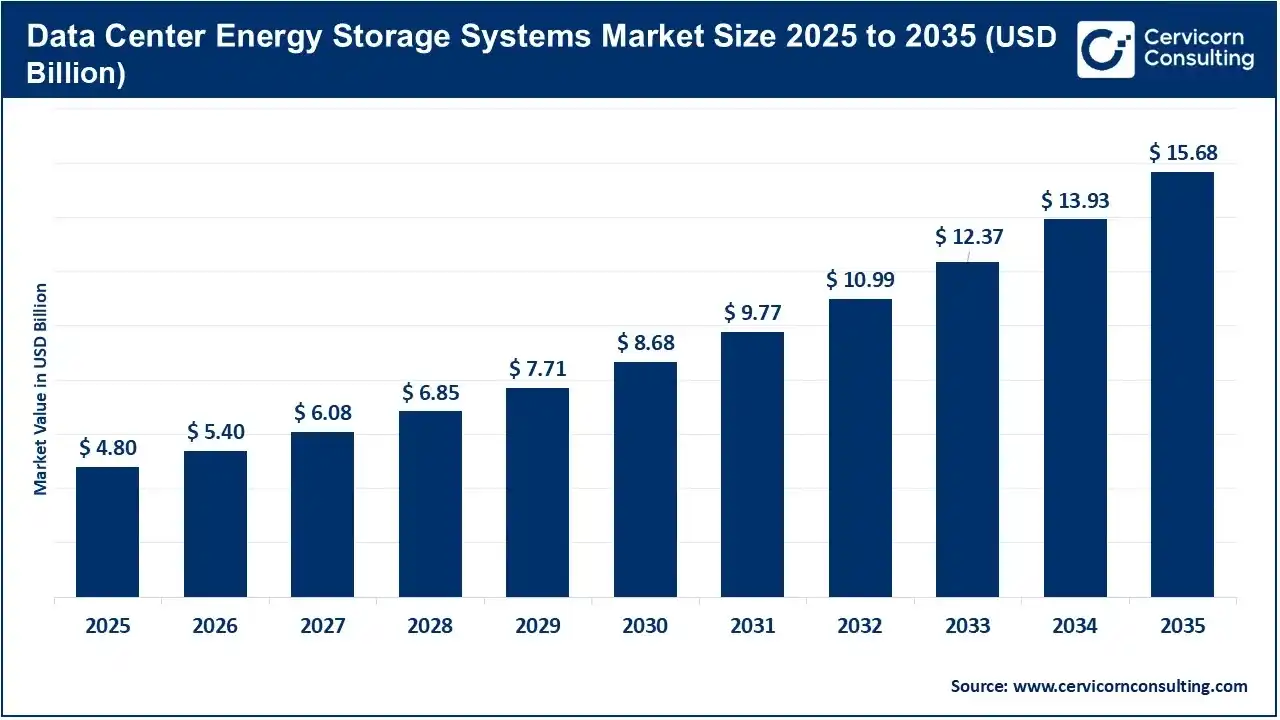
The global data center energy storage systems market was valued at USD 4.80 billion in 2025 and is projected to reach USD 15.68 billion by 2035, growing at a CAGR of 12.6% from 2026 to 2035. This growth reflects the increasing importance of battery energy storage systems (BESS), uninterruptible power supply (UPS) technologies and hybrid energy architectures in modern data centers.
However, market growth alone does not determine where companies should invest. The more important question is which storage configurations, technologies and deployment strategies can address specific power constraints while delivering measurable operational and financial benefits.
1. Why Is Energy Storage Becoming a Strategic Data Center Investment?
Electricity demand is increasingly influencing where data centers can be built, how quickly new facilities can become operational and how much infrastructure investment is required.
On October 8, 2026, Reuters reported that U.S. data center operators and utilities were exploring flexible power consumption to ease grid constraints. A Duke University study cited in the report estimated that demand-response strategies could potentially avoid USD 40 billion to USD 150 billion in capital spending over the next decade. The opportunity depends on implementation, market rules and the ability to reduce or shift electricity demand without disrupting critical workloads.
For data center operators, this development highlights an important distinction: energy storage is not simply an emergency backup asset. When appropriately designed and permitted, it can become part of a broader strategy for managing grid interactions and electricity demand.
Companies should evaluate three investment priorities:
- Power continuity: Maintaining critical workloads during grid outages, voltage disturbances and transitions between power sources.
- Capacity flexibility: Managing short-duration demand peaks and reducing dependence on grid infrastructure that may be constrained or expensive.
- Energy optimization: Coordinating batteries with renewable electricity, onsite generation and energy-management software.
The commercial value depends on the facility’s load profile, utility tariff structure, grid conditions and operating requirements. Storage should therefore be evaluated against a defined operational objective rather than installed solely because AI infrastructure is expanding.
Get a Free Sample: https://www.cervicornconsulting.com/sample/3054
2. Which Energy Storage Technologies Offer the Strongest Investment Potential?
Different storage technologies address different operating requirements. A solution designed for instantaneous backup may not be the most economical choice for several hours of energy shifting.
Cervicorn Consulting’s market analysis identifies lithium-ion batteries as the leading storage technology, while flow batteries and sodium-ion batteries represent emerging opportunities. The appropriate investment depends on discharge duration, response time, safety requirements, footprint and total lifecycle cost.
Lithium-ion batteries: For scalable, fast-response storage
Lithium-ion systems are well suited to applications requiring high energy density, rapid response and modular deployment. Their established supply chains and integration with power-conversion systems make them relevant to hyperscale and colocation facilities.
Investment decisions should compare battery chemistry, thermal-management requirements, degradation under repeated cycling, replacement schedules and warranty conditions. A lower initial purchase price does not necessarily translate into a lower lifetime cost.
Flow batteries: For longer-duration storage requirements
Flow batteries may be attractive where operators need longer discharge durations or frequent cycling. Their potential applications include renewable-energy integration and shifting electricity consumption across longer periods.
However, buyers must assess system footprint, installation complexity, efficiency, maintenance and supplier maturity before committing to large deployments.
Sodium-ion batteries: For diversification of storage supply chains
Sodium-ion technology is an emerging option for companies seeking alternatives to conventional lithium-based systems. Its potential commercial attractiveness will depend on application-specific performance, manufacturing scale, safety characteristics and delivered cost.
Procurement teams should distinguish demonstrated commercial performance from projected improvements in future production.
Flywheels and hybrid systems: For specialized power-quality requirements
Flywheel systems can deliver rapid power responses for short-duration applications. Hybrid architectures can combine technologies to address different operating timescales, such as immediate power support and longer-duration backup.
For mission-critical facilities, the objective should be to match each technology to the required duty cycle rather than force a single technology to perform every function.
3. Should Companies Prioritize UPS Batteries or Grid-Interactive Battery Storage?
This is one of the most important investment decisions for data center owners.
UPS systems primarily protect critical electrical loads against interruptions and power-quality disturbances. Larger battery energy storage systems can support additional functions, including peak-load management, renewable-energy integration and participation in eligible grid-service programs.
Cervicorn Consulting’s 2025 market estimates attribute approximately 42% of market revenue to UPS energy storage and 38% to BESS. These figures indicate the importance of both established backup infrastructure and broader battery-storage applications.
The two systems should not automatically be treated as interchangeable.
| Investment consideration | UPS energy storage | Grid-interactive BESS |
|---|---|---|
| Primary objective | Protect critical loads | Improve power flexibility and energy management |
| Typical use | Immediate backup and power conditioning | Peak management, load shifting and renewable integration |
| Key design priority | Response reliability and backup autonomy | Power capacity, discharge duration and cycling economics |
| Financial evaluation | Downtime risk and continuity requirements | Demand charges, energy savings and eligible grid revenues |
For many facilities, an integrated architecture may offer greater flexibility than expanding either system in isolation. Nevertheless, any shared configuration must preserve required backup reserves and comply with electrical protection, reliability and operating requirements.
Before investing, operators should establish whether the business case is driven by outage protection, peak-demand costs, grid limitations or a combination of these factors.
4. How Should AI Data Center Operators Evaluate Storage Capacity?
AI infrastructure introduces additional complexity because power demand can change as computing workloads and accelerator utilization change. Storage sizing based solely on average electricity consumption may therefore underestimate important operating conditions.
Cervicorn Consulting’s market analysis identifies the 1–10 MW capacity segment as the largest in 2025, representing approximately 35% of market revenue. Systems above 10 MW account for another substantial opportunity as larger facilities expand their electrical infrastructure.
These market segments provide useful context, but they should not be used as engineering specifications for individual projects.
Companies should evaluate four parameters before selecting storage capacity:
- Critical load: How much power must remain available during an outage or transition?
- Required duration: How long must the storage system support that load before another power source becomes available?
- Discharge profile: Does the facility need brief, high-power support or sustained energy delivery?
- Expansion requirements: Will additional AI racks, cooling equipment or computing halls change the power profile over the next three to five years?
For preliminary planning, the relationship between energy capacity and discharge duration is straightforward:
Required energy (MWh) = supported load (MW) × duration (hours)
For example, supporting a 5 MW critical load for 30 minutes requires 2.5 MWh of usable energy before accounting for conversion losses, operating reserves, degradation and other engineering margins.
This distinction matters because power capacity and energy capacity are not the same. A system may be capable of delivering the required megawatts but lack sufficient stored energy to sustain that output for the necessary period.
The investment case should therefore include engineering scenarios for current operations, planned expansion and credible peak-load conditions.
5. Can Energy Storage Improve Data Center Economics Through Grid Flexibility?
Energy storage can create value beyond avoided downtime, but additional revenue or savings should be demonstrated rather than assumed.
Potential applications include peak shaving, load shifting, renewable-energy integration and participation in demand-response programs where local rules permit.
For example, a facility facing high demand charges may charge its battery during lower-cost periods and discharge during selected peak periods. A data center with contracted renewable generation may use storage to improve the alignment between electricity availability and consumption.
The financial outcome depends on several variables:
- Electricity tariffs and demand-charge structures.
- Battery charging and discharging efficiency.
- Available grid-service compensation and program eligibility.
- Battery degradation caused by cycling.
- Interconnection limits and restrictions on exporting electricity.
- The need to retain sufficient energy for backup operations.
Operators should model several scenarios rather than assume that every potential application can operate simultaneously. A battery reserved for emergency backup may have limited availability for commercial dispatch, while frequent cycling for energy arbitrage can affect its long-term condition.
A practical investment model should compare the expected annual savings and eligible revenues against capital expenditure, financing, maintenance, replacement costs and residual value.
The most attractive project is not necessarily the one with the highest theoretical revenue. It is the one that creates dependable value without compromising power resilience.
6. Where Are the Regional Investment Opportunities?
Regional power constraints, data center construction pipelines and energy policies will influence storage adoption differently across markets.
North America: Grid constraints and hyperscale expansion
North America accounted for approximately 35% of the global data center energy storage systems market in 2025, according to Cervicorn Consulting’s estimates. Strong hyperscale investment and growing demand for AI computing support opportunities in battery storage, UPS modernization, energy-management software and integrated power systems.
Suppliers should pay particular attention to projects where grid interconnection delays, demand charges or expansion requirements create a clear business case for onsite storage.
Asia-Pacific: Rapid capacity additions and infrastructure development
Asia-Pacific accounted for approximately 33% of the market in 2025 and is projected to grow at the fastest rate. Expansion across India, China, Japan and Southeast Asia creates opportunities for modular storage, high-reliability backup systems and renewable-energy integration.
In India, the investment opportunity is linked to the broader expansion of digital infrastructure and energy storage. Companies entering the market should assess local electricity tariffs, site-level grid availability, procurement requirements, battery supply chains and applicable safety standards rather than assume that one deployment model will suit every country.
Europe: Renewable integration and power efficiency
European operators must evaluate storage alongside renewable-energy procurement, grid flexibility and sustainability objectives. Projects that combine storage with renewable generation may improve operational flexibility, but economics depend on local electricity markets, interconnection conditions and regulatory requirements.
For equipment suppliers and project developers, regional opportunity assessment should go beyond headline market growth to identify where actual projects are progressing, which buyers have committed capital and what technical specifications they require.
7. What Should Equipment Suppliers and Investors Prioritize?
For battery manufacturers, power-management vendors, engineering companies and infrastructure investors, the opportunity extends across the storage value chain.
The strongest commercial positioning will depend on the customer segment and the purchasing decision being addressed.
- Battery manufacturers: Evaluate demand for high-cycle systems, long-duration storage, modular designs and chemistries that meet data center safety and performance requirements.
- UPS and power-electronics suppliers: Focus on integration with existing electrical infrastructure, fast response, monitoring and coordination between backup and storage systems.
- BESS integrators: Develop solutions that combine battery management, power conversion, thermal controls, fire protection and energy-management software.
- Software providers: Address forecasting, battery dispatch, workload coordination and the protection of backup reserves.
- Engineering and construction firms: Identify opportunities in electrical-system upgrades, storage integration, commissioning and expansion planning.
- Investors and project developers: Assess supplier bankability, project economics, customer commitments, execution risk and the potential for repeat deployments.
Competitive positioning also requires examining which suppliers are winning projects, the technologies they are deploying and whether their offerings are designed for hyperscale, colocation, enterprise or edge facilities.
For companies entering a new geography, customer interviews, competitor benchmarking and project-pipeline analysis can help distinguish a growing market from an immediately addressable commercial opportunity.
8. The Investment Decision: What Should Companies Validate Before Committing Capital?
Before approving an energy storage project, management teams should align technical design with commercial objectives.
A robust assessment should answer five questions:
- What is the primary business case? Backup reliability, grid access, peak-demand reduction, renewable integration or a combination of these objectives?
- Which technology fits the operating profile? Compare usable capacity, response time, discharge duration, efficiency, safety and lifecycle cost.
- What is the realistic financial return? Model energy savings, demand charges, maintenance, degradation, replacement and financing costs.
- Can the system scale with future demand? Consider additional computing capacity, cooling loads, power density and site constraints.
- Which suppliers and markets offer the best opportunities? Evaluate competitive positioning, project activity, procurement conditions and regional growth prospects.
These questions are particularly important for companies investing in AI infrastructure, where electrical requirements may change faster than traditional facility-planning cycles.
Conclusion
The data center energy storage systems market is moving beyond conventional backup applications toward a broader role in power resilience, grid flexibility and energy optimization. With the global market projected to reach USD 15.68 billion by 2035, opportunities are emerging across battery technologies, UPS systems, grid-interactive BESS, hybrid architectures and energy-management platforms.
However, the commercial opportunity will differ significantly by facility size, electricity market, power constraints and customer requirements. Companies that align storage technology with measurable operational needs—and validate project economics before deployment—will be better positioned to allocate capital and compete for emerging opportunities.
To Get Detailed Overview, Contact Us: https://www.cervicornconsulting.com/contact-us
Read Report: Automotive Battery Aftermarket Market: Where Is Replacement Demand Shifting and What Should Companies Prioritize?