Immunoassays Market Revenue, Trends, and Strategic Insights by 2035
Immunoassays Market Size
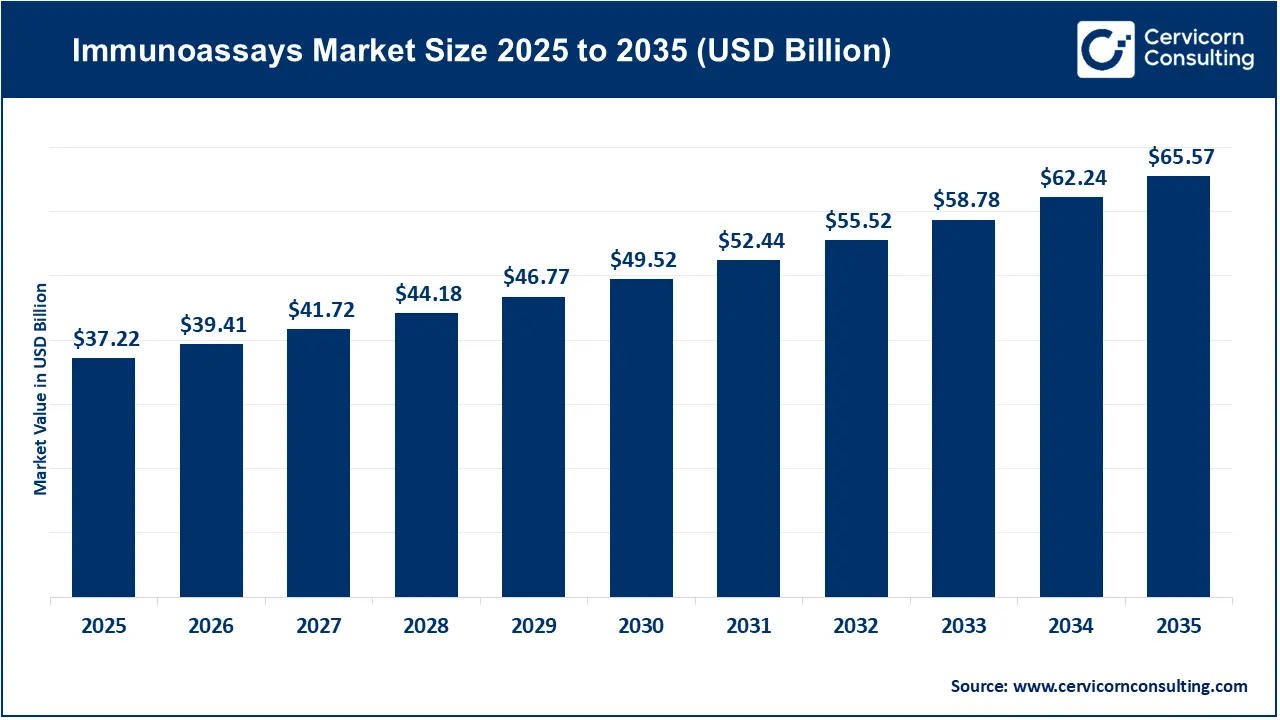
The global immunoassays market size was valued at USD 37.22 billion in 2025 and is projected to reach USD 65.57 billion by 2035, representing a 5.83% CAGR.
Immunoassays market growth factors
The global immunoassays market is expanding as healthcare systems increase their use of antibody-based diagnostic technologies for infectious diseases, cancer, cardiovascular disorders, endocrinology, autoimmune conditions, allergy testing, therapeutic drug monitoring and other applications. Growth is being supported by the rising prevalence of chronic and infectious diseases, increasing demand for early and accurate disease detection, expansion of clinical laboratory testing, improvements in automated analyzers, wider adoption of chemiluminescence and fluorescence-based technologies, growing use of multiplex testing, and the development of decentralized and point-of-care diagnostics.
The increasing integration of laboratory automation, digital connectivity and artificial intelligence is also improving laboratory throughput and workflow efficiency. In addition, government-backed screening programs, investments in healthcare infrastructure, expansion of diagnostic services in emerging economies, and the need for rapid pathogen detection are creating recurring demand for immunoassay reagents, kits, analyzers and related consumables.
Get a Free Sample: https://www.cervicornconsulting.com/sample/2765
What is the immunoassays market?
Immunoassays are analytical diagnostic methods that use the highly specific interaction between antibodies and antigens to detect and quantify substances in biological samples. Depending on the technology, immunoassays can identify hormones, proteins, antibodies, antigens, drugs, biomarkers, infectious agents and other analytes in blood, serum, plasma, urine and other specimens.
The market encompasses a broad range of reagents and kits, analyzers and instruments, software and services. Major technologies include enzyme-linked immunosorbent assays (ELISA), chemiluminescence immunoassays (CLIA), fluorescence immunoassays, radioimmunoassays, lateral-flow immunoassays and multiplex immunoassays. Immunoassays can be used in central laboratories as well as decentralized, point-of-care and potentially home-testing environments.
The technology has become an important component of modern in-vitro diagnostics because it can combine analytical sensitivity with relatively scalable workflows. Automated immunoassay platforms allow laboratories to process large numbers of samples while reducing manual intervention. The FDA defines IVDs as tests performed on specimens such as blood or tissue to detect disease or other conditions and notes their use in diagnosis, health monitoring and precision medicine.
Why is the immunoassays market important?
Immunoassays are important because they support multiple stages of the healthcare pathway, from screening and diagnosis to disease monitoring and treatment management. Their applications extend across infectious diseases, oncology, cardiology, endocrinology, reproductive health, autoimmune diseases, allergy testing and therapeutic drug monitoring.
In infectious disease diagnostics, immunoassays can detect pathogen-specific antigens or antibodies. This makes them useful in screening programs and clinical evaluation. In oncology, immunoassay-based measurements can support the detection and monitoring of specific biomarkers. In endocrinology, they are widely used for measuring hormones and related analytes.
The technology is also important for laboratories because automated immunoassay systems can consolidate multiple tests onto integrated platforms. This can help laboratories manage increasing testing volumes while supporting standardized workflows. As healthcare systems move toward earlier diagnosis and more preventive care, demand for reliable biomarker measurement is expected to remain an important market driver.
Another important factor is the expansion of testing outside traditional central laboratories. Lateral-flow and other rapid immunoassay formats can provide faster results and may be useful in decentralized healthcare environments. Meanwhile, high-throughput automated platforms continue to serve hospitals and reference laboratories.
Major companies shaping the immunoassays market
The competitive environment includes diversified medical-device companies, diagnostics specialists and life-science businesses. The companies below are among the important participants requested for this market assessment.
Abbott
Company: Abbott
Specialization: Diagnostics, medical devices, nutrition and pharmaceuticals
Key Focus Areas: Clinical chemistry, immunoassay diagnostics, integrated laboratory systems, point-of-care testing and diagnostic informatics
Notable Features: Abbott’s diagnostics portfolio includes the Alinity family of laboratory systems, which supports the company’s strategy of expanding integrated diagnostic testing.
2025 Revenue: USD 44.3 billion in total company sales.
Market Share: Abbott does not separately disclose a global immunoassay-market revenue figure in its annual reporting, so a precise immunoassay-specific market share cannot be calculated directly from company filings.
Global Presence: Abbott operates across North America, Europe, Asia-Pacific, Latin America, the Middle East and Africa.
Abbott’s diagnostics business remains a major component of the global laboratory-testing ecosystem. In 2025, Abbott reported that Diagnostics sales declined 4.5% excluding foreign exchange, primarily because of lower COVID-19 testing demand and challenging conditions in China, while routine diagnostic testing volumes and deployment of the Alinity platform provided offsets.
BD
Company: Becton, Dickinson and Company (BD)
Specialization: Medical technology, diagnostics, laboratory systems and medication management
Key Focus Areas: Sample collection, microbiology, laboratory automation, diagnostic systems and integrated laboratory workflows
Notable Features: BD combines diagnostic technologies with specimen-management and laboratory workflow solutions.
2025 Revenue: USD 21.84 billion.
Market Share: BD does not report an immunoassay-specific share as a separate financial category; therefore, company-wide revenue should not be interpreted as immunoassay revenue.
Global Presence: BD serves healthcare markets worldwide, with 2025 revenues of approximately USD 12.79 billion from the United States and USD 9.05 billion internationally.
BD’s global laboratory presence gives it opportunities to participate in diagnostic workflows in hospitals, reference laboratories and other healthcare settings. Its strategy has also emphasized geographic expansion, R&D investment and new product development.
Beckman Coulter, Inc.
Company: Beckman Coulter, Inc., part of Danaher Corporation
Specialization: Clinical diagnostics and laboratory automation
Key Focus Areas: Immunoassay, clinical chemistry, hematology, microbiology, automation and laboratory workflow optimization
Notable Features: Beckman Coulter’s portfolio includes automated laboratory analyzers and integrated diagnostic solutions designed for high-throughput environments.
2025 Revenue: Danaher reported USD 24.568 billion in total 2025 revenue, while its Diagnostics segment generated approximately USD 10.0 billion. Danaher does not separately report Beckman Coulter’s immunoassay revenue.
Market Share: Immunoassay-specific market share is not separately disclosed by Danaher.
Global Presence: Beckman Coulter products are marketed across North America, Europe, Asia-Pacific and other international markets.
Beckman Coulter is particularly relevant to the immunoassay market because of its focus on automated laboratory diagnostics. Danaher’s 2025 reporting identifies Diagnostics as a USD 10 billion segment, with 89% of segment revenue described as recurring, illustrating the importance of recurring laboratory demand within the broader business.
bioMérieux
Company: bioMérieux
Specialization: In-vitro diagnostics and infectious disease diagnostics
Key Focus Areas: Microbiology, molecular diagnostics, syndromic testing, infectious disease detection and laboratory diagnostics
Notable Features: The company combines multiple diagnostic technologies and has expanded its installed instrument base through platforms such as BIOFIRE and SPOTFIRE.
2025 Revenue: €4.07 billion in sales.
Market Share: bioMérieux does not publicly provide a standalone global immunoassay market-share percentage.
Global Presence: The company operates internationally, with a particularly strong presence in Europe, North America and emerging diagnostic markets.
bioMérieux’s 2025 results show continued expansion of its diagnostic platform ecosystem. BIOFIRE non-respiratory panels generated €598 million in sales, while SPOTFIRE generated €168 million, demonstrating the company’s emphasis on decentralized and rapid diagnostic workflows.
Bio-Rad Laboratories, Inc.
Company: Bio-Rad Laboratories, Inc.
Specialization: Clinical diagnostics and life-science research
Key Focus Areas: Immunohematology, quality control, infectious disease testing, laboratory diagnostics, research reagents and analytical systems
Notable Features: Bio-Rad combines clinical diagnostics with life-science research, providing reagents, instruments, consumables and systems.
2025 Revenue: USD 2.583 billion.
Market Share: The company does not separately disclose its immunoassay market share.
Global Presence: Bio-Rad has direct operations in more than 36 countries outside the United States and generates approximately 60% of consolidated sales internationally.
Bio-Rad’s Clinical Diagnostics segment represented approximately 60% of consolidated 2025 net sales, while Life Science represented approximately 40%. Its 2025 geographic revenue distribution was 46% Americas, 20% Asia-Pacific and 34% Europe, Middle East and Africa, highlighting its broad international footprint.
Note on market share: The companies above do not consistently disclose immunoassay-specific revenue. Therefore, assigning precise 2025 market-share percentages to individual companies would require third-party company-share estimates rather than audited company financial statements. The revenue figures above are total-company or parent-segment revenues and should not be interpreted as immunoassay sales.
Leading trends and their impact on the immunoassays market
Growth of chemiluminescence immunoassays
Chemiluminescence immunoassays are becoming increasingly important because they can support sensitive, automated and high-throughput testing. Their compatibility with automated analyzers makes them attractive for hospitals and reference laboratories handling large sample volumes.
The shift toward CLIA-based systems is also encouraging manufacturers to invest in analyzer performance, reagent menus and workflow integration. This creates recurring opportunities not only for instrument suppliers but also for reagent and consumables providers.
Multiplex immunoassays expand testing efficiency
Multiplexing enables multiple analytes to be measured from a single specimen. This is particularly relevant for research, infectious disease panels, oncology biomarker studies and complex clinical investigations.
The adoption of multiplex approaches could reduce the need for multiple separate tests and provide more comprehensive biological information. However, assay validation, interpretation and regulatory requirements remain important considerations.
Automation and laboratory integration
Laboratory automation is increasingly influencing immunoassay adoption. Modern systems can integrate sample preparation, analysis, result management and data connectivity. Automation can help laboratories address workforce shortages and rising testing volumes while reducing manual steps.
Digital laboratory infrastructure is also becoming more important as laboratories connect analyzers with laboratory information systems. FDA-recognized IVD standards include guidance related to laboratory information-system validation, demonstrating the increasing importance of digital infrastructure around diagnostic instruments.
Point-of-care and decentralized testing
Point-of-care immunoassays are expanding access to testing by moving diagnostics closer to patients. Rapid formats can be used in clinics, physician offices, pharmacies and other decentralized settings.
This trend is particularly relevant in regions where centralized laboratory infrastructure is unevenly distributed. Portable testing can support faster clinical decisions and improve access to screening.
AI and data analytics
Artificial intelligence is increasingly being incorporated into diagnostic workflows for quality control, interpretation, workflow optimization and decision support. Although immunoassays themselves depend on biochemical interactions, digital tools can enhance how test results are processed and interpreted.
The combination of automated analyzers, connected instruments and analytics could create new opportunities for diagnostic companies to offer complete laboratory solutions rather than individual tests.
Expansion of infectious disease testing
The continuing need for infectious disease surveillance remains an important market driver. Immunoassays can detect antigens or antibodies associated with infectious agents, making them useful across screening and diagnostic programs.
The experience of COVID-19 also demonstrated how quickly diagnostic demand can expand during public-health emergencies. Governments and regulators have subsequently continued to emphasize diagnostic preparedness and validation capabilities.
Increasing demand for biomarker testing
The growth of personalized medicine and targeted therapies is increasing the need to identify and monitor biomarkers. Immunoassay technologies can support quantitative measurement of proteins, hormones and other clinically relevant biomarkers.
This creates opportunities in oncology, cardiology, endocrinology and therapeutic drug monitoring, while also encouraging development of more sensitive and specific assays.
Successful examples of the immunoassays market around the world
United States: automated high-throughput laboratory diagnostics
The United States represents one of the most technologically advanced immunoassay markets, supported by large hospital networks, reference laboratories, pharmaceutical research and established regulatory infrastructure. Companies such as Abbott, BD, Beckman Coulter and Bio-Rad participate in different parts of the diagnostic ecosystem.
The country’s mature laboratory infrastructure supports demand for automated analyzers, reagent systems and connected diagnostic workflows. FDA recognition of consensus standards for immunoassay evaluation and performance further supports standardized development and validation.
Europe: regulatory-driven diagnostic quality
Europe is an important market because of its established healthcare systems and increasingly structured regulatory framework. The EU In Vitro Diagnostic Medical Devices Regulation (IVDR) introduced a more risk-based framework, strengthened performance evaluation requirements and increased the involvement of conformity-assessment bodies.
For immunoassay manufacturers, compliance with these requirements can increase development and documentation requirements while also emphasizing analytical performance, clinical evidence, quality management and post-market surveillance.
Asia-Pacific: expanding diagnostic infrastructure
Asia-Pacific is becoming an important growth region as healthcare infrastructure expands, laboratory capacity increases and diagnostic testing becomes more accessible. China, India, Japan, South Korea and Southeast Asian markets are investing in laboratory infrastructure and domestic medical-device capabilities.
India is particularly relevant because the government has been developing policies supporting domestic medical-device manufacturing and diagnostic capabilities. The National Medical Devices Policy, 2023 emphasizes regulatory streamlining, infrastructure, R&D and innovation, investment, human-resource development and industry promotion.
India: indigenous IVD validation
India also provides an example of government-supported development of domestic IVD capabilities. The Indian Council of Medical Research has established an IVD validation program intended to evaluate indigenously developed IVDs through scientific validation protocols. This initiative is aimed at strengthening the quality and credibility of locally developed diagnostic products.
Such initiatives can support domestic immunoassay developers by strengthening validation capabilities and potentially improving the competitiveness of locally produced diagnostic kits.
Global regional analysis
North America
North America remains a major immunoassay market because of its large healthcare expenditure, established clinical laboratory networks, high diagnostic-testing volumes and strong presence of multinational diagnostics companies. The United States dominates regional demand, supported by sophisticated hospital laboratories, reference laboratories, pharmaceutical research and decentralized testing.
Regulation is also a significant market factor. The FDA oversees IVDs and maintains recognized consensus standards covering aspects of immunoassay performance and laboratory testing. In January 2025, the FDA issued draft guidance addressing validation of certain IVDs for emerging pathogens during applicable public-health emergencies, highlighting the importance of diagnostic readiness.
Europe
Europe represents another established market, characterized by strong laboratory infrastructure, public healthcare systems and increasing regulatory emphasis on diagnostic safety and performance.
The IVDR is central to the region’s regulatory environment. It applies to IVD medical devices placed on the European Union market and introduces risk-based classification, more detailed performance requirements and stronger conformity-assessment processes.
These requirements are influencing product development, clinical evidence generation, quality systems and market-access strategies for immunoassay manufacturers.
Asia-Pacific
Asia-Pacific is supported by increasing healthcare investment, rising diagnostic awareness, growing chronic disease burdens and expansion of clinical laboratory networks. The region also offers manufacturing and localization opportunities.
China is a significant diagnostics market, although market-access requirements and procurement policies influence commercial strategies. Japan and South Korea provide technologically advanced laboratory environments, while India and Southeast Asia offer opportunities associated with expanding healthcare infrastructure.
India’s Medical Device Rules, 2017 establish a risk-based classification system for IVDs ranging from Class A to Class D, while import, manufacturing, sale and distribution are regulated under the medical-device framework.
Latin America
Latin America is experiencing increasing demand for laboratory diagnostics as healthcare systems expand access to testing. Brazil and Mexico represent important markets because of their population size and healthcare infrastructure.
The region’s immunoassay demand is linked to infectious disease surveillance, chronic disease management, hospital diagnostics and screening programs. However, differences in healthcare financing, import requirements and laboratory infrastructure can affect market penetration.
Middle East and Africa
The Middle East and Africa represent emerging opportunities for immunoassay manufacturers as healthcare infrastructure improves and diagnostic capacity expands. Gulf countries are investing in advanced hospitals and laboratory systems, while several African countries continue to strengthen infectious-disease surveillance and diagnostic capacity.
International health programs and government investments in infectious disease detection can create demand for rapid and laboratory-based immunoassays. The primary opportunity is increasingly centered on improving access to reliable testing rather than simply increasing instrument adoption.
Government initiatives and policies shaping the immunoassays market
Government policies are influencing the immunoassay market through regulation, diagnostic-quality standards, domestic manufacturing programs and public-health testing initiatives.
In the United States, FDA regulation establishes requirements for IVD development and market access, while recognized consensus standards provide technical frameworks for diagnostic performance. FDA guidance for emerging-pathogen IVD validation also demonstrates the role of diagnostics in public-health preparedness.
In the European Union, IVDR has significantly strengthened the regulatory framework for IVDs. The regulation covers placing IVDs on the market, performance studies and related devices, with greater emphasis on risk classification and performance evaluation.
In India, the Medical Device Rules, 2017 provide a risk-based regulatory structure for IVDs, while the National Medical Devices Policy, 2023 aims to encourage domestic manufacturing, research, infrastructure development and investment. The government has also supported IVD validation through ICMR initiatives intended to strengthen the scientific validation of indigenous diagnostic products.
These initiatives collectively shape the immunoassays market by raising expectations for product quality, analytical validation, clinical performance, manufacturing standards and post-market monitoring while simultaneously creating opportunities for innovative diagnostic technologies.
To Get Detailed Overview, Contact Us: https://www.cervicornconsulting.com/contact-us
Read Report: Data Center Lithium-ion Battery Market Revenue, Trends, and Strategic Insights by 2035