AI in Diagnostics Market Revenue, Trends, and Strategic Insights by 2035
AI in Diagnostics Market Size
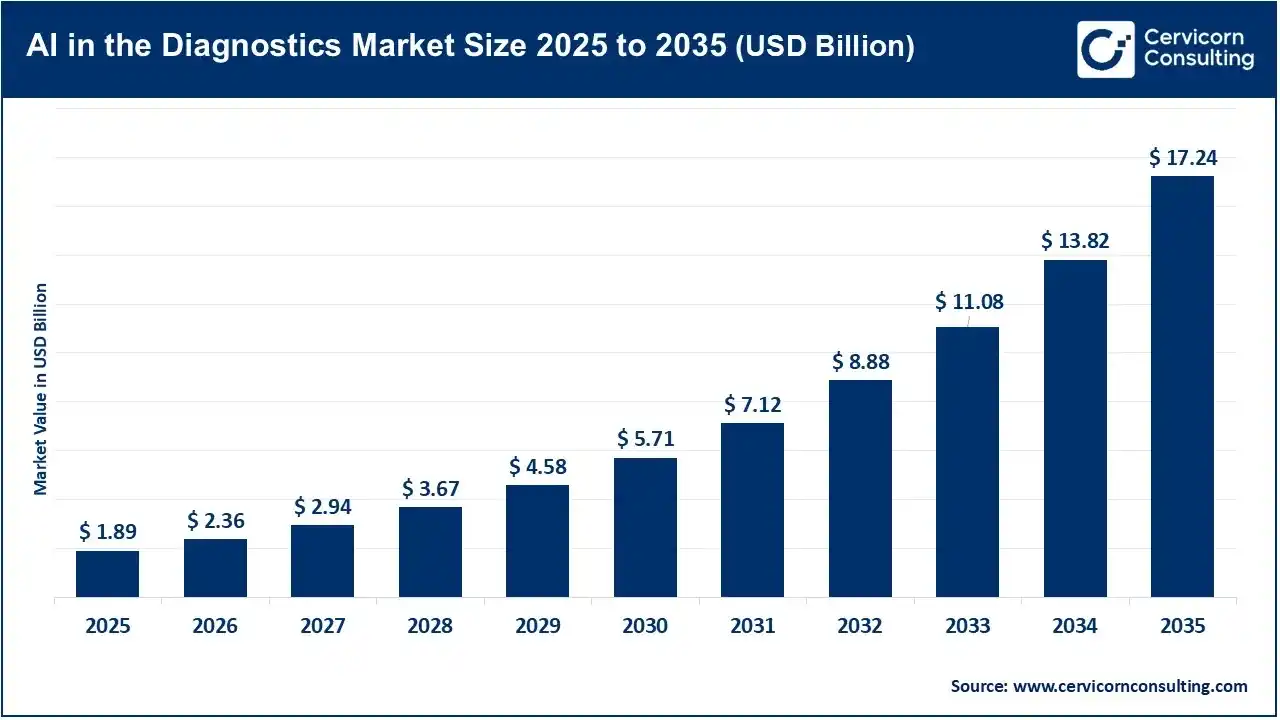
The global AI in diagnostics market size was valued at USD 1.89 billion in 2025 and is projected to reach USD 17.24 billion by 2035, representing a 24.74% CAGR.
AI in diagnostics market growth factors
The global AI in diagnostics market is expanding rapidly as healthcare providers increasingly adopt artificial intelligence for medical imaging, pathology, disease detection, clinical decision support, and diagnostic workflow optimization. The market is being driven by the growing volume and complexity of medical data, rising incidence of chronic diseases, increasing demand for early and accurate disease detection, shortages of radiologists and other specialized healthcare professionals, improvements in machine learning and deep learning algorithms, and growing investments in digital health infrastructure.
AI can analyze large volumes of medical images and clinical information at high speed, supporting clinicians in identifying abnormalities and prioritizing urgent cases. The increasing adoption of cloud-based healthcare platforms is also improving the scalability of AI diagnostic applications across hospitals and diagnostic centers.
At the same time, advances in computer vision, natural language processing, generative AI, and multimodal models are expanding AI beyond image analysis toward integrated clinical decision support. Regulatory progress is another important growth factor, with authorities such as the U.S. FDA maintaining dedicated frameworks and databases for AI-enabled medical devices. Increasing healthcare digitization in Asia Pacific, investments in precision medicine, growing use of AI-assisted radiology and pathology, and the expansion of AI applications into cardiology, oncology, neurology, ophthalmology, and point-of-care diagnostics are creating additional opportunities for vendors.
Get a Free Sample: https://www.cervicornconsulting.com/sample/3028
What is the AI in diagnostics market?
The AI in diagnostics market encompasses technologies, software, platforms, and services that use artificial intelligence to support the detection, interpretation, classification, and monitoring of diseases and medical conditions.
AI diagnostics typically combine machine learning, deep learning, computer vision, natural language processing, predictive analytics, and increasingly generative AI with healthcare data. The underlying data can include X-rays, CT scans, MRI images, ultrasound images, pathology slides, retinal images, ECG signals, laboratory results, genomic information, electronic health records, and clinical notes.
Radiology remains one of the most mature application areas because diagnostic imaging produces large quantities of structured visual data suitable for algorithmic analysis. AI systems can identify suspicious findings, segment organs and lesions, quantify disease characteristics, reconstruct images, prioritize examinations, and support radiologists during interpretation.
The market is also expanding into pathology, cardiology, oncology, neurology, ophthalmology, emergency medicine, and laboratory diagnostics. Rather than replacing physicians, many commercial systems are designed to provide clinical decision support, automate repetitive tasks, flag potentially urgent findings, and help clinicians process information more efficiently.
The growing number of regulatory clearances illustrates the expansion of this ecosystem. The U.S. FDA maintains a continuously updated list of AI-enabled medical devices, with numerous products from Siemens, GE HealthCare, Philips, Aidoc, and other vendors appearing across radiology and other clinical specialties.
Why is AI in diagnostics important?
AI is becoming important because diagnostic healthcare generates more information than clinicians can efficiently process manually. A single hospital can produce thousands of imaging studies, laboratory measurements, pathology slides, and clinical records every day. AI can help organize and analyze these datasets while identifying patterns that may require further clinical attention.
One of the most important applications is early disease detection. AI algorithms can identify subtle patterns in medical images and other diagnostic data that may otherwise be difficult to recognize. In oncology, for example, AI can support the identification and characterization of tumors. In cardiology, algorithms can analyze ECGs and imaging data to identify potential cardiovascular abnormalities.
AI also has the potential to improve workflow efficiency. Automated triage can prioritize potentially critical cases, allowing clinicians to review urgent examinations sooner. Automated segmentation and measurements can reduce repetitive manual work, while AI-based reconstruction can support faster imaging workflows.
Another important benefit is extending specialist capabilities. Healthcare systems in rural and underserved areas frequently face shortages of radiologists, pathologists, and other specialists. Cloud-connected AI platforms can provide decision-support capabilities across geographically distributed healthcare facilities.
AI diagnostics is also becoming important for personalized medicine. By combining imaging, laboratory, genomic, and clinical information, AI systems can help identify patient-specific disease patterns and potentially support more targeted treatment decisions.
However, clinical validation, data quality, interoperability, cybersecurity, explainability, regulatory compliance, and physician acceptance remain important considerations. AI therefore increasingly needs to be integrated into clinical workflows rather than operating as an isolated software tool.
Company landscape and competitive positioning
| Company | Specialization | Key Focus Areas | Notable Features | 2025 Revenue | AI Diagnostics Market Share | Global Presence |
|---|---|---|---|---|---|---|
| Siemens Healthineers | Medical imaging, diagnostics, cancer care and digital health | Radiology, imaging, laboratory diagnostics, oncology, AI-assisted workflows | AI-Rad Companion, AI-powered imaging and clinical workflow technologies | ~€23.4 billion | 9.8% (latest publicly cited 2024 estimate) | More than 180 countries; direct representation in more than 70 |
| GE HealthCare | Medical imaging, ultrasound, patient care and pharmaceutical diagnostics | CT, MRI, ultrasound, imaging AI, cardiology, diagnostics | Edison ecosystem, AI-assisted imaging and workflow technologies | $20.625 billion | Not publicly disclosed | Global operations across USCAN, EMEA, China and Rest of World |
| Koninklijke Philips N.V. | Health technology and diagnostic systems | Precision diagnosis, imaging, ultrasound, pathology, connected care | AI-enabled imaging, clinical decision support and connected-care platforms | €17.8 billion | Not publicly disclosed | Global presence across mature and growth markets |
| Aidoc | Clinical AI software | Radiology, emergency medicine, neurovascular, cardiovascular and enterprise AI | aiOS platform, automated detection, triage and clinical notifications | Private company; revenue not publicly disclosed | Not publicly disclosed | More than 1,600 hospitals worldwide |
| Zebra Technologies | Healthcare workflow technology, machine vision and intelligent automation | Point-of-care workflows, data capture, computer vision, clinical communication | AI-enabled OCR, machine vision, mobile computing and healthcare workflow tools | $5.396 billion | Not publicly disclosed | More than 100 countries; channel partners in about 179 countries |
Market-share figures are not consistently disclosed by individual companies. The 9.8% figure for Siemens Healthineers is a third-party market estimate for 2024 rather than company-reported 2025 share. Company revenue refers to total company/group revenue, not AI-diagnostics revenue.
Siemens Healthineers is a major participant in AI-enabled imaging and diagnostics. The company generated approximately €23.4 billion in fiscal 2025 and operates in more than 180 countries, with direct representation in more than 70. Its portfolio combines medical imaging, laboratory diagnostics, cancer care, digital technologies, and artificial intelligence. The company has continued positioning healthcare AI as an important component of its strategy, including AI-powered imaging and radiology technologies.
GE HealthCare generated $20.625 billion in 2025 revenue. Its imaging business includes CT, MRI, molecular imaging, X-ray, ultrasound, and related digital technologies, making it an important participant in AI-assisted diagnostic imaging. Its 2025 revenue was distributed across Imaging, Advanced Visualization Solutions, Patient Care Solutions, and Pharmaceutical Diagnostics.
Koninklijke Philips N.V. reported €17.8 billion in group sales in 2025. Its Diagnosis & Treatment activities include imaging and precision diagnostic technologies, while connected-care capabilities provide opportunities for AI-supported clinical workflows. Philips reported flat comparable sales in Diagnosis & Treatment in 2025, alongside growth in other businesses.
Aidoc represents a different competitive model because it focuses primarily on clinical AI software rather than broad medical equipment portfolios. Its platform supports radiology, cardiovascular, neurovascular, emergency, and enterprise workflows. Aidoc states that more than 1,600 hospitals worldwide use its AI-powered technology and medical AI platform.
Zebra Technologies is more strongly positioned around healthcare workflow digitization, mobile computing, machine vision, data capture, and intelligent automation than core diagnostic interpretation. Its healthcare technologies can support point-of-care data access, specimen management, clinical communication, and AI-powered machine vision. Zebra reported $5.396 billion in 2025 sales and operates across a broad international partner network.
Leading trends and their impact
Generative AI and multimodal diagnostics
Generative AI is moving diagnostic AI beyond narrowly defined algorithms. Newer systems can potentially combine imaging, laboratory information, clinical notes, patient history, and other data sources to provide more comprehensive decision support.
The impact is significant because clinicians often need to interpret several forms of information simultaneously. Multimodal AI could help connect imaging findings with clinical context, although validation and governance requirements remain essential before widespread clinical deployment.
AI-assisted medical imaging
Radiology remains one of the strongest areas for AI adoption. Algorithms are being integrated into CT, MRI, X-ray, mammography, ultrasound, and molecular imaging workflows.
AI can support image reconstruction, segmentation, lesion detection, quantification, prioritization, and reporting. Regulatory activity also demonstrates the breadth of innovation: FDA records from 2025 and 2026 include AI-enabled products from Siemens Healthineers, GE HealthCare, Philips, and Aidoc across radiology and related specialties.
AI in pathology
Digital pathology is becoming another important application. AI can analyze digitized tissue slides, identify suspicious cellular patterns, quantify biomarkers, and support cancer diagnosis.
The trend is particularly important for oncology because pathology workflows can involve large numbers of high-resolution images. AI-assisted analysis can help pathologists manage workloads and standardize quantitative assessments.
AI-powered early detection
Healthcare providers are increasingly interested in identifying diseases before symptoms become severe. AI can analyze diagnostic images and other clinical information to identify risk patterns associated with cancer, cardiovascular disease, neurological disorders, and other conditions.
Earlier identification can support faster clinical investigation and treatment planning, although AI outputs still require appropriate clinical confirmation.
Cloud-based diagnostic AI
Cloud deployment is expanding the reach of AI beyond individual imaging workstations. Hospitals can access centralized algorithms and update models across multiple facilities.
Cloud-based systems can also facilitate centralized management, software updates, model monitoring, and integration with enterprise imaging platforms. However, healthcare organizations must address cybersecurity, privacy, data residency, connectivity, and interoperability.
AI for workflow automation
AI is increasingly being used for tasks surrounding diagnosis rather than diagnosis alone. These include examination prioritization, report assistance, image routing, patient follow-up, data extraction, and clinical notifications.
This trend is important because healthcare providers are seeking measurable operational improvements in addition to diagnostic accuracy.
Point-of-care and portable diagnostics
AI is also moving toward portable and point-of-care devices. Smartphone-connected imaging, portable ultrasound, digital microscopy, and compact diagnostic devices can bring AI-supported analysis closer to patients.
This trend could be particularly significant in emerging markets where specialist availability and diagnostic infrastructure remain uneven.
Successful examples of AI in diagnostics around the world
AI-assisted radiology in the United States
The United States has become an important environment for commercial AI diagnostics because of its large healthcare system, advanced imaging infrastructure, and established regulatory pathway for software-enabled medical devices.
The FDA’s AI-enabled medical device database illustrates the breadth of adoption. During 2025, the agency recorded clearances for products involving Siemens Healthineers, GE HealthCare, Philips, and Aidoc across areas including radiology, cardiovascular diagnostics, and other specialties.
Enterprise clinical AI through Aidoc
Aidoc provides an example of how AI can move from individual diagnostic algorithms toward enterprise-wide deployment. Its AI platform connects clinical applications across radiology, cardiovascular, neurovascular, and emergency workflows.
The company reports deployment across more than 1,600 hospitals worldwide, demonstrating the movement toward scalable clinical AI platforms rather than isolated point solutions.
AI-enabled imaging in Europe
European medical technology companies are increasingly integrating AI into imaging equipment and clinical workflows. Siemens Healthineers has developed AI-enabled imaging technologies and continues to position healthcare AI as a strategic growth and innovation area.
The company reported approximately €23.4 billion in fiscal 2025 revenue and maintains operations in more than 180 countries.
Healthcare workflow AI in global hospitals
Zebra Technologies demonstrates another dimension of AI adoption: supporting clinicians and healthcare operations through intelligent automation. Its healthcare portfolio includes AI-powered OCR and machine vision capabilities that can automate data capture and support inspection and workflow processes.
At HIMSS 2025, Zebra highlighted AI-powered deep-learning OCR and computer vision technologies for healthcare applications, including surgical instrument processing and point-of-care workflows.
AI-enabled diagnostics in India
India represents an important growth market because of its large population, expanding digital health infrastructure, growing medical technology ecosystem, and uneven distribution of specialist healthcare professionals.
AI applications are expanding across radiology, pathology, ECG interpretation, remote monitoring, and point-of-care diagnostics. Industry discussions increasingly emphasize the need for Indian clinical validation, interoperability, regulatory clarity, and reimbursement mechanisms to move AI solutions from pilots toward large-scale implementation.
Global regional analysis, including government initiatives and policies
North America
North America remains a major AI diagnostics market because of its advanced healthcare infrastructure, high healthcare technology spending, strong AI ecosystem, and concentration of medical technology companies.
The United States has established a relatively mature regulatory pathway for AI-enabled medical devices. The FDA maintains an AI-enabled medical device list that provides visibility into authorized products and their clinical categories. The database includes a growing number of radiology and other diagnostic technologies.
The region is also benefiting from healthcare-provider investments in enterprise imaging, cloud infrastructure, digital pathology, and AI-enabled clinical workflows.
Europe
Europe has a strong medical technology base and is simultaneously developing a comprehensive framework for artificial intelligence governance.
Under the EU AI Act, certain AI systems associated with regulated medical devices and in-vitro diagnostic medical devices can fall within high-risk classifications when specified conditions are met. The regulatory framework emphasizes areas such as risk management, conformity assessment, transparency, and human oversight.
The European framework is therefore shaping how vendors develop, validate, document, and deploy medical AI. The European Commission has also been developing guidance on the classification of high-risk AI systems.
Asia Pacific
Asia Pacific is emerging as an important growth region due to increasing healthcare expenditure, large patient populations, expanding hospital infrastructure, growing digitalization, and rising investments in AI.
China, Japan, South Korea, India, Singapore, and Australia are developing AI and digital-health capabilities, with applications spanning medical imaging, clinical decision support, remote healthcare, and diagnostics.
India is particularly relevant because AI can potentially support healthcare delivery in regions where specialist availability is limited. However, interoperability, clinical validation, data governance, affordability, and reimbursement remain important considerations for large-scale deployment.
India
India’s healthcare AI ecosystem is developing alongside the country’s broader digital-health infrastructure. AI-enabled medical technologies are increasingly being explored for radiology, pathology, cardiology, ECG analysis, remote monitoring, and point-of-care screening.
Regulatory development is also evolving. The country’s medical-device framework and software-related classifications are increasingly relevant to AI-enabled diagnostic products, while industry stakeholders continue to emphasize the importance of appropriate clinical evidence and testing infrastructure.
Recent Indian medtech discussions have highlighted AI’s potential to extend specialist capabilities into underserved and rural areas, while also identifying fragmented data, interoperability, limited clinical validation, and reimbursement gaps as barriers to adoption.
United Kingdom
The United Kingdom is developing its approach to AI healthcare regulation through the Medicines and Healthcare products Regulatory Agency and broader government initiatives.
A National Commission into the Regulation of AI in Healthcare was launched by the MHRA in September 2025 to examine regulation of AI-enabled medical technologies as well as accountability, transparency, clinical practice, governance, and system-level assurance.
The UK approach reflects the increasing recognition that AI diagnostics require continuous oversight because algorithms can evolve, be updated, and interact with changing clinical environments.
Middle East and Africa
The Middle East is increasingly investing in digital hospitals, smart healthcare infrastructure, medical imaging, and AI. Countries such as the United Arab Emirates and Saudi Arabia are developing national strategies that encourage AI adoption and digital transformation.
In Africa, AI diagnostics has potential applications in screening, radiology, pathology, and remote healthcare because specialist resources are unevenly distributed. However, infrastructure, connectivity, data availability, affordability, and local clinical validation remain important adoption factors.
Latin America
Latin American healthcare systems are gradually adopting digital imaging, electronic health records, telemedicine, and AI-supported diagnostic technologies. Brazil and Mexico represent important markets because of their large healthcare systems and expanding technology ecosystems.
The region’s adoption trajectory is closely linked to healthcare digitization, investment capacity, regulatory development, interoperability, and access to specialized medical professionals.
Government initiatives and policies shaping AI diagnostics
Government policy is becoming a major factor in the AI diagnostics market. Regulatory agencies are moving toward frameworks that emphasize clinical safety, algorithmic performance, cybersecurity, transparency, and post-market monitoring.
In the United States, FDA authorization and the AI-enabled medical device database provide a regulatory foundation for commercial AI diagnostic products.
In Europe, the EU AI Act introduces additional governance requirements for qualifying high-risk AI systems, including certain medical-device-related applications. The framework is expected to influence product development, conformity assessment, documentation, and deployment practices.
The United Kingdom is developing additional healthcare-specific AI regulatory recommendations through the MHRA-led National Commission into the Regulation of AI in Healthcare.
In India, evolving medical-device regulation and investment in testing infrastructure are shaping the environment for AI-enabled medtech. Recent industry developments have also emphasized the importance of internationally accredited testing capabilities to support medical-device innovation and manufacturing.
Across regions, the direction of policy is increasingly moving from simply encouraging AI innovation toward establishing mechanisms for clinical validation, accountability, transparency, cybersecurity, human oversight, and continuous monitoring. This regulatory evolution is likely to influence which AI diagnostics technologies can move successfully from research and pilot programs into routine clinical use.
To Get Detailed Overview, Contact Us: https://www.cervicornconsulting.com/contact-us
Read Report: Insulin Delivery Devices Market Revenue, Trends, and Strategic Insights by 2035