Liquid Packaging Market Revenue, Trends, and Strategic Insights by 2035
Liquid Packaging Market Size
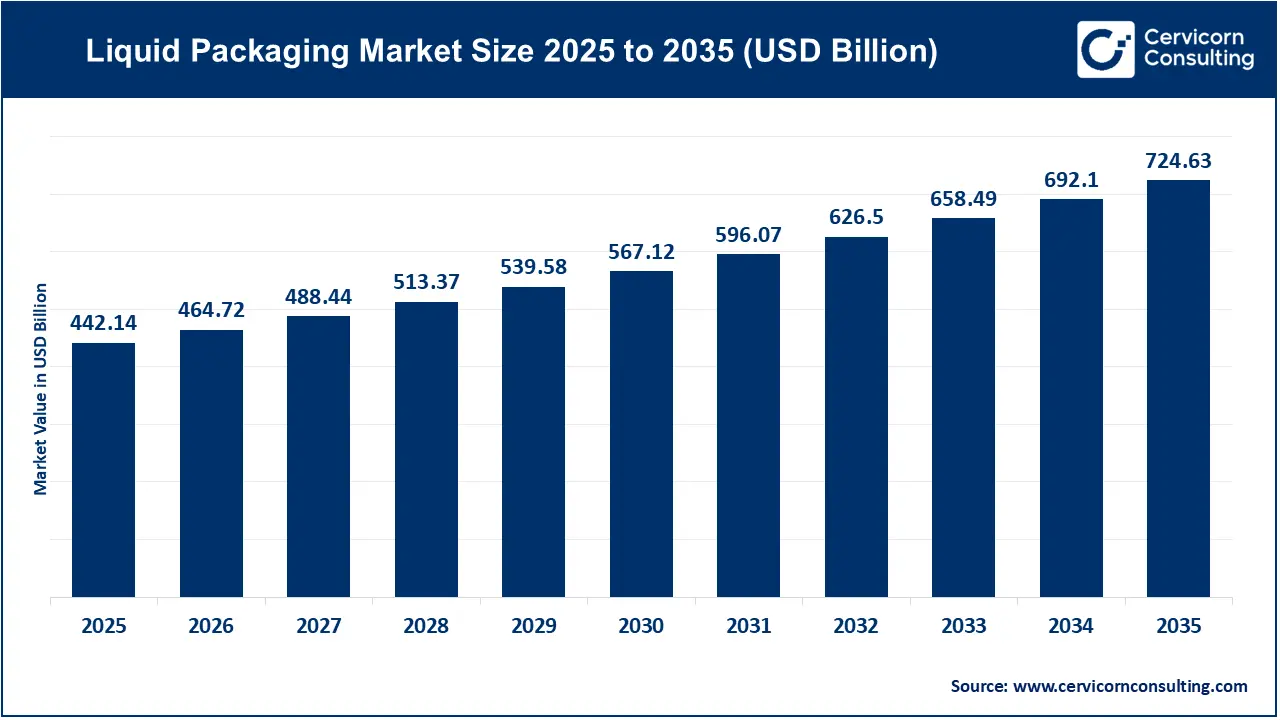
The global liquid packaging market was valued at approximately USD 442.14 billion in 2025 and is projected to reach around USD 724.63 billion by 2035, expanding at a CAGR of approximately 5.06% during the forecast period.
Liquid Packaging Market Growth Factors
The liquid packaging market is expanding because of rising consumption of packaged beverages, dairy products, ready-to-drink beverages, liquid foods, pharmaceuticals, personal care products, and household products; rapid urbanization and changing lifestyles are encouraging consumers to choose convenient, portable, resealable, and easy-to-store liquid products; the expansion of modern retail and e-commerce is increasing demand for leak-resistant, tamper-evident, lightweight, and transport-efficient packaging; growing demand for extended shelf life is supporting aseptic cartons, high-barrier films, multilayer structures, and advanced closures; sustainability regulations are accelerating investments in recyclable, lightweight, paper-based, bio-based, and reduced-material packaging; and technological advances in filling, barrier coatings, digital printing, intelligent packaging, and automation are allowing manufacturers to improve product protection while reducing material consumption and manufacturing waste.
Get a Free Sample: https://www.cervicornconsulting.com/sample/2738
What Is the Liquid Packaging Market?
The liquid packaging market refers to the global industry involved in designing, manufacturing, supplying, and recycling packaging formats specifically intended to contain, protect, transport, dispense, and preserve liquid products. The market spans packaging materials such as plastics, paper and paperboard, glass, and metal, as well as rigid and flexible packaging formats.
Liquid packaging is particularly important because liquids present different packaging challenges from dry products. Packaging must prevent leakage, contamination, evaporation, oxidation, moisture ingress, and degradation while maintaining structural integrity during transportation and storage.
Major applications include:
- Milk and dairy products
- Fruit juices and beverages
- Bottled water
- Plant-based beverages
- Soft drinks
- Edible oils
- Sauces and liquid foods
- Pharmaceutical liquids
- Cosmetics and personal-care products
- Household cleaning products
- Industrial chemicals and lubricants
The market is also closely connected with aseptic processing. Aseptic liquid packaging allows products such as milk and juice to be processed and packed under controlled conditions, enabling long shelf life without conventional refrigeration. Tetra Pak, for example, describes its aseptic carton system as a combination of UHT processing and multilayer packaging that protects milk from light, air, and microorganisms.
Why Is Liquid Packaging Important?
Liquid packaging plays a critical role across the global consumer and industrial economy because it performs several functions simultaneously.
Product protection
Liquid packaging protects contents from oxygen, moisture, light, microorganisms, physical damage, and contamination. This is especially important for milk, juices, pharmaceutical formulations, and sensitive personal-care products.
Longer shelf life
Aseptic and high-barrier packaging can significantly extend the usable life of products. Longer shelf life helps manufacturers distribute products over greater distances and reduces dependence on continuous cold-chain infrastructure.
Food waste reduction
Better packaging can reduce spoilage during transportation, retail storage, and household consumption. This is particularly valuable in emerging markets where refrigeration and distribution infrastructure may be less developed.
Consumer convenience
Lightweight bottles, cartons, pouches, spouted packs, and resealable containers make products easier to carry, open, store, and consume.
Sustainability
The industry is increasingly moving toward lower material consumption, recyclable structures, renewable materials, recycled content, and packaging designs that support circular-economy objectives.
Supply-chain efficiency
Lightweight liquid packaging can reduce transportation weight and improve warehouse utilization. Flexible packaging and compact carton formats can also increase logistical efficiency compared with heavier traditional containers.
Major Companies in the Liquid Packaging Market
The competitive landscape includes global packaging companies with different areas of specialization. Importantly, company-wide revenue should not be interpreted as liquid-packaging revenue, because many of these companies also serve healthcare, food, personal care, industrial, and other packaging markets.
| Company | Specialization | Key Focus Areas | Notable Features | 2025 Revenue | Market Share* | Global Presence |
|---|---|---|---|---|---|---|
| Tetra Pak International S.A. | Aseptic cartons, liquid-food processing and filling | Dairy, beverages, juice, plant-based products, sustainability | Integrated processing, filling, cartons, automation and services | €12.35B net sales | 16.42% in liquid packaging cartons | >165 countries |
| SIG Combibloc Group Ltd. | Aseptic cartons, bag-in-box and spouted pouches | Sustainable cartons, aseptic technology, digitalization | Integrated filling systems and packaging materials | €3.25B | Not separately disclosed | >100 countries |
| Elopak ASA | Fresh and aseptic cartons | Dairy, plant-based beverages, juice, sustainable cartons | Pure-Pak®, renewable/recycled polymers, low-carbon packaging | €1.206B | Not separately disclosed | 40+ countries/markets |
| Smurfit Kappa Group / Smurfit Westrock | Paper-based packaging and liquid packaging solutions | Paperboard, corrugated packaging, sustainability | Large-scale fiber-based packaging network | $31.18B net sales | Not separately disclosed | 40 countries |
| Amcor plc | Flexible and rigid packaging, containers and closures | Food, beverage, healthcare, personal care | Broad material portfolio and global manufacturing network | $15.01B FY2025 net sales | 16% in one 2025 liquid-packaging estimate | 40+ countries |
*Market-share figures are based on available third-party estimates for liquid packaging or liquid-carton segments rather than audited company disclosures. Tetra Pak’s 16.42% figure specifically relates to the 2025 liquid packaging cartons market, while Amcor’s 16% figure comes from a broader liquid-packaging market estimate. Therefore, these percentages should not be treated as directly comparable.
Tetra Pak International S.A.
Tetra Pak remains one of the most influential companies in liquid food packaging, particularly in aseptic cartons. Its portfolio extends beyond cartons to processing equipment, filling systems, automation, digital solutions, distribution equipment, and services.
Tetra Pak reported €12.35 billion in 2025 net sales, operated in more than 165 countries, employed 24,617 people, and had 52 production plants. Its integrated business model is a major competitive advantage because customers can obtain packaging materials and the equipment needed to process and fill products from the same ecosystem.
In India, Tetra Pak’s aseptic milk solutions have also supported programs such as school milk distribution, where UHT milk can be transported without a conventional cold chain.
SIG Combibloc Group Ltd.
SIG specializes in aseptic carton packaging, bag-in-box solutions, spouted pouches, filling systems, and related services. Its 2025 revenue reached €3.2487 billion, with carton, bag-in-box, and spouted-pouch sales representing the largest part of the business.
SIG’s sustainability strategy is increasingly centered on reducing aluminum use and increasing paper content. In 2025, it introduced an aluminum-free full-barrier aseptic carton solution for multi-serve applications. SIG says the structure can reduce the carbon footprint of standard aseptic cartons by up to 61% when combined with forest-based polymers.
Elopak ASA
Elopak is particularly recognized for its Pure-Pak® carton platform for fresh and aseptic liquid products. Its strategy focuses strongly on fiber-based packaging, renewable and recycled polymers, recycling compatibility, and lower-carbon solutions.
Elopak generated €1.206 billion in 2025 revenue, up 4.2% year over year. The company also reduced absolute Scope 1 and 2 emissions by 39% against its 2020 baseline and maintained 100% renewable electricity across its manufacturing operations.
India is becoming increasingly important for Elopak. Its Roll Fed business in India delivered 28% organic revenue growth in 2025, while the company began introducing chilled Pure-Pak cartons to Indian customers.
Smurfit Kappa Group / Smurfit Westrock
Smurfit Kappa combined with WestRock in 2024 to create Smurfit Westrock, significantly increasing its scale in paper and packaging. The company operates across paper-based packaging, corrugated solutions, consumer packaging, and liquid packaging-related applications.
Smurfit Westrock reported $31.179 billion in 2025 net sales, compared with $21.109 billion in 2024, with the increase primarily reflecting the WestRock combination. The company operated in 40 countries during 2025.
Its competitive positioning in liquid packaging is particularly relevant where fiber-based materials, paperboard structures, and renewable packaging are replacing heavier or more difficult-to-recycle alternatives.
Amcor plc
Amcor provides flexible and rigid packaging, specialty cartons, containers, closures, and dispensing solutions. The company expanded substantially following its merger with Berry Global in 2025.
Amcor reported $15.009 billion in fiscal 2025 net sales, including $10.872 billion from Global Flexible Packaging Solutions and $4.137 billion from Global Rigid Packaging Solutions.
The company’s broad portfolio positions it strongly across beverage containers, flexible liquid packaging, healthcare liquids, personal-care products, and other consumer applications. Its post-merger footprint spans more than 400 locations in over 40 countries.
Leading Trends and Their Impact on the Liquid Packaging Market
1. Shift Toward Sustainable Packaging
Sustainability is becoming one of the strongest forces reshaping liquid packaging. Brand owners are reducing packaging weight, increasing recycled content, adopting renewable materials, and investigating paper-based and mono-material structures.
The impact is substantial: packaging suppliers increasingly need to demonstrate not only product performance but also recyclability, carbon footprint, material sourcing, and end-of-life performance.
2. Growth of Aseptic Packaging
Aseptic packaging is expanding because it allows manufacturers to distribute liquid products with extended shelf life. It is particularly attractive for dairy, juices, plant-based beverages, nutritional products, and liquid foods.
The technology can reduce dependence on refrigeration and enable products to reach markets with less developed cold-chain infrastructure.
3. Aluminum-Free Cartons
The removal or reduction of aluminum layers is becoming an important innovation area. SIG’s 2025 aluminum-free full-barrier solution demonstrates how suppliers are attempting to preserve oxygen and light protection while simplifying material structures.
The transition can potentially improve recycling compatibility and reduce carbon impacts while maintaining shelf life.
4. Lightweighting
Manufacturers are using thinner films, reduced plastic content, optimized closures, lightweight bottles, and lower-material carton designs.
Lightweighting reduces raw-material requirements and can lower transportation emissions. However, manufacturers must maintain sufficient strength, barrier properties, and leak resistance.
5. Smart and Connected Packaging
QR codes, digital printing, RFID, traceability systems, temperature indicators, and connected packaging are creating new opportunities.
For pharmaceutical and premium liquid products, smart packaging can help improve authenticity and traceability. In food and beverage markets, digital features can support consumer engagement, product information, and recycling instructions.
6. E-Commerce and Direct-to-Consumer Distribution
Online grocery and direct-to-consumer delivery are increasing the need for robust liquid packaging. Products need to withstand handling, vibration, stacking, and last-mile transportation.
As a result, leak resistance, tamper evidence, resealability, and compact formats are gaining importance.
7. Growth of Plant-Based and Functional Beverages
The expansion of plant-based milk, protein drinks, functional beverages, nutritional products, and ready-to-drink products is creating additional demand for aseptic cartons, bottles, pouches, and other specialized liquid formats.
SIG, for example, has highlighted drinksplus technology that allows particulate ingredients such as fiber and fruit pieces to be incorporated into beverages, responding to changing health and nutrition preferences.
Successful Examples of Liquid Packaging Around the World
India: Aseptic Milk and School Nutrition
India provides a strong example of how liquid packaging can solve distribution and food-safety challenges. Tetra Pak’s aseptic technology has been used with Verka Dairy Chandigarh to package UHT milk for school programs. Because the milk can be safely transported and stored without conventional refrigeration, the packaging supports distribution to schools while helping maintain food quality.
India is also becoming a manufacturing and innovation hub for international liquid-packaging companies. SIG’s first Indian aseptic carton plant in Ahmedabad became fully operational in 2025, supplying dairy and non-carbonated soft-drink producers and serving as a potential export hub for neighboring Asian markets.
Germany: Aluminum-Free Aseptic Juice Cartons
SIG’s aluminum-free full-barrier carton technology provides another notable example. In 2025, ALDI began offering grape juice in parts of Germany using SIG’s new packaging material. The company reported a 29% carbon-footprint reduction for the multi-serve carton compared with its conventional equivalent.
This illustrates how sustainability innovation can move from laboratory development into mainstream retail.
South Korea: Recyclability-Oriented Aseptic Packaging
Seoul Dairy Cooperative became the first company in South Korea to launch products in SIG Terra Alu-free + Full barrier cartons recognized as recyclable under Korea’s recyclability grading system. The initial product was organic white milk.
The example demonstrates the growing relationship between packaging innovation and national recyclability requirements.
India: Elopak’s Expansion
Elopak’s expansion in India also illustrates how companies are adapting their portfolios to emerging markets. The company entered India through a partnership structure, expanded Roll Fed production, and introduced chilled Pure-Pak cartons in 2025. Its Indian Roll Fed business reached €43 million in revenue, with 28% organic growth during the year.
Global Regional Analysis Including Government Initiatives and Policies
North America
North America is a major market for liquid packaging because of high consumption of packaged beverages, dairy products, personal-care products, pharmaceuticals, and household liquids. Demand is shifting toward lightweight rigid containers, flexible packaging, recyclable structures, and premium sustainable formats.
The United States also remains an important investment destination for packaging manufacturers. Elopak opened its first U.S. production facility in Little Rock, Arkansas, in 2025, supporting its expansion in the Americas.
Government and regulatory pressure is increasingly focused on recycling, packaging waste, recycled content, and producer responsibility. State-level packaging policies are becoming particularly important, meaning companies selling liquid products across the United States increasingly need packaging strategies that can accommodate different state requirements.
Canada is similarly emphasizing waste reduction and extended producer responsibility through provincial programs. These policies are encouraging brands and packaging suppliers to improve recyclability and take greater responsibility for packaging after consumption.
Europe
Europe is one of the most advanced regions in sustainable liquid packaging. The region has strong consumer demand for recyclable packaging and an increasingly comprehensive regulatory framework.
The most significant recent development is the European Union’s Packaging and Packaging Waste Regulation (PPWR). Regulation (EU) 2025/40 entered into force on February 11, 2025, and began applying from August 12, 2026. The European Commission has also issued implementation guidance to help businesses and member states apply the rules consistently.
The regulation is increasing pressure on packaging producers and brand owners to address packaging minimization, recyclability, waste prevention, and circularity. This favors suppliers capable of developing fiber-based cartons, recyclable polymers, reduced-material structures, and packaging with improved end-of-life pathways.
Companies such as Tetra Pak, SIG, and Elopak are consequently investing heavily in paper-based barriers, renewable materials, aluminum-free structures, and recycling-compatible designs.
Asia-Pacific
Asia-Pacific represents one of the strongest growth opportunities for liquid packaging because of population growth, urbanization, expanding middle-class consumption, modern retail development, and rising packaged beverage consumption.
Grand View Research identifies Asia-Pacific as the leading regional market, accounting for 42.0% of global liquid packaging revenue in 2024.
India, China, Japan, South Korea, Southeast Asia, and Australia are all contributing to regional demand, although packaging preferences differ considerably between countries.
Government policies are increasingly focused on plastic waste reduction, recycling, EPR, and sustainable materials. In India, the Plastic Waste Management Rules and EPR framework require producers, importers, and brand owners to meet defined obligations related to plastic packaging waste. Government data specifies progressively increasing recycling targets, reaching 60–80% from 2027–28 onward for the relevant EPR framework.
These regulations are encouraging liquid-packaging companies to invest in recyclable materials, waste collection, recycling infrastructure, and lower-plastic packaging.
South Korea is another important example. Its recyclability grading system is influencing packaging design, as demonstrated by Seoul Dairy’s adoption of SIG’s aluminum-free carton recognized as recyclable under Korean regulations.
Latin America
Latin America represents an attractive growth market because of expanding beverage consumption, dairy demand, urbanization, and the development of modern retail networks.
Mexico and Brazil are particularly important markets for liquid packaging. Aseptic cartons are attractive because they can extend shelf life and support distribution over large geographic areas.
SIG reported strong aseptic-carton performance in Latin America during 2025 and expanded its carton-sleeve plant in Mexico to meet growing demand for smaller, on-the-go formats.
Government policy across the region is increasingly emphasizing plastic waste reduction, recycling, producer responsibility, and circular-economy practices. These measures are encouraging manufacturers to redesign packaging and improve collection and recycling systems.
Middle East & Africa
The Middle East and Africa offer significant long-term opportunities due to population growth, urbanization, rising packaged food consumption, and infrastructure development.
Aseptic packaging is particularly valuable in markets where long distribution distances and limited cold-chain infrastructure make conventional refrigerated distribution expensive.
Liquid cartons and flexible packaging can therefore help manufacturers distribute milk, juice, sauces, and other liquid products across larger geographic areas while maintaining shelf stability.
Governments across the region are increasingly introducing sustainability strategies, plastic-reduction programs, recycling targets, and circular-economy initiatives. These policies are encouraging packaging companies to reduce material use and develop recyclable and renewable solutions.
Elopak’s growing focus on the MENA region and its broader strategy of advancing low-carbon, fiber-based packaging illustrates how international suppliers are positioning themselves for these opportunities.
Competitive Outlook
Competition in the liquid packaging market is increasingly shifting from simply supplying containers toward providing complete packaging systems. Companies are competing through filling equipment, packaging materials, closures, processing technology, automation, recycling solutions, digital services, and long-term customer relationships.
Tetra Pak’s integrated processing and packaging model, SIG’s combination of cartons with bag-in-box and spouted pouches, Elopak’s focus on fiber-based cartons, Smurfit Westrock’s extensive paper-based packaging capabilities, and Amcor’s broad flexible and rigid portfolio demonstrate the diversity of strategies being used.
The market is also becoming increasingly innovation-driven. Sustainability is no longer limited to lightweighting; companies are working on aluminum-free barriers, renewable polymers, recycled content, paper-based structures, improved recyclability, and packaging designs that minimize material consumption.
For packaging buyers, the competitive landscape creates opportunities to select solutions based on cost, shelf life, recyclability, carbon footprint, filling-line compatibility, consumer convenience, logistics efficiency, and regulatory compliance. For packaging manufacturers, future growth will increasingly depend on their ability to combine these characteristics without compromising product safety or commercial scalability.
Overall, the strongest opportunities are emerging where rising liquid-product consumption intersects with sustainability regulation, e-commerce distribution, advanced aseptic processing, and demand for convenient packaging. Asia-Pacific is particularly important for volume growth, while Europe is likely to remain a major center for regulatory-driven sustainable packaging innovation. North America provides opportunities for premium and high-performance formats, while Latin America and the Middle East & Africa offer substantial potential through expanding packaged-food and beverage consumption.
To Get Detailed Overview, Contact Us: https://www.cervicornconsulting.com/contact-us
Read Report: India Petrochemicals Market Revenue, Trends, and Strategic Insights by 2035